Ministry Daze, er, Days

Charlotte, N.C.

General Assembly hasn’t begun, but ministers and religious educators have already arrived here for professional meetings: “Ministry Days” for ministers and seminarians, and “Professional Day” for religious educators. I won’t say that the streets around the convention center are swarming yet with Unitarian Universalists, but when I went out to get lunch today I ran into Rosie and Marie, old friends from seminary, on the sidewalk, and Nancy, a minister from the Bay Area, while crossing the street, and I saw several other people at a distance whom I felt sure I knew.

Just after four o’clock, I went over to the Hilton Hotel to register for Ministry Days. There were ministers everywhere: ministers in sandals, ministers in seersucker suits, ministers in dresses, ministers in hip black West coast urban garb, ministers in Midwestern pastels, old ministers, young ministers, ministers all over the place. Some of them were people I have never seen before, some of them were people who looked familiar, some of them were people I once knew, a few were people I know quite well. Unfortunately, my brain does not allocate much processing power to my facial recognition software, so when I am in large groups of people I often cannot cannot process faces rapidly enough; as a result, I tend to wander around looking vaguely dazed and slightly bewildered (more so than usual, that is).

Fortunately, I ran into my old friend Ellen, with whom I served at First Parish in Lexington, Massachusetts under Hellen Lutton Cohen. Ellen had not yet eaten, and was looking a little pale, so we went right out and looked for a place to eat. All the cheap restaurants I had looked up on the Web seemed to close at five o’clock. We finally wound up in Halcyon, the restaurant next to the Mint Museum. Ellen told me all about the things they’re doing in her church in Chelmsford, Massachusetts — the successful evening worship service, the way she mobilizes amateur musicians within her congregation, their coming of age program, their youth service trips to Saint Bernard Parish south of New Orleans. Then it turned out that our waitress grew up on Nantucket, so she and I tried to figure out if we had any common acquaintances, but the people I know who live there are all quite a bit older than she. Then Carol joined Ellen and me, and we began talking about families. We walked Ellen back to her hotel, talking all the while.

By the time we got done, today’s program for Ministry Days was over. Yet though I hadn’t attended any official programming, I got more good ideas while eating dinner with Ellen than I get in most half-day professional workshops.

Small “u” universalists are everywhere

Today I attended the annual Macedonia Church Singing, a group of people who have been singing shape note hymns on Sand Mountain in Alabama for generations. This is one of the few parts of the country where churches sing in four part a capella harmony from the The Sacred Harp, a four-shape note hymnal, in regular Sunday services. Thus, liturgically speaking it is one of the more conservative parts of the United States; they still conserve some of the old ways of conducting Sunday services that date back a hundred and fifty years or more.

At lunch I sat down across from a fellow who was also singing in the bass section, and when he found out that I was a Unitarian Universalist he grinned and said, “I’m a Christian universalist.” We spent the rest of the lunch hour talking about James Relly — when he found out I hadn’t actually read Relly, he said I simply had to do so — and about Rob Bell, and the Primitive Baptist Universalists, and Hosea Ballou. He probably knew more about universalism than I did, although I was able to tell him one thing that he didn’t know: that Abraham Maxim, one of the composers in The Sacred Harp, had been a Universalist.

It turns out that he belongs to a Methodist church, where he is a Bible study leader. When he became convinced of the truth of universalism, he offered to step down as a study leader, but his church thought it would be fine if he stayed on. I asked about his pastor, and he said that his pastor seemed to have universalist leanings, though of course he didn’t come right out and say so, he just never preached about hell.

You just never know when you’re going to run into another universalist.

Memphis: Civil Rights Museum

Carol and I went over to the Civil Rights Museum this afternoon. The museum has been constructed on the site of the Lorraine Motel, where Rev. Dr. Martin Luther King, Jr., was shot and killed on 4 April 1968. The exhibits are well-done and exhaustive, and very heavy on text — it took me two hours to read through the exhibit material, skipping over about half of the reproduction documents and explanatory text, and I only got halfway through the museum. You read about the big events — the sit-ins, the Freedom Riders, the Highland Folk School, and so on — but you also get to read about some of the smaller cities where things happened, and the one-person sit-ins that took place. For me, though, the most powerful moment in the museum was towards the end of the documentary film that served as an introduction to the museum, when Rev. Billy Kyles tells the filmmaker that King got shot because he was beginning to talk about economic inequality; in Kyles’s opinion, when King spoke out about economic inequality, that was more dangerous than speaking out about racial injustice. Given the increasing economic inequality in the United States today, that really struck home for me.

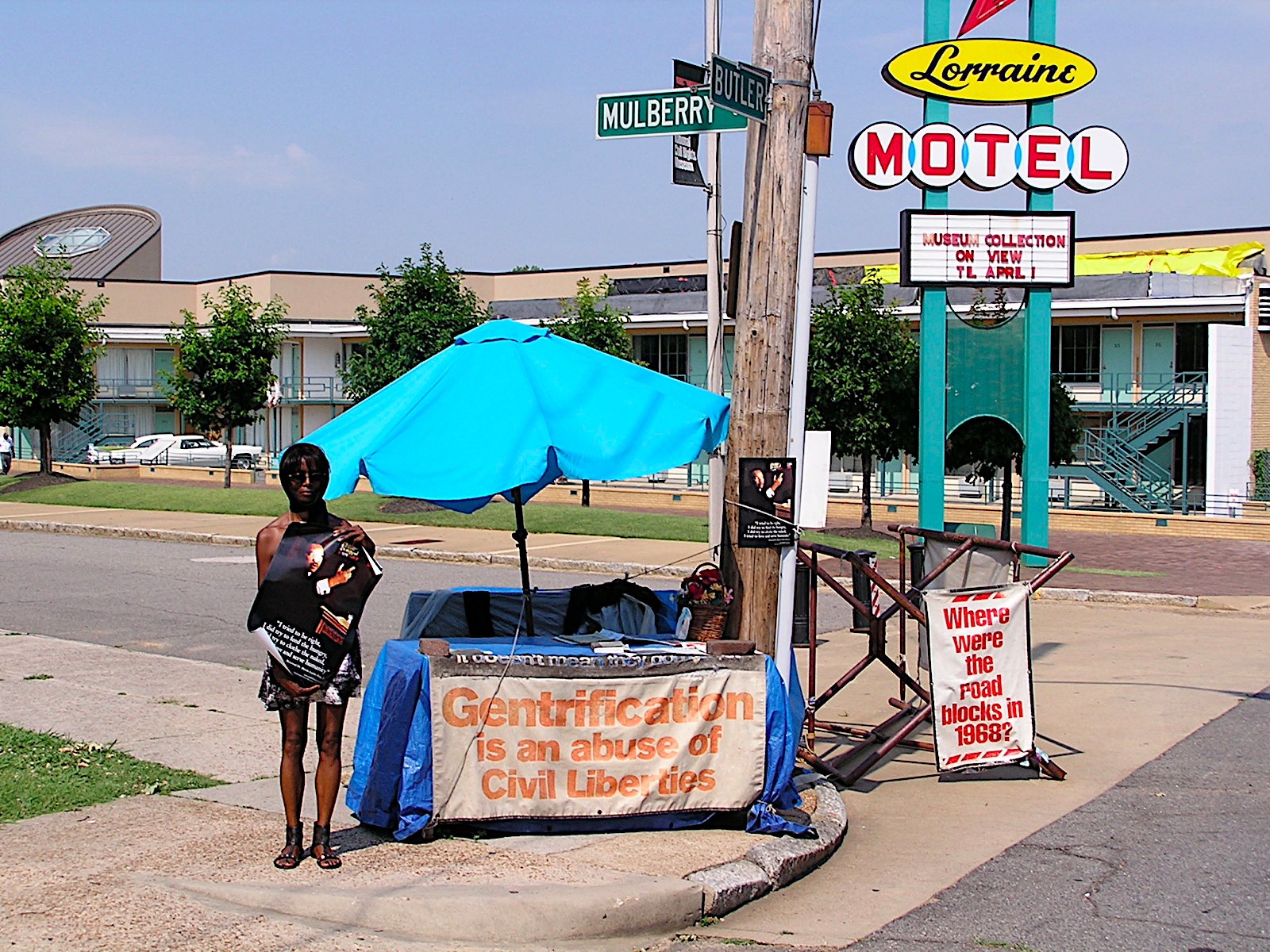
We headed out of the dark air-conditioned museum into the heat of a bright, sunny Memphis afternoon. Carol wandered over to where a woman sat behind a booth under an umbrella. On the front of the booth was a sign that read “Gentrification is an abuse of Civil Liberties.” We got to talking with the woman, whose name was Jacqueline Smith. She was the last person to live in the Lorraine Motel — apparently it housed quite a few permanent residents in the 1980s. The state of Tennessee forcibly evicted her in January, 1988, so they could take over the Lorraine Motel and turn it into the Civil Rights Museum. She said she believes that a more fitting monument to King would have been to turn the Lorraine Motel into housing for the poor, or some other project that furthered King’s ideals. She also pointed out how the neighborhood was being gentrified. “There’s an American Apparel store now, over in the next block,” she said scornfully. “Where are the poor people supposed to live?” She has a point. Chain stores like American Apparel usually mean the death of small locally owned businesses. In an article in today’s New York Times business section titled “A Slowdown for Small Businesses,” reported Catherine Rampell points out that small businesses are not doing well these days:

While big companies are buoyed by record profits, many small businesses, which employ half the country’s private sector workers, are still struggling to break even. And if the nation’s small businesses plan to further delay hiring — or, worse, return to laying off workers, as they now hint they might — there is little hope that the nation’s 14 million idle workers will find gainful employment soon. [p. B1]

Jacqueline Smith pointed out that the Civil Rights Museum was sponsored by many large businesses. I had already noticed that — half of one memorial mounted below Room 306 in the Lorraine Motel, the room where King had been staying before he had been shot, was devoted to extolling the virtues of its big corporate sponsor. That struck me as crass commercialism, at best; or disrespectful, at worst; take your pick.

Carol asked if we could take Jacqueline Smith’s photo and post it here, and she said we could. Ms. Smith also gave us a poster showing Dr. King, with the words “I tried to be right, I did try to feed the hungry, I did try to clothe the naked, I tried to love and serve humanity,” and in the photo below she is holding this poster. You can see the balcony where King was shot just above her in the photo.

Photo by Carol Steinfeld.

Ms. Smith has her own Web site where she promotes her point of view. She says in part: “Sadly, [the Civil Rights Museum] fails to live up to [its] ideals. The truth is that the museum has become a Disney-style tourist attraction, which seems preoccupied with gaining financial success, rather than focussing on the real issues.” And this raises the very interesting question for me: has Martin Luther King’s legacy become too sanitized?

Egregious conduct by politicians

Sometimes you just can’t believe the egregious behavior of certain politicians. No, I’m not talking about Anthony Whiner, er, Weener — and I’m not talking about former California governor the Gropinator’s 13 year old love child. I’m talking about the egregious hypocrisy of Gov. Rick Perry of Texas.

Perry, you may recall, presents himself as religious man. He’s the kind of guy who attends prayer breakfasts where he puts his religious faith on display; he has even opened a national prayer breakfast for governors of U.S. states. But while eating breakfast in our Texas motel this morning, I opened today’s edition of the Amarillo Globe-News and read that Perry gives financial support to his church at a rate lower than even than most Unitarian Universalists (who are the worst contributors to their congregations of any U.S. denomination aside from Catholics). Here’s an excerpt from the AP story:

“The San Antonio Express-News reports the Perry family’s income tax return shows Perry gave $90 to his church in 2007, a year in which he reported an income of more than $1 million….”

Hmmm. If I were his pastor, I think I’d be giving Rick Perry a friendly little phone call right now. However, to be fair, Perry’s giving record was not that bad every year he’s been governor:

“The records from 2000, when Perry became governor, through 2009 show he earned $2.68 million and gave $14,243 to churches and religious organizations, about a half percent.”

In other words, over a ten year period, Perry earned an average of $268,000 a year, and gave an average of $1,424 per year to his church. By comparison, last year I earned about $60,000 and gave about $3000 (or 5%) to my church.

This leads to Harper’s Rule: Politicians may not use Biblical references, nor refer to their “Christian faith,” unless they contribute at least 5% for their income to their church. If a politician breaks this rule, you should shout “Matthew 6:5!” at him or her.

Preparing for a road trip

We’re about to head off on a road trip across the country. Carol is stopping the newspaper and asking the neighbors to keep an eye on our apartment; I’m ironing and packing. Tomorrow we’ll start driving towards Charlotte, North Carolina, planning to arrive in time for General Assembly.

Along the way, I’ll spend the Friday and Saturday before General Assembly at the National Sacred Harp Convention, and that Sunday at the annual all-day singing at the Macedonia Church outside Section, Alabama. I’ll be at Ministry Days before General Assembly. At General Assembly, I’ll be reporting for the UU World Web site, and I’ll be making a brief appearance at workshop no. 3049.

If you’re going to be at any of those events, look for me — I’d love to say hi!

The most common marketing mistake

I’ve been reading Startup Guide to Guerrilla Marketing: A Simple Battle Plan for First-Time Marketers by Jay and Jeannie Levinson. It’s an excellent one-volume summary of basic marketing for smaller organizations. And it is worth reading if for no other reason than when you get to page 207, having gone over all the most basic and most effective marketing tools that exist, the Levinsons admit what anyone who’s worked in sales and marketing knows instinctively:

We hate to admit this in public, but… mediocre marketing with commitment is far better than brilliant marketing without it.

Then, in case you didn’t listen the first time, on page 208 they say:

You should know that a mediocre marketing program with commitment will always prove more profitable than a brilliant marketing program without commitment.

But alas…. Congregations are notorious for lack of commitment when it comes to marketing. Too many congregations think marketing consists of gorgeous advertisements and sexy PR, and a Web site makeover, once every two or three years. Not true. When you realize that neatness, telephone demeanor, and an honest interest in people are all marketing tools — that effective email, marketing calendars, and writing a benefits list are also all marketing tools — then you begin to realize that marketing involves constant, even obsessive, attention to detail, not just every Sunday, but every single day of the week, for years and years. Very few congregations have that kind of commitment.

And, not surprisingly, very few congregations are growing.

Green burials

Carol has a post on her blog about green burial at a Bay area “green cemetery.” I’m in favor of green burial myself, but as a minister I can tell you that it can be pretty difficult to avoid the default burial method of our society: embalmed body in the most expensive sealed casket you can afford, placed in a sealed concrete grave liner in a conventional cemetery, with the most expensive stone marker you can afford. Death and burial has been consumerized like everything else in our society: embalming and caskets are big business; and the funeral home industry is dominated by big chains that put profit margins before family desires. And green burial, which should offer cost savings, sometimes becomes just another marketing ploy. So if you’re hoping for a green burial, it’s best to start planning well in advance. The Funeral Consumer’s Alliance (FCA) has a pretty good brochure on green burial and a short FAQ on green burials. FCA also links to the non-profit Green Burial Council (GBC); I have no personal experience with GBC so can’t recommend them myself.

And I’d love it if any of my readers who have had personal experience with arranging a green burial would tell us about it in the comments.

From the big picture, to day-to-day operations

Below is a presentation I did at our Board retreat this morning. The presentation is titled, “How to take big-picture goals and spread them through every aspect of congregational life.” I’m posting this here both in case any of our Board members want to review some of the things I said, and in case any of my other readers are congregational leaders with an interest in this topic. (If you were there yesterday, you’ll see I didn’t follow this script exactly.) Continue reading “From the big picture, to day-to-day operations”

Humans at the center of the universe

Dad made an interesting suggestion this afternoon when I was talking with him. He suggested that calling oneself a humanist might tend to indicate that one assumes that human beings are at the center of existence. This might imply that those who are committed to environmental justice and ecological repair might prefer to call themselves naturalists (as in, a religious naturalist or theological naturalist).

Dad put it much better than that, but I think I’ve managed to communicate his basic idea. And I think he’s identified some of my discomfort with the term “humanism” — I don’t want to be associated with a theological label that puts humans at the center of the universe, because in my opinion a big part of the problem with Western culture is that it makes humans more important than any other kind of life form, an attitude that has gotten us into global climate change, denial of global climate change, release of toxics into the environment, etc.

What do you think? Does humanism put humans at the center of the universe? Is that a bad thing? I’d love to hear your thoughts. I’d particularly love to hear from someone who strongly identifies with both humanism and deep ecology, mostly because from my point of view those two positions would be mutually exclusive.

The way out of decline

The Unitarian Universalist Association is in decline by many measures: number of certified members, average Sunday morning attendance, enrollment in religious education programs. Now obviously this decline is an average across all congregations; some congregations are growing and thriving, while others are declining. So is there a way out of decline?

I don’t believe there is some magic bullet that will infallibly cure decline. Nor am I an ideologue who believes there there is one root cause from which all decline springs — that is, I don’t believe that we’re declining because of our polity, or because we’re not Evangelical Christian, or because we’re mostly white. As a historical materialist, I do believe that there are some broad demographic trends that are pushing us in certain directions. But I also believe that every congregation finds itself in a slightly different and therefore unique setting, with a unique set of pressures and opportunities. Specific techniques for growth that work in my congregation may not work for your congregation, and vice versa.

Having said that, there are at least three obvious principles that can help us reverse decline.

Most obviously, good management over the long haul is probably essential for reversing decline. A congregation can have the most fabulous vision in the world, but you have to manage your congregation on a day-to-day, week-to-week basis, over a period of months and years, in order to realize that vision. Management is somewhat different than leadership. Management are those habits and practices that keep an organization running smoothly and efficiently, and that coordinate efforts towards the big goals of the organization.

It is worth noting that the nonprofit world is a competitive place. Like it or not, a congregation is just another nonprofit competing for people’s personal involvement and financial support. In a competitive marketplace, there will be forces pushing our congregations to use resources — money, staff time, volunteer hours — with increased efficiency. Therefore, increased efficiency through better management is a goal throughout the nonprofit world — and should be a goal within our congregations.

It is probably the case that a congregation will always need more than one person driving good management. We can’t just delegate management to one person, because if only one person is a good manager, that person is going to get tired out pretty quickly. Boards have to supervise paid staff and key volunteers with management in mind; they have to be sure that staff and key volunteers have access to training in appropriate management skills; and boards have to manage themselves properly. Ministers, religious educators, and administrators have to make sure they are constantly honing their management skills. Everyone management reponsibility has to take pride in being a good manager. In short, you have to build a culture where good management is the norm, where your key people are managing the organization for the long haul.

Along with good management, you have to have good leadership — once again, over the long haul — and once again, there has to be more than one good leader. A good leader always has his or her eyes constantly on the big picture. A good leader is someone who is able to motivate other people to work towards a compelling shared vision. And a good leader is also skilled at good followership; a good leader knows when it is time to follow, as well as when it is time to lead.

Permit me to add what should be a too-obvious point: if you are not relying on your senior minister as one of your key leaders, that’s a little weird. Some ministers are not good managers, but if you don’t trust your senior minister to lead, you need to ask yourself some hard questions: do you not trust your senior minister because that person is incompetent, or do you not trust your senior minister because you are unable to trust ordained clergy or any authority figure? If you feel you can’t attract good leaders to be your minister, you will want to ask yourself why that is so: is it because you are unable to offer a financially attractive package, or is it because you have a pattern of hiring less than competent leaders, or is it because your congregation holds ministers in contempt such that they can’t be effective and/or leave quickly? These may be difficult questions for you to answer, because it’s going to be hard to get straight answers from anyone. But it is wise to answer them straight, because without good leadership from a visionary senior minister, I think you’re going to find it’s difficult to reverse decline.

I would also suggest you’ll want to ask the same sorts of questions if you can’t attract good lay leaders. If you find that your best lay leaders are getting burned out, and maybe even leaving the congregation after a stint in a formal leadership position, you’ll want to figure out why, and fix that problem. Reversing decline is a long-term effort, and you need leaders who can stick around for the long haul.

With solid management and visionary leadership in place, the next step is cheerful and dogged persistence to reverse your decline.

Every congregation will be in decline because of a different set of reasons. If you’re lucky, the reason for decline will be obvious. Maybe your congregation is unable to ask confidently and consistently for financial support. Maybe your congregation avoids all risks. Maybe your congregation’s physical plant has deferred maintenance that results in an unsafe, unattractive, messy, dirty, and/or smelly building. Maybe your congregation has a secret history of misconduct by clergy or lay leaders. If there is an obvious reason why you’re in decline, the solution is obvious. If your building is smelly, dirty, and unsafe, you can create a management plan to fix it up, etc. And you keep at it, cheerfully and doggedly, until the obvious problems are solved.

More likely, there won’t be an obvious reason why you’re in decline. Then your task is more difficult. You can spend years trying to sort out all the subtle and complex reasons why you’re declining. Or, more practically, you can focus on positive action: determine what your compelling vision is, articulate it clearly to the congregation and the surrounding community, and turn your compelling vision into reality.

This is an iterative process; that is, you start out with a rough idea of your compelling vision, try to articulate it and bring it into reality, and when you fail to articulate it and make it real, figure out why you failed and try again. Then go through this process again several more times, and the whole time you’re doing this you should be constantly paying attention to managing the congregation more efficiently, and constantly paying attention to informal and formal feedback loops that tell you honestly whether you’re succeeding or not. You keep trying, and failing, and getting better at it, and trying again, and failing but not so badly this time, over and over again, until you get good at whatever you’re doing.

If Unitarian Universalists have one weakness these days, it’s that we lack a certain amount of stick-to-it-tiveness. In social justice, we are afflicted with the “cause-of-the-month” syndrome. When it comes to growth, we’re afflicted with a similar lack of persistence — if we don’t see immediate and rapid growth, we start saying to each other, “Well, but there’s more to growth than numerical growth.” Both social justice and growth require dogged and cheerful persistence. Nobody’s going to end racism in a year; nobody’s going to reverse congregational decline in a couple of months. Our planning horizons for growth should be this Sunday, next year, five years from now — and twenty years from now, looking ahead to the next generation. This iterative process takes years — years of trying things and admitting failure, years of building up small successes until they become big successes.

There is no magic bullet to end our decline. Every congregation is going to face unique problems, and what works in someone else’s congregation may or may not work in yours. But some things we can be sure of: we need good management, good leadership, and cheerfully dogged persistence.