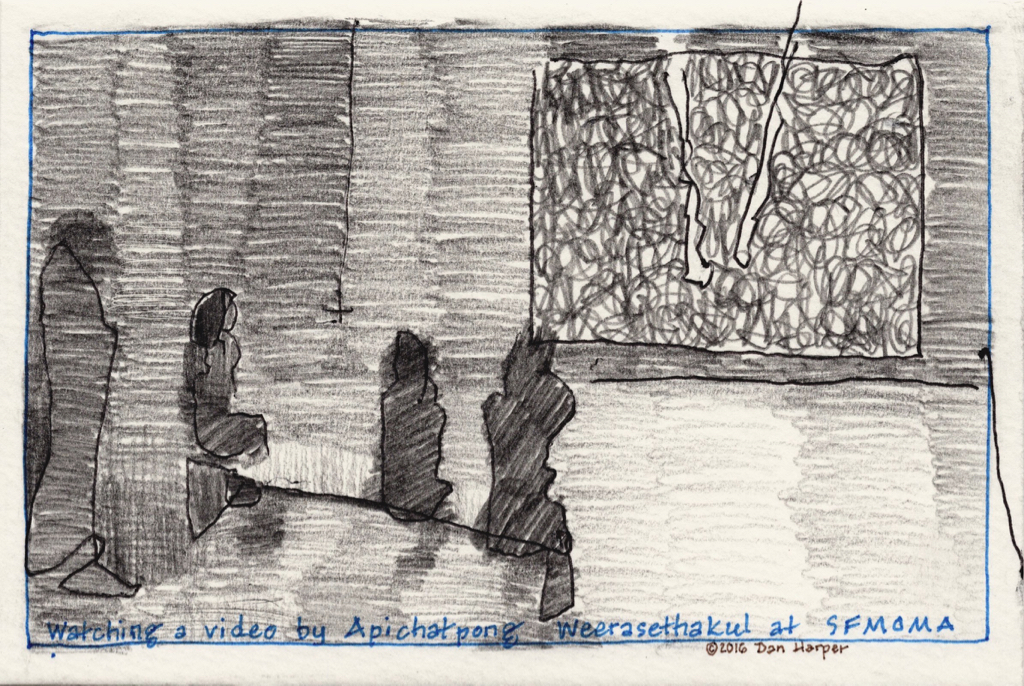
Watching a video by Apichatpong Weerasethakul, at SFMOMA.
Yet Another Unitarian Universalist
A postmodern heretic's spiritual journey.
Watching a video by Apichatpong Weerasethakul, at SFMOMA.
For our “Neighboring Faith Communities” class for middle schoolers, I continue to think about ways to communicate the incredible religious diversity in our area. My latest effort: a map that shows faith communities in South Palo Alto, an area roughly bounded by U.S. 101 on the northeast, Oregon Expressway on the northwest, El Camino Real on the southwest, and San Antonio Rd. on the southeast. (I did go a little past these arbitrary boundaries to include some additional faith communities.)
The map below shows the approximate boundaries of the area I researched, a rectangle about 2 miles by 2-1/2 miles. Our faith community, the Unitarian Universalist Church of Palo Alto (UUCPA), is circled in red. All the faith communities shown are within about a half hour’s walk of our congregation. You can click on this map to go to an interactive map on Mapquest (I’ve also embedded the Mapquest map at the very end of this post).
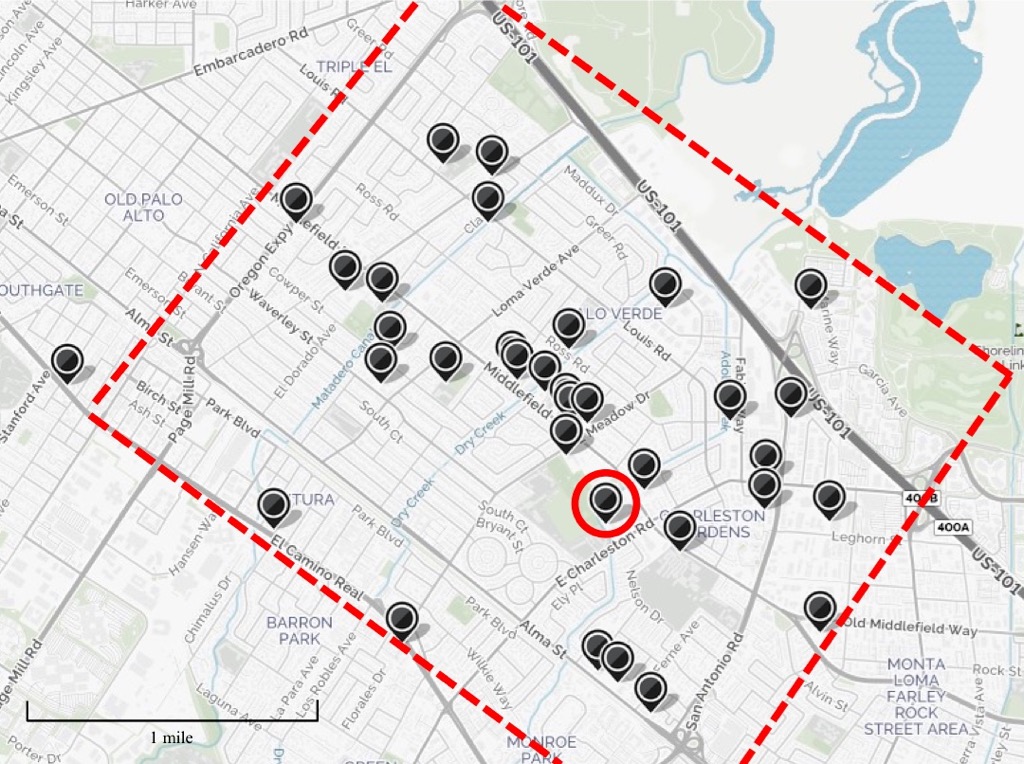
Below is the list of the 35 faith communities I found in this area. I suspect I missed some; if you can identify other faith communities in this area, please let me know about it in a comment. (Updated 10/20/16 based on Erp’s comment.) Continue reading “South Palo Alto faith communities”
A few days ago, I started at my office in the Unitarian Universalist Church, and took a walk around the neighborhood. In less than an hour, I walked past or near 7 different faith communities.
I walked to the corner of Charleston and Middlefield; down the street and just out of sight on my left was the Church of Jesus Christ of Latter-Day Saints at 3865 Middlefield Rd., which is locally famous for the annual Christmas Creche exhibit that is erected in its front yard in December.
Continuing down Charleston, I crossed Fabian Way; to my left, a few blocks down at 3900 Fabian Way is Kehillah Jewish High School, where the Keddem Congregation, a Reconstructionist Jewish faith community, holds its larger events and services.
At the corner of Charleston and San Antonio Road, I walked next to the Jewish Community Center, where, every Sunday, the C3 Silicon Valley Church rents their auditorium for a worship service. The C3 Church is a worldwide movement based in Pentecostal Christianity.
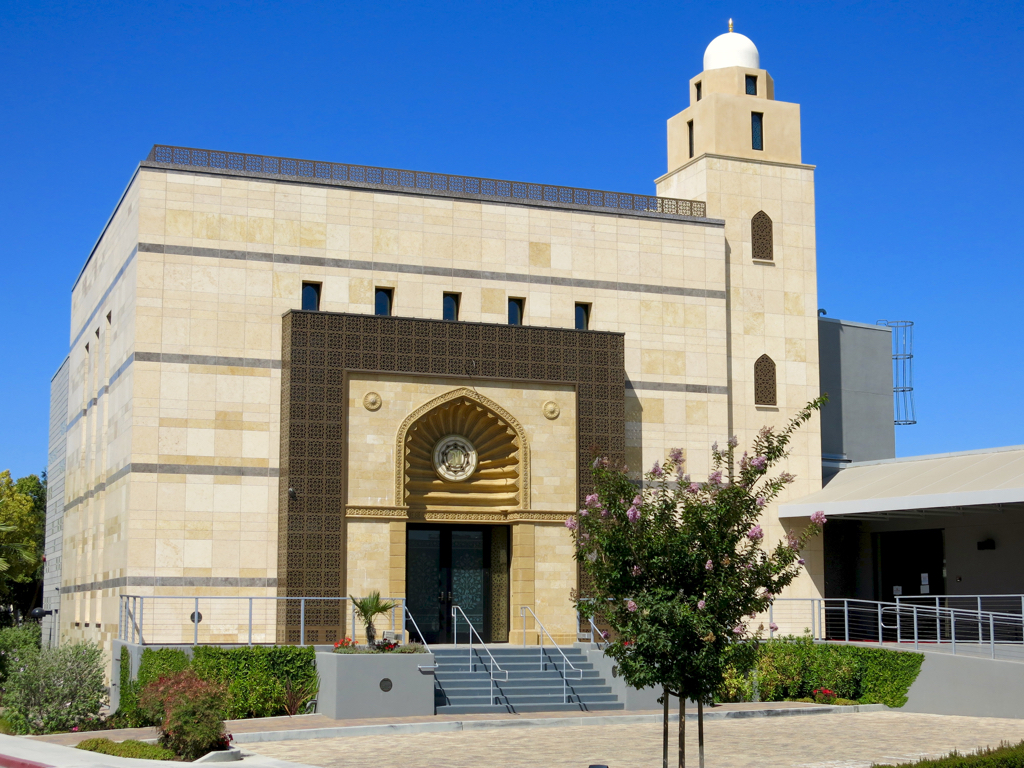
Turning left on San Antonio, I came to Anjuman-e-Jamali, a new Dahwoodi Bohra mosque, an impressive stone-clad building; the minaret is over 60 feet tall, though supposedly it isn’t functional.
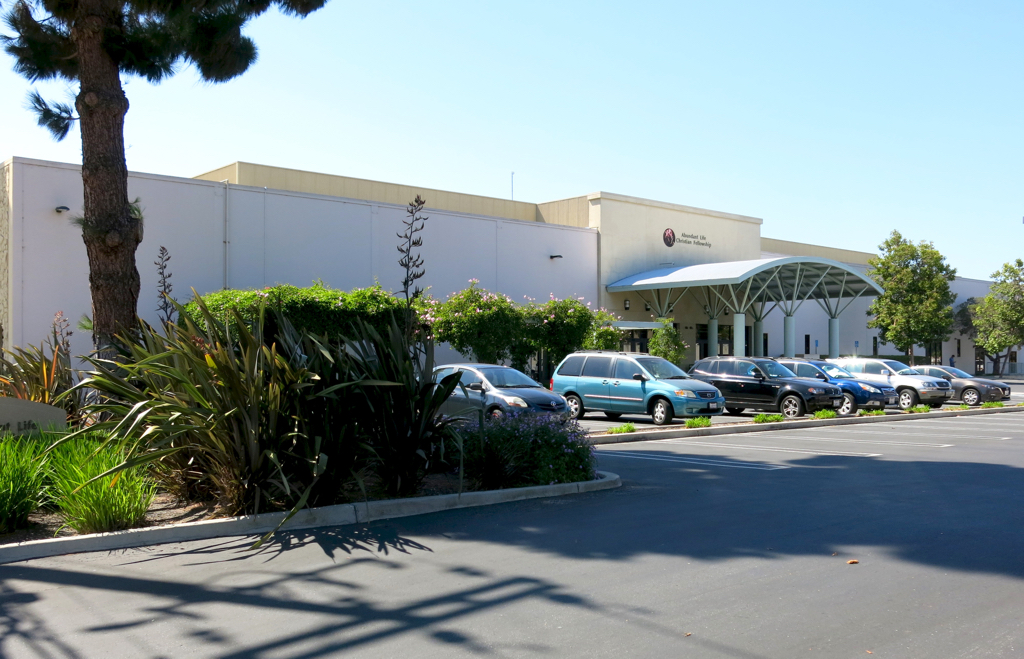
I crossed back over Charleston Rd., and went a block or two into the city of Mountain View, where I saw the Abundant Life Christian Fellowship, in a large building that looks like a corporate headquarters or maybe a big-box store. The Web site lists no denominational connection, but recent pastors have had connections to Pentecostalism.
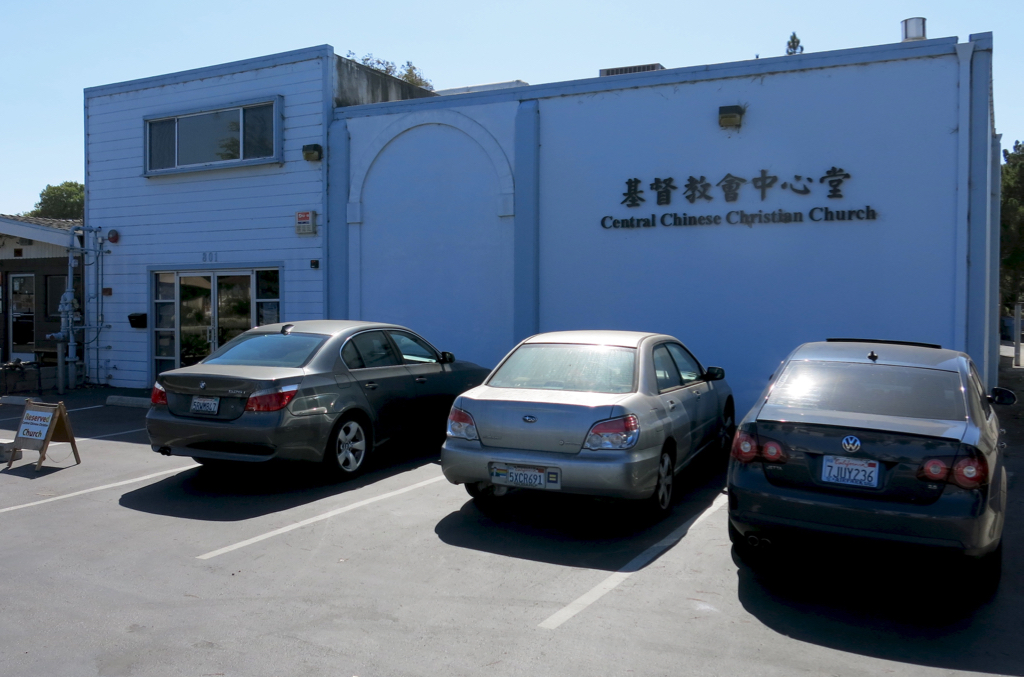
Back over the city line in Palo Alto, along San Antonio Rd., I walked by the small Central Chinese Christian Church. Unfortunately, the Web site is in Chinese, so I don’t know which branch of Christianity this church comes from.
I walked back down Charleston Rd., and returned to the Unitarian Universalist Church.
The final tally for a one-hour, 2-12 mile walk:
1 Jewish congregation: Reconstructionist Jewish congregation, rented space
1 Muslim congregation: Dahwoodi Bohra (a sect of Shia Islam)
4 Christian congregations:
— Church of Jesus Christ of Latter Day Saints (Mormon), Restorationist Christian
— C3 Church, Pentecostal Christian
— Abundant Life Christian Fellowship, nondenominational Christian
— Central Chinese Christian Church, unknown Christian
1 post-Christian congregation, Unitarian Universalist
On a whim, we decided to stop at the Thunder Mountain Monument near Imlay, Nevada. Frank Van Zant, who determined that he was partly descended from Creek Indians, decided to build a monument to the American Indian. The monument consists of buildings, fences, figures sculpted in concrete, junk sculptures. The monument tells a non-linear story about the destruction of Native American peoples by peoples from Europe. Van Zant changed his name to Chief Rolling Thunder.
But there’s a back story. Before he started work on the monument, Rolling Thunder’s wife died, and one of his children committed suicide, according to a 2010 article on Smithsonian.com; and the first figure that Rolling Thunder made was a sculpture of the son who had died. In this monument, personal grief is mingled with grief arising from genocide and racism.
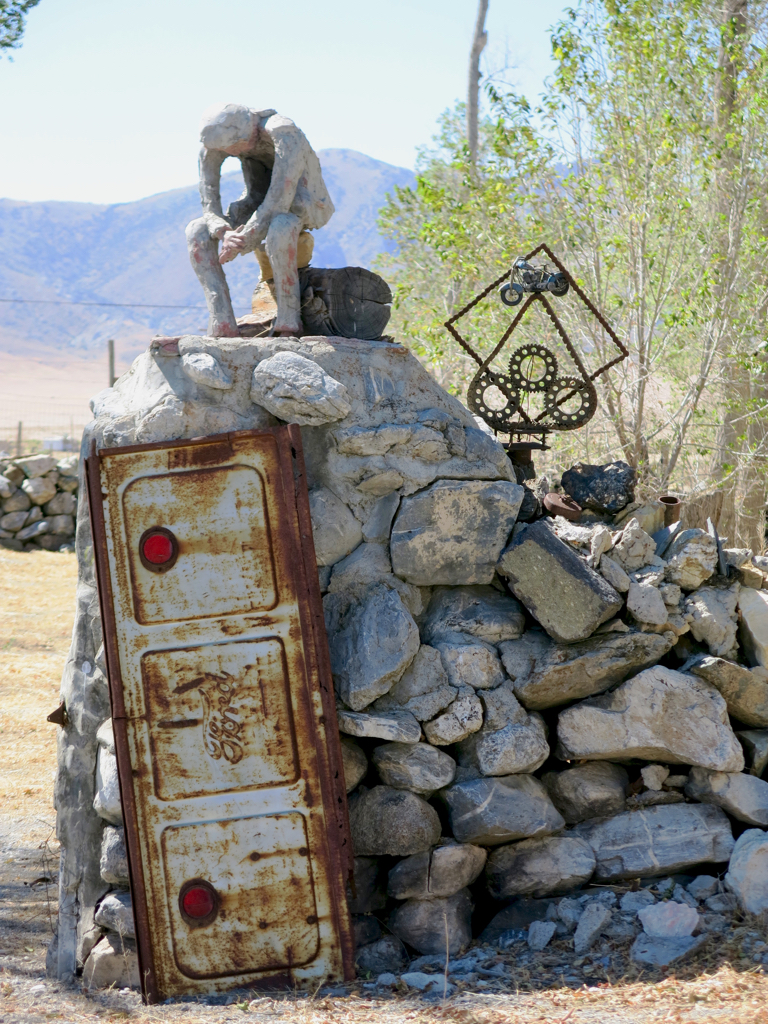
Rolling Thunder’s grief proved overwhelming, and luck was not with him. His followers began to drift away. An arsonist set a fire that destroyed many of the buildings that were once part of the monument. His new wife left him, taking their children. He committed suicide in 1989.
The monument is slowly decaying: vandals and the weather are both taking their toll. It has been declared a state historical site, and looks like there is now someone living on the site to watch over the monument. It would be possible to descend further into grief, and declare it a tragedy that the masterpiece of an outsider artist is not being maintained. I prefer to view it from another vantage point: this is a work of art that exists in four dimensions, where the fourth dimension is time. Some things are fading away, but some of the sculptures seem to me to be improving with time: they are becoming more pointed in their message, more urgent, more real.
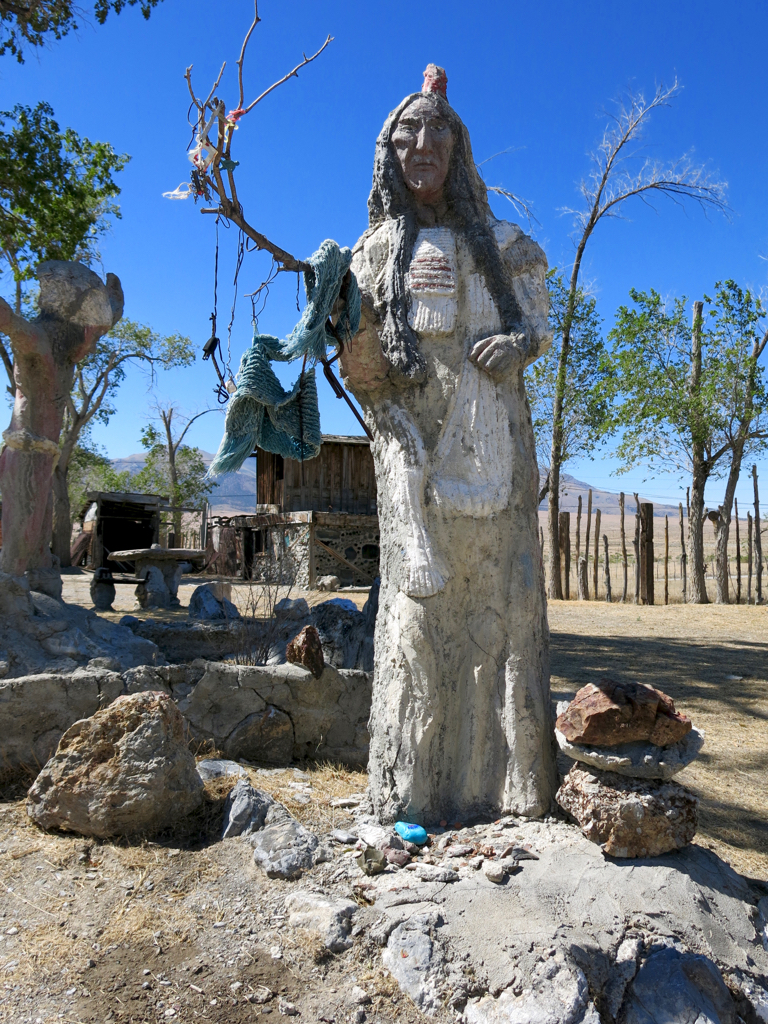
Grief happens over time. If you try to freeze it so that it cannot change and evolve, that can get you into trouble. You need to move forward with it, towards the light.
We stopped at the Donner Pass trailhead for the Pacific Crest Tail, parked the car in some shade, and started out on a hike through the Sierra Nevadas. It was a perfect day for hiking: cool mountain air, a pleasant breeze, a clear blue sky overhead. We hiked for an hour and a half, talking idly about this and that, then turned around and hiked back. I stopped to look at a Williamson’s Sapsucker; Carol stopped to photograph glacial erratics.
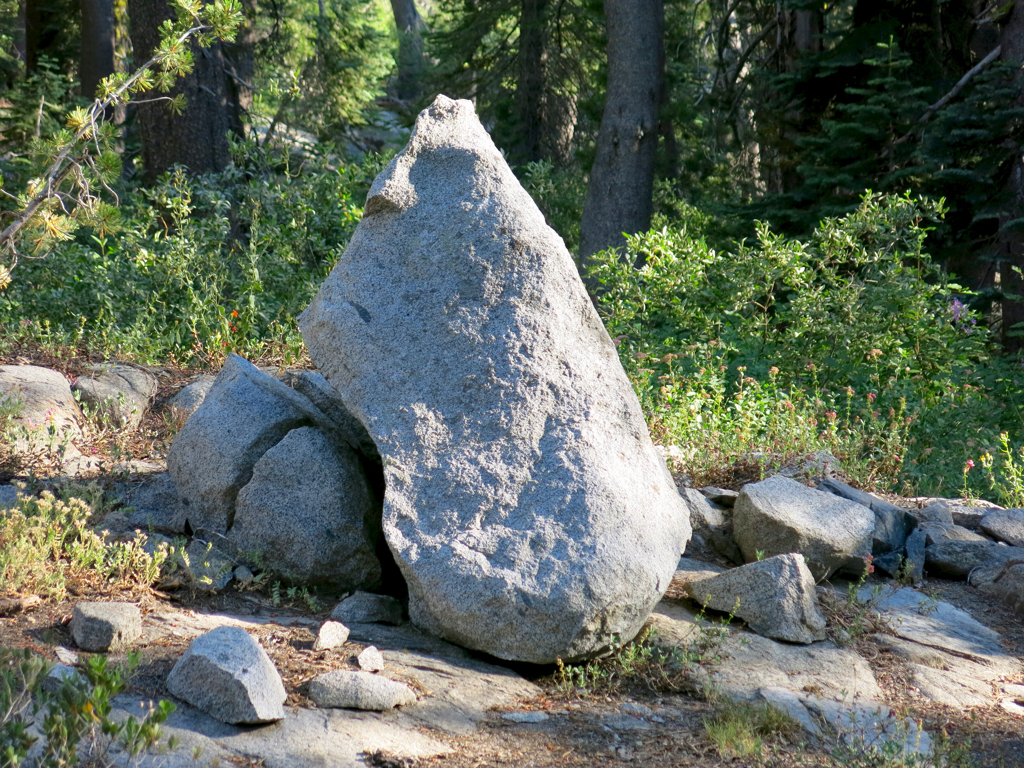
After three hours of hiking, we got back to the car refreshed and happy. We sat under the trees at the edge of the parking lot and ate our picnic dinner. And we arrived back at home at about 10:30, tired, content, and different from when we set out.
I had a slight but sharp headache when I got up, and it took me a few minutes to remember why: Evanston is about 6,750 feet above sea level, and I am not used to air that thin. Then I remembered that we were back in the Far West, where the air is much drier than the air in the eastern half of the continent, so I was probably dehydrated too. Coffee helped the headache go away.
Within an hour from the time we left Evanston, we were in the outskirts of Salt Lake City. We hadn’t driven through a city since we had to get through Chicago, and we did not like the thought of having to drive through Salt Lake. So we decided to go around it, up Interstate 84 to the north of Great Salt Lake, then down state highways to rejoin Interstate 80 in Utah.
As we left Interstate 84, a sign on Utah Highway 30 read: “Next Services 102 miles.” We drove past the occasional agricultural field, growing what appeared to be hay or alfalfa, and through open range (though we didn’t see any cattle). A sign declared that we were passing through the town of Park Valley, though we didn’t see much beyond a small cluster of houses and a Mormon church. A little later, we wound through another cluster of houses that a sign said was Rosette. People who live in these two communities have to drive forty miles or more to buy gasoline.
About halfway between Rosette and Grouse Creek Road, we pulled off the two-lane highway to look out over the basin of the Great Salt Lake Desert. We watched dark areas of rain fall from clouds fifty or a hundred miles away. We could see the glint of sunlight shining on the salt flats far to the south of us.
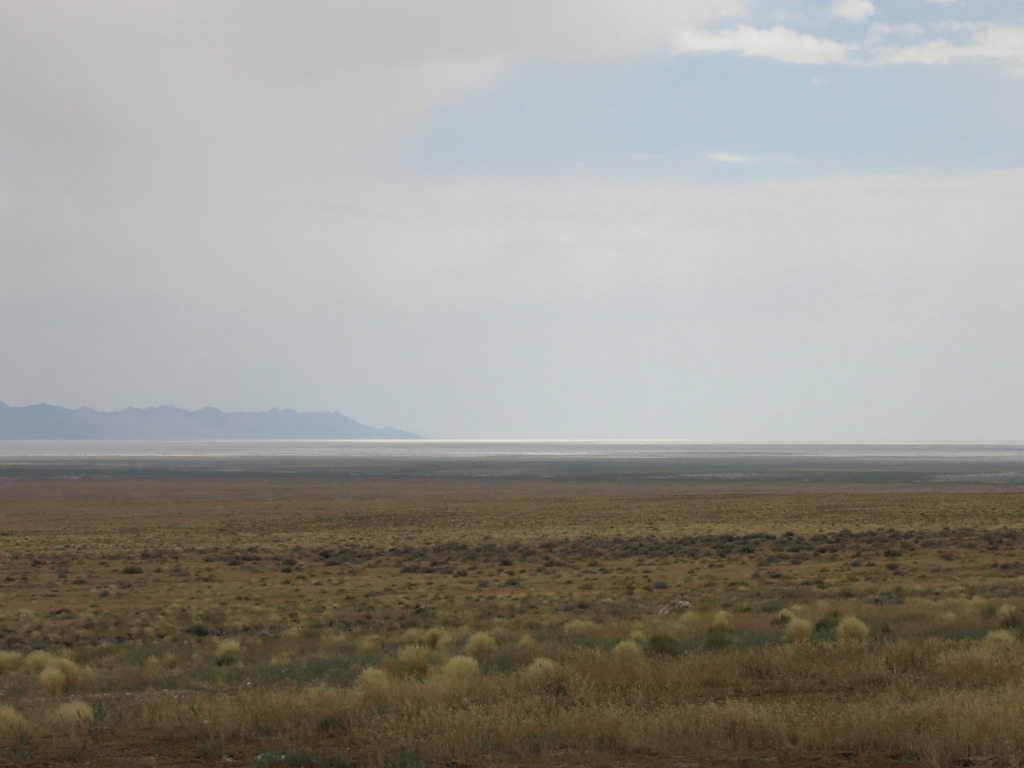
I stood in the middle of the highway to take a photograph of the highway and the plain sloping up to the mountains. There were so few vehicles I was able to stand in the middle of the road for several minutes and frame exactly the photograph I wanted.
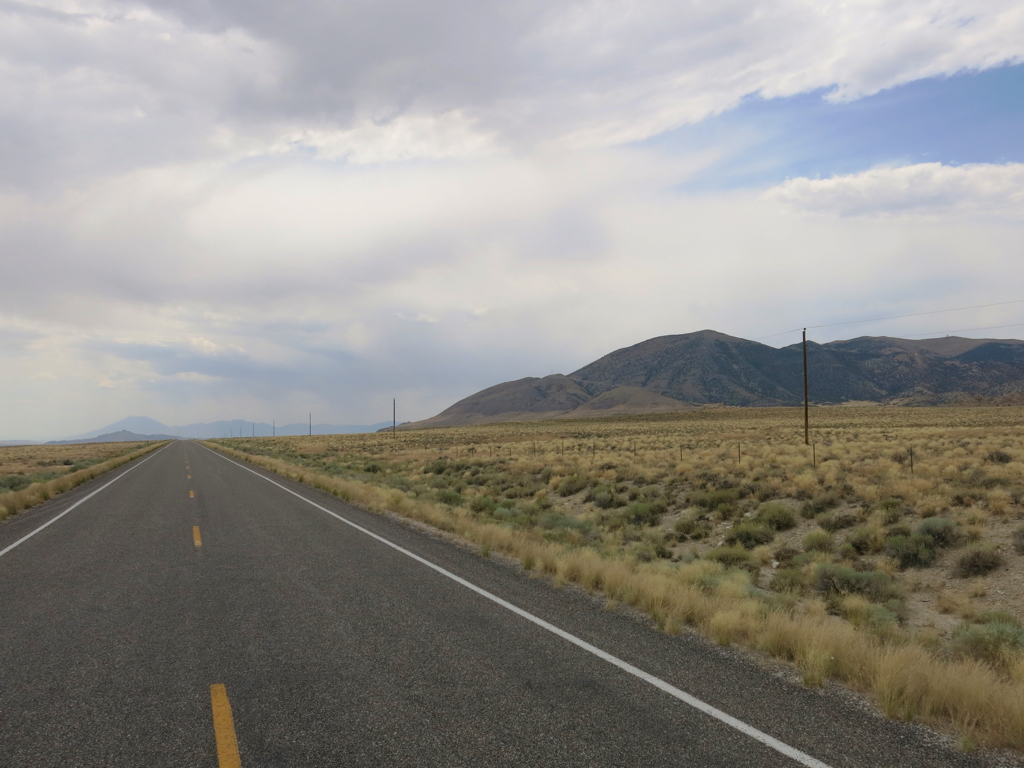
Yet it didn’t feel lonely at all; it was just beautiful. But we had to keep driving west, so we got back in the car. We stopped briefly in Montello, Nevada, for something cold to drink; Montello boasted a couple of bars and a sort of general store that also sold gas. And in another half hour, we were back on the interstate.
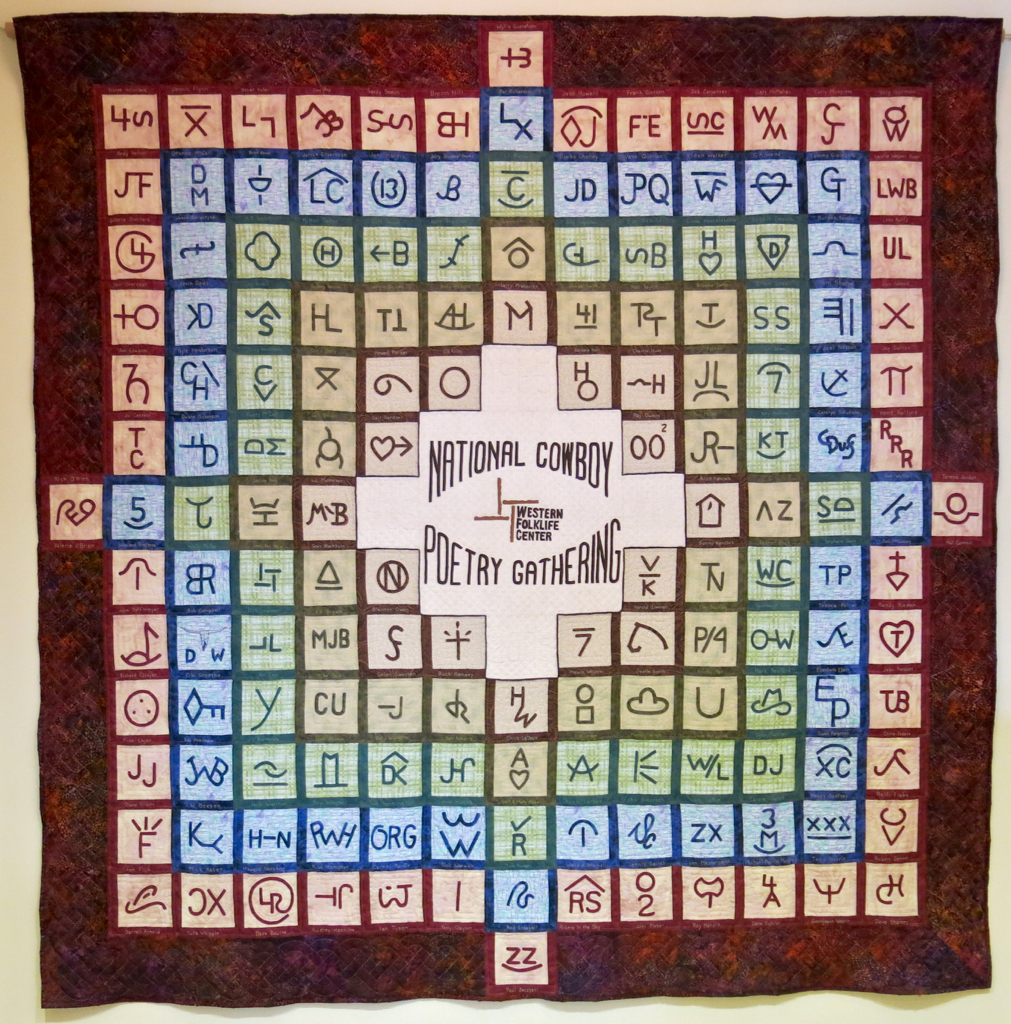
We made one more stop, at the Western Folklife Center in Elko, Nevada. They have one of the most interesting selection of books on the Far West, ranging from cowboy poetry to academic studies to just plain weird books. (In fact, one of my favorite books that I’ve bought at the Western Folklife Center is titled Living the in Country, Growing Weird, about life in a tiny town in north central Nevada.)
I got to talking with the man who was watching over the shop, and he told me that if I liked the books they sold, I should come in January to the National Cowboy Poetry Gathering. It’s more than cowboy poetry, he said, there are workshops on hatmaking, and Basque cooking, and it’s lots of fun. And, he added, you can come by train, so you don’t have to drive through the snowy passes in January.
I’ve always wanted to come, I said, but it’s hard to get away from work in January. And that reminded me that I will be back at work on Monday, just two days from now. I love my job, but I’m not sure I’m ready to go back to work, not quite yet.
Faced with an eight hour drive today, we slept late and didn’t get on the road until ten. Our first rest stop was in Pine Bluffs, Wyoming. We pulled into the rest area expecting the usual fenced-in area beside the highway; but we found a trail that connected to a fairly extensive trail network, and we took and hour-long hike up a small canyon, between widely spaced pines, onto the tableland above the highway, and back down. The trail in the canyon followed a now-dry watercourse, but we could see that there had been heavy rains fairly recently.
The rest area had another short trail that led to a University of Wyoming archaeology site. As we walked up to the building that covered the site, we met a young woman shoveling gravel and stones off the path. She told us that a severe thunderstorm had hit Pine Bluffs on Wednesday afternoon, with high winds and golf-ball sized hail. Inside the building, we were greeted by a woman who told us more about the site, and more about the storm. The dig site began with a nineteenth century trash midden in which was uncovered a bottle of Lydia Pinkham’s famous elixir, a specific for nearly all ills, which contained mostly grain alcohol; the dig extended downwards and back in time to a Clovis point dating from about 9,000 years ago.
Our tour guide also told us about Wednesday’s storm. She showed us photos on her smartphone: the ground white with several inches of hail, windows broken by hail blown almost horizontally by severe winds, the inside of her apartment badly damaged by water and blowing hailstones. She didn’t have renter’s insurance, but, she said, fortunately there was state disaster relief money available. After talking with her, we walked back to the rest area, where we chatted with a volunteer staffing the information desk. At his house, a few miles outside the town, the hail had only been pea-sized, but he and his wife had been in Pine Bluffs and the hail had shattered his windshield. He told us about houses damaged and crops destroyed, and then somehow he and Carol wound up talking about British television murder mysteries.
Once we knew about the storm, we understood some of the curious things we had seen on our hike: grass beaten down and pointing in one direction; the pine trees half bare of needles with a thick carpet of green needles under each tree; poison oak with most of its leaves torn off with bruised and torn branches; the mix of ice and pine and juniper needles that we had crunched over in the now-dry watercourse.
We drove into town to have lunch. It was after one o’clock, but the restaurant we walked into was full. We decided to wait for a table. A mother with three children walked in after us. She obviously knew the restaurant hostess, and I gathered that the reason there were so many people in the restaurant is that there were so many people who didn’t have functional kitchens. We decided we could eat a picnic lunch, and gave up our place in line to the mom and her three children.
We drove into town to the one small supermarket to buy food for lunch. We saw several houses that had no paint on one side, where the hail had stripped it off.
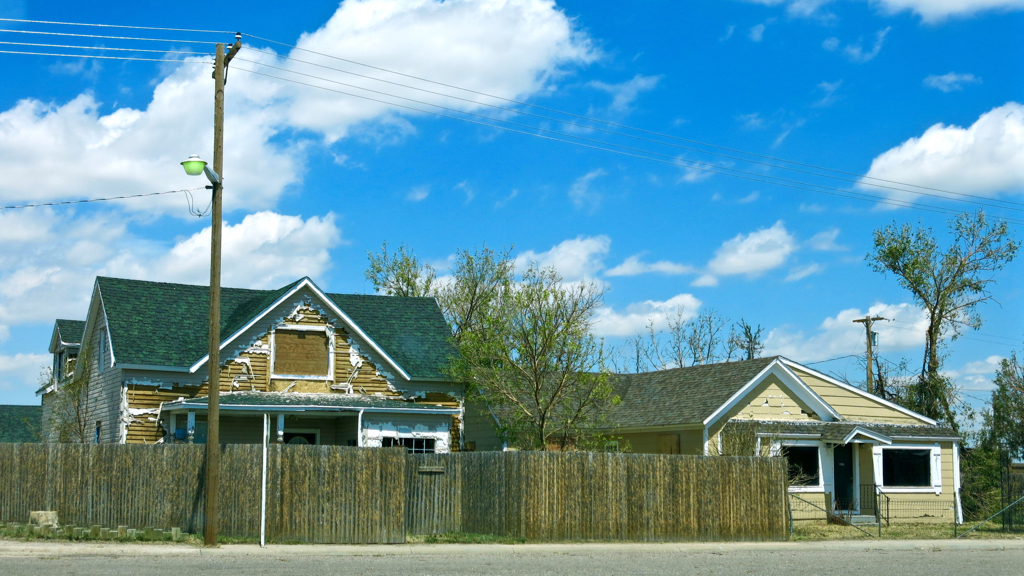
Yet just outside town, we could see no damage at all. And we drove across the High Plains, the vast sky and the wide open landscape a constant reminder of how unimportant humans really are.

This morning, before we did anything else, I had to sign a legal document relating to my father’s estate in front of a notary. We stopped at an insurance agent’s office, and the woman who greeted us said the person who was a notary was out, but her father-in-law up at the Ford dealership was a notary, so she called him and he said to come right up. We drove the three blocks up the hill to the Ford dealership across from the Jones County Courthouse. As soon as we got out of the car, a smiling man who had been talking with some people on the sidewalk greeted us and said he was Terry, the man we were looking for.
He took us into his office, made a couple of photocopies for me, and put his seal on the documents I signed. When I asked him how much I owed, he smiled and said, “Not a thing.” I was beginning to get the idea that everyone in Murdo, South Dakota, was friendly and courteous. I walked across the street to the Post Office to mail the documents, and everyone there was friendly and courteous. We stopped at the grocery store in town to get some vegetables, and everyone there was friendly and courteous, too. Murdo seemed like it might be a pleasant place to live.
We drove south on U.S. 83 over rolling prairie, down into valleys where small swift rivers shaded by a few stands of trees, then back up onto the almost treeless prairie. We were really in the Great Plains now. At Valentine, Nebraska, we turned east and drove four miles to Fort Niobrara National Wildlife Refuge. Here we got our first introduction to the Sand Hills of Nebraska: we went for a hike in what we knew was the prairie, but the soil was almost pure sand in places and we sometimes felt like we were hiking up a grass-covered sand dune at the beach on Cape Cod. Yet we were more than a thousand miles from the ocean.
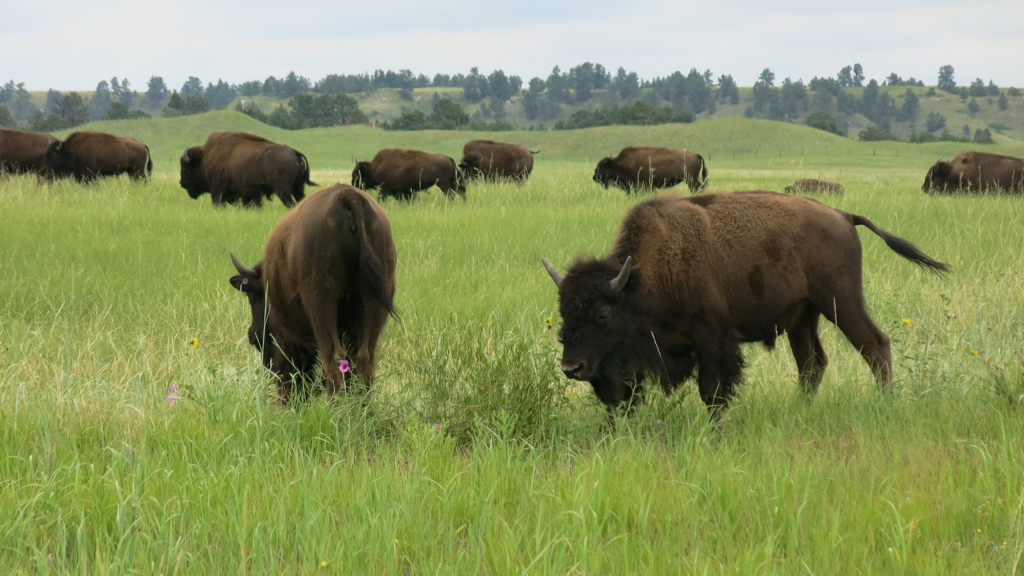
While we were hiking, someone from the refuge rode by on an ATV. He stopped, and asked where we were going, and he said we should be fine but if we saw a buffalo we should keep away from it. Indeed, as we walked along we saw buffalo tracks in the sand, made probably early that morning: big cloven-hoofed tracks that went a couple of inches deep into the sand. But we didn’t see any buffalo, so when we finished our hike we drove east a mile along a gravel road to the summer bison range. And there they were, grazing, and running around in the grass, and rolling in the dirt of the road.
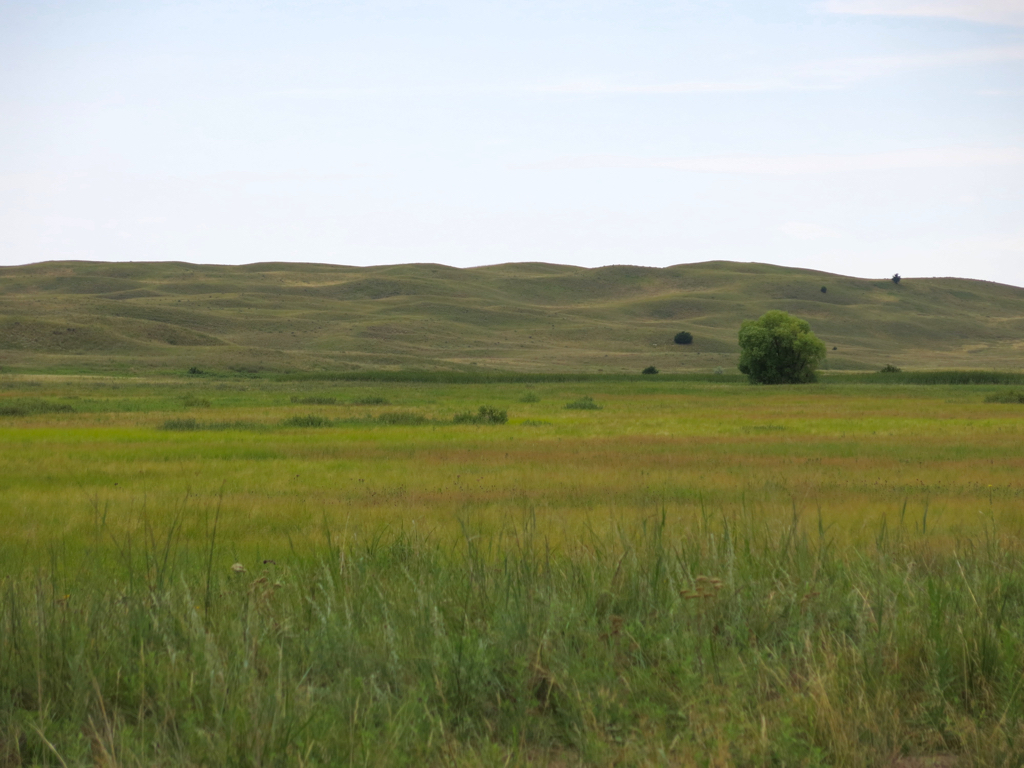
I am fascinated by the Nebraska Sand Hills, and I persuaded Carol that we should stop at Valentine National Wildlife Refuge, just a few miles south of Fort Niobrara, to see more of them. We walked the half mile trail up to an observation tower built by the Civilian Conservation Corps, and looked out at the strange landscape: huge areas of dull-green grass-covered sand hills, the hills a few hundred feet higher than the low-lying flat lands; the flat lands were either large shallow lakes, or bright green marshlands. The sand hills made weird shapes on the horizon, and they were steep enough in places that you could feel it in your legs when you climbed up them.
We arrived in Big Springs, Nebraska, at about half past six. As we drove into the motel parking lot, Carol saw a man with a bicycle. She said, it looks like he’s riding across the country. And sure enough he was riding across the country. His name was Tayo, he had started in Seattle, and he was headed east to his home in Maryland. Carol asked if she could photograph him, and I asked if I could put the photograph on my blog, and he gave his permission.
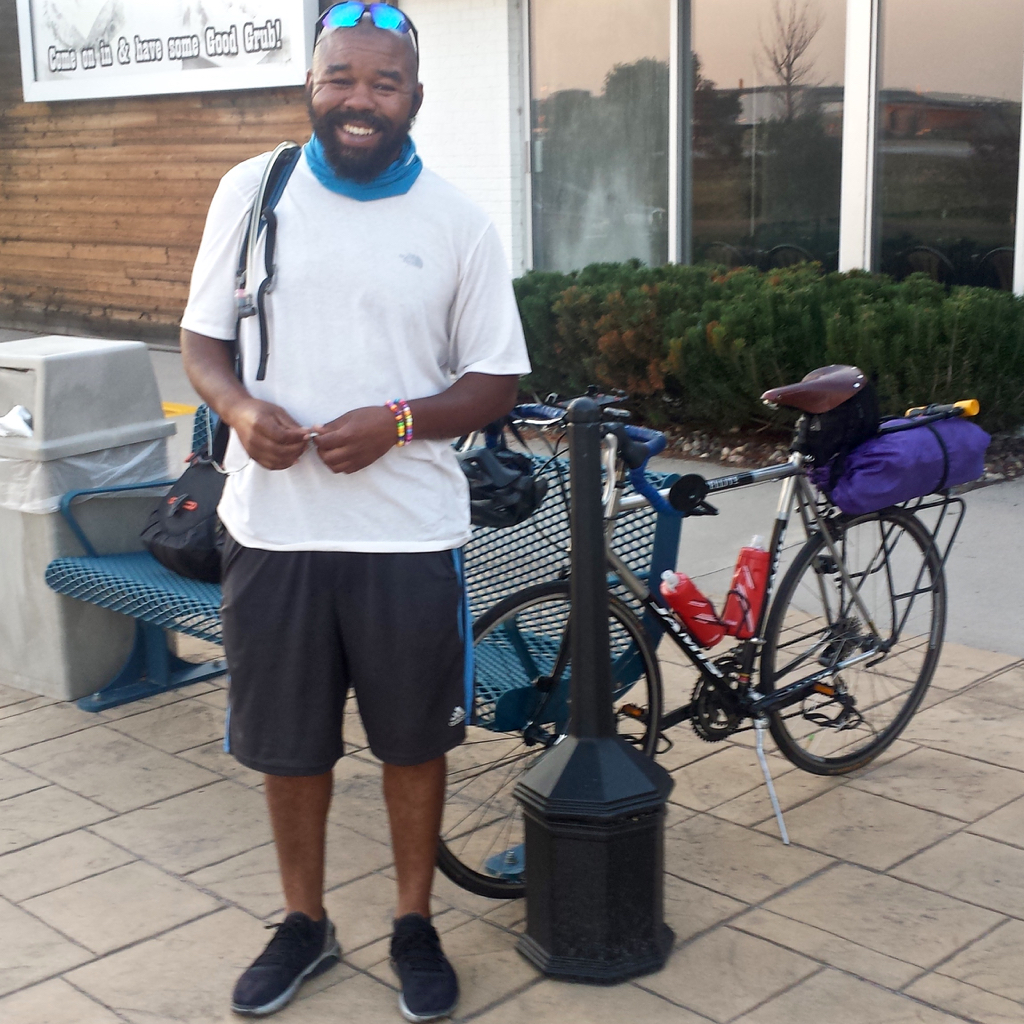
We asked him about his route, and how it was riding all that way, and then Carol asked him if he was riding for any particular reason. He said he was riding in memory of his son, who had lost his battle with depression last summer. I asked how old his son had been, and he said sixteen. I have his ashes right here, Tayo said, pointing to the rack on the back of his bicycle. He said he had been fine most of the day today, but it hit him about twenty minutes ago. I said that my father had died three months ago, which was not nearly as bad as losing a child, but that it came in waves. He nodded; it came in waves.
Tayo’s bike had gotten damaged earlier today, and while we were talking he was waiting for the rural shuttle to arrive and take him to North Platte where he could get it fixed. The shuttle pulled up, we helped him load his bike into the van, then we exchanged email addresses, and away he went.
After we brought our luggage into our room, I realized that a wave of grief had just washed over me, so while Carol talked with her friend Kirsten on the phone, I took a walk across the Platte River and back. I was fine when I got back; getting outdoors is the way I deal with those waves of grief. During our trip this summer, the best I’ve felt has been when I’m outdoors: fishing off the end of a dock at Lake Winnebago, spending a couple of hours looking for birds in Great Meadows in Concord, camping out in Maine. I can understand why Tayo wanted to spend several weeks riding his bike through hundred-degree heat and rainstorms, and cool cloudy days like today.
This morning we drove to Yankton, South Dakota, to have a brief visit with Carol’s Aunt Rose. We talked about family history, and Aunt Rose showed us her family history and genealogy files: carefully organized computer files along with neat notebooks and files; I silently wished my family history and genealogy files were half so organized.
Then we drove west along county and state roads through the rolling landscape of southeastern South Dakota: dark green soybean fields, lighter green corn fields, a few scattered stands of trees, and every ten or twenty miles a little town. We stopped for lunch in Tyndall, the county seat of Bon Homme County. After lunch, we walked and drove around the town. The railroad line had been abandoned, but the grain elevators were still next to the old train tracks, and they were still being used. There were half a dozen restaurants in town, a couple of banks, an old fire house now being used as the county food pantry, an old power plant building and a new municipal building, a park with grass and trees and a small pond and a playground, a pleasant red-brick library building, and a stone county courthouse.
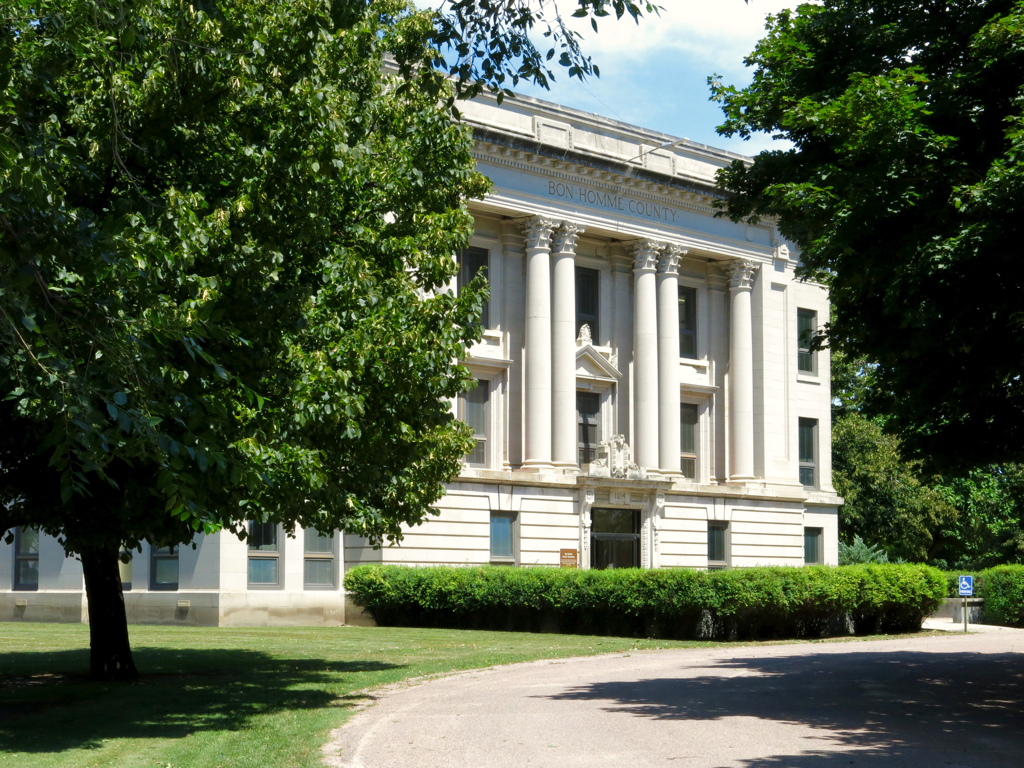
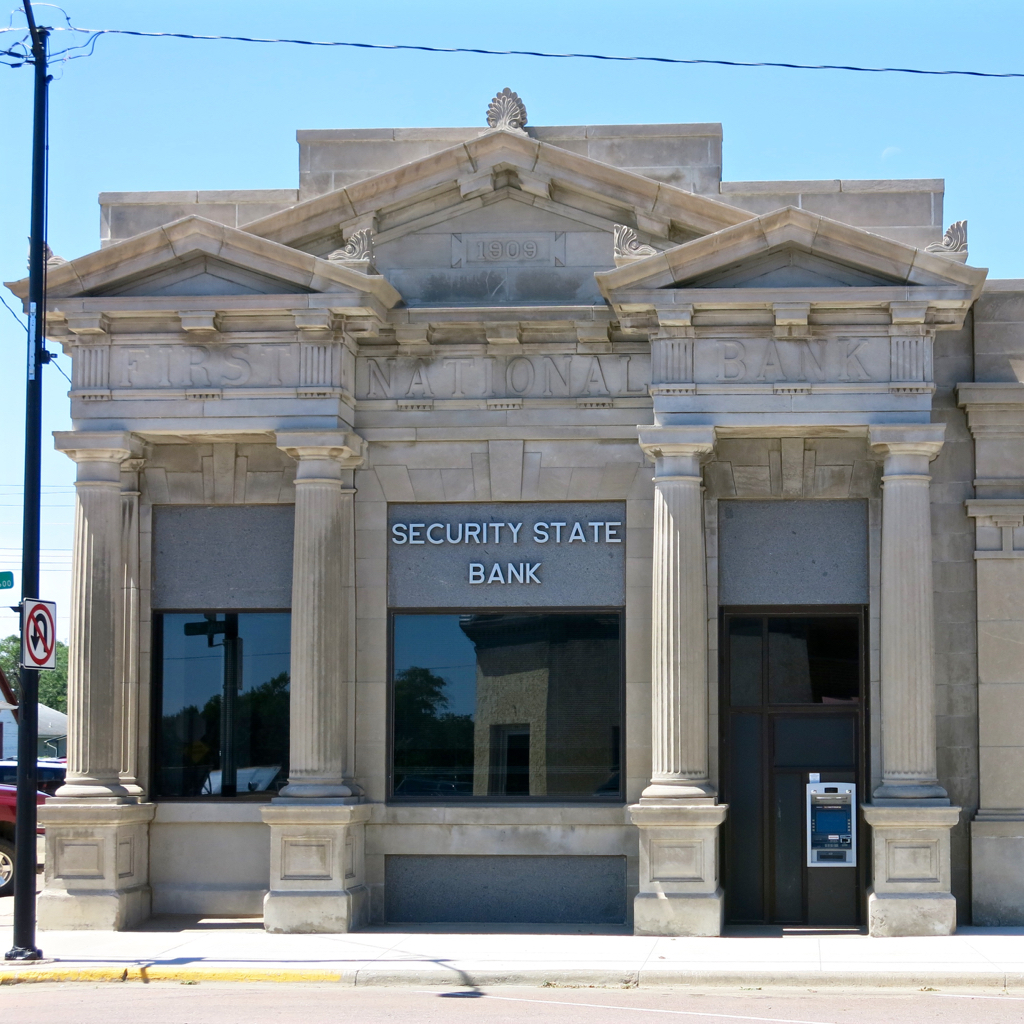
The town looks fairly prosperous, though the newer buildings are made of inexpensive materials and lack ornamentation. The most impressive buildings — small, but solid, built of stone and brick, with modest but interesting ornamentation — bore dates from just before the First World War. Presumably, that was the economic heyday of Tyndall.
We got back on the interstate, and at a rest area near White Lake, S.D., we saw a curious sight: a tiny church separated from the rest area by a low chain link fence, but with a gate.
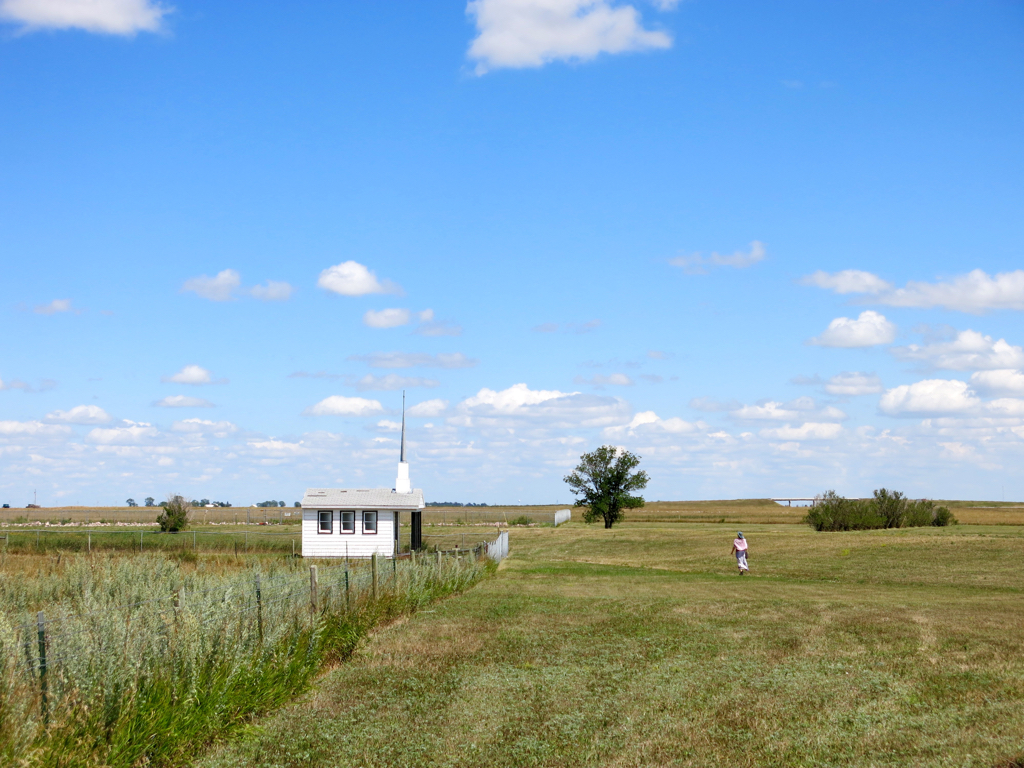
We went inside and found three rows of small benches, with an aisle between the benches. The windows were sealed shut so it was stuffy, but I noticed that there was a thermostat and a small radiator so presumably the building is heated. At the back of the church was a rack containing a variety of tracts about the Bible; I wished I had brought along some extra copies of the “Unitarian Universalist Views of the Bible” pamphlet to add to the rack.
We’re spending the night here in Murdo, South Dakota. Just after we arrived, it started raining. We ducked into The Diner, which was attached to the Pioneer Auto Museum and gift shop. It was still raining when we finished eating, so we went into the gift shop. Carol managed to get a reduced admission rate to the Museum, because it was near closing time. I stayed in the gift shop, where they had a small but excellent selection of books on local history; I bought a biography of Oscar Micheaux, an African American homesteader in Dakota Territory who also happened to be a filmmaker.
I wound up talking politics with the man who sold me the book. We both agreed that we were disappointed with both parties’ nominees for president. He said that Trump was a bully and Clinton was a crook; I contended that one reason we have gotten to where we are now is the lack of common courtesy in politics and on social media; in short, we said nothing that hasn’t already been said over and over again in casual conversations throughout the United States.
That man had to help another customer, so while I waited for Carol to come out of the museum, I talked with the man who sold admission to the museum. He had worked for years in local law enforcement. He told me about several of his encounters with mentally ill people, and contended that mentally ill persons would be better served by some kind of institutions, rather than dumping them on the streets where they forget to take their medications and become the responsibility of law enforcement personnel.
At last Carol came out of the museum, just before it closed. She told me it was really something and that I should have gone in with her, but I was satisfied with the conversations I had while I was waiting.
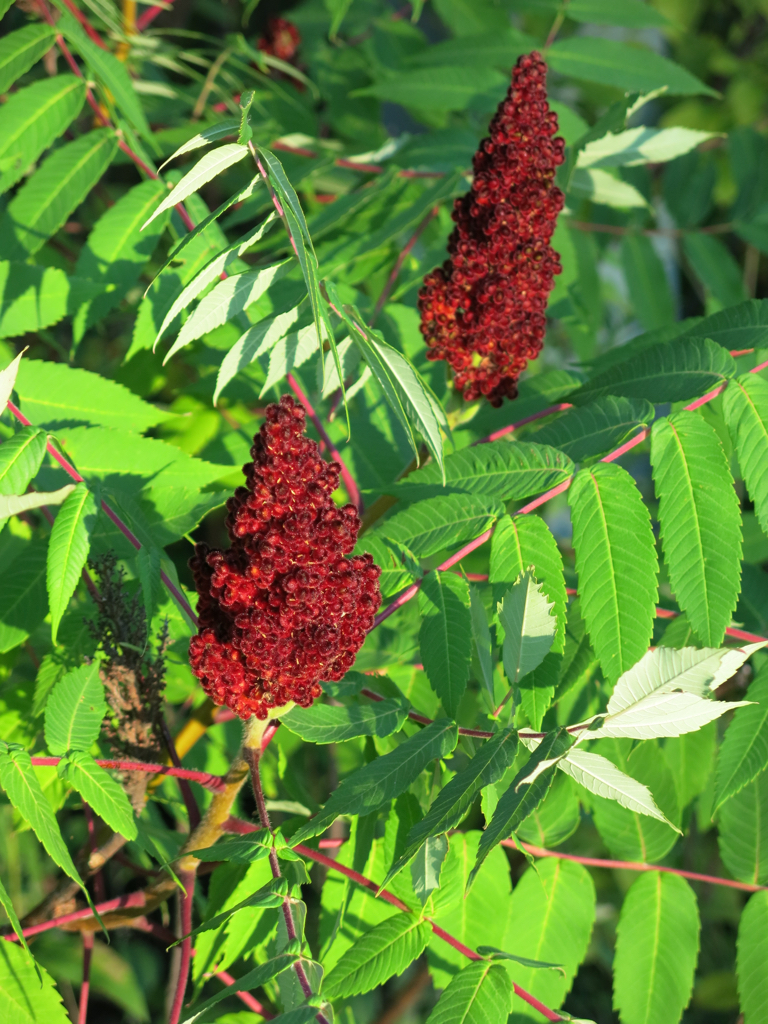
Yesterday, Carol and I had picked several clusters of Staghorn Sumac fruit. We soaked them overnight in water, and this morning we had sumac tea to drink. The tea was tart but not as flavorful as some I’ve had; I suspect the rain storm two days ago washed away much of the flavor. Still, it was worth drinking, and we each had a large glass of it with breakfast.
We said goodbye to Ed and Nancy, and drove west through central Wisconsin. We stopped for lunch at Necedah National Wildlife Refuge, where we startled two Sandhill Cranes, who flew up out of the march grass into the air, bugling loudly; we were almost as startled as the cranes.
After lunch, it was Carol’s turn to drive, and I read aloud the coverage from the Democratic National Convention from the Milwaukee Journal Sentinel. We had watched some of the speeches last night at Ed and Nancy’s, and had been impressed and a little surprised at Bernie Sanders’ ringing endorsement of Hillary Clinton; but we hadn’t realized that when he declared his support for Clinton, some of his supporters had booed loudly. There are lots of angry white people out there in this presidential election season, and it is hard to predict what they will do.
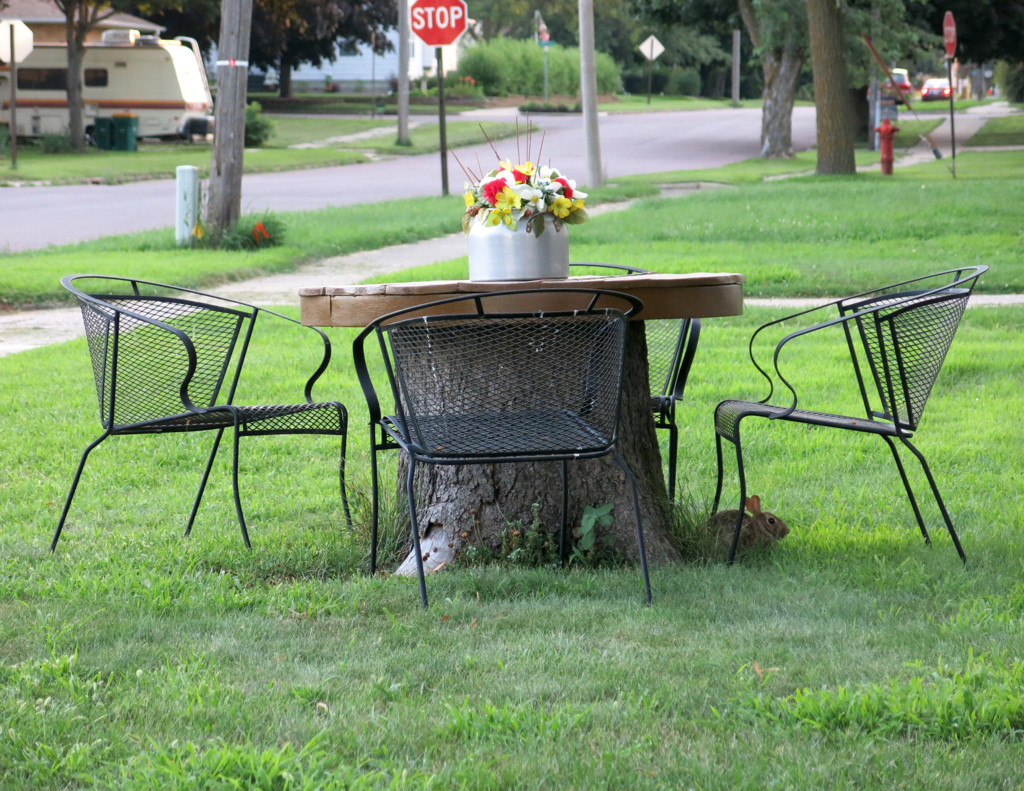
Tonight we are staying in Jackson, Minnesota. We drove into the town’s small business district for dinner; it’s a small little Midwestern town along small swift river, with a tall majestic courthouse towering over the town center. The town is not particularly scenic, the downtown has the usual empty storefronts, but we both found it relaxing and enjoyable to walk around the town at dusk. Carol chatted with the owner of a large Newfoundland while I let the dog sniff my fingers. We stopped to look up at the Common nighthawks flying around the statue of Blind Justice high atop the dome of the courthouse. And we admired the round picnic table built on the stump of a tree in someone’s front yard. Look, said Carol, there’s even a bunny sitting under the table.