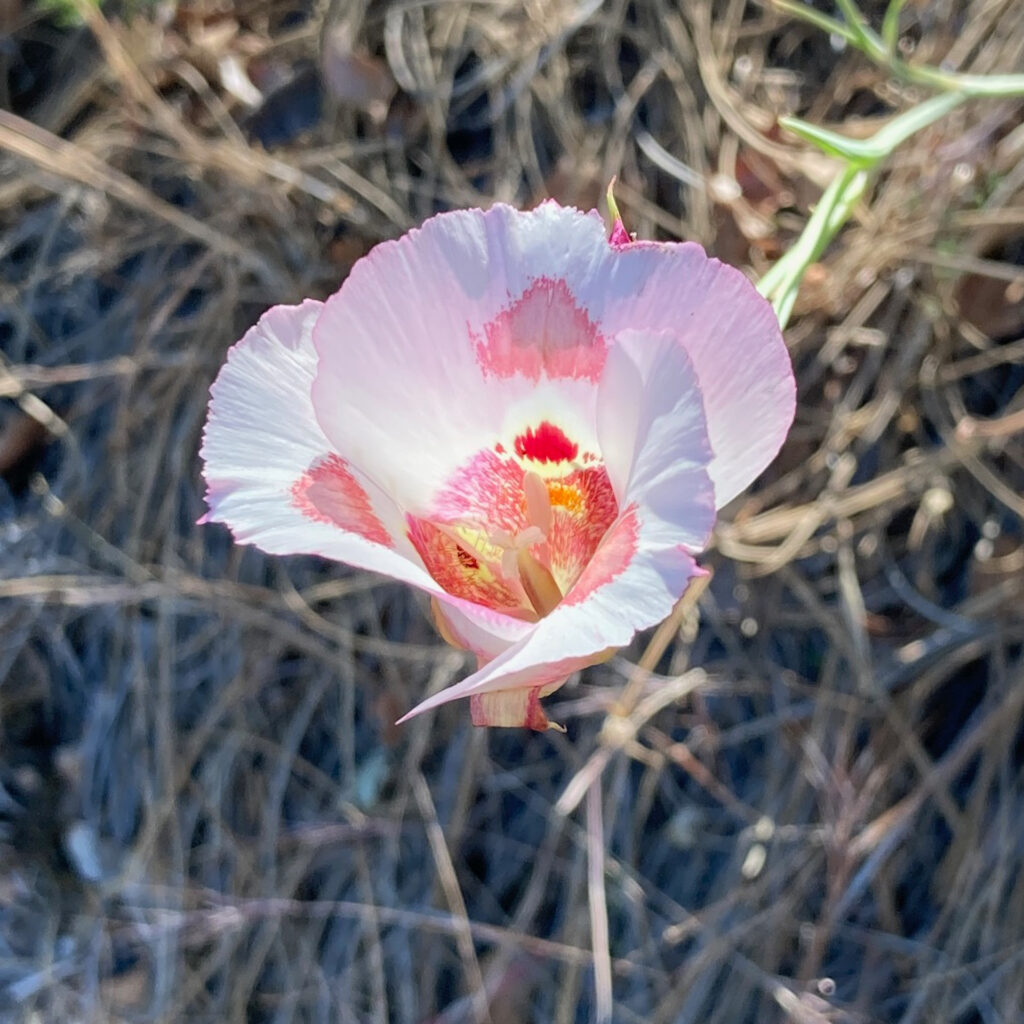
We went for a hike in Henry W. Coe State Park today. There were still quite a few flowers in bloom, of which my favorite was the Butterfly Mariposa Lily:
Butterfly Mariposa Lily
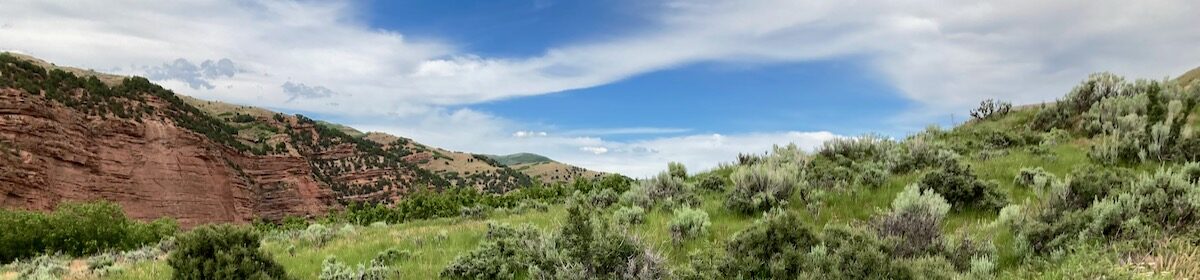
The terrain was the usual steep hillsides of the Coastal Ranges:
Carol on the trail heading back from Frog Lake
The weather was ideal: 65-75 degrees, with a steady northerly breeze. We walked about 8-3/4 miles with 1360 total elevation gain, enough of a workout to make it seem worth while, but we took it slow so we didn’t get burned out. Just about a perfect day.
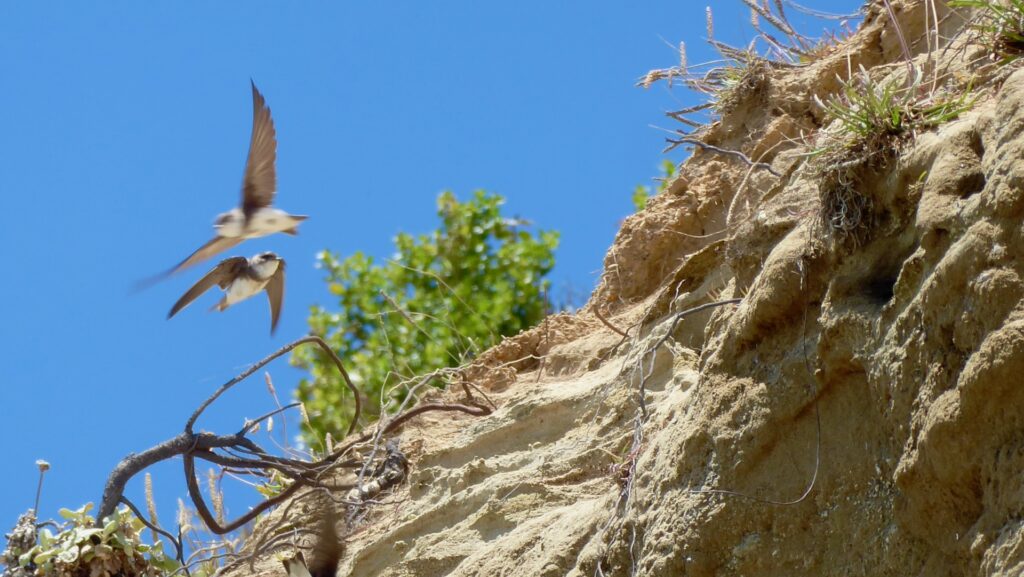
The highlight of a trip to Ano Nuevo State Park is supposed to be the sight of hundreds of Elephant Seals. But when Carol and I visited the park today, what I enjoyed most was seeing Bank Swallows building nests in a bluff high above the beach. I watched through binoculars as the swallows whizzed around the bluff, and in and out of their nesting holes. Every once in a while, a small shower of sand would come out of one of the next holes, presumably because one of the birds was doing some excavation work inside the hole.
A Bank Swallow leaving a nesting hole, while a second one approaches the hole
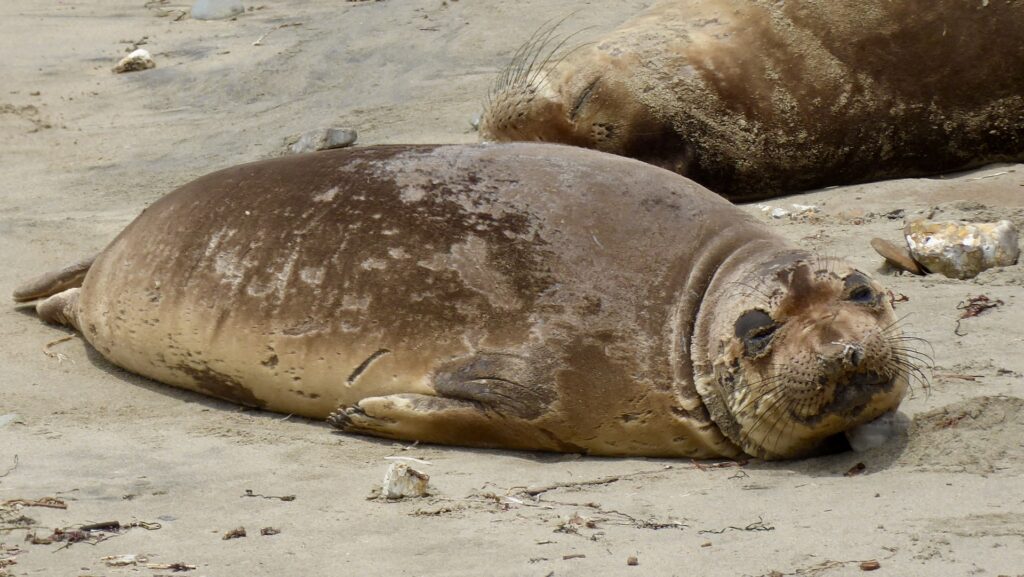
On my way home from a ministers’ retreat this afternoon, I stopped at Ano Nuevo State Park. The reason most people visit the park is to view the Elephant Seals that live there. And what’s not to like about these charismatic megafauna?
Molting female Elephant Seal
Today’s visit was too short. I’ve already convinced Carol to accompany back to the park tomorrow. (Although, to be completely honest, my primary motivation is seeing the nesting Bank Swallows I didn’t have time for today. Don’t tell Carol.)
A fairly major revision of a gr. 8-9 Coming of Age program is now online. From the course description: “The goal of our Coming of Age program is to help young people sort out their ethical and religious identity (recognizing that some young people do not feel religious at all), so that they may make rational decisions about the kind of person they want to become.”
This Coming of Age program assumes that Unitarian Universalist religious identity is primarily concerned with what we do in the world. Second, the program does not take Christianity as the paradigm of all religion, which means that belief and doctrine are de-emphasized, while ethics is emphasized. Third, the course includes many hands-on activities, as well as discussions, to reach different learning styles. Fourth, the course is outcome-driven, with everything in the course designed to prepare participants to write and deliver statements of religious identity in a culminating worship service.
I wrote the curriculum, but it’s based on the real-world course we’ve offered at the UU Church of Palo Alto for the past decade. Many other teachers, and many participants, have contributed to the program.
There are still known issues with the curriculum. The session plan for Session Seven, “Western Religious Practices,” is teachable, but needs revision. Session Ten, “Football Is Religion,” was taught for the first time in 2021, and the session plan is still rough. Session Eight is designed as a field trip to a specific art museum in San Francisco, but could be adapted to other museums in other locales. The social justice project is very specific to the Palo Alto congregation, but with careful attention to the criteria for what constitutes a good social justice project, other congregations can find suitable projects.
The curriculum does make use of copyrighted material. However, the online curriculum provides to online sources for all copyrighted material.
Overall, the curriculum is quite sound and produces excellent outcomes. While written for the Palo Alto congregation, it should be fairly easy to adapt to most UU congregations.
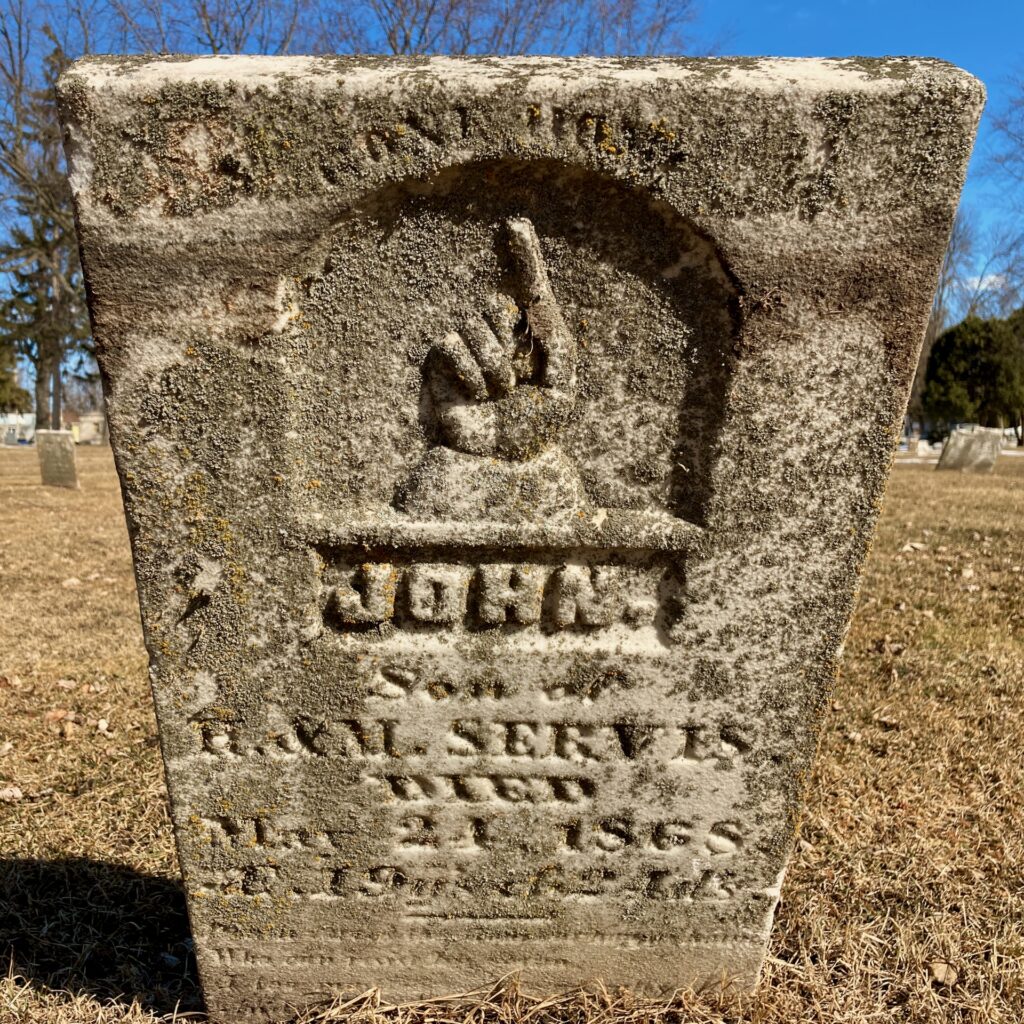
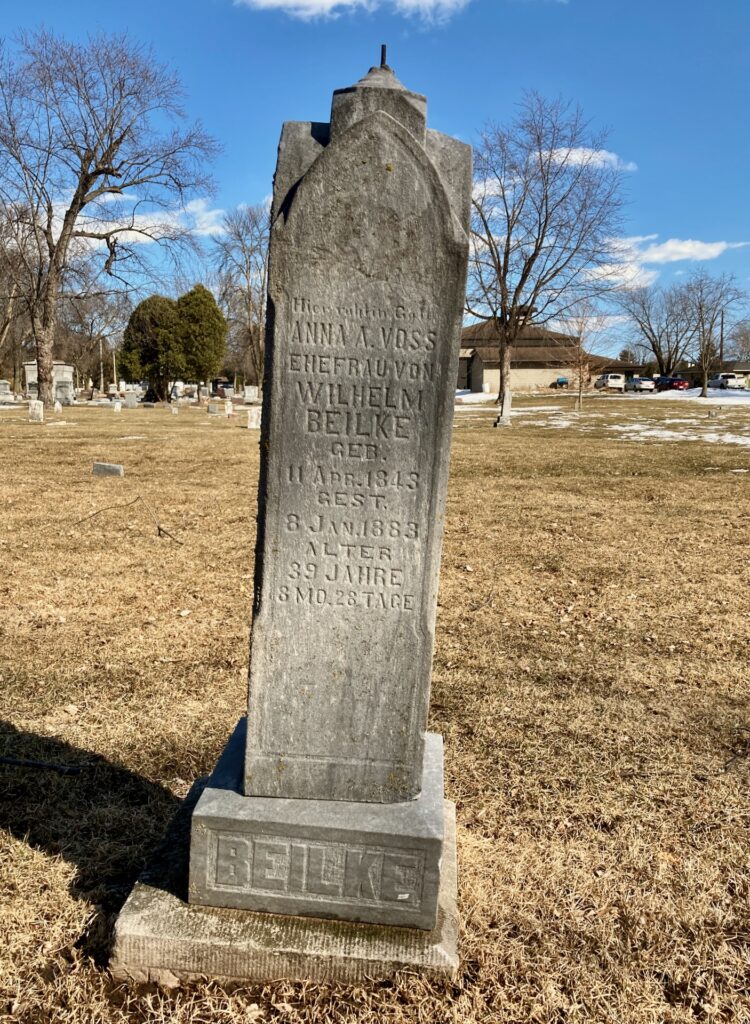
After last night’s snow storm, temperatures rose above forty degrees. This afternoon, Carol and I took a long walk. We wound up in Riverside Cemetery, where we were especially interested in the nineteenth century gravestones.
The gravestone reads: “John / Son of / H. & M. Serves, / died / May 21, 1868 / AE 19 yrs & 2 wks [?]” The lower lines were illegible.Grave marker, with inscription in German
Carol is a local bike activist, and she’s been working with MoveSanMateo to promote bike lanes in North Central, our old neighborhood in San Mateo (which we got priced out of when our landlord sold the building we lived in).
So when she heard that bo2focused was organizing a bike ride in North Central, the neighborhood where he grew up, she got other MoveSanMateo bicyclists to go and join their ride.
It wasn’t just a bike ride, it was Bike life. What is Bike life? It’s a subculture. It’s a bunch of young bike riders popping wheelies on city streets. Bike life sometimes puts together big rides, not unlike Critical Mass or Bike Party put together big rides. Just like Critical Mass, Bike life sometimes annoys motorists by filling up the public right of way with so many bicycles that cars and trucks have to slow down.
bo2focused posted some videos of Saturday’s ride, and Carol appears at the beginning of one of the videos, talking to one of the vendors who showed up.
Carol’s brief appearance in a Bike life Instagram video
Carol says she was probably the only bicyclist there who was over 40. She was also one of the few women, and one of the few white people. The Bike life people drifted in over next next couple of hours, and at last they started riding through North Central. Wheelies that last five or ten minutes, and bicyclists weaving around one another, are characteristic of Bike life. Carol decided to drop to the back of the pack, and then at a traffic light she lost the Bike life group. So she rode over to Wursthaus, where some of her MoveSanMateo bicyclist friends were hanging out and eating lunch to celebrate City Council approving the North Central bike lanes.
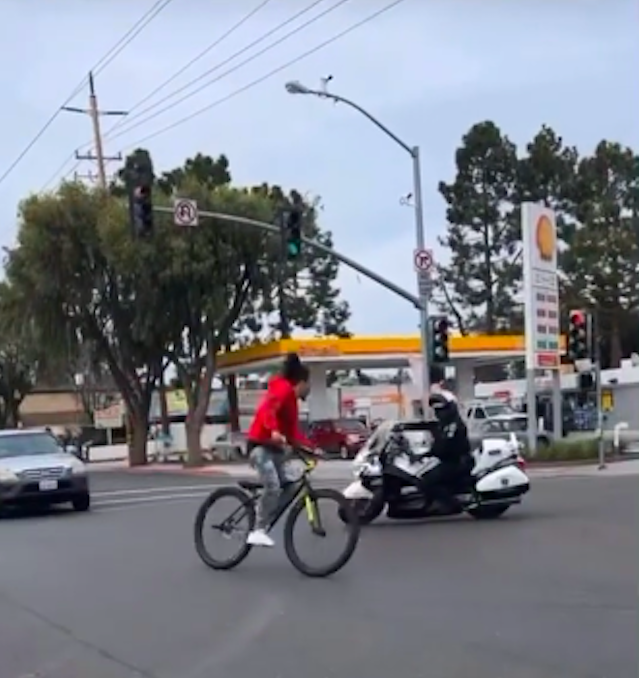
Bike life is not known for being cautious. After Carol left the ride, Bike life kind of took over the intersection at Delaware and Fourth. The police were called out, including a motorcycle cop who attempted to follow one of the bicyclists….
Click on the screen grab above to see the video on Instagram
Embarrassingly for the police officer, his motorcycle fell down. The Bike life group rode off down Delaware.
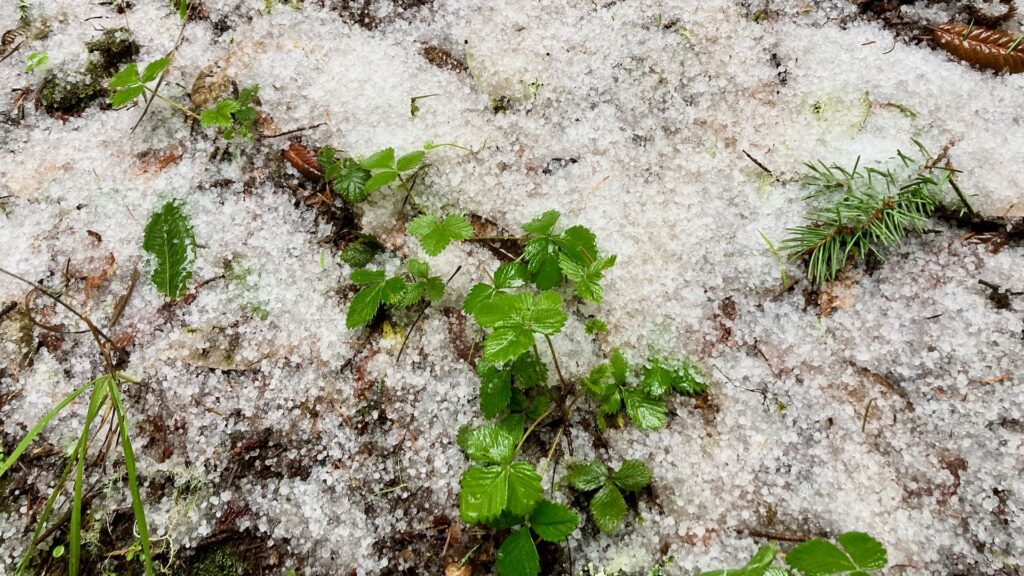
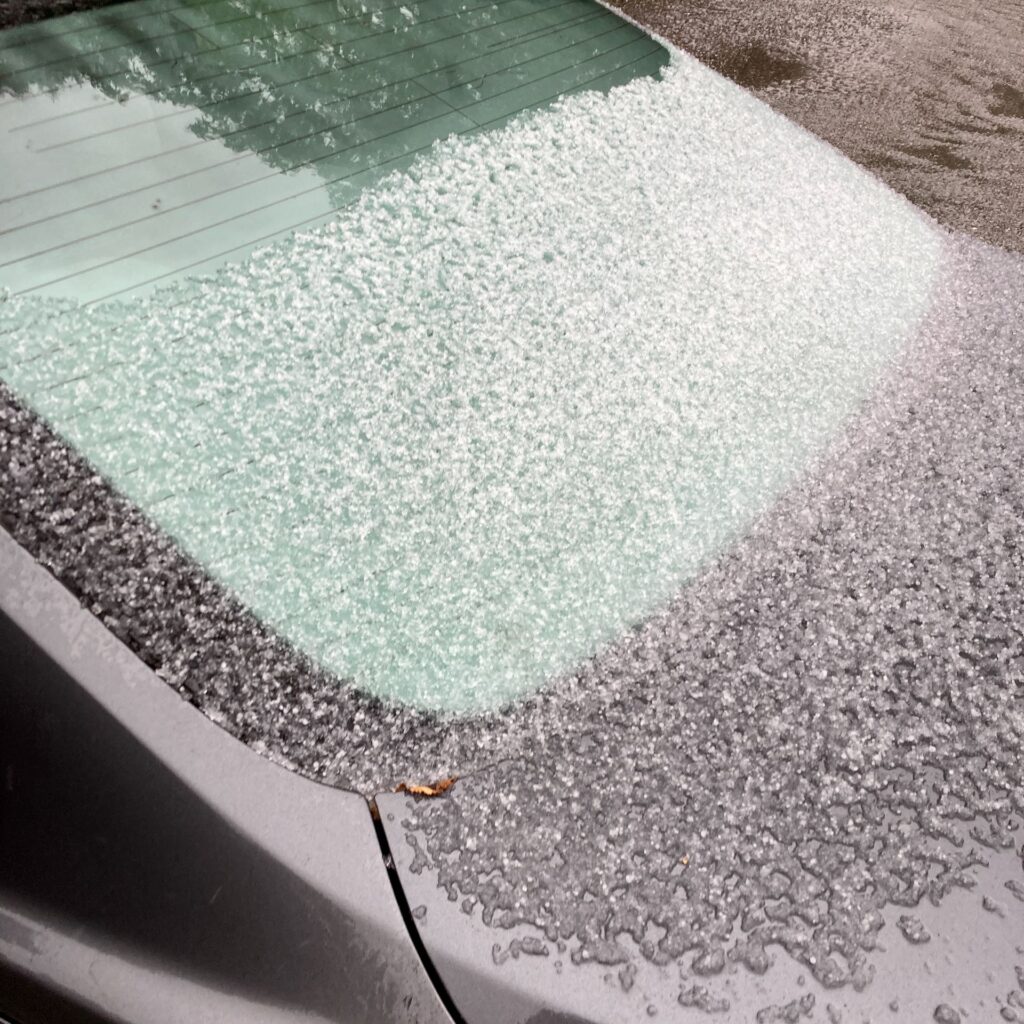
This morning, I went for a walk up in the Santa Cruz Mountains. I was expecting showers, and forecast warned me there might even be thunderstorms. But I was not expecting hail.
In places, the tiny hailstones covered the ground, looking so much like snow that I decided it was a white Christmas — just like the ones we used to have at home.
I was wary of driving down winding, twisty mountain roads covered with a quarter of an inch of hail stones. But I watched other cars drive by without any trouble, and decided to try. The driving wasn’t that bad — after about five minutes I got below 1500 feet elevation, and the roads were clear of hail.
Scrooge famously said: “If I could work my will, every idiot who goes about with ‘Merry Christmas’ on his lips, should be boiled with his own pudding, and buried with a stake of holly through his heart!”
The omicron strain of COVID-19 is acting like Scrooge. If you go wish your family ‘Merry Christmas’ in person, you could wind up with omicron in your lungs. Bah humbug.
A month ago, we started planning in-person services for Christmas Eve. But as of today, it looks like we’re going to be moving to online-only for Christmas Eve. Omicron is present here in Santa Clara County. Omicron doubles every 2-4 days (depending on who you listen to). Vaccinated and boostered people are getting omicron. Everyone is expecting a major surge by mid-January. So in-person indoors meetings are most definitely Not A Good Idea. Bah humbug indeed.
I had been looking forward to seeing people in person on Christmas Eve — especially college students, many of whom come home for winter breaks. But honestly I’m relieved that we’re not going to have in-person services. I admit it — I don’t like the looks of omicron.
Part Five of a history I’m writing, telling the story of Unitarians in Palo Alto from the founding of the town in 1891 up to the dissolution of the old Unitarian Church of Palo Alto in 1934. If you want the footnotes, you’ll have to wait until the print version of this history comes out in the spring of 2022.
In November, 1921, Elmo Arnold Robinson, known as “Robbie,” arrived at the Unitarian Church of Palo Alto with his wife Olga and sons Kelsey, who was 9 months old, and Arnold, almost 5 years old. Robbie, ordained as a Universalist minister, had lots of experience in small congregations, plus he had just finished a two-year stint as the Director of Religious Education at a church in southern California. Olga was also licensed as a Universalist minister, although her time was taken up with her small children. It’s hard to imagine that the Unitarian Church of Palo Alto could have found a better match for their needs.
Not much happened in Robinson’s first year, except that Sunday school enrollment dropped still further. Emma Rendtorff had been the superintendent of the Sunday school in the 1920-1921 school year, and Sunday school enrollment crept back up to 31 children, but that was Emma’s last year as superintendent; her daughter Gertrude entered Stanford University in the fall of 1921, so Emma was no longer quite so invested in the Sunday school. In 1921-1922, Elmo Robinson’s first year, the church went through three Sunday school superintendents: Jessie Morton, who was William H. Carruth’s mother-in-law; William Ewert, a student at Stanford University; and Frank Gonzales, another Stanford student who served the longest of the three. With all that turnover, it’s not surprising that enrollment in the Sunday school dropped to 20, probably the lowest enrollment since 1908.
But Elmo Robinson had already turned his thoughts to religious education. In the summer of 1922, his essay “The Place of the Child in the Religious Education Community” was published in the Pacific Unitarian. This essay outlined a progressive philosophy of religious education that was tied to social reform:
“Every religious community believes that the future can be made better than the present. Every church, while cherishing certain ideals and methods of the past, must fire its young people with a vision of the future which will encourage them to devise new ways and means to realize it. Do you want world peace? World justice? The cooperative commonwealth?… All these things can be accomplished only by admitting children and young people to the full fellowship of the religious community as friends….”
Presumably, this essay repeated what had already been going on in the Palo Alto church. Bertha Chapman Cady was one of the teachers in the Sunday school in 1921-1922, and she involved the children in helping to run the class; one of her daughters, for example, became the class secretary. Children were becoming fully involved into the religious community of the church. The lay leaders seem to have found his vision a compelling one. The next school year, 1922-1923, the charismatic William Carruth agreed to be the superintendent of the Sunday school, and enrollment immediately shot up to 33 children.
For the 75th anniversary of the Unitarian Universalist Church of Palo Alto.
1947 — On April 6, Rev. Delos O’Brian of the American Unitarian Association holds the first meeting of the emerging congregation; some present at the first meeting were members of the old Unitarian Church of Palo Alto 1947 — Rev. Nat Lauriat, minister in San Jose, drives up each week to preach in Palo Alto
1948 — The first Sunday school is a cooperative venture with Palo Alto Friends Meeting; former Unitarian Josephine Duveneck is one of the teachers 1948 — The new congregation applies for membership in the American Unitarian Association (AUA) as the Palo Alto Unitarian Society
1949 — From April through June, Rev. Lon Ray Call, extension minister from the AUA, serves the new congregation; membership more than doubles 1949 — After Nat Lauriat turns them down, the congregation calls Rev. Felix Danford Lion as minister; Lion arrives in September
1950 — Services are held at the Palo Alto Community Center 1950 — PAUS hold first Flower Communion service
1951 — The congregation changes its name to the Palo Alto Unitarian Church (PAUC) 1951 — The congregation purchases a house for Rev. Dan Lion and his family to live in
1952 — Following the lead of the Los Angeles Unitarian church, PAUC refuses to sign California’s “Loyalty Oath,”and has to pay state tax even though it’s a nonprofit 1952 — The Forum is started by Dr. Robert C. North of Stanford, for open discussion of controversial questions of the day
1953 — PAUC, the San Jose Unitarian church, and the Los Gatos Unitarian Fellowship form a dental loan fund to aid children of migrant workers
1954 — PAUC purchases property at 505 Charleston Rd. for $30,060 [$300,000 in 2020 dollars] 1954 — Women’s Alliance raises $1,326 for PAUC [$13,000 in 202 dollars] 1954 — A second service is added at 9:30 a.m.
Rev. Dan Lion at the Lucie Stern Center, c. 1955
1955 — The choir sings for the first time in a PAUC service 1955 — PAUC no longer needs financial assistance from the AUA
1956 — Prominent Bay Area architect Joseph Esherick is chosen to design PAUC’s new buildings 1956 — Religious education enrollment is over 400, with waiting lists to get in 1956 — Emma Lou “Timmy” Allen becomes PAUC’s first choir director
1957 — PAUC raises $83,850 for the Building Fund [$783,000 in 202 dollars], and negotiates a bank loan for $90,000 1957 — PAUC assists a displaced persons family from East Germany 1957 — Rae Bell begins serving as children’s choir director
1958 — Ground-breaking ceremony at 505 Charleston Rd.; total cost of the new building, $178,000 [$1.6 million in 2020 dollars] 1958 — First Sunday services are held in new building 1958 — The Bookstore has its own space in the new building 1958 — San Mateo Unitarian church gives PAUC two redwood trees which are planted by the entrance drive 1958 — A madrone branch from Maj. Todd’s land on Skyline Drive is installed in the Main Hall
Groundbreaking ceremony, 1958
1959 — Congregation votes to support a spin-off group from PAUC which becomes the Unitarian Fellowship of Redwood City 1959 — C. Sargent Hearn, the first full-time salaried religious educator, is hired 1959 — Public address system is installed in Main Hall
1960 — Florence Sund becomes the Director of Religious Education 1960 — Main patio is finally paved 1960 — Congregation votes 75 to 1 to support the proposed consolidation of the Unitarians and the Universalists 1960 — PAUC assists a displaced persons family, plus four children from Indonesia
1961 — Women’s Alliance raises $4,590 for enlarging and paving the rear parking area [$403,000 in 2020 dollars] 1961 — Rev. D. Roen “Bud” Repp becomes assistant minister; Rev. Dan Lion goes on sabbatical for six months
Coffee hour on the patio, October, 1961
1962 — Wooden benches are installed in the main patio 1962 — Madrone branch from the Santa Cruz Mountains is installed on the wall of the Main Hall; it replaces a smaller one 1962 — Sunday school enrollment peaks at over 600; there are three Sunday services to accommodate the Sunday school 1962 — Congregation supports the spin off of the Sunnyvale UU Fellowship from PAUC
1963 — Choir has 50 members; Dr. Arthur P. Barnes, Stanford Music Professor, becomes choir director 1963 — Sunnyvale Fellowship is in operation; over the next two years, 100+ children transfer there, relieving pressure on PAUC’s Sunday school 1963 — Musician Jerry Garcia and Sara Ruppenthal marry in the Main Hall with Rev. Dan Lion officiating
1964 — Rev. Dan Lion participates in the Mississippi Summer Project (a.k.a. Freedom Summer), and is supported by PAUC 1964 — 100 junipers are planted in front of the Main Hall 1964 — Minister’s study is added to the rear of the office building 1964 — PAUC gives $2,000 [$17,000 in 2020 dollars] to the Redwood City Fellowship so they can hire a minister 1964 — Rev. Dan Lion officiates at a wedding ceremony for musicians Mimi Baez and Richard Fariña (they had been legally married in Paris a few months before)
1965 — PAUC supports Rev. Dan Lion’s trip to Selma, Ala. 1965 — Mike Young becomes assistant minister; congregation ordains and installs him in November 1965 — Congregation votes to investigate the possibility of building a larger church building at the front of the lot 1965 — Nationwide, Unitarian Universalism stops growing and begins declining around about 1965
1966 — PAUC sells 2.2 acres to Stevenson House elderly housing community at below market rates, then gives Stevenson House a $5,000 donation [$405,000 in 2020 dollars] 1966 — Activism against the Vietnam War
1967 — Clarice Gault hired as new Director of Religious Education 1967 — Revs. Dan Lion and Mike Young provide counseling to conscientious objectors
1968 — Congregation votes to not build a new church building, and instead votes to spend the money on “human rights” programs (however, some voted against building because they thought the design was ugly) 1968 — Rev. Mike Young resigns as of Dec. 31, 1968, and is not replaced 1968 — Stevenson House construction is completed, including the bridge linking Stevenson House with PAUC
Rev. Mike Young at a church meeting, 1968
1969 — Covered patio building is completed for $13,000 [$93,000 in 2020 dollars] 1969 — Due to falling adult attendance and religious education enrollment, PAUC goes down to two services per Sunday 1969 — Virginia Stephens and Ellen Thacher become co-DREs 1969 — Rev. Dan Lion and other Unitarians participate in anti-war march in downtown Palo Alto
1970 — PAUC forms a nonprofit corporation to start an alternative high school, called “Lothlorien High School” 1970 — Ron Garrison hired as “Youth Minister” 1970 — The congregations declines to invest in Black Affairs Council bonds 1970 — Rae Bell resigns as children’s choir director 1970 — Congregation declines to add “Universalist” to its name, at the requests of Universalists in the congregation
1971 — PAUC establishes a day care center, still in existence,which is named after the recently deceased Ellen Thacher 1971 — PAUC calls Rev. Dr. Ron Hargis as minister of religious education
1972 — Rev. Dan Lion resigns; Rev. Ron Hargis becomes sole minister until Rev. Sidney Peterman arrives in the fall as interim minister 1972 — PAUC grants to use of the church as sanctuary for those “acting according to the dictates of their conscience in opposition to civil of military actions” [i.e., for conscientious objectors]
Two charter members of the congregation (front left and center) in 1972
1973 — PAUC votes to call Rev. William Jacobsen to serve as co-minister with Ron Hargis 1973 — A live-in custodian is hired, living in what is now the Choir Room 1973 — Women’s Alliance disbands, donates their remaining money to charity 1973 — The son of musician Joan Baez attends Thacher Children’s Center
1974 — “Stagflation” reduces income and increases expenses; the “Baby Bust” means fewer children; as a result PAUC shrinks financially and numerically 1974 — A grant makes it possible for 6th and 7th graders to participate in an art project for an afternoon with innovative artist Ruth Asawa
1975 — The Social Concerns Committee supports the United Farm Workers boycott of Gallo
1976 — Lothlorien High School ceases operations 1976 — The house purchased for use by the minister (the “parsonage”) is sold
1977 — Rev. Ron Hargis and Rev. William Jacobsen promise to resign effective Jan. 1, 1978, if finances don’t improve; when finances don’t improve, Hargis resigns, but Jacobsen does not 1977 — Gail Hamaker and other PAUC women are active in getting the Unitarian Universalist Association General Assembly to adopt the groundbreaking Women and Religion resolution
1978 — Religious education enrollment rises from 50 to 100 with leadership from DREs June and Bob Donmoyer 1978 — First annual “mini-vacation” at Bass Lake 1978 — Women and Religion resolution: PAUC votes to examine sexist religious beliefs, but declines to examine sexist language and actions
Crafts project, c. 1978
1979 — For the first time, PAUC offers a preschool class in Sunday school
1980 — DRE Mary Brau also becomes “executive officer” of the entire church 1980 — A women’s group, based on the Women and Religion resolution, is formed and given Board sanction 1980 — Nationwide, after a decade and a half of decline, Unitarian Universalism begins to grow at about 1% per year
1981 — The World Concerns Committee presents non-partisan lectures on various topics of social concern
1982 — Congregation votes in December to join South Bay Sanctuary Covenant to provide protection and advocacy for Central American refugees 1982 — Mary Brau resigns as DRE 1982 — Men’s group forms, with a dozen men meeting Monday evenings 1982 — Steel posts and chains are installed at entrance and exit drives to reduce vandalism 1982 — Congregation votes to remove sexist language from bylaws
Main Hall from the street, 1982
1983 — 25th anniversary celebration; Rev. Dan Lion speaks at the celebration
1984 — The Sanctuary Committee raises $100 a month to support South Bay Sanctuary Covenant [$250 in 2020 dollars] 1984 — The Stevenson House Committee helps raise funds to renovate Stevenson House, arranges activities to “enliven the environment” of residents
1985 — Caring Network is organized to be “available to those of us in emergency situations” 1985 — The Social Action Committee is temporarily inactive, but it did distribute funds to South Palo Alto Food Closet and other groups
1986 — Wall paneling and track lighting installed in the Main Hall Lobby for art exhibits 1986 — PAUC UUYAN, a young adult group for people ages 18 to 35, meets nearly weekly
1987 — Congregation votes to join the Mid-Peninsula Peace Center 1987 — Congregation votes to make PAUC a Nuclear Weapons Free Zone 1987 — Congregation votes to join the Urban Ministry of Palo Alto, to address homelessness
Banners that hung in the Main Hall from 1971 to 1993. L-R: “Love,” “Reason,” “Freedom,” “Tolerance”
1988 — Congregation votes to change name to the Unitarian Universalist Church of Palo Alto (UUCPA) 1988 — UUCPA is a founding member of Hotel de Zink, a short-term homeless shelter 1988 — Edith Parker becomes Director of Religious Education
1989 — Friendship Bridge linking UUCPA and Stevenson House is built 1989 — The Board of Trustees meets just two hours after the Loma Prieta earthquake 1989 — PAUC purchases its first computer, a Mac IIcx 1989 — Congregation votes that Bill Jacobsen shall retire no later than August 31, 1990
1991 — Rev. Ken Collier is called as minister 1991 — Main Hall is often 80-90% full on Sunday mornings; Ken Collier first proposes double sessions
1992 — A new madrone branch from the Santa Cruz Mountains is installed in the Main Hall; this is the third branch to hang in the Main Hall 1992 — PAUC joins with three other UU congregations to form a congregation in Fremont
Rev. Ken Collier helping at a work day, c. 1992
1993 — The large hanging quilt banners, made by fabric artist Wendy Hill, are installed in the Main Hall 1993 — Congregation votes to name Dan Lion as Minister Emeritus 1993 — “Caring and Sharing” added to Sunday service
1994 — Overgrown trees are removed from the back lawn in front of Rooms 11, 12, and 13 (now Rooms A, B, C, and D) 1994 — Bequest of $340,000 received from the estate of Dorothy B. White [$600,000 in 2020 dollars]
1995 — PAUC votes to include a non-discrimination clause in the bylaws 1995 — PAUC votes to provide up to $10,000 [$17,250 in 2020 dollars] to the new UU congregation in Fremont
1996 — “An Easter Egg Hunt was created for children of preschool through 2nd grade.”
1997 — PAUC joins with other churches to form Peninsula Interfaith Action 1997 — Congregation sees enough growth in membership to consider adding a second minister 1997 — Anti-Racism Task Force is formed 1997 — PAUC commissions sculptor Bennet Sykes Blackburn to make a wooden chalice
1998 — Articles of Incorporation are amended on April 19: “The name of this corporation is UNITARIAN UNIVERSALIST CHURCH OF PALO ALTO.” 1998 — UUCPA hires Rev. Til Evans as interim minister of religious education, to serve with Ken Collier 1998 — Ellen Thacher Preschool is now part of Palo Alto Community Child Care 1998 — UUCPA votes to support community minister Rev. Erinn Melby for three years, our first community minister
1999 — A capital campaign is begun, with the goal of a new administration building 1999 — UUA recognizes UUCPA as a Welcoming Congregation,welcoming to LGBTQIA+ people
Auction, 1999
2000 — In January, UUCPA adds a second worship service on Sunday morning 2000 — Rev. Darcey Laine is called as minister of religious education 2000 — Live-in custodian resigns and is not replaced
2001 — Rev. Ken Collier resigns to become minister in Santa Barbara 2001 — Proposed building project will cost $1.82 million, more than the congregation can raise [$2.78 million in 2020 dollars] 2001 — Rev. Kurt Kuhwald starts as interim minister, just before 9/11
Minister’s office, 2001, before the renovation (this room is now the library)
2002 — A Building Committee is formed, with a new lower budget of $686,000 [$1 million in 2020 dollars]
2003 — Rev. Amy Zucker is called as parish minister, to serve as co-minister with Darcey Laine 2003 — UUCPA adopts a statement of conscience opposing a preemptive strike by the U.S. on Iraq
2004 — Rooms 11-13 renovated as Rooms A-D (1 classroom and 3 offices); new restrooms added; office and library reconfigured 2004 — UUCPA votes to reaffirm its support for marriage equality 2004 — The Senior High Youth Group and Darcey Laine, along with youth from the Redwood City Fellowship, install the first labyrinth at UUCPA
2005 — New sound system installed in the Main Hall 2005 — Parking lot resurfaced 2005 — Rev. Amy Zucker marries, becomes Amy Zucker Morgenstern
2006 — Congregation adopts a relational covenant 2006 — Wifi installed in the Fireside Room and most classrooms
2007 — 60th anniversary celebration, Rev. Dan Lion speaks 2007 — Rev. Darcey Laine resigns, as her family wants to relocate to upstate New York 2007 — Rev. Eva Ceskava becomes interim minister of religious education
2008 — Til Evans garden is completed 2008 — Hearing aid loop system in Main Hall improves accessibility for persons who are hard of hearing 2008 — Welcoming Congregations Committee organizes congregation to defeat Prop 8, a ballot measure to ban same-sex marriage
Til Evans Garden dedication, 2008 (faces blurred to protect privacy)
2009 — Congregation hires Rev. Dan Harper as assistant minister of religious education 2009 — Church consultant Alice Mann suggests bringing the congregation together more often, inspiring Second Sunday Lunches to begin 2009 — Nationwide, Unitarian Universalism begins small annual decline that continues to the present
2010 — With the help of church consultant Alice Mann, UUCPA sets goal of “adding the next 50 people” as measured by average annual attendance 2010 — Rev. Sean Parker Dennison serves as sabbatical minister, UUCPA’s first transgender minister
2011 — Solar panels installed on the roof of the Main Hall, providing about half of UUCPA’s energy needs 2011 — New fenced-in play area installed in front of Thacher School’s playground 2011 — Bruce Olstad becomes Music Director 2011 — Congregation votes to endorse single payer health insurance for California
Tibetan monks create a sand mandala at UUCPA, 2011 (faces blurred to protect privacy)
2012 — Energy efficient LED lights installed in the parking lot 2012 — Our Whole Lives comprehensive sexuality education classes are open to the wider community 2012 — Navigators program is organized at UUCPA, providing scouting that welcomes all genders and LGBTQIA+ persons
2013 — Board of Trustees transitions to using an online document filing system 2013 — UUCPA moves membership database to a cloud-based system 2013 — Music Director Bruce Olstad launches Bodhi Tree North concert series to raise money for charitable causes
2014 — The front of the lot is landscaped, junipers removed, and a native plant garden and a larger labyrinth are installed 2014 — Religious education enrollment peaks at 135 2014 — Sunday school “Ecojustice class” installs first rain barrel at UUCPA
2015 — UUCPA provides meeting space and use of our kitchen to Stevenson House, while their buildings are renovated 2015 — Congregation votes to ordain UUCPA member and hospital chaplain Melissa Thompson
2016 — Board prohibits smoking on campus 2016 — Membership and Growth Committee reports that UUCPA is halfway to the goal of adding 50 people, as measured by average annual attendance
2017 — UUCPA adds more solar panels to Main Hall roof, which now produce all the congregation’s electrical needs 2017 — UUCPA leases the parking lot to a solar energy company to erect a solar panel array 2017 — Staff cut-backs due to attrition save UUCPA money 2017 — UUCPA moves website to WordPress CMS
2018 — UUCPA begins hosting Heart and Home Collaborative, a women’s homeless shelter, for 6 weeks each winter 2018 — A Membership Engagement Coordinator is hired for 15 hours per week, on a one-year trial basis 2018 — Congregation considers removing the word “Church” from its name, but confronted with 5 possible new names, none receives the necessary 2/3 majority
Coming of Age service, 2018 (faces blurred to protect privacy)
2019 — Rising health insurance costs prompt Board of Trustees to create innovative funding scheme that maintains insurance coverage while lowering costs 2019 — About 30% of enrolled children and youth are non-white
2020 — COVID cause state-wide shutdown, UUCPA moves worship services and programs online, congregation members respond with creativity and resilience 2020 — Due to COVID lockdown, Heart and Home homeless shelter remains at UUCPA for 3 months, 24/7 2020 — UUCPA receives federal Paycheck Protection Plan loan to help cover payroll during COVID
The beginnings of livestreaming from the Main Hall, January, 2021
2021 — In the Main Hall, Worship Tech crew upgrades audio board and adds 3-camera video and large video screens, to allow multi-platform livestreaming capability 2021 — Of 99 people responding to a congregational survey, roughly 15% are non-white 2021 — UUCPA begins hosting a Safe Parking Program, where up to four homeless families can live in their cars
2022 — UUCPA celebrates its 75th anniversary!
Timeline researched by Rev. Dan Harper
Updates: (1) 2021-11-15: corrections and additions to timeline; (2) 2021-11-15: added approximate constant dollar values; (3) 2021-12-09: began adding vintage photos.