Shrew-mole

After a week of twelve hour days, getting everything set for the first day of Sunday school, I was ready for a break. When Carol suggested we go for a late-afternoon walk at Purisima Creek Redwoods Open Space Preserve, I was ready to go.

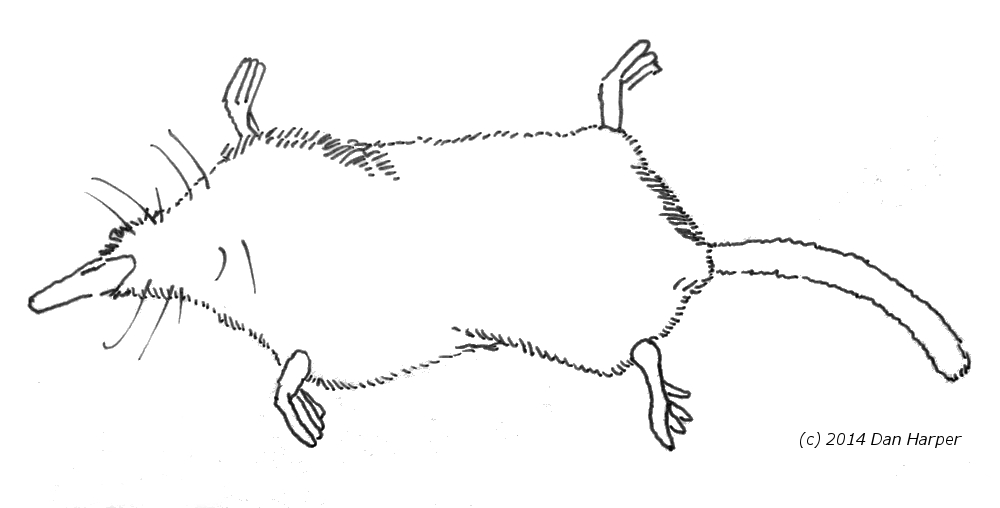
About an hour into our walk, Carol pointed down at the ground. “What’s that?” It was a small animal, dead. A mouse? No, a closer look revealed it was a mole. I turned it over carefully. There was a bit of a flat place where it had been lying; presumably decomposition was beginning. But you could still see the general shape of the animal. I admired it for a while then made a sketch, slightly smaller than the actual size of 110 mm total length, which I refined once we got home:

Shrew-mole, Neurotrichus gibbsii

Of the two species of mole which inhabit our area, it was clearly a Shrew-mole (Neurotrichus gibbsii). According to Jameson and Peeters, in Mammals of California, we humans don’t really know what this species eats, or how it reproduces: “The Shrew-mole seems to feed indiscriminately on a board spectrum of soil-dwelling insects, pill-bugs, and centipedes”; it “appears to breed in late winter”; and “little is known of its reproductive habits” (my emphases). Another organism to which we humans live in close proximity, but about which we know little.

Three predators

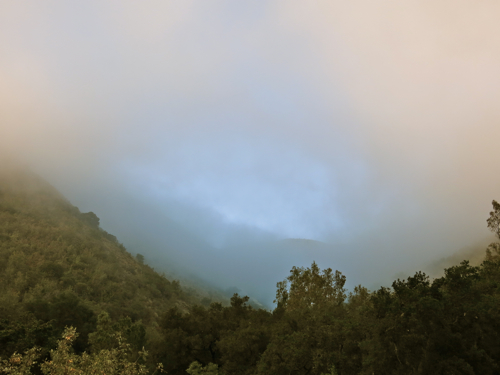
This afternoon, we went for a walk at Purissima Creek Redwoods Open Space Preserve in the Santa Cruz Mountains southwest of San Mateo. It was a stunning afternoon, warm but not too hot, with fog beginning to roll in up the canyons from the ocean.

As we hiked down into the preserve, we kept hearing a hawk screaming somewhere in the distance, but we never saw it. And then when we were hiking back up to the parking lot, there it was overhead: an accipter flying over the ridge we were on, then turning and riding the breeze coming up the canyon to our right. And what kind of accipter was it, a Cooper’s Hawk or a Sharp-shinned Hawk? I’d say it was perhaps a little larger, the neck a little longer, the tail a little more rounded, the wingbeats a little more deliberate: probably a Cooper’s Hawk, but I’m not good enough at field identification to be sure. It wheeled around, high above the canyon floor but at eye level for us; a couple of Band-tailed Pigeons came over the ridge, saw the accipter, and quickly ducked into the trees below us. Then the fog rolled up the canyon, and it was gone.

As we continued up the trail, Carol got about a hundred feet in front of me. Suddenly we both froze: walking the trail well up the hill in front of us was a dog-sized canid: a Gray Fox, its long tail behind it, its head turning from side to side, giving us a flash of the rufous fur up the side of the neck. It didn’t seem to notice us; it was busy watching the undergrowth on either side of the trail, and at least once it pounced at something.

We got back to the car a little after seven, and decided to go down to the beach to eat dinner. It was a beautiful foggy evening, and we walked along past Heerman’s and California Gulls, but the real attraction of the beach was the Velella velellas. When I was reading up on this species last night, I found a Web page by Dr. David Cowles that gave a possible reason why so many Velella velellas have washed up on northern California beaches:

“The angled sail makes it sail at 45 degrees from the prevailing wind. Some have a sail angled to the left, others to the right. Off California the right-angled form prevails, and these remain offshore in the prevailing northerly winds. Strong southerly or westerly winds, however, may bring huge aggregations ashore.”

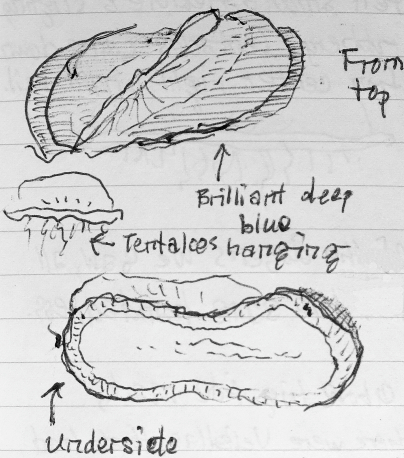
We walked down the beach, making an unscientific survey: of the dozens of individuals we saw — ranging in size from less than two inches long to one that was as long as my notebook or approximately four inches (10 cm) long — all the sails had the same handedness (according to Dr. Cowles’ terminology, right-angled sails). Here’s a sketch from my notebook:
BlogAug0214

I picked one up by its sail to look at the tentacles hanging down underneath. The velellas, like the fox and accipter, are predators, feeding on smaller organisms with their dangling tentacles. The tentacles seemed to descend from the central oval, and were of varying lengths. The sail itself felt smooth, flexible, and slightly rubbery; I dropped it back into the waves after I had looked at it.

Three very different predators — but each one a fabulously beautiful organism.
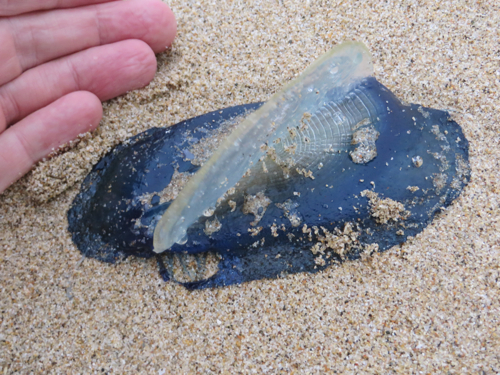
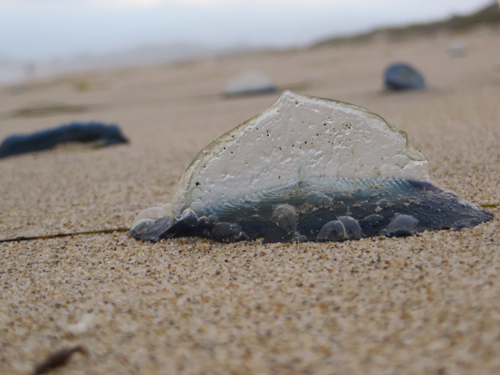
Velella velella

My cousin and her husband were visiting from Seattle, and she wanted to go to the beach to see the sun set in the Pacific. So Carol and I and the two of them drove over the Coastal Range to Half Moon Bay.

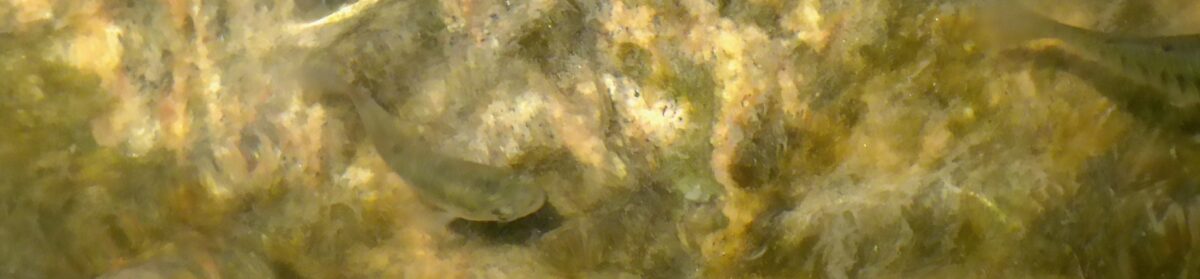
“Maybe we’ll see the velellas,” said Carol. The velellas — scientific name Velella velella — are small bright blue creatures that are distant relations of the jellyfishes. They float on the surface of the ocean, feeding underneath the water with tiny tentacles, and being blown about by the wind on their small sail. Recently, hundreds of them have been blown up along the shore in San Francisco and Santa Cruz and Humboldt County. But I was skeptical that we’d see velellas, since I had seen nothing about them being blown onto beaches in San Mateo County.

When we got to the beach, the fog was so thick it was obvious that we weren’t going to see the sun set in the Pacific. But Carol said, with a big grin, “Look, the velellas!” Sure enough, all over the beach just above the line of waves, were these little blue things. The biggest one I saw would fit easily in my hand.

BlogAug0214a

When you got down and looked at them closely, they were beautiful and amazing creatures. The San Francisco Chronicle interviewed Jim Watanabe, who works at the Hopkins Marine Station in Monterey County; the newspaper quotes him as saying, “They’re a nice reminder of the diversity of other life in the sea that we sometimes don’t think about.”

BlogAug0214b

The velella turns out to be a highly interesting organism that is not particularly well understood, as this Web page from Walla Walla University points out.

New Jersey

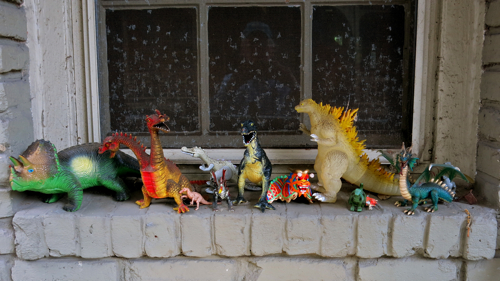
E and her sweetheart and Carol and I spent the morning in Lambertville, New Jersey, a town where people have front porches that come right to the edge of the sidewalk. Some of the porches feature interesting decorations; one porch featured a collection of plastic dinosaur and dragon toys.

BlogJul0314b

Above: Lambertville, New Jersey

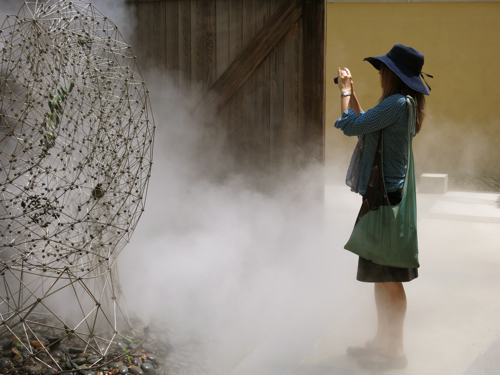
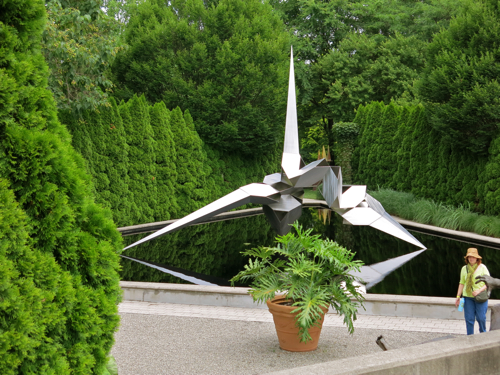
Then we went to Grounds for Sculpture, a sculpture park in Hamilton, N.J. Not only did we see some very fine work by a wide range of contemporary artists, but I felt the grounds were particularly well-designed to display sculpture.

Grounds for Sculpture

BlogJul0314c

Above two photographs: Grounds for Sculpture, Hamilton, N.J.

We were also able to get a brief tour of the Johnson Atelier, a sculpture foundry next door to Grounds for Sculpture. I once worked for a sculptor who cast work at the Johnson Atelier, but I wasn’t part of the in-crowd so I never got to go along when he was casting work there. The Johnson Atelier no longer pours molten metal, but they do everything else involved in the founding process: enlarging, mold-making, chasing and finishing, applying patina, etc.

The Johnson Atelier leases part of their space to the Digital Atelier. They do highly accurate laser scans of three dimensional objects, modify the scans as necessary in CAD software (enlarging, fixing problems, etc.), then produce a 3-D product in foam (which can then be cast in bronze or another metal) or wood using a CNC milling machine. I asked the man who gave us the tour of the Digital Atelier about 3D printing, and he said 3D printers could not yet work at the large scale they needed, he was watching the technology closely.

The technology of sculpture has come a long way since I worked for the sculptor.

Flower

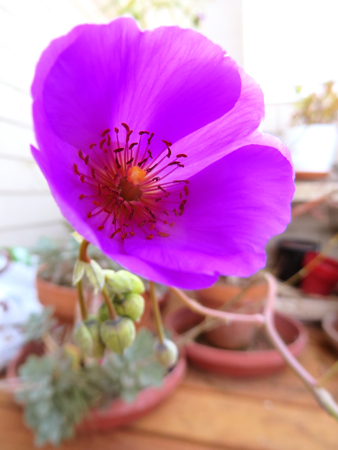
A couple of years ago, Carol discovered the Really, Really Free Market which meets on the first Sunday of the month in Redwood City. The first time she went there, she got some rubber stamps and a couple of potted succulents which bloom at the tail end of the winter wet season. The plants produce small vividly pink flowers on astonishingly long stalks — the plant is all of ten inches high, the stalk extends twenty-four inches from the nearest leaf to the farthest blossom, and each blossom is an inch to an inch and a half in diameter. The flower in the photo is one of sixteen buds or blossoms or seed pods on one of the stalks. Each blossom seems to last a day or two before it fades, and then another bud near it comes into bloom.

Close-up of flower

Today, the day after Mother’s Day, would have been my mother’s ninetieth birthday; I’m pretty sure the flower I photographed was in bloom yesterday, so its blooming will cover both these days.

Sutra

The headlines on today’s newspaper screamed: “U.S.CLIMATE HAS ALREADY CHANGED, STUDY FINDS, CITING HEAT AND FLOODS” [New York Times, 7 May 2014, p. A1]. This is news because we didn’t already know what this report, the National Climate Assessment, is telling us. A related story tells us that “Polls Find Americans Skeptical On Climate” [ibid., p. A13]. And why? “Scientists predict that climate change will cause larger problems for poor countries than rich ones….” And the U.S. is way ahead of all other countries in per person emissions of climate-changing gasses.

Smokey the BearThis is human nature: the ones who are causing the problem are least likely to be affected by the problem, so they believe they are not causing the problem. The minority of U.S. citizens who are aware of the magnitude of the problem attempt to convince other U.S. citizens of the truth with rational arguments, but since when did humans change their behavior as a result of rational argument?

No, it is time to call on a higher power. One of the growing problems caused by climate change is the increased incidence of forest fires, and so we immediately know on whom we must call. We will follow the example set by poet Gary Snyder in 1969. Both Buddhists and non-Buddhists, both those who follow the circumpolar Bear cult and those who don’t, should call on the Boddhisattva of Compassion Avalokitesvara — who is also Kamui Kimun of the Ainu — who is also a consort of She Who Saves, Boddhisattva Tara, Mother of Liberation — who is he who carries the vajra-shovel.

Abandon rational argument, and chant together:

Smokey the Bear Sutra

Once in the Jurassic, about 150 million years ago, the Great Sun Buddha in this corner of the Infinite Void gave a Discourse to all the assembled elements and energies: to the standing beings, the walking beings, the flying beings, and the sitting beings—even grasses, to the number of thirteen billions, each one born from a seed—assembled there: a Discourse concerning Enlightenment on the planet Earth.

   “In some future time, there will be a continent called America. It will have great centers of power called such as Pyramid Lake, Walden Pond, Mt. Rainier, Big Sur, Everglades, and so forth, and powerful nerves and channels such as Columbia River, Mississippi River, and Grand Canyon. The human race in that era will get into troubles all over its head, and practically wreck everything in spite of its own strong intelligent Buddha-nature.”

   “The twisting strata of the great mountains and the pulsings of volcanoes are my love burning deep in the earth. My obstinate compassion is schist and basalt and granite, to be mountains, to bring down the rain. In that future American Era I shall enter a new form, to cure the world of loveless knowledge that seeks with blind hunger, and mindless rage eating food that will not fill it.”

   And he showed himself in his true form of

         SMOKEY THE BEAR.

Continue reading “Sutra”