Water striders

BlogJun1815

This afternoon, I went walking up Purisima Creek Trail, off Higgins Canyon Road in Half Moon Bay. Purisima Creek flows down through a canyon in which grow Coastal Redwoods. It’s a perennial stream, but at this time of year the water is only a few inches deep. I was curious to see if I could find any organisms living in the creek.

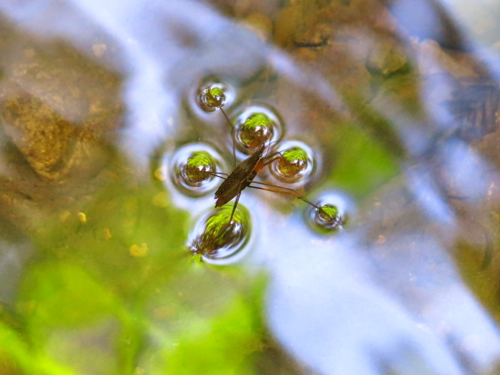
The first organism I saw was a water strider, probably Aquarius remigis, Common Water Strider; in a half an hour of walking along the creek, I saw dozens of these water striders, in sizes ranging from tiny (I was barely able to see them) up to an inch or so long. They were mostly quite aware of my presence, and if I moved too quickly, or got too close to fast, they would skate away from me over the surface of the water. The only other organism I saw in the stream was a Banana Slug, which had somehow gotten to a rock in the middle of the stream; it was mostly out of the water.

But I didn’t see anything else living in the water. Most of the plants I saw grew on the steep banks at least half a foot from the water, and my guess is that the bottom of the stream bed gets well-scoured when water comes pouring down the creek after winter storms; any plants that manage to take root there in the summer get torn away in winter. Nor did I see any other insects, crustaceans, amphibians, or other animals living in the stream; though I suspect there are other animals in the stream. I did see several hatches of small insects dancing in a cloud a few feet above the stream; did they hatch from the water? do their nymph forms live in the water? I’ve seen California Newts (Taricha torosa) in this area; I would guess some of these newts breed in this stream, the largest stream in the vicinity, and that the tadpoles must therefore live in the stream for a time.

But today, the only organisms I saw in the stream were the water striders.

Dawn, Black Mountain

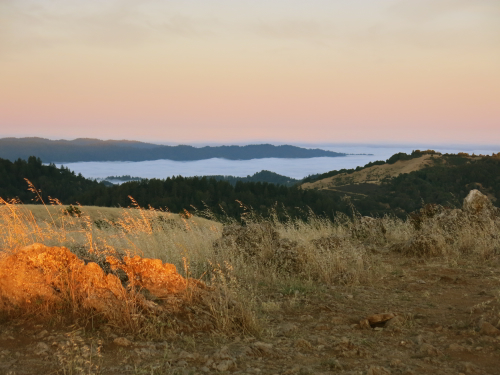
Standing on the top of Black Mountain this morning at about 5:45 a.m. and looking west, I could see the fog in the valleys below:

BlogJun1715

Where I was standing was about 2,812 feet above sea level; I’d guess that the top of the fog was about half that height, perhaps 1,500 feet high.

The view to the east was even more spectacular: the sun just peeking over the 4,000 foot high Hamilton Range, and the entire Santa Clara Valley covered with a blanket of fog — or, more precisely, covered with a layer of stratus clouds the tops of which were about 1,500 feet high, and the bottoms of which were probably about 500 to 1,000 feet above sea level. It was funny to think that there were ten million people down there under the fog who were enjoying a cool, cloudy, grey morning, while I was looking up at a cloudless sky and wondering where in my backpack I had put my sunscreen.

Obscure Unitarians: Mary and George Rosebrook, pioneers

Mary Frances (Greer) Rosebrook, and George H. Rosebrook, lived a pioneer life in Oregon before settling in Palo Alto in 1892. Mary Frances (known as “Fannie” at the time) traveled the Oregon Trail in 1852, when she was 6 years old, with her parents and siblings. George married Fannie in 1882, the same year he received a patent for a homestead farm in the Willamette Valley.

Here are brief biographies of Mary and George:

ROSEBROOK, MARY FRANCES GREER — Over the course of her life, she went by Frances, Fannie, and (after 1900) Mary.

She was born Jan., 1846, in Missouri; her parents, James and Margaret, were both from Ireland, where they were married in 1832. James went to the California gold fields in 1850, where he heard about Oregon; in 1852, James and Margaret took their family, including Fannie, on the Oregon Trail; a quilt that Margaret had made in 1840, and which came with them on the trail, may be seen in the book Quilts of the Oregon Trail (Mary Bywater Cross, 2007, p. 68). The family settled in Kings Valley, Ore., in Sept., 1852, and there James worked as a farmer.

“Fannie” married George H. Rosebrook on Apr. 12, 1882, in Polk, Oregon. She and George had no children together, although George had one child by a previous marriage. They moved to Palo Alto in 1892.

Mary was a member of the Palo Alto Woman’s Club. She was active in the women’s suffrage movement, and served as treasurer for the 1907 Annual Convention of the California Equal Suffrage Assoc. (Western Woman, vol. 1, no. 14, Oct. 1907 [San Francisco], p. 12).

Mary was one of the charter members of the Unity Society in 1896, a lay-led Unitarian group gathered by Rev. Eliza Tupper Wilkes, and she served on the Committee on Executive and Finance. Then in 1905, she became one of the earliest members of the Unitarian Church of Palo Alto. She joined the Women’s Alliance in about 1905. She also served in other leadership roles in the church.

She died after 1920.


ROSEBROOK, GEORGE H. — He was born Oct., 1846, in Gouldsboro, Maine. He married Margaret A. Graham, Sept. 9, 1874, and they had one son, Joseph Wilton (Benton County [Ore.] Genealogical Society, www.chateaudevin.org/bentongs); Joseph was born May, 1876, in Oregon. By 1880, George was widowed and living “in [a] Lighthouse” (1880 U.S. Census) in Newport, Oregon, with his son Joseph and his mother Mary A.

George was issued a patent for 150 acres of land for a homestead near Willamette, Ore., on Apr. 10, 1882 (Benton Cty. Gen. Soc.). He married Fannie (Mary Frances) Greer on Apr. 12, 1882. He and Fannie came to Palo Alto in 1892; once in Palo Alto, he became a carpenter who built a number of houses, including a house he built for himself and Mary F. in 1893, at 225 Emerson St. (Historic Buildings Inventory, City of Palo Alto, 1978).

George’s son, Joseph, also moved to Palo Alto. He attended Stanford briefly in 1897. He became a builder like his father, married a Presbyterian in 1900 (Palo Alto Times, June 22, 1900); Joseph appears never to have gotten involved with the Unitarian Church.

George’s wife Mary was part of the Unity Society of Palo Alto in 1895-1897; George may have been, too, but almost no records of that early Unitarian group survive. George was one of the early members of the Unitarian Church of Palo Alto, probably joining in 1905. He served on the Board of Trustees of the church.

He died before 1920.

Nesting colonies

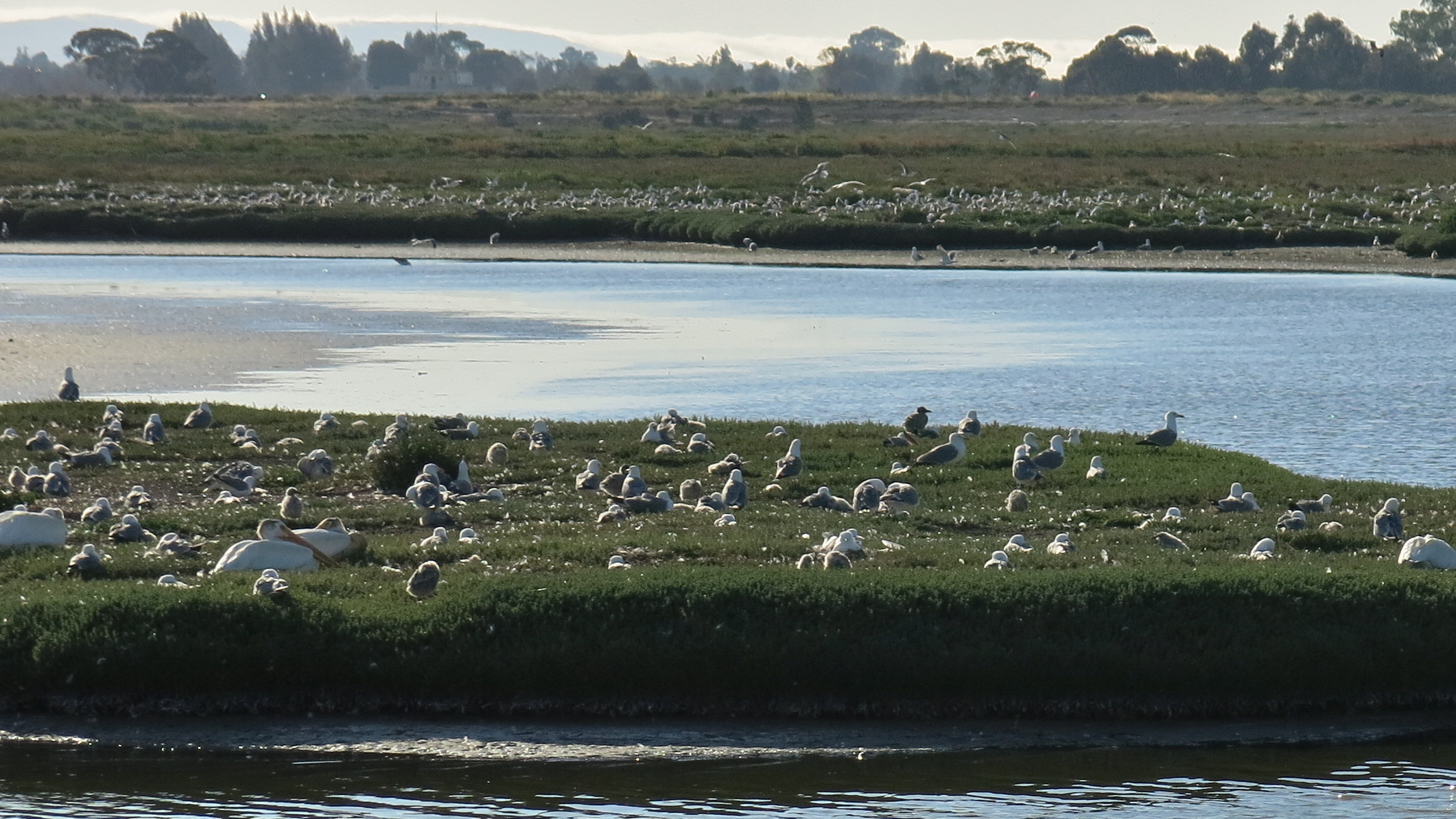
It’s nesting season, and this afternoon I managed to take some time out of a busy day to visit two nesting colonies. The first one I visited was the California Gull nesting colony at Baylands Nature Preseve in Palo Alto.

IMG_2858

The gull chicks still have their downy feathers, but they are looking pretty big, about three quarters the size of the adults. A few White Pelicans sat along one edge of the colony, seemingly ignoring the gull chicks stumbling around near them.

From there, I drove over to Mountain View where there is an egret nesting colony along a street lined with corporate offices. The only nests I saw had Snowy Egrets on them; but I also saw Great Egrets and a Black-crowned Night-heron, along with the usual suburban passerines. The nests look like Great Blue Heron nests, untidy piles of twigs jammed into tree crotches; and just as with heron nesting colonies, it’s strange to look up thirty feet in the air, and see birds that you’re used to seeing stalking through swamp water.

The sounds coming from the nesting colony were varied and interesting. It turns out egrets make a wider variety of sounds than do Great Blue Herons, everything from raucous cries like you’d imagine a dinosaur would make, to low burbling noises not unlike you might hear at a gull nesting colony.

Definitely a pleasant break in an otherwise too-busy day!

Obscure Unitarians: the Rendtorff / Meyer family

Karl and Emma E. Rendtorff were two of the key leaders of the old Unitarian Church of Palo Alto (1905-1934). Emma’s mother and sister happened to be living in Palo Alto 1905-1908, and also got involved with the church. With baby Gertrude, there were thus three generations of Meyers/Rendtorffs involved with the founding of the church.

Palo Alto was a small town, with a population of 4,486 in 1910; 5,900 in 1920 (Sawyers, History of Santa Clara County, California, 1922). The town really wasn’t big enough to support a Unitarian church, and I suspect the church never got bigger than what Arlin Routhage calls “family-size” — that is, a small church that acts more like a family, with matriarchs and patriarchs. I further suspect that Karl and Emma E. Rendtorff were two of the matriarchs/patriarchs. Their extended family is of interest for this reason alone.

But their extended family is also of interest because of the characteristics they share with so many other members of the church. Karl and Emma both spoke German, and both were associated with Stanford; as was true of many members of the church. Karl was trained as a librarian, and there were at least half a dozen other librarians who were part of the congregation; he was a pacifist, and there were many other pacifists in the congregation. Emma was a woman with a college degree in an era when that was uncommon, and she was an experienced teacher; many other women in the congregation also had college degrees, and some were experienced and dedicated teachers (like her sister and daughter).

Without further introduction, here are brief biographies of the Rendtorff / Meyer family, three generations of five fascinating people who were part of the Unitarian Church of Palo Alto: Continue reading “Obscure Unitarians: the Rendtorff / Meyer family”

Obscure Unitarians: Melville B. Anderson

Melville Best Anderson was born in Kalamazoo, Michigan, in 1851. He studied at Cornell University in 1870-72, where he was a classmate of David Starr Jordan, who became president of Stanford University.

Melville Anderson received his A.M. from Butler University in 1877, and taught there for the next three years; he was then professor at Knox College, 1881-1886; Purdue University, 1886-1887; University of Iowa, 1887-1891; and finally, professor of English at Stanford University, from 1891 until his retirement. He was a charter member of both the Unity Society and the Unitarian Church of Palo Alto. He married Charlena Van Vleck April 27, 1877; she received her A.B. at Lawrence University in 1874. They had four children: Balfour (1878-1895); Malcolm Playfair (b. 1879, A.B. Stanford ’04); Gertrude (1883-1892); Robert (1884-1949, A.B. Stanford ’06).

Anderson was a distinguished scholar best known for his translation La Divina Commedia: The Divine Comedy of Dante Alighieri, a Line-for-Line Translation in the Rime-form of the Original (Yonkers-on-Hudson, N.Y., World Book Co., 1921). He became friends with Ewald Flügel in 1891, while staying in Leipzig. Flugel joined the faculty of Stanford partly through the good offices of Anderson; and Flugel was another one of the early members of the Unitarian Church of Palo Alto. Unfortunately their differing viewpoints on the First World War put a damper on their friendship; Flügel was a pacifist, while as early as 1916, Anderson advocated for the entry of the United States into the First World War in a long self-published poem; one stanza will suffice to give a sense of the dreary whole:

Since men first gathered into clans
    Was peril never yet so sharp;
    Loud would I smite the chorded harp:
    Awake! awake! Americans…

The Stanford Daily, vol. 49, no. 48, Nov. 2, 1916, p. 3, said: “The poem, which is a denunciation of the apparent apathy of Americans in regard to the issues of the great war, was dedicated to David Starr Jordan, and written during Anderson’s stay in Florence, Italy, where he has been translating in triple rhyme ‘The Divine Comedy’ of Dante.”

Anderson died on June 22, 1933.

Obscure Unitarians: John Merton Aldrich

Update, 14 Nov. 2025: See my new, expanded biography of John Merton Aldrich.

John Merton Aldrich was born Jan. 28, 1866, in Olmsted County, Minnesota, and went to school in Rochester (where there is a Unitarian church founded in 1866). He graduated from South Dakota State University in 1888, and received his M.S. there. In 1893, John founded the Department of Zoology at the University of Idaho. He married Ellen Roe of Brookings, South Dakota, and they lived in Moscow, Idaho.

After four years of marriage, his wife and infant son died, and he lost himself in his researches on insects of the order Diptera, or true flies. On June 28, 1905, he married Della Smith of Moscow, Idaho. He then took a year of sabbatical leave, went to Stanford University to study, and received his Ph.D. in May, 1906. While at Sanford, he was active in the formation of the Unitarian Church of Palo Alto.

One of the pre-eminent entomologists of his day, he became Associate Curator and Custodian of Diptera at the Smithsonian Institute, Washington, D.C., and became a member and trustee of All Souls Unitarian Church in Washington. He died May 7, 1934, just before setting out on a collecting trip to the West Coast.