D-Day

Today is the seventieth anniversary of D-Day, the invasion of Nazi-controlled Normandy by Allied forces.

My dad was a ground-based radio operator in the 437th Troop Carrier Group. An article on the U.S. Air Force Air Mobility Command Web site — “437th Airlift Wing honors its history,” written on the occasion of the last reunion of the 437th TCG in 2012 — tells a little about what the 437th did on D-Day:

“The 437th TCG, flying C-47 Skytrain transport units, played a vital role during the early morning hours of D-Day, June 6, 1944, and the remainder of World War II. During the Normandy campaign, the group towed and released glider planes, as well as carried troops, weapons, ammunition, rations and other supplies for the 82nd Airborne Division.” (More history of the 437th is available on this military history Web page.)

Radio operators like Dad provided a communication link to the C-47s flying missions, including high-frequency (HF) radio direction finding assistance. Although strict radio silence was observed at the beginning of each of the four missions flown during the D-Day actions, on the return trip, planes that were in trouble could radio in and ask for a bearing to help them return to the airbase.

Dad said the 437th TCG began flying before midnight on D-Day, dropping paratroopers at Sainte-Mère-Église. Later during the invasion, the 437th TCG also towed gliders full of troops. Something on the order of a hundred planes flew each mission on D-Day. When he wasn’t on duty as a radio operator, Dad said he stood out on the flight line, counting the planes that were in formation waiting to land, seeing how many made it back. The 437th TCG only lost a few planes; by contrast, the 434th TCG lost something like half its planes.

According to the “Friends of the WW2 437th Troop Carrier Group” Facebook page, a couple of former members of that unit are in England right now for the 70th anniversary of D-Day — you can see pictures on the Friends of 437th TCG Facebook page.

The other May Day

Around the world, except in the United States, May Day is International Workers Day. This is odd, because May Day commemorates something that happened in the United States.

On May 1, 1886, some 350,000 workers went out on strike across the U.S., although the strike was centered in Chicago, where 80,000 workers marched along Michigan Avenue. This May Day strike was the culmination of a movement to obtain an eight-hour day for workers. All the railroads that went into Chicago, the major rail center in the country, stopped running. Many industries through the U.S. were paralyzed.

Generally speaking, the May 1 strike was peaceful. But on May 3, there was violence at the McCormick Harvester plant in Chicago. The workers there had been shut out of the plant, and scabs brought in. The workers were holding a rally outside the plant when police charged them, shooting into the crowd and killing six.

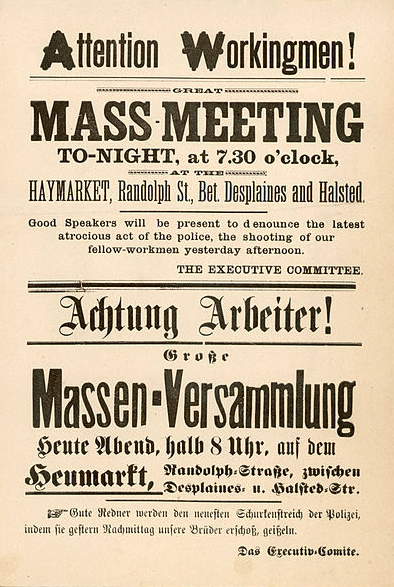
Bilingual 1886 May Day posterThe violence escalated the next day, May 4, at rally in Haymarket Square in Chicago, that was called to protest the violence at the McCormick plant. The mayor of Chicago attended the rally, and there were hours of peaceful speeches by labor leaders. Late in the evening, the police decided to march into Haymarket Square and order the crowd to peaceably disperse. The leaders of the rally pointed out that were already peaceful. At this point, someone threw a bomb. Later, the newspapers and the city government, all of whom had an anti-labor bias, claimed that the rally’s organizers must must be held responsible for the bombing, though there was no evidence linking them to it.

Eight organizers of the labor rally, although seven of them weren’t even present at the time of the riot, were arrested on charges of murder. Civic leaders and the newspapers whipped up public sentiment against the eight organizers. Since many of the workers involved were immigrants, much of the media’s ire was directed at “foreigners.” No one seems to have mentioned the fact that the police marched on a peaceful political assembly, something that is supposedly protected by the First Amendment of the U.S. Constitution.

All eight organizers of the rally were convicted, and seven of them were condemned to death. One of these last committed suicide in his cell, and three more were hanged. Almost a decade later, then-governor of Illinois John Peter Altgeld issued pardons for the four dead organizers and the three still living, saying “The proceedings lost all semblance of a fair trial.”

In the years after the 1886 events, May Day came to be celebrated internationally as a day to celebrate workers’ rights. We still don’t celebrate International Worker’s Day in the United States, but as you dance around the Maypole dances, or sing your Beltane carols, or as you attend the occasional May 1st rally for immigrants’ rights — it’s worth remembering the other May Day.

(N.B.: In the image of the poster announcing the rally in Haymarket Square, notice that it is bilingual, in German and English, reflecting the fact that many workers were immigrants.)

Better easy bubble juice recipe

Back in 2012, I posted an easy bubble juice recipe for making soap bubbles 9-12″ in diameter. Here’s a better easy bubble juice recipe, which uses easily obtainable ingredients, and features a superior mixing procedure for the lubricating jelly. With this mixture, I’ve made bubbles that start out at 4-5 feet long tubes, then stabilize into two or more spheroids up to 30 inches in diameter. The glycerin isn’t absolutely necessary, but it does seem to make the bubbles last a bit longer, an important point in our dry Bay area climate.

Ingredients:
4 oz. tube of personal lubricating jelly (store brand is fine)
2 oz. container of glycerin
12 oz. of Dawn Ultra dishwashing liquid (do not substitute another brand)
water to make up about 1 gallon
Total cost: $12-15

Method:

Put 3 quarts of water in a gallon container. Continue reading “Better easy bubble juice recipe”

What we do at committee meetings

One of the things we do in committee meetings in our congregation is we wind up talking about other subcultures of which we are a part. Beth, for example, is part of the autoharp subculture. And, said Beth, one of the things they sometimes do at autoharp conventions is they have an autoharp toss. What’s that? we asked. That’s when you take an old autoharp that’s beyond repair, and see how far you can toss it. So we interrupted committee business to watch a Youtube video of autoharp tossing….

Autoharp Toss

When I showed this video to Carol, my partner, she thought it was silly. She’s obviously not a sports fan.

Happy (belated) National Adoption Day

Yesterday was National Adoption Day, a day to celebrate those people who adopt children for all the right reasons. I’m thinking especially of M. and O. who are in the adoption process right now. Adoption can be a long process, with lots of bureaucratic hurdles. All those hurdles are designed to protect the interests of the children, but they sound like very challenging hurdles to me. I have a lot of admiration for those good-hearted adults who are willing to jump those hurdles, and welcome deserving children into loving homes.

So here’s to you, adoptive parents!

A clear causal chain

I did not follow the World Series.

I wore my Hebrew Red Sox cap during the Series.

Ergo:

The Red Sox won the World Series.

You can talk all you want about there being a big difference between correlation and causality. I know better.

The Red Sox won because I did not follow the Series, and because I wore my Hebrew Red Sox cap during the Series. I know that there is a direct causal link, because the world revolves around me.

Red Sox clergy

What’s the well-dressed clergyperson from Red Sox Nation wearing today? Well, obviously it depends on which faith tradition you’re part of. Since I’m from a faith tradition that requires Biblical knowledge in its clergy, an obvious choice for me is some kind of Red Sox garb in a Biblical language. No, not Koine Greek — that message of loving your enemies is not a good fit with the World Series. The teleology of Revelation is not exactly the kind of thing I’m looking for either. Definitely not Koine Greek.

Hebrew, on the other hand — the language of Moses and the story of the journey to the Promised Land — and, in case the Sox lose, the language of Jeremiah — Hebrew strikes me as a good Biblical language for Red Sox clergy. So today I’m wearing the hat that my friend the rabbi gave to me:

BlogOct2813

Yeah. Go, Sox!

Shareable economy

“Shareable economy” and “the new mutualism” are new and trendy terms for new-fashioned things like bikesharing programs, coworking, hacker spaces, etc. — and also names for old-fashioned things like public libraries, public parks, credit unions, co-ops, etc.

Two blogs on the shareable economy that seem worth reading:

Shareable

OuiShare

Both blogs encourage social entrepreneurship. Both blogs look beyond North America to Europe, South America, Australia, and beyond. Not sure I’d read either blog on a regular basis, but both are worth looking at for ideas at least once.

The real America

In his 1994 introduction to his 1981 novel Hello, America, J. G. Ballard writes: “The United States has given birth to most of our century’s dreams, and to a good many of its nightmares. No other country has created such a potent vision of itself, and exported that vision so successfully to the rest of the world…. Whenever I visit the United States I often feel that the real ‘America’ lies not in the streets of Manhattan or Chicago, or the farm towns of the mid-west, but in the imaginary America created by Hollywood and the media landscape.”

The real America is the imaginary America which is presented in pop culture; this makes sense to me. And this raises a question for me: should religion accommodate to this imaginary America, as for example Rick Warren and his version of the prosperity gospel do? — or should religion take pains to point out that the “real America” is really an imaginary America? — or should religion ignore altogether the problems caused by the imaginary America being the real America? Or put more starkly: should religion resist pop culture, or embrace it?