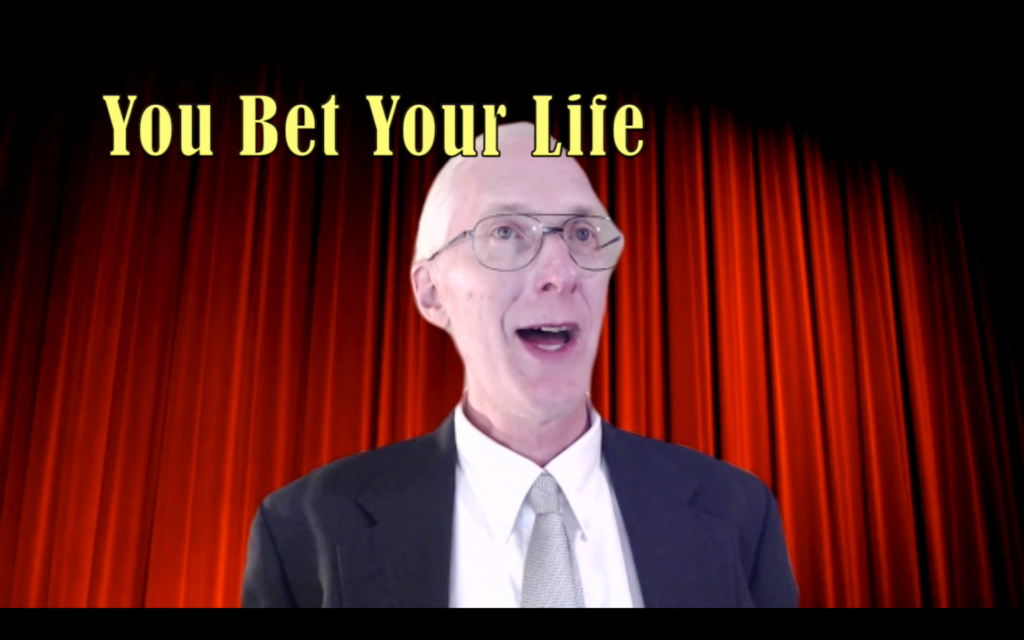
The second installment of the Contestants on a Game Show! video series:
Yet Another Unitarian Universalist
A postmodern heretic's spiritual journey.

The second installment of the Contestants on a Game Show! video series:
The first installment of the Contestants on a Game Show! video series:

Just in time for Independence Day, here’s a song about how nobody tells me what to do:
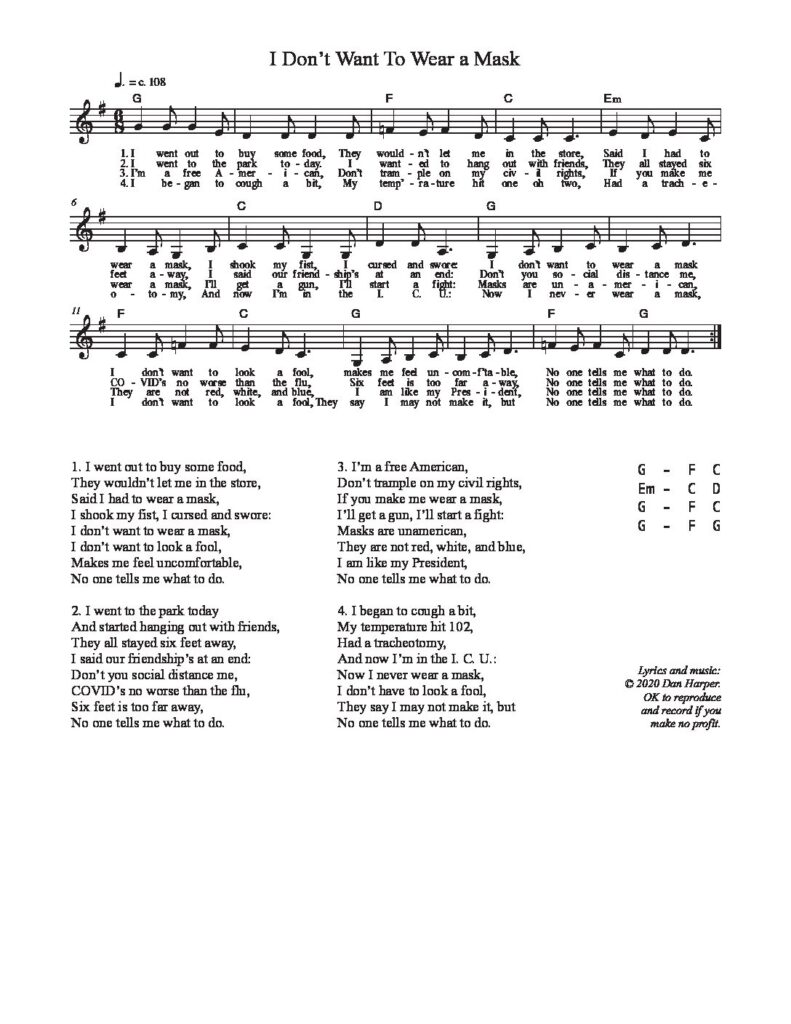
1. I went out to buy some food,
They wouldn’t let me in the store,
Said I had to wear a mask,
I shook my fist, I cursed and swore:
I don’t want to wear a mask,
I don’t want to look a fool,
Makes me feel uncomfortable,
No one tells me what to do.
2. I went to the park today
And started hanging out with friends,
They all stayed six feet away,
I said our friendship’s at an end:
Don’t you social distance me,
COVID’s no worse than the flu,
Six feet is too far away,
No one tells me what to do.
3. I’m a free American,
Don’t trample on my civil rights,
If you make me wear a mask,
I’ll get a gun, I’ll start a fight:
Masks are unamerican,
They are not red, white, and blue,
I am like my President,
No one tells me what to do.
4. I began to cough a bit,
My temperature hit 102,
Had a tracheotomy,
And now I’m in the I. C. U.:
Now I never wear a mask,
I don’t have to look a fool,
They say I may not make it, but
No one tells me what to do.
Update July 8: Revised music and lyrics.
Shaun Bythell, a used bookseller in Scotland, has made a video showing how to repair a Kindle:
[SPOILER ALERT]
Here’s my favorite still from the video:

We already know that friends don’t let friends buy books from Amazon — Amazon’ s business practices have reduced author income while reducing the profitability of bookstores to a razor-thin margin. Friends certainly don’t let friends buy Kindles, because they don’t want their friends being tracked by Amazon — no one needs a faceless multinational corporation learning exactly how much of every book you read, and what you underline in your book, and what color your underwear is.
A good friend will tell their friends to buy their new books from a place like the Seminary Coop Bookstore, or used books from a place like Powell’s (but not from ABE, it’s owned by Amazon), or if you’re in the U.K. from Shaun Bythell’s The Bookshop — or better yet, buy your books from your local bookseller, so they don’t go out of business.
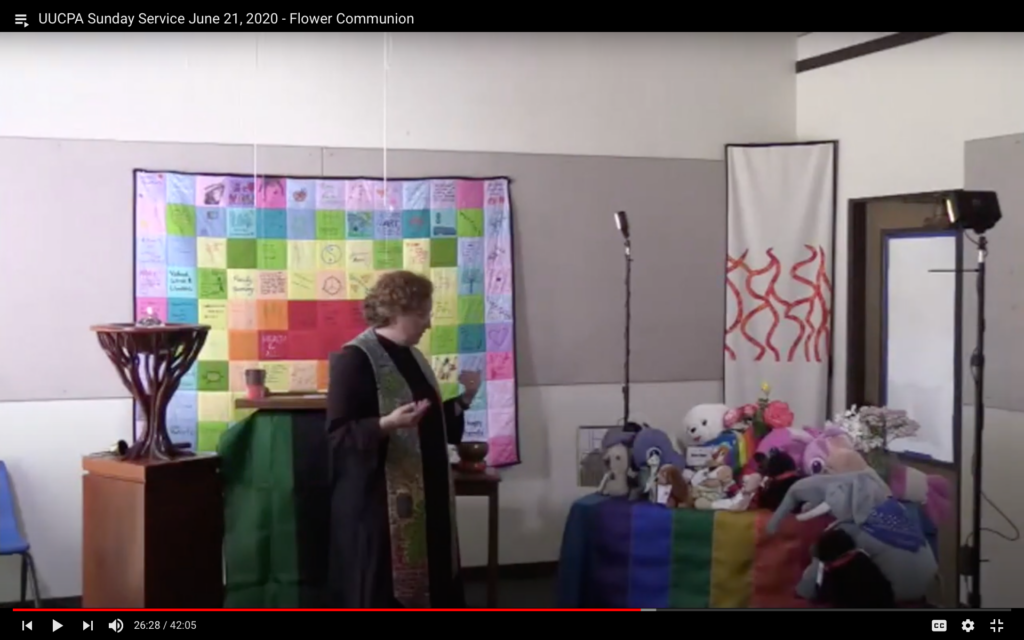
The stuffies who were staying on the Stuffed Animal Sleepover appeared in the worship service today, and participated in the Flower Communion. Here’s a photo of the senior minister, Amy Morgenstern, welcoming the stuffies to the service:
A group of Christian evangelicals have published a book titled “The Spiritual Danger of Donald Trump.” In an interview with Religion News Service, the editor, Ronald J. Sider, founder of Evangelicals for Social Action, answers the question, “So what is the spiritual danger of Donald Trump?”
“I would summarize it this way [Sider says]: Trump lies constantly. He has repeatedly demonstrated adulterous sexual behavior. He fails to make justice for the poor a concern in his policies. He constantly stokes white racism. His response to COVID-19 was dreadfully weak in the first couple of months. His position on climate change is simply disastrous. And his constant attacks on the fake media undermine democracy.”
Most Unitarian Universalists don’t like Donald Trump, but rarely do we speak about why he is a spiritual danger; mostly we focus on why he’s a political danger. I’m obviously not an evangelical Christian, and therefore not the target audience for Sider’s book or his remarks, but I think this summary of Trump as a spiritual danger is spot-on.
Another interesting point Sider makes in this interview is in response to the question of why white evangelicals supported Trump so strongly in 2016. A part of Sider’s response is particularly relevant to Unitarian Universalism:
“It’s partly because, let’s be honest, there’s a left wing fundamentalism as well as the right wing fundamentalism. And there’s a part of the liberal wing of the Democratic Party, which is really, I think, hostile to Christianity and certainly to evangelicalism. White evangelicals feel that, and don’t like it.”
This describes too many Unitarian Universalists: we can indeed come across as left wing fundamentalists who refuse to acknowledge that intelligent people can disagree with us on religious issues. For example, there are Unitarian Universalists who are convinced that global climate change is one of the top two or three most pressing issues facing humanity, who claim they’ll do everything they can to arrest global climate change, yet who are condescending and dismissive when they hear the term “creation care.”
There is no doubt that Donald Trump represents a pressing spiritual danger: he’s a liar, a racist, a misogynist, and he’s going to let the world go up in flames. It would be wise for us Unitarian Universalists to figure out how we can work effectively with all those who want to stop this clear and present spiritual danger.
It has been very interesting to listen to Donald Trump respond to the protests following the lynching of George Floyd by Minneapolis police officers: Trump has made calls for “law and order.” For anyone who remembers Barry Goldwater or Richard Nixon, in the not-so-distant past a call for “law and order” was code for using police to keep African Americans in their place. But that history goes back before Goldwater and Nixon, as is made clear in this excerpt from “O Say Can You See,” the blog of the National Museum of American History:
“William J. Simmons, a former minister and promoter of fraternal societies, founded the second incarnation of the Ku Klux Klan in Georgia in 1915. His organization grew slowly, but by the 1920s, Simmons began coordinating with a public relations firm, in part to chip away at the (accurate) perception that the Klan was an outlaw group involved in extralegal violence. Membership in the Klan exploded over the next few years. As part of this PR campaign, Simmons gave an interview to the Atlanta Journal newspaper in January 1921. While explicitly advocating white supremacy, Simmons played up his group’s commitment to law and order … and even boasted of his own police credentials. He claimed members at every level of law enforcement belonged to his organization, and that the local sheriff was often one of the first to join when the Klan came to a town. Ominously, Simmons declared that ‘[t]he sheriff of Fulton County knows where he can get 200 members of the Klan at a moment’s call to suppress anything in the way of lawlessness.'”
This blog post ends with a pertinent question in Latin, “Quis custodiet ipsos custodes?” Here’s my free translation of this phrase: “Who will police the police?”
As reported by Religion News Service: Breonna Taylor, a black woman, was killed by police on March 13, yet…
“‘Despite the number of unarmed Black women killed by police or who have died under police custody under suspicious circumstances, none of them, with the exception of maybe Sandra Bland, has brought a lot of widespread attention, whereas consistently we see that men get more attention,’ said Dr. Chanequa Walker-Barnes, womanist theologian and associate professor of pastoral care and counseling in the McAfee School of Theology at Mercer University.”
Why is this so?
“‘Black women are often romantically imagined. We are “warriors.” We are “mothers.” We are “queens” … People don’t consider us as human. And our institutions, including churches, schools, workplaces and even our movements are guilty of exploiting the labor of Black women. We are forever invisible and, yet, simultaneously, always to blame,’ said [Baptist minister Candace] Simpson.”
Back to Walker-Brown for a final quote:
“‘We believe when Black women are free and when Black women’s lives matter, everyone’s lives will matter.'”
On Saturday, Clarissa-Jan Lim, a journalist with BuzzFeed News, reported on the violent protests against police violence and George Floyd’s murder:
“In a video that has been shared online widely, [Tay] Anderson [a Denver school board director and activist], who is black, is seen confronting a white man with a cloth covering on his face after the man spray-paints ‘ACAB’ — ‘all cops are bastards’ — on public property. Anderson said he was doing a news interview when he saw the man vandalizing, so he turned around and tried to stop him.
“‘I said, “We asked allies to step back so that we can make sure that you’re following what we’re asking you to do,”’ he recalled. ‘And he was like, ‘I’m not your ally, you guys want to protect the status quo….”’”
Well, actually — that white guy is doing his best to reproduce the status quo.
We white men are brought up to believe that we always know best, that we always have to be in charge. Just like that white guy that Tay Anderson confronted in Denver. I get very skeptical when I hear about white men talking about joining or helping organize protests against racism. Us white guys need to — to paraphrase Tay Anderson — step back and follow the lead of people who are not white guys. If we can’t do that, for all we may talk about being allies we’re actually just protecting the status quo.
How does this protect the status quo, you ask? Let’s go back to Tay Anderson:
“Anderson … said he knows that others ‘are going to blame black people for the violence and destruction, whether or not they started it. When we aren’t asking people to destroy things in our name and people do it anyway, we know that this is something that’s going to blow back on us,’ he said. ‘I’m pissed that this is going to blow back on us, because we don’t deserve this. We didn’t ask for this.’”
You see how this works, right?
White guys go to a non-violent protest march organized by black people. The white guys can’t stand not being the center of attention, so they start getting violent. This displaces the center of authority from the black organizers of the protest march to the white guys. Suddenly, it’s no longer a non-violent protest march organized by black people, it’s a violent protest organized by white guys. And as usual, if anything goes wrong, black people get blamed. The status quo of American racism is preserved yet again.
Here’s a word of advice to my fellow white guys:
If you really want to change the status quo, then when you go to one of the protests, make sure for once in your life that you’re not in charge of anything. In fact, if you go to a white allies protest, let white people of other genders run it. When you’re at a protest, don’t draw attention to yourself. Don’t do anything to cause others to photograph you. Don’t be a rugged individualist or a lone ranger. Don’t even go bragging all over social media about what a social justice warrior you are because you, a white guy, were brave enough to attend a protest. In short, for once in your life, you’re not going to be the center of attention. I’m a white guy myself, so I know how hard that will be; but that’s what we need to do.
Because if us white guys could actually stop trying to be in charge all the time, that would go a long way towards changing the status quo.
Beginning back in the 1980s, science fiction writer Jerry Pournelle wrote a column for BYTE magazine called “Computing at Chaos Manor” which consisted mostly of entertaining accounts of his struggles with computers and other IT software and hardware. Later on his blog “Chaos Manor,” arguably the first blog ever, Pournelle continued to write about his IT struggles, though unfortunately it looks like those old posts disappeared when Pournelle moved his blog to the WordPress platform in 2011. That’s too bad, because it would be fun to read those posts today, and se whether we’ve made any progress in home computing.
This past week, I’ve felt like I entered the land of Chaos Manor.
My troubles began when my HP Laserjet 1320 started malfunctioning: it would only print a page or two of a multi-page document, then shut down. At first I suspected that perhaps I’d missed an update for the printer driver, only to learn that HP no longer issues updates for that printer; I have to rely on Apple’s drivers. I’m told that writing printer drivers is not that hard — if you’re a software engineer, which I’m not. Instead, I looked online and bought a smaller, more energy efficient monochrome laser printer for under a hundred dollars. I had grown to like the old printer, as one grows attached to well-designed and reliable tools. Plus there is still plenty of toner in the cartridge (a corollary of Murphy’s Law says that a printer will die not long after you’ve purchased a new toner cartridge), and it can still print one page at a time. So it will go to my office as a last-ditch emergency back-up printer.
Then I made the mistake of learning how to use JamKazam, a service that allows you to make music online with other people, in almost real time. The problem with making music with other people online can be summed up in one word: latency. From a musician’s point of view, latency is the lag time between musicians, measured in milliseconds. 10 milliseconds of latency is approximately equivalent to standing 11 feet from your fellow musician; for a rule of thumb, think of 1 additional millisecond of latency as being 1 additional foot away from a fellow musician. Most musicians won’t even hear a latency of 10 milliseconds; 20 milliseconds becomes noticeable and may require extra concentration; and a latency of, say, more than 35 milliseconds makes it difficult to play in synch. If you want to know more about latency, you can read these posts on JamKazam’s support forum.
Jam Kazam provides a way of minimizing the latency, but it is not a plug-and-play-music solution. As I found out very quickly. When I tried to use the JamKazam service, their desktop client gave me several error messages. After a certain amount of swearing and head-scratching, the problem proved to be in my 11 year old wifi router. I attempted a firmware update, and the router stopped working. I had a moment of panic — Carol and I both rely on our internet connection, and we’d be in deep trouble if the router went down — but when I shut the power off and rebooted the router, it started working again. Sort of. Clearly, it was time to buy a new router.
The new router arrived today, and setting it up was mercifully easy. I started up the JamKazam desktop client on my MacBook Air, and everything worked well. However, the Jam Kazam client reported that at time I was using 20% of my processor power — and that was with just me, and no other musicians. So I started up the JamKazam desktop client on my Mac Mini, which has a much faster processor, plugged in my Blue brand Snowball USB microphone — and JamKazam returned an error message. The Snowball microphone samples at 44.1 KHz, and although JamKazam claims to allow you to change the sampling rate of your microphone, it soon became clear that unless I used a USB mic with a sampling rate of 48 KHz, the audio quality would be poor. In addition, the JamKazam desktop client revealed that the internal latency of the Mac Mini was quite high; it turns out this is a known issue with Macs: the Mac sound card introduces significant latency, which can be overcome by purchasing an external audio interface for, oh, two or three hundred dollars, or more.
I had just spent $180 on a blazing fast new wifi router; that expense I can justify. I cannot justify spending several hundred dollars on an audio interface and a new microphone. I went back to the MacBook Air. Using the internal microphone, the basic latency was under 10 milliseconds — more than sufficient for me to try using JamKazam with other musicians to see if I even like the experience.
One final addition to my home office has nothing to do with information technology, though it is the biggest improvement so far. I purchased a small apartment-sized rowing machine for under a hundred dollars. I can’t type while I’m rowing, but I can sit on the rowing machine and watch webinars or even read long pieces on Web sites. And whenever I need a five minute break, there it is, ready for me. If you’re ever on a videoconference call with me, and I turn off my video, you’ll know why — I’m rowing.
Speaking of which, I’ve been sitting at my computer too long. It’s time to row.