Yelp.com used to be my go-to online source for finding religious communities in a given area. In the San Francisco Bay area, I could type in my location, plus the search term “Religious organizations,” and I’d get a fairly complete list of religious communities, including communities that had no other web presence.
But here in southeastern Massachusetts, Yelp has been failing me. A Yelp search for “Religious organizations” seems to miss a good many religious communities, and has incorrect or outdated information for quite a few others. I won’t say it’s useless, but it’s almost not worth looking at. YP.com, the “real Yellow Pages,” turns out to be somewhat better than Yelp, though you have to use search terms for specific religious groups.
Not sure what the significance of this is. It may simply be that Yelp’s user community in this area simply doesn’t pay much attention to religion. But I also think Yelp pays little attention to religious organizations these days. I claimed the Yelp page for First Parish in Cohasset, and have tried a number of times to get Yelp to change the name of our congregation from “Unitarian Church” to “First Parish in Cohasset,” but they just ignore me. I’m guessing Yelp gets no revenue from hosting religious organizations, so they just ignore us.
I’ve picked up the ukulele again, but there’s not a lot of live ukulele happening in southeastern Massachusetts. So I’ve been getting my uke fix watching the weekly video podcast of Hawaii Music Supply, which you can find on their YouTube channel. Yes, they promote their high-end ukuleles. Yes, there’s a lot of pointless chit-chat, as on every podcast. But there’s also plenty of music, with some of the best of the newer ukulele players, sometimes playing songs and compositions they haven’t yet recorded. Players like Honoka, Neil Chin, Taimane Gardner, and many others, appear on the podcast and jam with regulars Corey Fujimoto and Kalei Gamaio.
For someone like me who’s trying to pick up the uke again, it’s really helpful to hear what really good ukulele playing sounds like. Plus ukulele players tend to be welcoming friendly people, and the ukulele itself is a gentle happy instrument. I put this podcast on while I’m cleaning the floor or doing laundry, and it cheers me right up even on a rainy windy winter day.
Science fiction author Charlie Jane Anders takes on the J.K. Rowling brouhaha in a post to her Buttondown newsletter. Anders asks, can we separate the art from the artist? Or, to be more specific, can we separate Hogwarts from notorious transphobe J.K. Rowling?
Anders reminds us that not every artists gets to have their art separated from the artist:
“…I don’t think marginalized creators, including trans creators, ever quite get that luxury. Our identities are always going to be bound up with the stuff we create, even if we aren’t explicitly writing about our own marginalizations, and we’re highly dependent on our own communities to support us. Someone like Rowling has a lot more leeway to behave like a jerk in public, because she belongs to most of the default categories: white, cis, straight, abled. If you are not viewed immediately as a ‘mainstream’ creator, your life is going to be scrutinized a lot more no matter what you do….”
Anders also points out that part of the problem with J.K. Rowling is that she’s been turned into a celebrity:
“We really need to stop turning authors into celebrities, y’all. It’s toxic and shitty, and leads to bad behavior at least some of the time. One of the many problems besetting the publishing industry is this star system, which turns a handful of authors into supergods, and keeps everyone else, even pretty successful authors, in a lesser category. Even if someone wrote books that are really, really good and they’re selling like hotcakes, let’s resist the impulse to turn this person into the One True Author To Rule Them All.”
Anders has a good point. If J.K. Rowling hadn’t been turned into a celebrity (acknowledging that she herself was eager to turn herself into a celebrity), we would not care what she thought about transgender people. Nobody pays much attention to Jane Yolen’s opinion about much of anything, even though she’s a successful writer who’s written a successful book about a wizard’s school (Wizard’s Hall), along with some 350 other books. While Yolen gets to check off the same identity boxes that Rowling checks off — white, cis, straight, abled — she’s not a celebrity like Rowling. (Parenthetical note admitting my bias: I love some of Jane Yolen’s books, and in my opinion, she’s a better writer than Rowling.)
So yeah. Maybe we really do need to separate the art from the artist.
Religion News Service (RNS) reports that a recent poll finds that 10% of United States residents are hard-core Christian nationalists, and another 19% are fellow travelers. On the other hand, 29% of U.S. residents reject Christian nationalism. Another 39% are skeptical of Christian nationalism. You can read a detailed report of the PRRI survey here.
Are you a Christian nationalist? If you’re reading this blog, I sincerely doubt you are. Nevertheless, if you strongly agree with all of the following statements, according to PRRI you are indeed a Christian nationalist:
U.S. laws should be based on Christian values.
If the U.S. moves away from our Christian foundations, we will not have a country anymore.
Being Christian is an important part of being truly American.
God has called Christians to exercise dominion over all areas of American society.
That last statement is the one that really creeps me out. Unitarians and Universalists got kicked out of the U.S. Christian club a century ago, when the National Council of Churches wouldn’t let us join. So even if you’re a Christian Unitarian Universalist, the Christian nationalists want to exercise dominion over you…tell you what to believe, probably.
This is worrying because the Republican party has become dominated by Christian nationalists. Last summer when RNS asked fifty prominent Republicans whether their party should become a Christian nationalist party, only two of them responded to say, contrary to Christian nationalist rhetoric, that they supported the separation of church and state (Senator James Lankford and Representative Nancy Mace). All the other Republicans refused to answer, probably because they were too scared to say anything.
I finally watched the BBC’s video clip showing the moments when the Republicans heckled Democratic president Biden’s “State of the Union” speech. Looks like heckling has now become a normal part of the “State of the Union” speech.
What interests me is the hecklers shouting about lies and lying. The first such heckler, if you remember, was the fellow who shouted out that Obama lied. This tradition was upheld this year by the Christian nationalist shouting “Liar!” at Biden.
Knowing what is true is a major concern for U.S. society right now. And those who are within a traditional Christian worldview seem to suffer most from a sense that truth is under attack. Traditional Christians who believe that non-Christians will go to hell are often troubled by the multi-religious landscape of the United States today; those non-Christian people are going to hell, and yet our legal system protects them. This must be extremely disconcerting to certain traditional Christian worldviews.
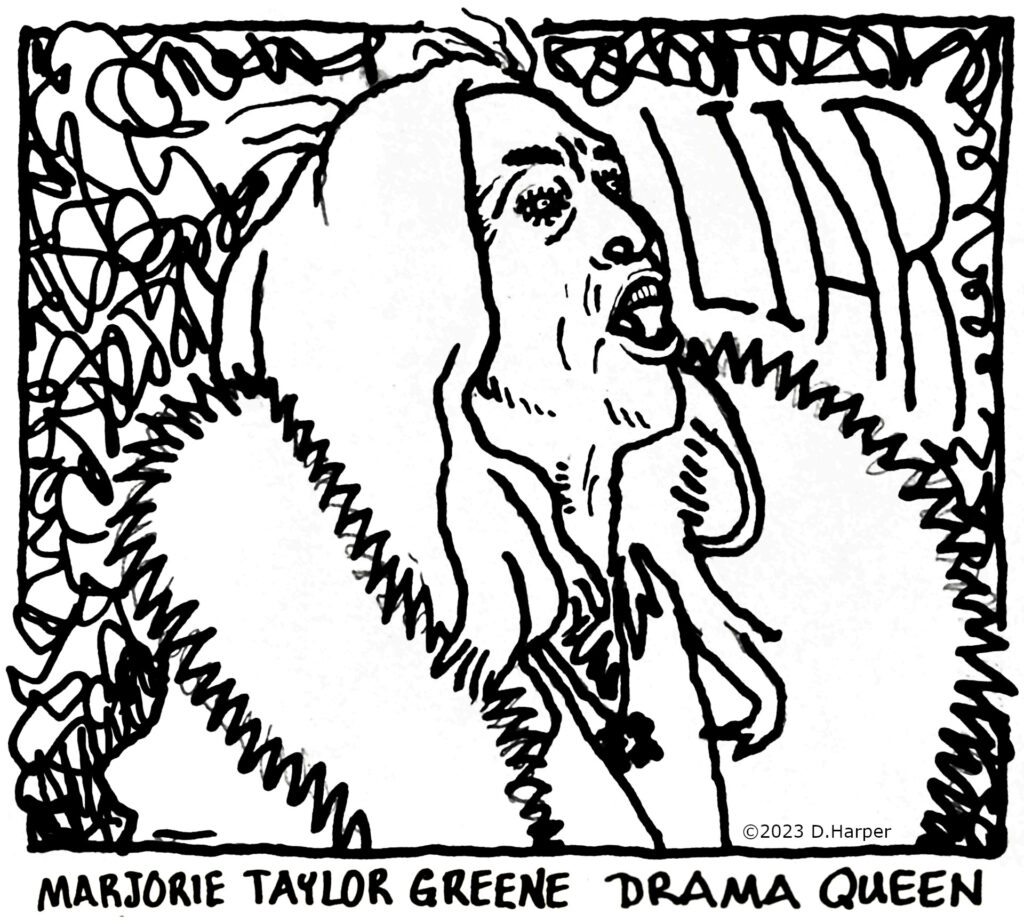
So it is no surprise that one of the people shouting about lies during this year’s “State of the Union” speech was Christian nationalist Marjorie Greene. I suspect that Greene, who’s a bit of a drama queen, prepared herself in advance for her moment in the spotlight: she wore a dramatic white coat with a big furry ruff, which must have been dreadfully hot but was clearly meant to set off her blonde good looks. And she so obviously enjoyed the moment when she made the audience turn and look at her. She seems to have forgotten, however, that when you shout, it distorts your mouth and face and throat, and it brings out all the little lines in your face making you look older than you are. (This is why I hate seeing videos of myself preaching.) No matter: she made her truth claim in a very public manner, that she knows the truth, and unless the rest of us agree with her she will shout us down as liars.
Back in 2005, philosopher Richard J. Bernstein argued that there were two prevailing mentalities in the United States. On the one hand there is a “mentality that neatly divides the world into the forces of good and the forces of evil.” On the other hand, there are those of us who “live without ‘metaphysical comfort,’ … live with a realistic sense of unpredictable contingencies” (The Abuse of Evil: The Corruption of Politics and Religion Since 9/11 [Malden, Mass.: Polity Press, 2005], pp. 12-13).
Greene and other Christian nationalists belong to the mentality that neatly divide the world into good and evil; they long for comfort and fear the unpredictability that pervades the world. Because of their fear, they cling to whatever certainties they can manufacture, and call those manufactures divine revelation.
But they should remember that when they shout, it distorts their faces….
Sometimes I need to shut my brain off. One way I can do that is by writing. But writing can also act as a stimulant, making my thoughts go round even faster.
People tell me meditation will shut my brain off. I meditated seriously for years, until I realized that I really disliked meditating, and that it made me detached and mean. I’m one of those people who gets “meditation-related adverse effects.”
Nope, prayer doesn’t work either. I want fewer words going around in my head, not more of them.
Walking is a sure-fire way for me to quiet my brain. Talking with my spouse will do it. Singing. Doing chores (sometimes).
But right now, I’m going to read a murder mystery. It’s too late to go for a walk or sing, my spouse is in Wisconsin, I’m sick of doing chores. A murder mystery, that’s just the ticket. It will engage my brain just enough, but it won’t require much concentration.
You do your spiritual practices, I’ll do mine. Erle Stanley Gardner, here I come.
Red Flags, a novel by Juris Jurevics, was originally published in 2011, and reissued as a paperback in 2021 by Soho Crime. Soho Crime typically publishes mysteries, but this isn’t exactly a mystery. Maybe it’s a thriller, thought it’s not one of those thrillers that raises your blood pressure and keeps it high.
I’d say Red Flags is maybe a war novel. It’s set in Vietnam circa 1967 or 1968. Two noncommissioned officers in the U.S. Army Criminal Investigation Division are ordered to find who’s behind a large opium growing operation that’s netting huge amounts of money for the North Vietnamese. The two non-coms are sent to Cheo Reo, a backwater town in the Central Highlands of Vietnam that served as a provincial capital. Eventually they find out who’s in charge of the drug operation, and of course it turns out to be someone that was right in front of them the whole time.
Considered as a mystery, or even as a thriller, the plot is a bit thin. But really the genre elements are just there to support a portrait of what it was like to be in Vietnam in the Central Highlands. Jurevics actually served in Cheo Reo for more than a year, in 1967-1968:
“Juris Jurjevics deployed to Vietnam and was assigned to C Company, 43rd Battalion in the 1st Signal Brigade at Kontum, but spent very little time there before being assigned to a remote outpost in Cheo Reo, in what was formerly Phu Bon province, in the Central Highlands. Shocked by the austere defenses of his camp, he found the corruption staggering. Supplies intended for the troops or for Montagnard auxiliaries rarely reached their destination, or arrived in significantly reduced quantities. He noticed that everything in Vietnam was for sale, and extortion through tribute was widespread. While in Vietnam, he felt a bond with the Montagnards, but noticed the South Vietnamese disdain for the mountain people.” (from the introduction to an oral history video, West Point Center for Oral History)
Or maybe this is more of a history book thinly disguised behind an entertaining veneer of genre fiction. The level of detail in this 390 page book is almost overwhelming. You learn about the diseases, the parasites, the wildlife, and the beauty of the Central Highlands. You get portraits of people that are probably based in large part on real people (presumably suitably disguised to prevent lawsuits). You get a stunningly detailed look at corruption caused by the Vietnam War.
I would also say this book is a meditation on morals and ethics. There is no ultimate Goodness in this fictional/historical world. Even the essentially good characters have compromised morals. On the other hand, there is plenty of evil, but the evil grows out of the overall situation and can never be fully attributed to individuals.
The United States pulled out of the Vietnam War when I was fourteen years old. I spent my childhood listening to nightly body counts on the evening television news. I spent my teen years listening to adults argue about what happened in Vietnam, why we pulled out, whether it was a war we lost or a war we threw away. By the time I was a young adult, most everyone stopped talking about the Vietnam War. Every once in a while a Vietnam vet would talk a little bit about what they had seen. So Vietnam was a huge real-life mystery story for me. What had happened? People my age had to piece together clues. I’ve looked at any number of histories of the Vietnam War, but most of the histories turn out to be dry recounting of battle plans, with the human story mostly left out. I’ve read any number of Vietnam memoirs, but too many of them are gung-ho boring military porn. Because I’ve read so many bad books on the Vietnam War, I no longer go looking for books about it. Yet every once in a while I run across a good book that manages to give me a little part of the answers I’ve been looking for: Graham Green’s The Quiet American (1956); Tim O’Brien’s book If I Die in a Combat Zone, Box Me Up and Ship Me Home (1973); Robert Mason’s Chicken Hawk (1983)….
And now Juris Jerjevics’s Red Flags (2011) has just given me another little part of the answers.
Recommended. But only if you don’t mind a grim book with lots of killing that gives a depressing portrait of humankind.
Michael E. Mann, The New Climate War (New York: Public Affairs, 2021), 2022 paperback edition with a new Epilogue.
Michael Mann is a real live actual climate scientist, a professor of atmospheric science at Penn State. He’s also a pretty good writer. That’s a great combination, if you want to read about climate change.
His book The New Climate War doesn’t bother rehearsing the arguments for the validity of global climate change. As he says in the book, the science is clear now. There is now doubt that climate change is real, and that we are already witnessing some of the predicted changes (and disasters) that result from climate change.
Instead, Mann takes on Big Oil. He points out that Big Oil is no longer engaging in climate change denial. They have changed tactics. They want to slime out of taking any responsibility for causing climate change. Even though they knew that climate change was real back in the 1970s and 1980s, even though they made accurate predictions of the effects of climate change that far back, they desperately want to pretend they have no responsibility for climate change.
So instead of taking responsibility for climate change themselves, Big Oil wants us to believe that if we would just change our personal behavior — if we would just drive electric cars, stop flying on jets, and turn the thermostat down — climate change will end. They want us to believe it’s our fault. And Big Oil has figured out that if we believe that our personal behavior is what’s most important, we are far less likely to demand that Big Oil be held politically accountable.
That’s not the only sleazy, manipulative practice that Big Oil is engaging in. Mann details several other tactics, such as doomsaying — it’s all so bad, we can’t change anything, so let’s just give up. Once again, doomsaying lets Big Oil off the hook. Another tactic is promoting wild-eyed technological fixes — because if there’s some wild technological fix that’s going to come along in a couple of years (we can spew particles in the sky to block the sun! we can wait for cold fusion!), then yet again, Big Oil will not be held accountable. Yet again, Big Oil will be able to keep on raking in record profits.
But Mann says that we know what we have to do. We don’t need what he calls “false solutions.” We have to do things like follow the 2015 climate accords (which Big Oil would love to have us ignore, because it will cut into their profits). We have to push proven technologies like renewable energy (which Big Oil wants us to stop doing, because renewables cut into their profits). And we, the citizens, have to hold our political leaders’ feet to the fire (and stop electing leaders who are beholden to Big Oil). We cannot let Big Oil distract us from what actually needs to be done.
A quick read, and well-written, a necessary call to arms. Highly recommended.
(I only wish someone would write equally good books about the other ecological disasters facing us, like the spread of invasive species, and toxication, and land use change.)
But here’s my playlist for this year’s World Ukulele Day. It’s mostly instrumental, except for two pieces. Many of the performers are from Hawai’i, of course, but I tried to make this about world ukulele by including players from Thailand, Japan, the US mainland, Germany, England, and Canada. Musical styles range from traditional Hawai’ian to jazz to pop to folk and beyond.
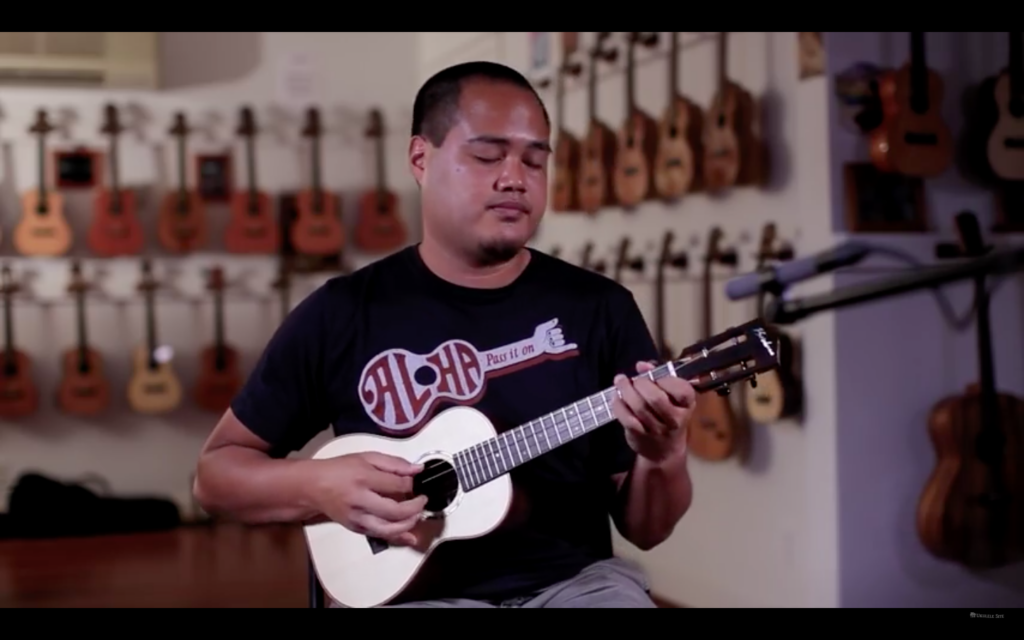
Corey Fujimoto may not be showy like some Big Name Uke Players, but his musicianship and technical prowess are top drawer. This Presto movement from a Bach sonata shows off both his technical prowess, and his excellent musical taste.
Screen grab from the Corey Fujimoto video
“Ukulele, I Love You” written and performed by Singto Numchok with the Ribbee Crew (Thailand)
The words to this song are both silly and sweet. The real joy in this video is watching five top-notch uke players, all doing different things with the same tune. If you have five really good uke players, you really don’t need any other instruments.
Japan has some of the best uke players in the world, and Natoyama is one of Japan’s best players. Enough said.
“Spain” performed by Andrew Molina, Kalei Gamaio, and Neal Chin (Hawai’i)
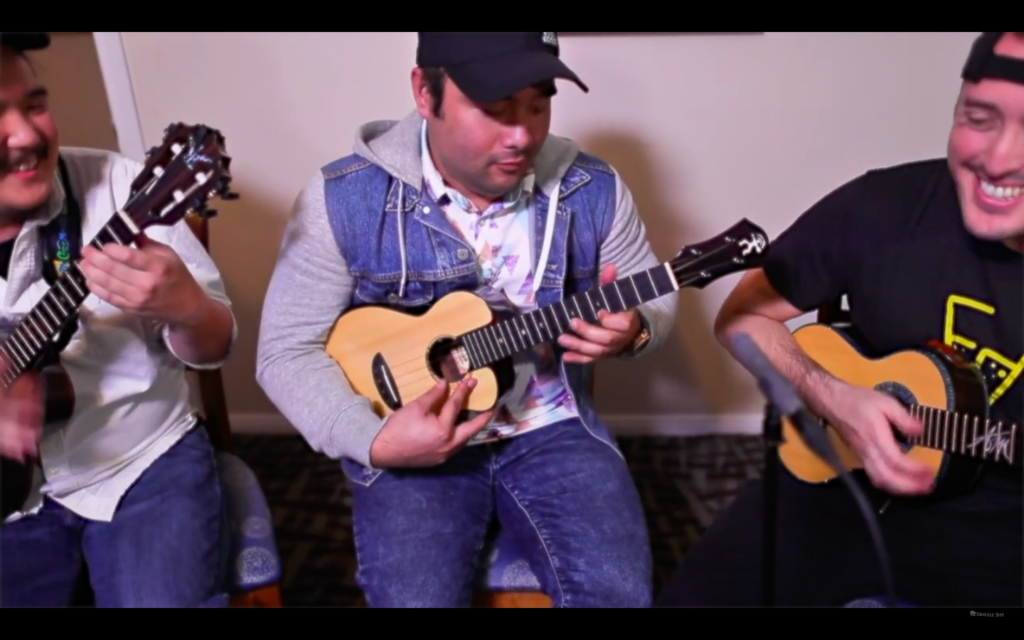
Three younger uke players trading improvised solos based on Chick Corea’s jazz standard “Spain.”The musical interaction between the three players results in sheer joy.
Screen grab from the video. L-R: Neal Chin, Kalei Gamaio, Andrew Molina
John King was trained as a classical guitarist in the campanella style, and he made his name in uke circles by performing classical music on the uke. His arrangements of melodies by Hawai’ian composers are less well known, but well worth listening to. Both his arrangements and his playing are understated, allowing the beauty of the melodies to shine through.
Pfeiffer is another player who trained as a classical guitarist then switched to uke. She is probably best known for her uke method books, but her performances are well worth listening to as well.
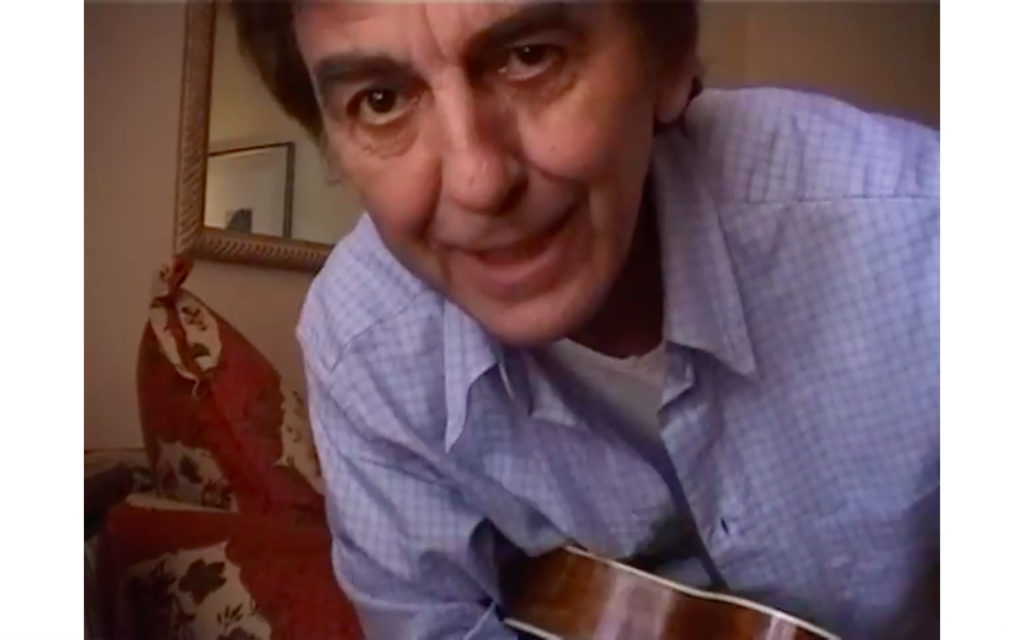
A video from the near end of Harrison’s life. Topnotch rhythm playing from a master guitarist and uke player. (Note the name “Keoki” on the headstock of the uke — that’s Harrison’s uke name.)
Screen grab from the George Harrison video.
“Swallowtail Medley” performed by John King (US mainland) and James Hill (Canada)
James Hill is a ukulele virtuoso, and he sometimes suffers from virtuoso-itis, making music more complicated than it needs to be. Not in this video, where Hill plays second fiddle, er uke, to John King.
“Neptune’s Storm” performed by Taimane Tauiliili Bobby Gardner (Hawai’i)
Taimane Gardner is another incredible uke player who sometimes suffers from virtuoso-itis. But in this performance, the high level virtuosity she displays is well matched to the requirements of the music.
For my money, Israel Kamakawiwo’ole was the best ukulele player ever. He doesn’t play with the virtuoso pyrotechnics of a James Hill, a Jake Shimabukuro, or a Taimane Gardner. But his playing is perfect. So is his singing.
Since 1947, the Bulletin of the Atomic Scientists has maintained the “Doomsday Clock.” That mythical clock shows how close humanity is to total destruction. Originally, the Clock only looked at the danger from nuclear armageddon, but in recent years has included threats from ecological catastrophe, bio-security, and other controllable threats to humanity.
The Clock was advanced from its previous setting of 100 seconds before midnight (i.e., to destruction), up to 90 seconds before midnight. According to Rachel Bronson, PhD, president and CEO, Bulletin of the Atomic Scientists: “90 seconds to midnight is the closest the Clock has ever been set to midnight.” The Bulletin’s press release attributes most of the increase in threat to humanity to Russia’s invasion of Ukraine and ongoing threats that Russia will use nuclear weapons.
Ten years ago, the Clock was set to 5 minutes (300 seconds) to midnight. When I first got active in the movement calling for reduction in nuclear stockpiles, back in the late 1970s, the Clock was set at 9 minutes to midnight, and we thought that was terrifying.
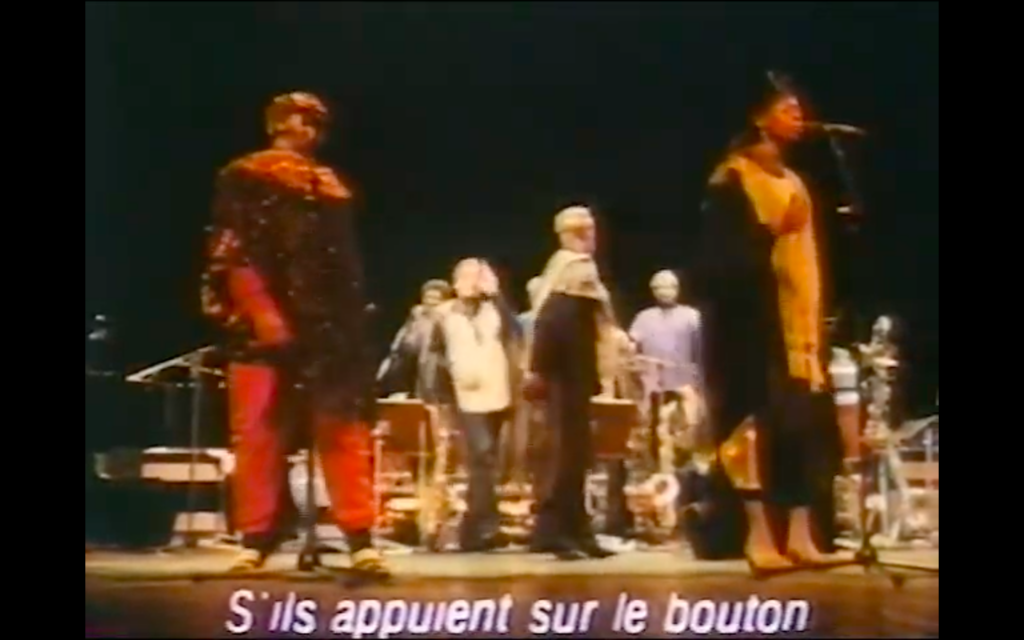
I still remember attending a Sun Ra concert in Philadelphia sometimes around 1983, when Sun Ra led his band in a snake dance through the audience while chanting, “It’s a motherfucker / Don’t you know / If they press that button / Your ass gonna go.” That chant was one of the things that helped me make sense of something you can’t really make sense out of. Nuclear war. It’s a motherfucker — and Sun Ra never used strong language, except in this piece, but that strong language is the only possible language for this topic — but there it is. Don’t get frantic about nuclear disaster, but don’t ignore it either. Confront it head on, in all its seriousness, with all the possibility of oblivion, while making music about it.
(For the record, the live version I remember hearing differs from the 1982 recorded version. Musically, the version I heard in Philadelphia is probably more like the live version recorded in Germany in 1984; though the words of the German recording differ from what I remember. There’s also the version recorded in Paris in 1983, which is quite different musically. No matter. If you’re looking to make sense out of nuclear armageddon, the effect of any of the recorded versions is the same: helping us make sense of the senseless.)
Screen grab from a 1984 film of Sun Ra performing “Nuclear War” in Paris.