Poll

I received a long email today from a research group called “Exploring the Pandemic Impact on Congregations.” The email began:

“Dear Pastor, Greetings! This past spring, you or your church completed a survey for the national study entitled Exploring the Pandemic Impact on Congregations.  At that time you were willing to be contacted for follow-up questions. In that survey, we found that 51% of clergy had thought about leaving the pastoral ministry. This was a considerable increase from our earlier survey. Because of this finding, we wanted to better understand the challenges clergy were facing. Religious leaders have suffered especially hard due to the pandemic and the many other challenges in our changing society. This short survey specifically addresses clergy health and well-being….”

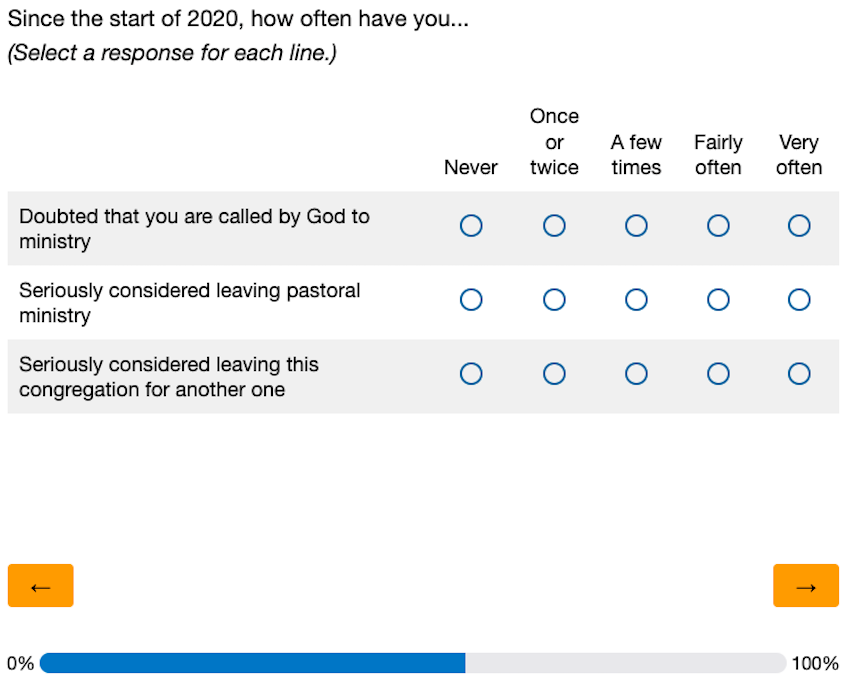
So I took their survey. First they asked a lot of questions about the congregation (e.g., our average annual attendance went from 68 in 2018 to 48 in 2022). Then they asked questions about me: Am I employed full-time or part-time? How’s my financial well-being? Do I doubt that I am called by God to ministry? (Left that one blank, that’s not my theology.) Am I part of a clergy support group, do I see a shrink or spiritual director, do I still pray as much as I did before the pandemic? (Yes, and yes, and I pray as much now as before the pandemic which is not at all.)

The survey ended with two open-ended questions: What’s the biggest challenge in my ministry right now? and: What do I find most satisfying in my ministry? I was able to say that my biggest challenge, and also the most fun part of my job, is coming up with creative ways to respond to the rapidly changing world around us while maintaining the integrity and traditions of a 275 year old congregation. Then I was able to say that pretty much everything is satisfying, because I love my job.

Yep, I love my job. I was surprised at how positive I felt. I know that quite a few Unitarian Universalist ministers have left pastoral ministry, and that many others are unhappy with the way pastoral ministry has changed. Not me. I feel excited and energized.

Huh. Maybe there’s something wrong with me.

Screenshot of one of the questions from the online survey
Questions from the survey. Have I ever doubted that I was called by God to ministry? I left that one blank. Have I ever seriously considered leaving pastoral ministry? Not since 2020. Have I seriously considered leaving this congregation for another one? This was kind of difficult to answer, since I just started serving this congregation in 2022, and I left my previous congregation for reasons unrelated to COVID — so I answered “never.”

New online resource

Back in 2020, in the depths of the pandemic, I began assembling a collection of copyright-free hymns. (Remember when we were all figuring out navigate copyright laws with online worship services?) I uploaded PDFs of the hymns to Google Drive, and made the folder publicly accessible. It was clumsy, and probably very few people actually used those hymns.

I finally moved all those hymns off Google drive and onto one of my own websites. You can find them here — with a much-improved navigation system.

Pure Land

I got interested in the Buddhist Churches of America (BCA) after reading Jeff Wilson’s book Dixie Dharma: Inside a Buddhist Temple in the American South. Ekoji Temple, the one Wilson writes about in this book, was founded by Rev. Takashi Kenryu Tsuji in the 1980s. Tsuji had retired as a bishop of BCA, and Ekoji Temple was one of his retirement projects. In his book, Jeff Wilson quotes Tsuji extensively, and I found I resonated with what Tsuji had to say. As in this passage from Tsuji’s book The Heart of the Buddha-Dharma: Following the Jodo-Shinshu Path:

“Shinran Shonin and the teachers before him explained that the Pure Land was situated in the western corners of the universe, zillions of miles away. It was pictured as a very beautiful place, free of suffering, where everyone is happy. Philosophically speaking, however, the Pure Land does not refer to a specific location out there somewhere. Rather, the Pure Land is symbolic; it symbolizes the transcendence of relativity, of all limited qualities, of the finiteness of human life. In this transcendence, there is Compassion-Wisdom, an active moving, spiritual force. The Pure Land ideal is the culmination of the teaching of Wisdom and Compassion.”

First of all, Tsuji makes Pure Land Buddhism sound a little like Universalism. The old Universalists, coming out of the Christian tradition, said that everyone gets to go to heaven. Similarly, Pure Land Buddhists said that everyone can can enter Buddha’s Pure land, that is, everyone can achieve Buddhahood. We Unitarian Universalists translated the old Universalist ideas into modern terms, and that’s what Tsuji does for Pure Land Buddhism in this passage: “The Pure Land ideal is the culmination of the teaching of Wisdom and Compassion.”

What I like is that both groups have not only translated their religious traditions into Modernity, both groups say that all persons are radically equal. Maybe this is because I know I’m not good enough to be one of those Christians who gets into heaven, and I lack the self-discipline to become one of those Buddhists who reaches Enlightenment. Whatever the reason, I prefer the radically egalitarian religious groups.

Healing from religious trauma

Religion New Service interviews Laura E. Anderson, a psychologist who has written a new book, When Religion Hurts You: Healing from Religious Trauma and the Impact of High-Control Religion. In the interview Anderson makes the obvious point that the cure for religious trauma might not be renouncing all religion:

“[Religion News Service:] Why might it be important for therapists working with religious trauma not to be anti-religion?

“[Laura Anderson:] Anti-religious messages can quickly become prescriptive and fundamentalist. To say all religion is terrible and you just have to get rid of it, or the idea that God is dumb and only for mentally weak people, is incredibly shaming and discouraging. It’s also not necessarily helpful for the healing process. My job as a therapist is not to get you to a belief that I might hold. It is to help you heal and to lean in more to who you are authentically. I think that includes religion or spiritual practices. Now I always say I’m not anti-religion, but I am anti-harm and power and control, and anti-abuse. So if you can find a religion or faith or spiritual practice that isn’t including those things, I think that’s wonderful.”

I call this an “obvious point,” though it might not be obvious to everyone. But think of this analogy: if someone is sexually assaulted, psychotherapists don’t tell them to never have sex again. Instead, the therapeutic goal is healing so that the person who survived sexual assault can go on to have healthy relationships, including health sexual relationships.

The entire interview with Anderson is worth reading, not just for her thoughts about religious trauma, but also for her insights into trauma and healing from trauma.

Internet criminals

It’s been a busy couple of days for me. Another one of my websites started misbehaving. The problem turned out to be that the site had been compromised by some bad actor, presumably for nefarious purposes. While I was working on that problem, my younger sister told me that this site was down. Now I had two sites down at once. Yikes.

My internet service provider quickly brought this site back up. He described the problem:

“…When a group of processes, in this case the PHP Interpreter php-fpm, experiences high memory pressure, it kills the entire group. The cause of the pressure is too many criminals attacking too many sites simultaneously. They’re stupid, running scripts which very rapidly request php pages with vulnerabilities, hoping to find one. When too many of them are doing this at the same time, we get this problem…. It’s irritating to me that literally more resources have to be devoted to fending off criminals than providing the actual service….”

As for my other website, I’m converting it from a dynamic site run on WordPress to static HTML. It’s kind of funny. I started out building websites by writing HTML in a text editor. That was too time-consuming, so I switched to using WordPress as a CMS. And now for this one small website, I’m switching back writing HTML in a text editor because it takes less time than dealing with all the security needed to keep WordPress from being compromised.

Confucian quiet-sitting

I’m slowly making my way through a 19,000 word article on Confucian quiet-sitting — “A Study of Cheng Yi’s Quiet-Sitting Meditation and Other Contemplative Practices in the Confucian Context” by Bin Song, Mandala Texts (2023), 1-46 (https://doi.org/10.57010/NCGZ4591. Accessed October 6, 2023.)

Not only is it a fascinating article, it might have a real-world effect on the way I think about my own contemplative practices.

I’ve tried the the usual sitting meditation practices taught in North America, and I haven’t felt comfortable with them. Most of the sitting meditation techniques we learn in North America are based on Buddhist sitting meditation, or less often on meditation techniques from the Indian subcontinent. Both Buddhist and Indian meditation techniques are based on distinct end goals (e.g, nirvana in the case of Buddhism). Buddhist and Indian meditation techniques also presume a certain social orientation, often involving some kind of retreat or separation from society. So if you’re like me, and you don’t buy into the end goals or the social orientation of the usual sitting meditation, you’re likely to wind up not wanting to do sitting meditation.

The Confucian — or, to use scholarly jargon, Ruist — technique of quiet-sitting offers another type of contemplative practice. Quiet-sitting differs significantly from Buddhist sitting meditation. Bin Song writes:

“The term ‘sitting at ease’ is used in Chinese Buddhist texts to refer specifically to the Buddhist style of cross-legged sitting meditation. These two quotations suggest that [Ruist scholar] Cheng Yi had reservations to this style for two reasons: first, it encourages Buddhist practitioners to talk about miraculous but impractical deeds and events, and second, it detaches meditators from their everyday human affairs. Cheng Yi aimed to distinguish his contemplative practices from Buddhism and Daoism….”

In addition, Cheng Yi taught that quiet-sitting was just one of several contemplative practices that would achieve the same goal. Bin Song describes several of these. I was specifically interested in the one called “beholding the vitality of the myriad things,” which Song calls “among the most emblematic of Ru contemplation.” Here’s how Cheng Yi and his brother Cheng Hao describe this practice:

“By beholding pattern-principles in things, one can examine oneself. Once able to illuminate pattern-principles, there is nothing that cannot be understood. All things in the world can be illuminated by pattern-principles; if there is something, there must be a norm, and every single thing must have a pattern-principle.” — Cheng Hao and Cheng Yi, The Collected Works of Cheng Brothers (1981), 193.

Based on this description, “beholding the vitality of the myriad things” sounds like it has a family resemblance to the contemplative practice that Henry Thoreau did while living at Walden Pond. As in this example:

“In front of Cheng Hao’s window, the lush grass covered the pavement. Some people advised him to cut it, but he refused, saying that he wanted to witness the vitality of the creative universe. He also kept a small pond and raised a few small fish, which he beheld from time to time. When asked why, he said he wanted to behold how all things remain content in themselves.” — Huang Zongxi et al., Learning Cased in Song and Yuan —– vol. 14 (the He Shaoji print, 1648): 8, accessed March 30, 2023, https://ctext.org/library.pl?if=gb&file=22359&page=86&remap=gb#%E5%B0%8F%E9%B1%BC

Not the same as Thoreau, but you can see the family resemblance — close observation of the non-human world as a way of deeper understanding.

Bin Song begins the article by pointing out that, in the West, the field of contemplative studies has pretty much ignored Confucian, Jain, Jewish, and Sikh contemplative practices. Popular culture never gets much beyond Buddhist and Christian contemplative practices. Learning more about Confucian quiet-sitting might help all of us better understand the strengths and weaknesses of Buddhist meditation and mindfulness — just as happened a generation ago, when learning about Buddhist meditation helped us in the West better understand the strengths and weaknesses of Christian prayer. Not that we all have to go out and start pretending to be Confucianists — but another perspective might help us better understand ourselves.

Google is even more evil than I knew

Cory Doctorow wrote a lengthy blog post on how evil Google has become. I already knew that Google search results have declined in quality over the past few years. But I didn’t realize how bad it’s gotten. Here’s how Doctorow describes it:

“When you send a query to Google, it expands that query with terms that are similar – for example, if you search on ‘Weds’ it might also search for ‘Wednesday.’ In the slides shown in the Google trial, we learned about another kind of semantic matching that Google performed, this one intended to turn your search results into ‘a twisted shopping mall you can’t escape.’

“Here’s how that worked: when you ran a query like ‘children’s clothing,’ Google secretly appended the brand name of a kids’ clothing manufacturer to the query. This, in turn, triggered a ton of ads — because rival brands will have bought ads against their competitors’ name (like Pepsi buying ads that are shown over queries for Coke). …

“As [Megan] Gray points out, this is an incredibly blunt enshittification technique: ‘it hadn’t even occurred to me that Google just flat out deletes queries and replaces them with ones that monetize better.‘ We don’t know how long Google did this for or how frequently this bait-and-switch was deployed.” [emphasis added]

In short, Google is far more evil than I expected. Once again, in bigger type:

Google just flat out deletes queries and replaces them with ones that monetize better. — Megan Gray

Next time you use Google to search, remember that. Google is going to replace your actual search query. You will not be searching for what you wanted to search for. You will be searching for something that will make Google more money.

Redesign

Back in 2015, the Unitarian Universalist Association (UUA) developed a WordPress theme for congregational websites. It was one of the best things the UUA has done in the past 25 years, because the theme made it super easy to build an excellent website in just a few hours.

Unfortunately, the UUA WordPress theme hasn’t been updated in three years, with no indication that it will ever be updated again. The design is beginning to look outdated. The theme relies on plugins that are now outdated, making it difficult to use the latest improvement in WordPress such as the Gutenberg block editor. We’ve been using the UUA WordPress theme in Cohasset, but it’s getting to the point where we feel like we have to start looking for an alternative.

So I’ve been looking at congregational websites to see what others are doing. I looked at the website of Temple Beth Israel in Northfield, N.J., because an old friend is rabbi there — love the site, but they hired a web design firm to make a custom WordPress template for them, which we can’t afford. Ditto with Grace Cathedral in San Francisco — another great site, but again we can’t afford a custom WordPress template. For a minimalist look, Unity Temple in Oak Park, Ill., uses a customizd version of the Kale WordPress theme. The Kale theme is free, but I’m sure they paid for the customization, which we probably can’t afford. The UU Congregation of Atlanta, Georgia, uses the Divi theme, which costs $89 a year. We can probably afford that, but it looks like Divi is complicated enough that we’d have to hire a WordPress developer, which we probably can’t afford.

Turning to websites we could maybe afford, Second Unitarian in Chicago uses the Cream Magazine theme, giving their site a nice straightforward look. The theme is reasonably priced at $49.

Um. Yeah. That’s it.

That’s the only UU congregational website I’ve found so far that looks good, and seems affordable.

But if you know of a great congregational website using an inexpensive WordPress theme, please put the URL in the comments….

Still going on

In 1977, Ursula K. LeGuin wrote an introduction for her anti-war novel The Word for World Is Forest — a novel which she had begun writing in 1968. In the 1977 introduction, she said:

“1968 was a bitter year for those who opposed the [Vietnam] war. The lies and hypocrises doubled; so did the killing. Moreover, it was becoming clear that the ethic which approved the defoliation of forests and grainlands and the murder of noncombatants in the name of ‘peace’ was only a corollary of the ethic which permits the despoilation of natural resources for private profit or the GNP, and the murder of creatures of the Earth in the name of ‘man.’ The victory of the ethic of exploitation, in all societies, seemed as inevitable as it was disastrous.”

Today, in 2023, the connection between war and environmental exploitation is still in place. Sad to say, humanity is still dominated by the ethic of exploitation.

Another problematic hymn

“The Earth Is My Mother,” no. 1073 in the Unitarian Universalist hymnal Singing the Journey, turns out to be one of those problematic songs.

The first problem is — who wrote it? In Singing the Journey, it’s attributed to “Native American, from Songs for Earthlings, ed. Julie Forest Middleton, copyright 1998 Emerald Earth Publishing.” Let’s look first at whether it’s truly a Native chant, and second, who might own the copyright.

On the “Rise Up and Sing” website, Annie Patterson and Peter Blood note: “It has been suggested that this chant is based on a Lakota (Plains) chant and elsewhere as coming from the Hupa tribe of Northern California.” But, as they point out, it’s almost impossible to evaluate such claims. Patterson and Blood also write: “We urge people to consider carefully issues of cultural and religious appropriation in utilizing material like this. At the very minimum acknowledge the issues involved when you utilize songs of this kind.” To put it more bluntly: if it’s really a sacred chant from a specific indigenous tradition, then you probably shouldn’t be singing it unless you know the actual social context from which the chant comes, and whether it’s a chant that has a specific cultural meaning that you should respect. And if it’s not actually a sacred chant from a specific indigenous tradition, then if you sing it you look like you’re “playing Indian.”

Next, let’s think about who owns the copyright. If it is in fact a chant from an indigenous tradition, then either the copyright should be held by a person from that indigenous tradition who composed it, or it’s from a folk tradition in which case it’s in the public domain.

There’s a third possibility, one which I believe is the most likely: the chant came out of the New Age community and/or the environmental activist community. These two communities overlapped a good deal, and both generated a lot of creative ferment in the late twentieth century. A quick search of documents on Google Books leads me to believe this third possibility is likely. Prior to 1990, I found a couple of definite references to this chant being used by environmental activists.

In the earliest appearance I can find, the lyrics to this chant were printed in The International Permaculture Seed Yearbook, 1983, along with the notation, “The Earth Chant is based on a Native American chant with the portions starting ‘the moon’ added by Dawn Seed. Reproduction and singing of the chant is encouraged,” i.e., the publishers were not claiming copyright. (The moon portion goes like this: “The moon is our grandmother, we must take care of her….”) Then a few years later, the lyrics of the song appeared as part of the testimony given by environmental activist Robin Gould of Santa Fe, New Mexico, during a public hearing held by the U.S. Department of Energy for an Environmental Impact Statement for the Waste Isolation Pilot Plant Project, held on 17 June 1989 in Santa Fe (see p. 46 of the transcript, lines 3-22). Gould apparently sang the song during the public hearing.

So I’m guessing that this chant was in wide circulation among (White) environmentalists and (White) New Agers at least as early as 1983, maybe going back to the 1970s. Note that the phrase “the earth is our mother” dates back even further. For example, the phrase “The Sky is our father, the Earth is our mother” appears in anthropologist James George Frazer’s book The Worship of Nature: The Worship of the Earth, the Sky, and the Sun (London: Macmillan & Co., 1926). Interestingly, Frazer attributes the phrase, not to indigenous North Americans, but to the Lo-lo p’o people of China. And many others in the West have used the phrase “the earth is our mother” — not just anthropologists, but also socialists, spiritualists, Christians, etc., going back twenty-five hundred years to Lucius Junius Brutus, the founder ancient Rome.

Thus the lyrics to the verses predate Julie Forest Middleton’s 1998 publication of them. Mind you, I don’t fault Middleton for copyrighting the version she printed in her song collection. It’s fine to copyright typesetting and arrangements. But the lyrics predate her 1998 publication by at least a decade, and the long history of the phrase “the earth is our mother” means the lyrics of the verses are almost certainly in the public domain.

As for the non-lexical vocables of the chorus — usually rendered as “Hey, yunga, ho, yunga…” or as “Hey, yanna, ho yanna…” — their origins are obscure. These vocables are somewhat consistent with some Native American music. David McAllester, in an article titled “New Perspectives in Native American Music,” notes: “In traditional Native American music, many songs may be entirely vocabalic and a majority are largely so with only a line or two of translatable text. The vocables are part of a Native American view that a song does not need many, or even any, lexical words to communicate its meanings” (Perspectives of New Music, vol. 20, no. 1/2, Autumn, 1981 – Summer, 1982, p. 434). It would be very difficult to determine if the lyrics to the chorus are actual Native vocables (which could be cultural misappropriation), or vocables designed to sound like Native vocables (which would be “playing Indian”).

As for the melody, it could be a traditional Native American melody, borrowed from somewhere. Or it could have been based on someone’s hazy recollection of a Native American chant. Or it could have been composed by non-Native singers (and it does sound a lot like many of the chants that were emerging in Neo-Pagan and New Age circles in the late twentieth century). Maybe someday someone will figure out where this melody came from, but for now I have to conclude that we just don’t know.

So should we sing this chant, or not? Even if it’s in the public domain, the criticism leveled by Annie Patterson and Peter Blood remains — singing this chant could be cultural misappropriation, or it could be “playing Indian.” Either way, I don’t think we should be singing it.

Updated and substantially rewritten 1 Oct. 2023, based on additional research.