May Day

I went to see Ken today. He and his Morris dancing friends got up at dawn, singing and dancing to make sure the sun came up. Thank you, Ken.

But that’s not the May Day I’m thinking oh right now. I’m thinking of International Workers Day, celebrated everywhere in the world except in the U.S. International Workers Day commemorates the Haymarket Massacre in Chicago, when (to oversimplify) workers were gunned down while exercising their right to assemble publicly — in a peaceful demonstration seeking the right to an eight hour day. International Workers Day is not celebrated in the U.S. to help everyone forget the Haymarket Massacre, and to forget that ordinary working class people have rights and needs.

And here we are today, with the two dominant political parties pretty much ignoring the working class. I have to give credit to the Republicans, at least they pretend to stand up for the working class. The reason given for Republican tariffs was to bring jobs back to the U.S.; the reason for immigration crackdown was to keep jobs for American working class people. Of course, it hasn’t worked out that way, for neither tariffs nor immigration crackdowns have created jobs; all that has happened is prices have gone up and ordinary working people are worse off than before. The Democrats, for their part, seem to have the forgotten working class completely. They talk about No Kings and letting trans kids play sports — both of which I happen to agree with — but I’m not hearing much talk about decent jobs, support for unions, and pathways for struggling families to make economic progress.

And neither political party seems to think of workers as somehow human. Instead, they treat workers as economic abstractions. To quote Marx: “Political Economy regards the worker like a beast of burden, he must receive enough to enable him to work. It does not consider him, during the time when he is not working, as a human being.” Except sometimes I think our two political parties don’t even care if the workers get enough to enable them to work.

I find myself in agreement with Rev. Dr. William J. Barber — the real battle is against poverty. He lays out his arguments in his book White Poverty: How Exposing Myths About Race and Class Can Reconstruct American Democracy. The real needs of poor people — who Barber says constitute 40% of the U.S. population — are being ignored by both parties. And those real needs boil down to the words of an old poem for workers: Bread, and roses too. Jobs, and dignity and beauty.

Working people, poor people, are getting left behind. They’re sending out a mayday, and no one’s listening.

Rebound? No, recalibration.

The ongoing research project “Exploring the Pandemic Impact on Congregations” (EPIC), part of Hartford Institute for Religion Research, has released a new report titled “Signs of Rebound Amid Uneven Recovery.” The results are cautiously optimistic. Key findings, summarized on their website, include the following:

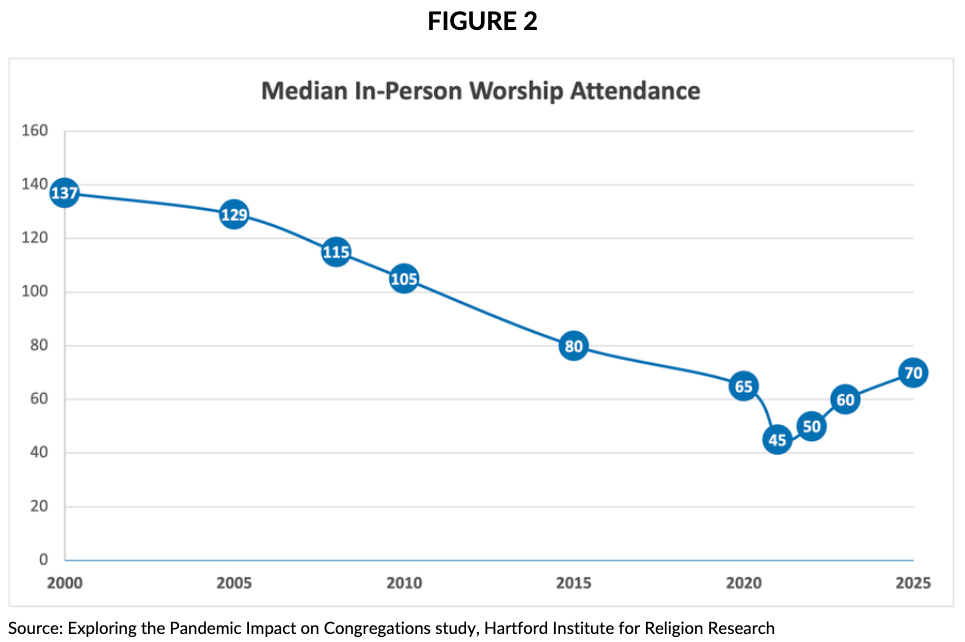
  • “Median in-person worship attendance has risen to 70 — surpassing pre-pandemic levels and marking the first positive gain in 25 years of tracking
  • “Median congregational income reached $205,000 in 2025, well above inflation-adjusted expectations
  • “Volunteer participation has rebounded to pre-pandemic levels, with 40% of congregants now volunteering regularly
  • “58% of congregational leaders say their congregation is stronger now than before the pandemic
  • “Clergy well-being has improved across physical, mental, spiritual, relational, and financial dimensions”

The new report makes me cautiously optimistic about the state of organized religion. The report also confirms anecdotal evidence that at least some congregations are experiencing a bit of growth. Growth, that is, compared to the past few years; 2025 median worship attendance (traditionally one of the best measures of growth) was slightly higher than what it was before the pandemic, and this graph from the report shows:

Graph showing worship attendance over the past 25 years.

The report includes data from many different denominations. Figures for Unitarian Universalism may possibly vary somewhat from the nationwide norm — e.g., from what I remember of the data collected by the Unitarian Universalist Association (UUA), we supposedly hit our peak attendance in about 2005 and thus started declining a bit later than the national average.

On the other hand, attendance data reported by the UUA depends on figures reported by local Unitarian Universalist (UU) congregations, and from what I’ve seen, many local UU congregations are not good at collecting data on average attendance. I’d place far more trust in the data collected by Hartford Institute for Religion Research — just remember as you read their report that Unitarian Universalists fit neatly into the sociological category of “Mainline” congregations.

I’m only cautiously optimistic, because the trends outlined in Robert Putnam’s book Bowling Alone continue — most Americans no longer want to participate in voluntary associations. And in spite of all the chatter about how isolated people are feeling these days, it remains hard to convince most Americans that showing up at a values-based community once a week might help reduce their feelings of isolation. If we could just convince people of that, then we might see a more robust increase in weekly attendance.

Cohasset Patriots

It’s Patriots Day tomorrow, and I’m giving a sermon tomorrow telling the stories of three Cohasset Revolutionary War heroes and heroines, all of whom would have attended services in our 1747 meetinghouse. These three were Persis Tower Lincoln Hall, Briton Nichols, and Noah Nichols.

Due to the time constraints of a sermon, I have to give shortened versions of their life stories tomorrow. I had hoped to post fuller versions of their life stories here, but the research took much longer than I had planned and I’m out of time. Instead, I’ll put a timeline of Noah Nichols’s life after the jump — just to get the information on the web where it’s publicly accessible.

So… just in time to commemorate Patriot’s Day, here’s the life of Captain Noah Nichols….

Continue reading “Cohasset Patriots”

Philip Gulley on why war doesn’t work

I first encountered Philip Gulley a couple of decades ago in the book he co-wrote with James Mulholland titled If God Is Love: Why God Will Save Every Person. In that book, Gulley and Mulholland set forth a Quakerly approach to universalism.

The current U.S. war in Iran has prompted me to seek out other pacifists. This is not an easy time to be a pacifist. While I’m hearing quite a few people who are opposed to the war, I’m not hearing people who are opposed to all war — only to this war. Or maybe they’re just opposed to the current administration.

So I was pleased to stumble across a blog post Philip Gulley wrote back in March in which he makes the case that all war is wrong:

And he adds a pacifist statement that is both Quakerly and Universalist:

If you’re a Universalist pacifist like me, you might find Gulley’s post worth reading in its entirety.

Snow and moss

I’m on study leave this week. A friend of Carol’s offered to let stay in her house in Maine, which is good for my studying, since there are fewer things here to distract me. And when I need a break from studying (to stretch my legs and rest my brain), I can go outside and look at the amazing diversity of mosses and liverworts around here. Mosses and liverworts can be surprisingly beautiful, as in the photo below.

This is a view through the microscope of the peristome on a capsule of Dicranum species — the peristome is a structure that holds the spores in the capsule until they are ready to be released. I find the colors and shapes quite beautiful.

As an added bonus, it snowed for several hours. Although it was cold enough to snow, it was too warm for any accumulation of snow to build up; we had the beauty of snow without the mess. And it was quite something to watch large flakes of snow fall on tiny moss plants.

Snow falling on a rocky hillside covered with moss.

3 AI dangers you might consider

Here are three emerging AI dangers, with brief comments on their implication for religious professionals and congregation. Since a large percentage of the population is already using generative AI for various purposes, let’s make sure we’re using those services wisely and well.

AI danger number 1

Your chatbot logs, and the queries you make to chatbots, may be accessed by lawyers during lawsuits. See, for example, how one law firm used such files in a defamation lawsuit against a Youtube influencer. In this lawsuit, the Youtube influencer is being sued for defamation by a woman, about whom he allegedly made intentionally defamatory comments. The woman’s lawyers claim to show that the influencer’s ChatGPT logs reveal his malicious intent.

As usual with anything to do with Big Data (including the web, the broader internet, text messaging, etc.) — you have to assume that anything you put into electronic format can and will be made public in ways that you might not like.

Nothing new here, but it’s a good reminder that congregations and religious professionals should refrain from placing any confidential information into chatbots. in addition, congregations and religious professionals can help educate people about this very real danger — including educating teens (e.g., in OWL programs), people going through divorces, etc.

AI danger number 2

The title of a peer-reviewed study says exactly what AI danger number 2 is: “Sycophantic AI decreases prosocial intentions and promotes dependence.” To quote the editor’s summary in full:

An obvious implication is that there are specific and measurable dangers if you use AI as an inexpensive therapist. Unfortunately, lots of people have good reasons for turning to chatbots for mental health support — mental health professionals are expensive and may not be covered by insurance; in many places there is a shortage of mental health professionals; for many people there remains a significant social stigma for referring to mental health professionals; etc.

Congregations and religious professionals should be aware that some people are relying on chatbots for mental health support. While we are not qualified to provide mental health support, this might be an area where we could help create low- or no-cost mental health services and/or steer vulnerable people to existing low or no-cost services.

AI danger number 3

The U.S. Copyright Office has denied copyright protection to certain AI-generated works: “In general, the office will not find human authorship where an AI program generates works in response to user prompts….” See the U.S. Congress webpage on “Generative Artificial Intelligence and Copyright Law.” There remain questions about how much human influence is required before a work may be protected by copyright.

I’d expect this to be mostly a concern for religious professionals. If we use generative AI to come up with sermons, music, curriculum materials, etc., we should assume that material is not protected by copyright and can be used freely by anyone. In addition, it’s wise to be aware that generally speaking your prompts (and maybe even output generated by your prompts) can be used by AI companies for many purposes, so e.g. assume that you are giving away the rights to any text you enter into a chatbot.


There are legitimate uses for generative AI (think: people with dyslexia who use it to clean up writing). However, it appears that many current generative AI services are not well designed, nor do they make clear the potential dangers in using their services. I’m not saying “don’t use generative AI ever,” but I’m also not saying “AI is the solution to all our problems and we should use it for everything.” Using generative AI is analogous to using a chain saw — great tool for specific purposes, used wrongly it can cut your leg off. So read the (non-existent) warning label and wear safety gear.

Dawoodi Bohra masjid

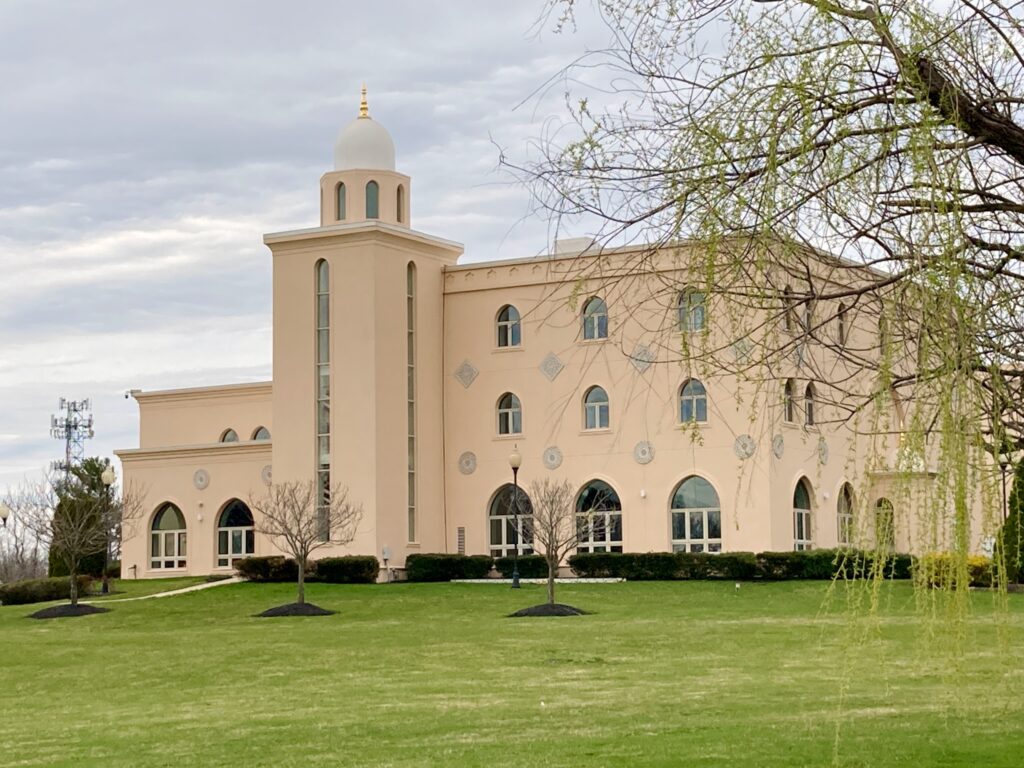
Next to the northbound New Jersey Turnpike rest area in East Brunswick, there’s a Dawoodi Bohra masjid. Carol and I looked at it over the fence separating it from the rest area access road. It looked quite impressive. Behind the masjid is a parking lot, and on the far side we saw two men wearing the characteristic white clothing of the Dawoodi Bohra.

If you’ve never heard of them before, the website of the Dawoodi Bohra community in the United States says:

Carol and I both wanted to see the inside of the building. But we were on a tight schedule. Plus, given the increased security necessary for many religious communities these days, we thought unexpected visitors might not be welcome. So we admired the outside of the building from afar.

Al Masjid Al Zainee (Dawoodi Bohra), East Brunswick, New Jersey

Big tech landscape

A large bleak-looking warehouse
Crate and Barrel warehouse, Cranbury, New Jersey

On our way to a seminar in Maryland, we stopped at a rest area in New Jersey. Right behind the rest area was a bleak Crate and Barrel warehouse that extended more than a quarter of a mile in one direction; behind it was another bleak warehouse, an Amazon fulfillment center, again more than a quarter of a mile long.

We mostly think of big tech as software and computer companies. But huge fulfillment centers are also a part of the big tech landscape — all that merchandise we buy online goes through physical plants like these.

NAACP and No Kings Day

NAACP has issued a set of talking points for the No Kings Day protests set for March 28. To my way of thinking, the NACCP talking points sound better than the verbiage on the official No Kings website. One especially good NAACP talking point: “Today we march. Tomorrow we organize. In November, we vote.” In other words, protesting has to be followed by organizing.

Yeah I know, NAACP seems so old school, but they’ve been doing protests for decades, and they know what they’re talking about. For example, check out their tips for staying safe during protests. And if you’re an NAACP member, they’re offering a webinar next week; I’ve found their webinars inspiring and informative.

Update 3/25/26: Removed non-working link to the NAACP talking points. They set up the link so it can only be opened via an email from them. Yes I could have downloaded the PDF and reposted it here, but I respect their commitment to member security and privacy. Join NAACP to get the full list. In the mean time, here are a few more of their talking points (posted under fair use of copyright law, fewer than 500 words, less than half the document):