In the depths of curriculum development. Coming up for air soon….
Patol House
While developing a curriculum for middle elementary grades, I found an interesting game, “Patol House,” originally played by Native Americans in New Mexico. I found this game in the book Handbook of American Indian Games by Allan and Paulette Macfarlan (Toronto: General Pub., 1958; reprint, Mineola, N.Y.: Dover Pub., 1985). The Macfarlans are recreating games for use by middle class white kids in summer camps in the 1950s, and no doubt they have modified the rules to this game somewhat. I have further modified the rules, turning this into a board game suitable for use indoors in a multi-racial Sunday school classroom; and I further modified the rules to fill in a gap or two that we found in the Macfarlans’ rules during test play.
Sample game play with adults showed this can be a fun game. It’s supposed to be a game of skill and strategy, not of luck — the skill comes in being able to throw the counting sticks to yield the number you want; the strategy comes in planning your moves to “kill” opponents’ horses. In our sample play, we gained enough skill to throw the desired number maybe one out of ten times, so it was mostly a game of luck for us. But even as a game of luck, it was enjoyable to play.
With no further ado, here’s how to make and play the game:
Making the game: According the the Macfarlans, the Indians used a game board of 40 stones arranged in a circles, with 4 gaps between the stones; the gaps are “rivers.” The design shown in the photo below reproduces this game board on paper; the blue stripes are the “rivers.” I printed the design in halves, on two 11 by 17 inch pieces of cardstock; then gluing the cardstock to foamcore to make a 17 by 17 inch game board. The counting sticks are popsicle sticks that are shortened; the sticks are marked (based on Tiwa Indian designs) as follows: all three sticks have two hatch marks on one side; two are left blank on the reverse side, while one is marked with three hatch marks on the reverse. A flattish stone goes in the center; this is to bounce the counting sticks off. I made two cards showing how to score the throws of the counting sticks. For playing pieces, I found some small stones, as you can see in the photo below; however, these were not very satisfactory, and I have since substituted colored game pawns.
(Notes on making the game: 1. The point of this game is not to try to recreate an utterly authentic Native design, but to make a game that is easily playable. 2. The file for the game board is something like 5400 x 5400 pixels at 300 dpi and too big to post here, so you’ll have to draw your own game board. 3. I’m prototyping the game using the Board Games Maker Web site; when they ship it to me I’ll post a photo on this blog.)
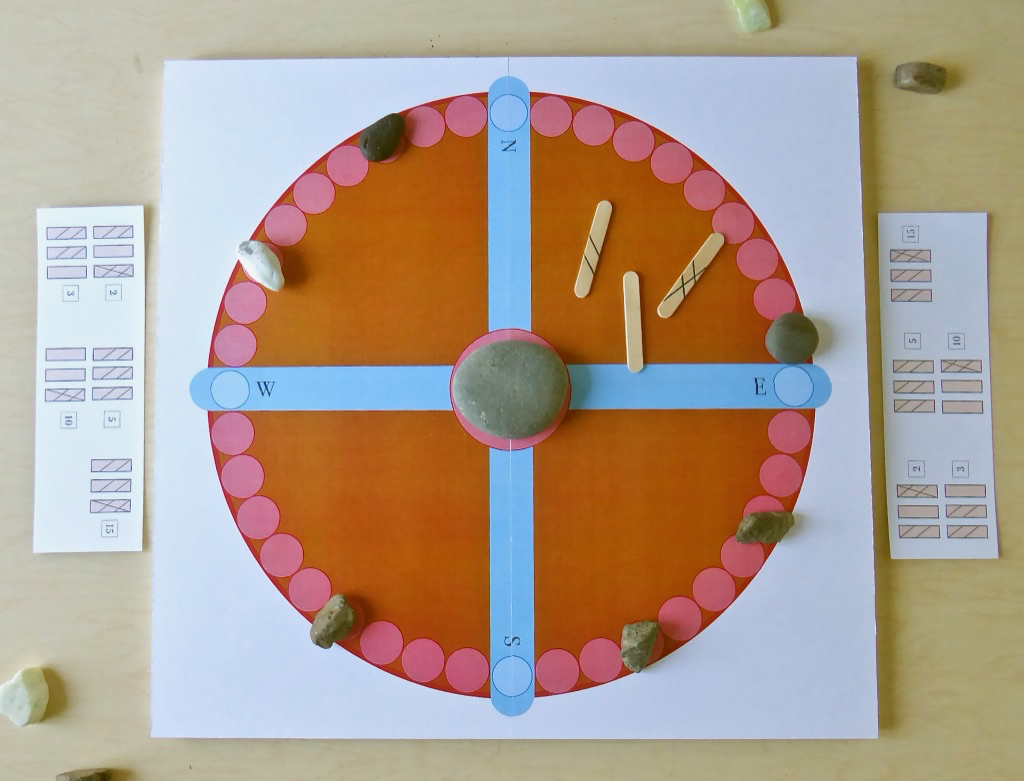
This game works best with 8 or more players. If you have fewer players, give each player two horses; players take a separate turn for each horse.
Setting up the game:
Put the stone in the center of the game board. The playing pieces, called “horses,” remain off the game board until a player plays them.
Throw the counting sticks to see who goes first:
Hold the three counting sticks in your hand about a foot above the game board. Bring your hand down, and release the sticks about 6 inches above the stone (but no closer). The sticks hit the stone, bounce, and fall with one face or another showing.
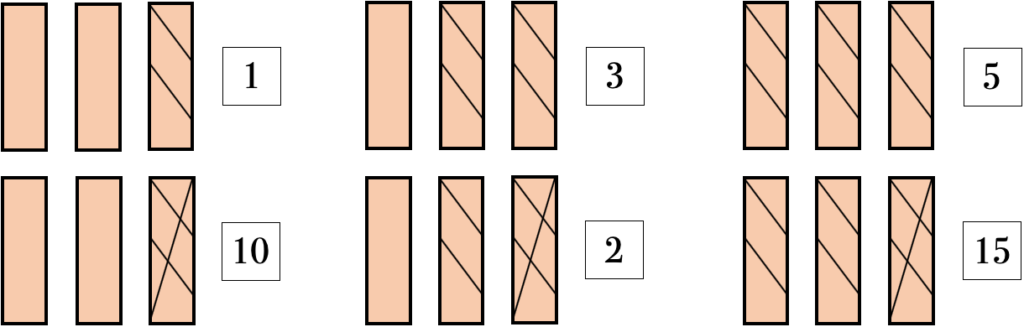
The diagram below shows how many points you get, depending on which sides of the counting sticks are showing. The player with the highest number of points goes first.
Game play:
The first player throws the counting sticks, and, starting from a blue circle nearest to where they are sitting, moves their horse that number of spaces. Players may move either clockwise or counterclockwise as they wish, but once they begin moving in one direction they must keep moving in that direction in subsequent turns. However, if they throw a 10, this would place their horse in a river. Horses may not land in rivers. Whenever a throw lands their horse in a river, the player must throw the counting sticks again until they throw a number that will not land their horse in a river.
The other players may begin from the same river that the first player started from, or from a different river. Again, they may move either clockwise or counterclockwise, but once they begin moving in one direction they must keep moving in that direction.
Player’s horses may pass over other players horses. But if one player’s horse ends up on the space occupied by another player’s horse, the other player’s horse is considered dead and must start over. A player may have to start over several times during the course of a game.
If you start over, you must start in the same river you started in before (that is, in the same blue circle). However, if you start over, you can again choose to go either clockwise or counterclockwise—though again, once you choose a direction you have to keep going in that direction, until you have to start over again.
Winning the game:
The first player whose horse makes it all the way around the circle, back to their starting point or past it, wins the game.
Strategy: For good players, this is a game of skill. A good player can hold the sticks in their hand and bounce them in such a way as to get the number they want. But be sure to release your hold well above where the sticks hit the stone, so you’re not accused of cheating.
Paper bag puppets for a Jataka tale
I’m in the middle of writing curriculum for middle elementary grades, and here’s a children’s craft project I just developed for this curriculum. These are puppets for acting out the story-within-the-story of the Buddhist Jataka tale “The Little Tree Spirit” (which you can read on my old blog here).
You will need:
patterns that you print and cut out ahead of time
glue sticks or paste
scissors
pencils
black magic markers
paper bags (lunch bag size, 5 x 10 in. folded)
paper or card stock in the following colors:
—pink (for noses and mouths)
—white (for eyes)
—dull green (for Little Tree Spirit)
—bright green (for Great Tree Spirit)
—orange (for Tiger)
—yellow (for Lion’s head)
—brown (for Lion’s mane)
Let’s start by seeing how the Tiger is made.
(1) Cut out the head, attach it to the paper bag:
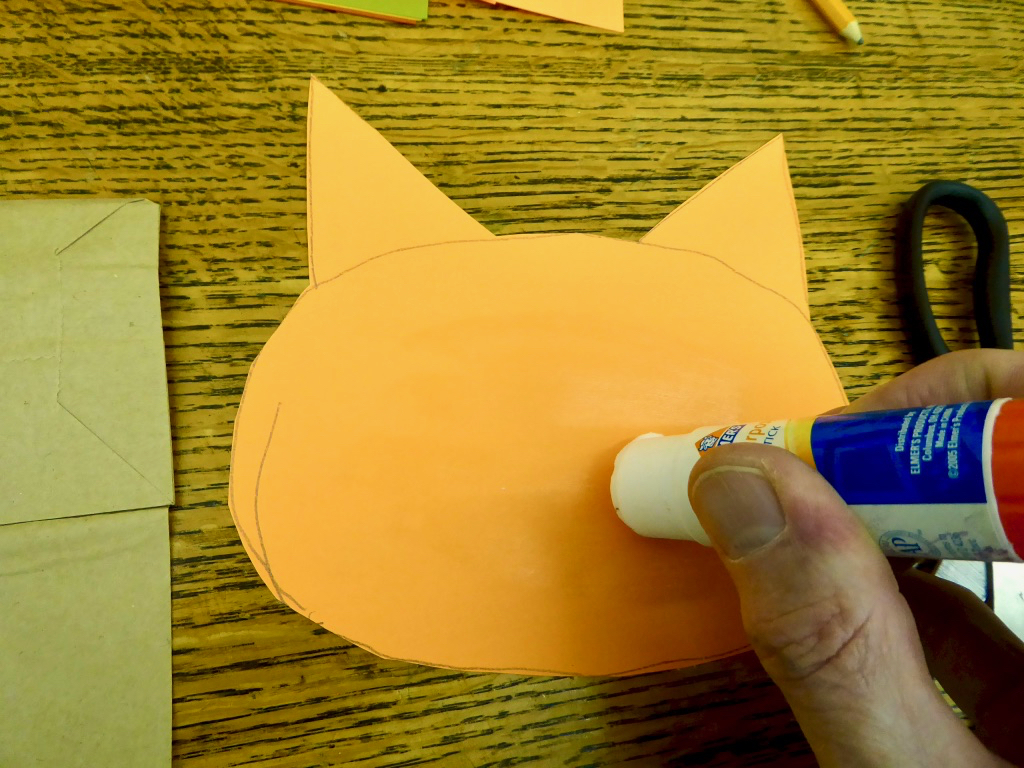
Trace the head shape from the patterns or draw it freehand on orange paper, then cut it out. Glue the head to what is the usually bottom of the paper bag.
(2) Add details to the head:
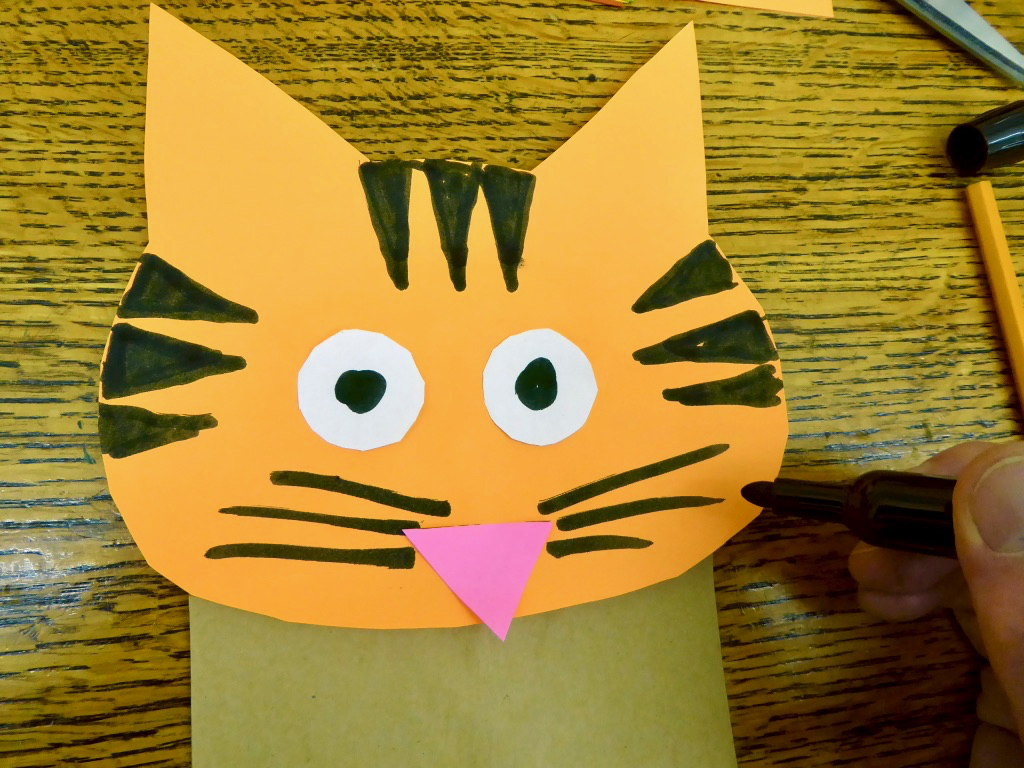
Cut out the nose from pink paper, and two eyes from white paper. Glue on the eyes and nose, and draw pupils in the eyes. Using the black magic marker, draw stripes and whiskers on the tiger as shown above.
(3) Add the mouth:
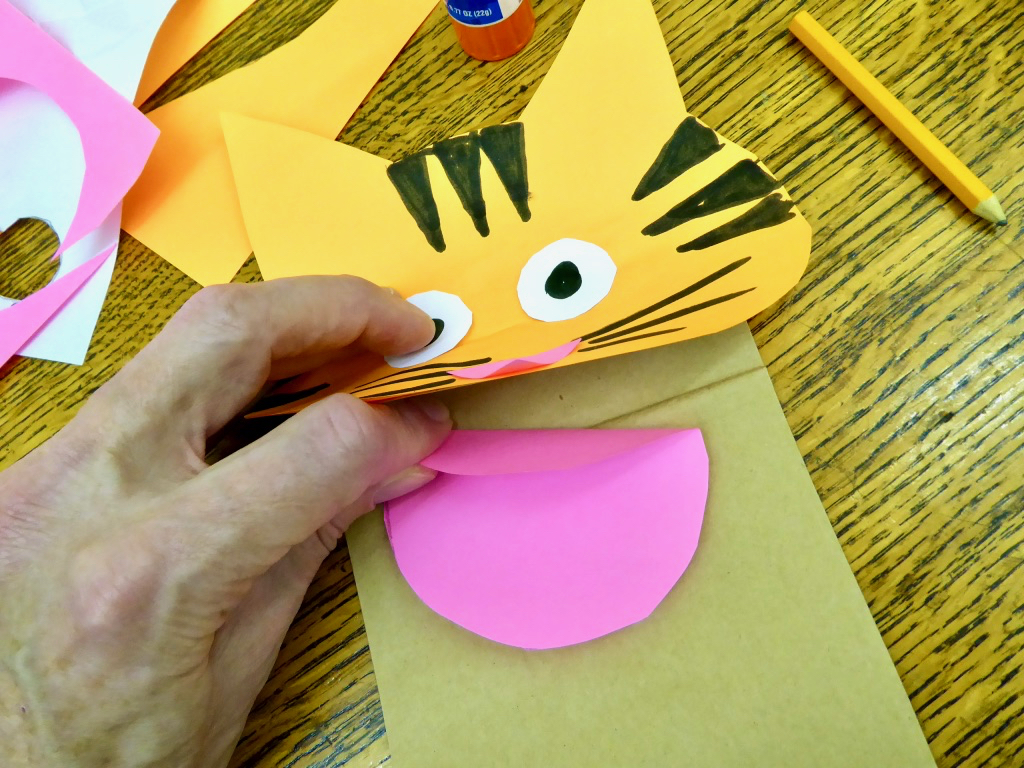
Cut out the mouth, and fold it at about one third of the way across the diameter (about one inch from the edge). Glue the mouth in the flap formed by the bottom of the paper bag where it’s folded over, as shown in the drawing. You want a little bit of the pink mouth to show below the head of the puppet.
(4) Try your puppet:
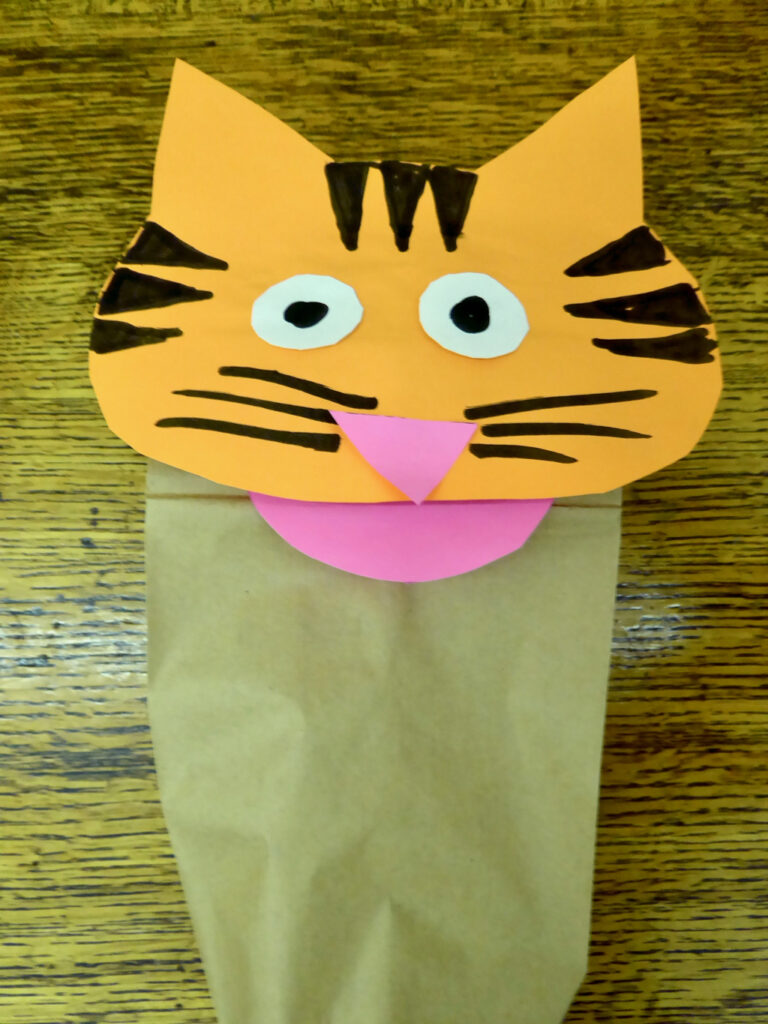
Put your hand inside the puppet, and make sure the mouth looks right when you open and close the puppet’s mouth.
(5) Make the other puppets:
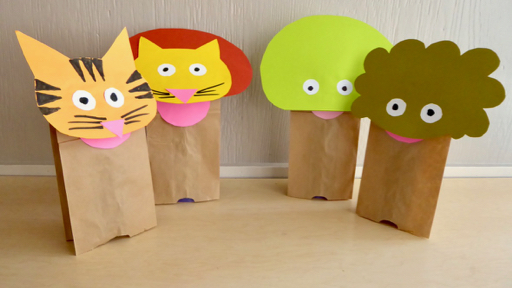
The rest of the puppets are made in much the same way. (1) For the Lion: use the same head pattern but cut the head out of yellow paper; then cut a mane out of brown paper and glue the head on the mane. (2) For the Little Tree Spirit: use the tree pattern and cut the tree out of green paper. (3) For the Great Tree Spirit: use the mane pattern, cutting the shape out of green paper for the “head.”
Now you have all the puppets you need to act out the story. They’re kind of crude, but they’re effective.
Unitarians in Palo Alto, 1891-1934: A Biographical Dictionary
A couple of years ago, I printed a biographical dictionary of Palo Alto Unitarians from 1891 to 1934. Since then, a missing box of old records resurfaced, and those records provided me with many more names of early Palo Alto Unitarians. Today, I completed the draft version of a new, expanded biographical dictionary.
Eventually, this biographical dictionary will be printed out and placed in the archives of the Unitarian Universalist Church of Palo Alto, successor to the late nineteenth and early twentieth century Unitarian congregations in Palo Alto. But first I have to proofread it (a task which I abhor), and check it for errors (marginally less abhorrent). Who knows when I’ll get that done?
In the mean time, I’m releasing a PDF of the uncorrected proof — mostly to get this information on the Web for people who might be looking for it, including genealogical researchers and people looking into Unitarian history.
Unitarians in Palo Alto, 1891-1934: A Biographical Dictionary — uncorrected proof (PDF, 2.3 MB)
Many of biographical appeared here earlier, in a slightly different form, as blog entries.
For scholars of Unitarian and Universalist history, perhaps the most interesting point made in this biographical dictionary is that David Starr Jordan did indeed formally become a member of a Unitarian church, contrary to what is stated in his biography on the UU Historical Society Biographical Dictionary Web site. Records of the Unitarian Church of Palo Alto show: “In his annual report for 1925, Rev. Elmo Arnold Robinson noted that David became a member of the church in that year, and he appeared in the 1926 List of Resident Members.” [Note that in the uncorrected proof, “1925” is mistyped “1295.”] I also touch on Jordan’s now-controversial embrace of eugenics.
Local historians will be interested to learn a little more about Rev. Leila Lasley Thompson, the first duly ordained woman installed in any Palo Alto congregation. Feminist historians will appreciate the effort made to trace the lives of women in the congregation; too many histories of congregations ignore women members and participants.
However, this biographical dictionary is going to appeal to a very limited number of people; if it bores you, ignore it.
Obscure Unitarians: Sylvie Grace Thompson Thygeson
This post has been superseded by a new post on Thygeson which contains substantial additional research.
An advocate for woman suffrage, and an early birth control activist, Sylvie Grace Thompson was born June 27, 1868, in the small town of Forreston, in central Illinois. Progressive activism had a long history in her family: her name “Sylvie,” a French name, came from a girl that her father had met when he was a boy; his parents were active with the Underground Railroad, and this girl was one of a family of fugitive slaves escaping from Louisiana.
Her family had no religion, and was the only family in town that were atheists. When interviewed at age 104, she stated that she had never had any religion, though as we shall see she associated for a brief time with a Unitarian church.
She entered high school at age twelve and graduated at sixteen, then taught in a country school for a month until her father died; thereupon she went to live with an uncle who lived in St. Louis, Mo. She worked for her uncle, an appellate judge, as a stenographer. She later recalled that time in St. Louis as a broadening experience, one that made up in part for her family’s inability to send her to college. After two years in St. Louis, she rejoined her mother and younger siblings, who were then living in St. Paul, Minn.
She married Nels Marcus Thygeson, a lawyer, in 1891. They had children including Ruth Adelaide (b. April 9, 1895, Minn.), Elling Henry McKee (b. Feb. 26, 1898, Minn.), Phillips Baker (b. March 28, 1903, Minn.), and Mary Ellen Baker (b. May 26, 1906, Minn.).
While living in St. Paul, Sylvie became active both in the suffrage and birth control movements. Her suffrage work in St. Paul was centered in the Women’s Welfare League, of which she was the First Vice President. The Women’s Welfare League also financially supported birth control efforts. Around 1915, working with two other women, Sylvie started a birth control clinic in St. Paul. Margaret Sanger came to speak to them, and they found two (male) physicians to work with them, to actually provide the “birth control instruments.” Birth control was illegal, so while they arranged public lectures on the topic, actually providing birth control was done in secret, relying on word-of-mouth referrals.
In 1917, Nels died after a long fight with cancer, upon which Sylvie and her four children moved to Palo Alto — after a brief stop in Old Orchard, Maine — so the children could attend Stanford Univ. By 1920, Sylvia was widowed and living with Elling, Phillips, and Mary in Palo Alto; Sylvie gave her occupation as “none”; Nels’ death apparently did not cause her financial hardship. In Palo Alto, Sylvie was active with the Women’s International League for Peace and Freedom (WILF) — as were Annie Tait and Marion Alderton, who were both members of the Unitarian Church of Palo Alto, and may have introduced her to church.
Sylvie was listed in the 1919 parish directory of the Unitarian Church of Palo Alto with her daughter Ruth, and Sylvie appeared on the 1920 membership list. This church would have been a good fit for her; the young adult group called themselves the Humanist Club, and there were many other pacifists and advocates for women’s rights in the church. However, Sylvie’s name was crossed out in the 1921 revision. Fellow pacifists Marion Alderton and Alice Locke Park resigned from the church in June, 1920, in protest against “the attitude taken” by the church in the First World War; Sylvie left the church at about the same time, perhaps for the same reason.
In 1925, Sylvie was still living in Palo Alto with Elling, Mary, and Phillips; Ruth had married in 1918, and had moved to San Francisco with her husband. Mary was the last to finish her studies at Stanford, receiving her degree in 1928, and she and Sylvie were still in Palo Alto in that year. After that, Sylvie moved to Los Angeles. In 1930, she was living there with her mother, her son Elling, a brother and other relatives. In 1940, she was still in Los Angeles, now living with her mother and two brothers. While in Los Angeles, she continued her social activism, and was a member of the Anti-Nazi League. Her mother died in May, 1946. Sylvie returned to Palo Alto in 1955.
Late in life, she expressed her world view as being based on the theory of evolution. She died in San Mateo County, Calif., in 1975, at age 107. At her request, there was no funeral service.
Though she was a Unitarian for only a couple of years, given her strong commitment to women’s rights and her commitment to women’s access to birth control, we should be proud that this freethinker and atheist was willing to affiliate with a Unitarian church for even that brief time.
Notes: 1870, 1880, 1900, 1910, 1920, 1930, 1940 U.S. Census; 1895, 1905 Minnesota State Census; Feminist History Research Project, interviews conducted by Ralda Sullivan, and Sherna Gluck and Mary Shepardson, “Sylvie Grace Thompson Thygeson: In the Parlor,” The Suffragists: From Tea Parties to Prison, Berkeley: Univ. of Calif., 1975; Directory of Palo Alto, Mayfield, Stanford Univ., Ravenswood, and East Palo Alto, Palo Alto: Willis Hall, 1925; New York, New York Passenger and Crew Lists, 1909, 1925-1957, S. S. Majestic sailing from Cherbourg, May 2, 1928; Obituary, Mary Ellen Thompson, Los Angeles Times, May 13, 1946, p. 8; California Death Index.
A Glee at Christmas
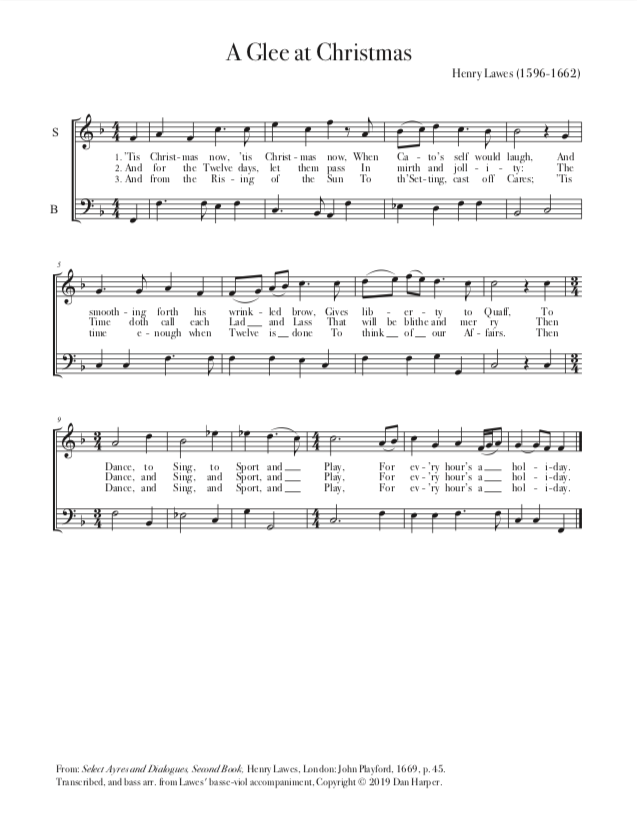
A little-known song for Christmas by Henry Lawes. This song, published in 1669, is a Christmas party song, with absolutely no religious content except the word “Christmas.”
’Tis Christmas now, ’tis Christmas now,
When Cato’s self would laugh,
And smoothing forth his wrinkled brow,
Gives liberty to Quaff,
To Dance, to Sing, to Sport and Play,
For ev’ry hour’s a holiday.
And for the Twelve days, let them pass
In mirth and jollity:
The Time doth call each Lad and Lass
That will be blithe and merry
Then Dance, and Sing, and Sport, and Play,
For ev’ry hour’s a holiday.
And from the Rising of the Sun
To th’Setting, cast off Cares;
’Tis time enough when Twelve is done
To think of our Affairs.
Then Dance, and Sing, and Sport, and Play,
For ev’ry hour’s a holiday.
Click on the image below for a PDF of sheet music for this song. The melody in the sheet music is Lawes’ melody; Lawes outlined a bass line to be played on theorbo or bass-viol, and I changed the rhythms of this slightly to fit the lyrics so bass voices could sing this part.
Kisolo
I’m in the process of writing a curriculum for middle elementary that will include a story from the Kongo religious tradition, “Spider Steals Nzambi Mpungu’s Heavenly Fire.” As a supplementary activity, I’m planning to include instructions for Kisolo, a traditional Congolese game that resembles the well-known Mancala game that’s commercially available in the U.S. So here’s my first pass at Kisolo rules, somewhat simplified for middle elementary grades. (If you play this game, let me know what you think of the rules.)
To make a Kisolo board: Take two egg cartons, and cut their lids off. Tape them together to make a game board with six by four holes. (Most traditional Kisolo boards are four by seven holes in size, but a smaller board is allowable and makes for shorter game play.) You can also use he commercially available Mancala boards — take two of them, place them side by side and ignore the large bins at the ends of the boards.
To set up the board: Place three “seeds” in each bin. You can use actual bean seeds, or small glass tokens or what-have-you, for seeds. (For a faster game, plant only two seeds per bin.)
To start:
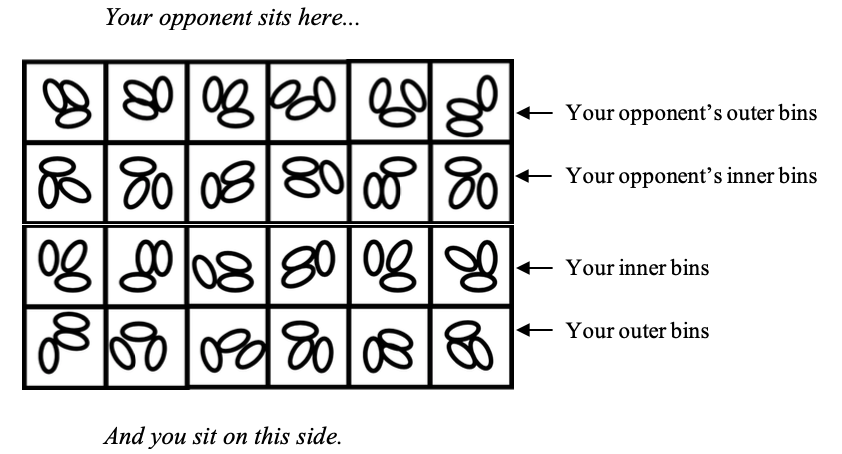
Two players sit at the long sides of the game board opposite each other. The twelve bins on your side belong to you, and the twelve bins on your opponent’s side belong to them. Each player has six “outer bins” (the row of bins nearest to them) and six “inner bins” — see the diagram above.
To play:
Youngest player starts.
When it is your turn, see if one of your inner bins contains seeds AND your opponent’s inner bin opposite it contains seeds. (If that’s true of more than one of your inner bins, just pick one; OR if you can’t capture any seeds, see below.)
Then remove all the seeds from your inner bin, plus the seeds in the corresponding bin that belongs to your opponent, and any seeds in your opponent’s outer bin that’s next to that inner bin.
Now “sow the seeds,” that is, starting with the inner hole you’ve just emptied, place one seed in each of your holes and continue counterclockwise sowing seeds only into you holes, until you have sown all the seeds.
If your last seed falls in one of your inner holes, then you ALSO get to remove all the seeds from your inner bin, plus the seeds in the corresponding bin that belongs to your opponent, and any seeds in your opponent’s outer bin that’s next to that inner bin. Then you sow the seeds as before—it’s like you get another turn (but after that your turn is over).
IF YOU CANNOT CAPTURE ANY SEEDS, then empty the seeds out of any one of your holes and sow those seeds counterclockwise into your own holes.
To win the game:
Capture all the seeds in your opponent’s INNER holes (doesn’t matter how many seeds are in the OUTER holes).
Note that some games will end in a draw, where neither player can win. If it feels like the game is going nowhere, the players can agree to a draw.
Obscure Unitarians: historian Frank Golder
A historian, Frank Alfred Golder was born near Odessa, Russia, on Aug. 11, 1877, and emigrated to the United States about 1880. He attended schools in New Jersey and Kentucky, and attended Bucknell Univ., from which he graduated in 1898. He then taught for three years in a government school in Alaska, where he collected Aleut songs and stories which he published in the Journal of American Folklore. He went to Harvard Univ. in 1902, received his A.B. in 1903, then did graduate study relating to Alaska, receiving his Ph.D. from Harvard in 1909. He taught briefly at Boston Univ. and the Univ. of Chicago before joining the faculty of the State College of Washington in Pullman, Wash.
His dissertation was published in 1914 under the title Russian Expansion on the Pacific, 1641-1850. He was studying in Russia in 1914, and on Aug. 2 saw the Tsar address an excited crowd in front of the Winter Palace, telling the nation that they were at war. He returned to the United States by way of Siberia, and resumed teaching in Pullman. But he returned to Russia in 1917, sailing from Seattle to Petrograd, arriving on March 4, less than two weeks before the Tsar was overthrown. He remained in Russia through August, working in the archives on material relating to Russian expansion on the Pacific Coast of North America, but he also witnessed the July uprising in the capital city of Russia; he also traveled in Russia between Vladivostok and Petrograd, and in European Russia as well. The notes during 1917 he took helped him write The Russian Revolution and the Jugo-Slav Movement, published in 1918; his work in the archives studying the Russian presence in North America led to the book Bering’s Voyages (vol. 1, 1922; vol. 2, 1925).
In 1920, he returned to Russia, and did relief work there under the auspices of Herbert Hoover’s American Relief Administration; this work led to the book On the Trail of the Russian Famine (coauthor Lincoln Hutchinson, 1927).
In 1923, he went to the Hoover War Library, Stanford Univ., where he was both professor of history and one of the directors of the library. He visited Russia again in 1925 and 1927.
He joined the Unitarian Church of Palo Alto in 1924, and was listed in the 1926 “List of Resident Members.” He died Jan 7, 1929, in Santa Clara County, Calif.
Notes: 1920 U.S. Census; Passport application, Frank Golder, Aug. 23, 1920 (no. 84075); H. H. Fisher, “Frank Alfred Golder,” Journal of Modern History, June, 1929, pp. 253-255; California Death Index.
The Accursed Lake
Another in a series of stories for liberal religious kids. This story comes from Charles Fletcher Lummis, Pueblo Indian Folk-Stories (New York: D. Appleton-Century Co., 1910), pp. 109-116; a book of stories of the Ysleta Del Sur Pueblo, or Tigua Indians of Texas. I have edited the story for length and clarity.
Long ago there was still a village east of the Eagle-Feather Mountains, where there lived a Hunter. One day, while out hunting, he followed the trail of an antelope until the trail ended in a large lake.
Just then, a fish thrust its head from the water and said, “Friend Hunter, you are on dangerous ground!” and off it went swimming.
Before the Hunter could recover from his surprise, a Lake-Man came up out of the water and said, “How is it that you are here, where no human ever came?”
The Hunter told his story, and the Lake-Man invited him to come in to his house. They entered the house by a trap-door in the roof, and climbed down a ladder. Inside, there were doors to the east, north, west, and south, as well as the door in the roof. Soon the Lake-Man learned that the Hunter had a wife and son at home.
“Why not come live with me?” the Lake-Man said. “I am no hunter, but I have plenty of other food. We could live very well here together.” And he showed the Hunter the four other huge rooms, all filled with corn and dried squash and the like.
“I will come with my wife and son in four days,” said the Hunter, “if the leader of my village will let me.”
So the Hunter went home, and his wife thought very well of the offer. The leader of his village did not want him to go, for he was the best hunter in all the pueblo, but at last gave permission.
So the Hunter and his wife and little boy came to the lake with all their property. The Lake-Man welcomed them, and they settled in. The Hunter went out hunting and brought back great quantities of game, and his wife took charge of the household, as was their custom.
Some time passed very pleasantly. But at last the Lake-Man, who had an evil heart, pushed the Hunter into the East Room, locked the door and left him there to starve. The room was full of the bones of people whom he had tricked in the same way.
The boy was now old enough to hunt small game, and he brought home many rabbits. But the evil-hearted Lake-Man wanted to get him out of the way, too. One morning when the boy was about to start hunting, he heard his mother groaning as if about to die.
“Your mother is in terrible pain,” said the evil Lake-Man, “and the only thing that will cure her is sacred ice from the Lake of the Sun in the east.”
The boy said he would go get the ice, and started off toward the sunrise.
He walked over the brown plains until at last he came to the house of Old-Woman-Mole. She was there all alone, for her husband had gone to hunt. They lived in an old broken-down hut, and she was huddled trying to keep warm by a dying fire. But when the boy knocked, she rose and welcomed him kindly and gave him all there was in the house to eat: a tiny bowl of soup with a patched-up snowbird in it. The boy was very hungry, and picking up the snowbird bit a big piece out of it.
“Oh, my child!” cried the old woman. “You have ruined me! My husband trapped that bird these many years ago, but could never get another, and that is all we have had to eat ever since. So we never bit it, but cooked it over and over and drank the broth. And now not even that is left.” And she wept bitterly.
“Nay, Grandmother, do not worry,” said the boy, for he saw many snowbirds alighting nearby. Using his long hair, he made sanres and soon caught many snowbirds. Then the Old-Woman-Mole was full of joy. After the boy told her his errand, she said:
“I shall help you. When you come into the house of the True People, they will offer you a seat, but you must not take it. They will try you with smoking the weer, but I will help you.”
With that, the boy started away to the east. At last, he came so near to Sun Lake that medicine men and guards of the True People saw him coming, and went in to tell the True People.
“Let him be brought in,” said the True People; and the guards brought the boy in through a magnificent building, until he stood in the presence of the True People in a vast room: white-colored gods of the East, blue gods of the North, yellow gods of the West, red gods of the South, and rainbow-colored gods of Up, Down, and Center. Beyond them were the sacred animals: the buffalo, the bear, the eagle, the badger, the mountain lion, the rattlesnake, and all the others that are powerful in medicine.
The True People offered the boy a white robe to sit on; but he declined respectfully, saying that he had been taught, when in the presence of his elders, to sit on nothing save what he brought, and he sat upon his blanket and moccasins. Then he told them that he had come for the sacred ice, to save his mother’s life.
The True People gave him a sacred weer, that is, a hollow reed filled with the magical plant pee-en-hleh, from the smoke of which the rain clouds come. The boy took in the unpleasant smoke, but the Old-Woman-Mole dug a hole up to his toes, and the smoke went down through his feet into the hole so that no smoke escaped into the room of the True People.
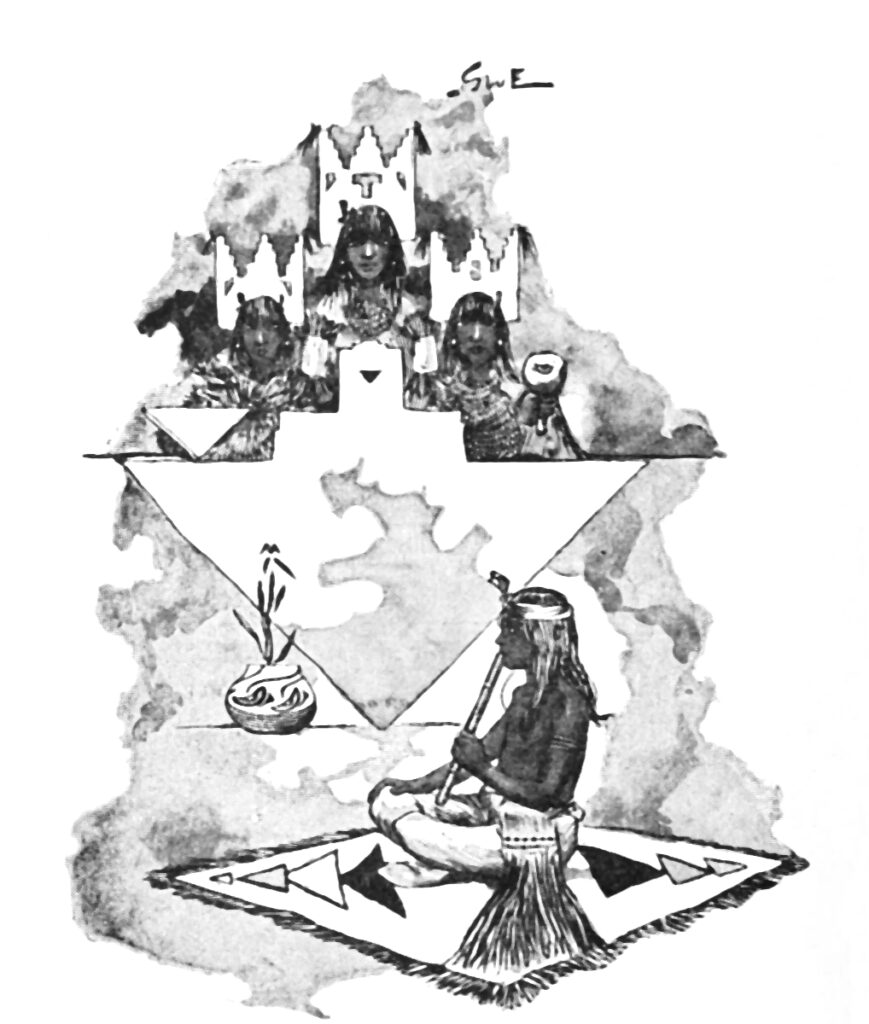
“Surely he is our child,” said the True People to one another, “but we must test him again.” So they put him into the room of the East with the bear and the mountain lion, but he came out again unhurt. They put him into the room of the North, with the eagle and the hawk; into the room of the West, with the snakes; into the room of the South, with the Apaches and other human enemies of his people. He came forth from each room unhurt.
“Surely he is our child,” said the True People to one another, “but we must test him again.” They had a great pile of logs built up, set the boy on the top of the pile and lighted it. But in the morning, the boy sat there unharmed, saying, “I am cold and would like more fire.”
So the guards brought him inside, and the True People said: “You have proved yourself worthy of us, and now you shall have what you seek.”
They gave him the sacred ice, and he hurried home, stopping only to thank the Old-Woman-Mole.
When the evil Lake-Man saw the boy, he was very angry, for he had never expected him to return with the sacred ice. He pretended he was glad to see the boy, but said he must go to the gods of the South to get sacred ice there.
The boy walked south across the brown plains until he came to a drying lake. There, dying in the mud, was a little fish. Picking it up, the boy put it in his gourd canteen of water. After awhile he came to a good lake, and the fish in his gourd said, “Friend Boy, let me swim while you eat your lunch, for I love the water.”
So he put the fish in the lake; and when he was ready to go on, the fish came to him, and he put it back in his gourd. At three lakes he let the fish swim while he ate; and each time the fish came back to him.
Beyond the third lake began a great forest which stretched clear across the world, and was so dense with thorns and brush that no human being could pass through. The tiny fish changed itself into a great Fish-Animal with hard, strong skin, and bidding the boy mount upon its back, it went plowing through the forest, breaking down big trees like stubble, and bringing him through to the other side without a scratch.
“Now, Friend Boy,” said the Fish-Animal, “you saved my life, and I will help you. When you come to the house of the True People of the South, they will try you as they did in the East. When you have proved yourself, the leader of the True People will bring you his three daughters, from whom to choose you a wife. The two eldest are very beautiful, and the youngest is not; but choose the youngest, for she is good and the beauty of the older sisters does not reach to their hearts.”
The boy thanked the fish and went on. At last he came to the house of the True People of the South. They tried him just as the True People of the East had done. Once again he passed the tests, and they gave him the sacred ice. Then the leader of the True People brought his three daughters, and said, “You are now old enough to have a wife, and I see that you are someone who cares for those around him. Therefore, choose one of my daughters to marry.”
The boy remembered the words of his fish friend, and said, “I choose your youngest daughter.”
The leader of the True People was pleased, and the boy and the youngest daughter were married. They started home, carrying the sacred ice and many presents. With the help of the Fish-Animal, they got through the forest, and walked on.
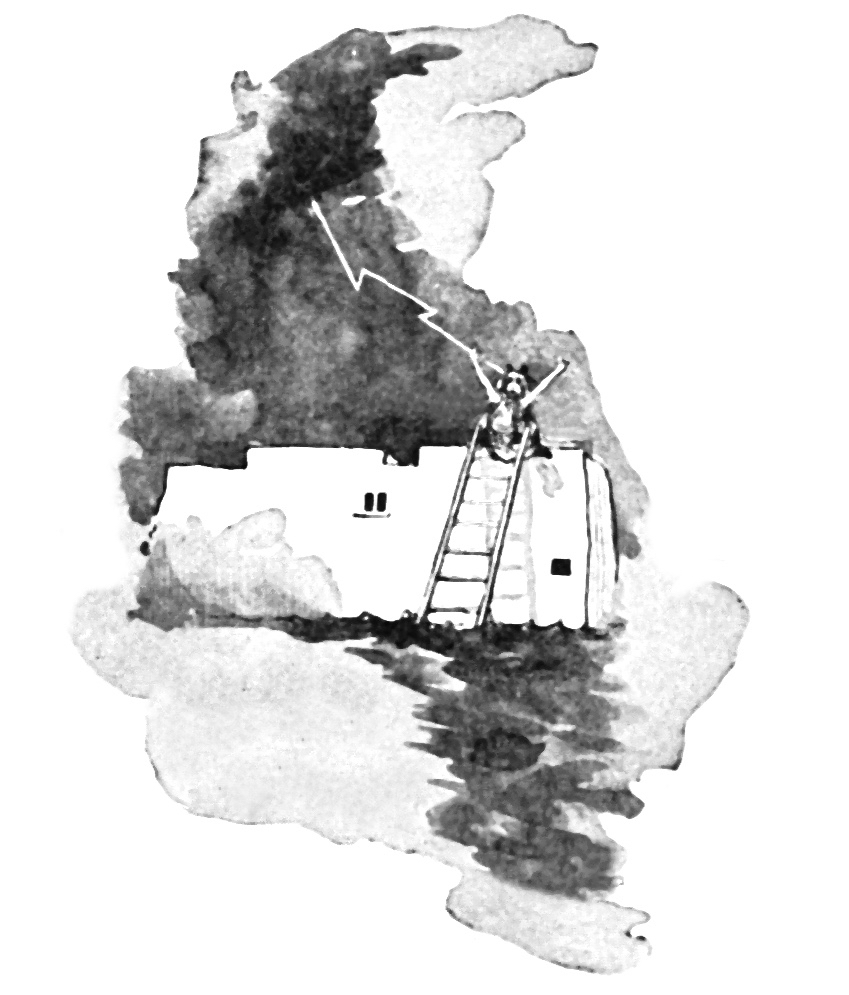
At last they came in sight of the big lake, and over it were great clouds, with the forked lightning leaping forth. They could see the evil Lake-Man sitting at the top of his ladder, watching to see if the boy would return, and as they watched the lightning of the True People struck him dead.
So the boy and the youngest daughter found the boy’s mother, and the three of them left the house of the evil Lake-Man. They left all the belongings of the evil Lake-Man behind, and when they got to the shore of the lake, the boy stood and prayed to the True People that the lake might be accurst forever. From that day its waters turned salt, and no living thing has drunk therefrom.
The Red-Cedar Sculpture of the Woman Who Had Died
Another in a series of stories for liberal religious kids. This is a Tlingit myth recorded in Wrangell, Alaska.
A young man and a young woman on the Haida Gwaii, the Islands of the Haida People, married. The young man was a chief, and the couple were very happy together. But soon after they were married, the young woman fell ill. Her husband sent around everywhere for the very best shamans, to try to cure her of her illness. He heard about a very fine shaman from another village on the island, and sent a canoe there to bring that shaman. But that shaman could do nothing. The young chief heard about another fine shaman at another village on another island, and again sent a canoe; but neither could that shaman cure the young woman. The young man sent for several fine shamans, but none of them could help his wife, and after she had been sick for a very long time she died.
The young chief felt very badly after his wife had died. He went from village to village to find the best wood-carvers in order to have them carve a sculpture of his wife. But though he asked several fine carvers, no one could make a sculpture that looked like his wife.
All this time there was a wood-carver in his own village who could carve much better than all the others. This man met the young chief one day and said, “You are going from village to village to have wood carved like your wife’s face, and you can not find anyone to do it, can you? I have seen your wife a great deal walking along with you. I have never studied her face with the idea that you might want some one to carve it, but I am going to try if you will allow me.”
The young chief agreed to try. The wood-carver found a very fine piece of red-cedar and began working upon it. When he had finished, the wood-carver had dressed the sculpture just as he used to see the young woman dressed. Then he went to the young chief and said, “Now you can come along and look.”
The young chief came to the wood-carver’s workshop, and when he got inside, he saw his dead wife sitting there just as she used to look. This made him very happy, and he said he would like to take this sculpture home. “What do I owe you for making this?” he asked the wood-carver.
The wood-carver had felt sorry to see how the young chief was mourning for his wife, so he said, “Do as you please about it. It is because I felt badly for you that I made that. So don’t pay me too much for it.”
But the young chief paid the wood-carver very well, both in slaves and in goods.
The young chief dressed this sculpture in his wife’s clothes and her marten-skin robe. When he finished, he felt that his wife had come back to him. He treated the sculpture just like her. One day, while he sat very close to the sculpture, mourning for his dead wife, he felt the sculpture move. He thought that the movement was only his imagination. Yet he knew his wife had been as fond of him as he was of her, and so each day as he ate his meals he sat close to the sculpture, thinking perhaps some time it would in fact come to life.
After a while the whole village learned the young chief had this sculpture of his wife. One by one, they all came to see it. It was so life-like that many people could not believe that it was not the woman herself until they had examined it closely and saw it was only made of wood.
One day, after the chief had had it for a long, long time, he sat down next to the sculpture, and saw that the body was just like the body of a human being. Now he was sure the sculpture was alive, and he began to treat it just as if it were his wife. Yet though he was sure the sculpture was alive, it could not move or speak.
Then one day the sculpture gave forth a sound like cracking wood. The man was sure something was wrong; perhaps the sculpture was ill. He had some people come and move it away from the place where it had been sitting, and when they had moved the sculpture they found a small red-cedar tree growing there on top of the flooring. The man left the young red-cedar tree to grow there, until it grew to be very large. (For many years afterwards, when people on the Queen Charlotte Islands went looking for red-cedars, if they found a good one they would say, “This looks like the baby of the chief’s wife.” And it is because of the young chief’s wife that red-cedars on the Queen Charlotte islands provide the very best wood for carving.)
But to return to the red-cedar sculpture of the young woman: The sculpture continued to grow more and more like a human being day after day. People from villages far and near heard the story, and came in canoes to look at the sculpture, and at the young red-cedar tree growing there, at which they were very much astonished. The sculpture moved around about as much as a tree trunk might move in the wind, which is to say not much at all, and the sculpture was never able to talk. Yet the woman’s husband had dreams in which she spoke to him, and even if the sculpture could not talk, it was through these dreams the husband knew his wife was talking to him.
Source: Tlingit Myths and Texts, John R. Swanton, Bureau of American Ethnology Bulletin 39, U.S. Government, 1909, pp. 181-182
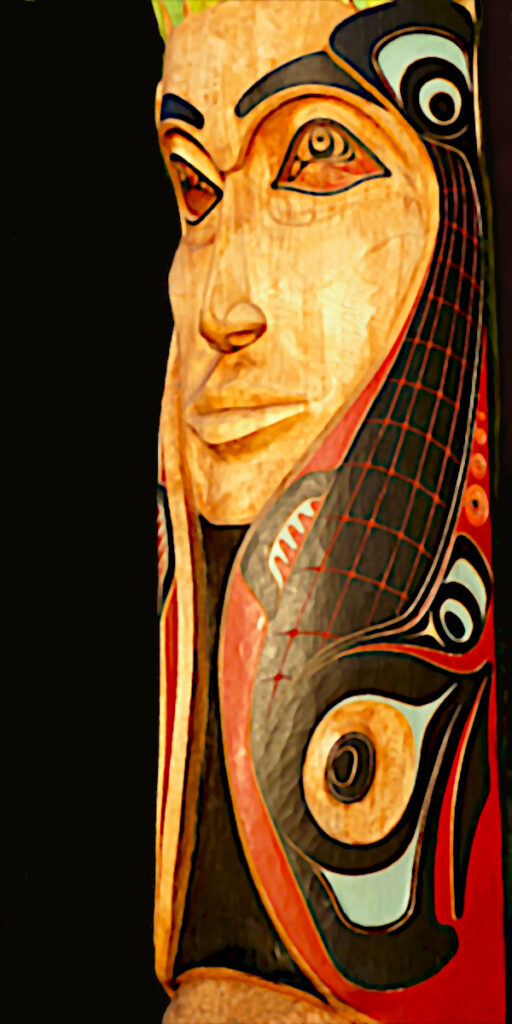
The above is an edited public domain photograph of the Centennial Pole, dedicated in 2011 at the Sitka National Historical Park, Sitka, Alaska, showing the woman carved at the bottom of the pole. “The bottom figure…is a fascinating female portrait by Donnie Varnell, a Haida carver from…Ketchikan (Alaska). Flanked by male and female salmon, she represents Mother Earth.” (Mike Dunham, “Sitka’s Centennial Pole a showpiece of modern totemry,” Anchorage Daily News, June 6, 2014.) Since the story above is a Tlingit tale of the Haida Gwaii, the homeland of the Haida people, it seemed appropriate to use a Haida sculpture to illustrate the story.