The UUA really needs to do this

Within the past couple of hours, Religion News Service has posted an article titled “Reform movement publishes extensive report on sexual misconduct in its youth programs.” The Union for Reform Judaism (URJ) commissioned an outside law firm to investigate sexual misconduct in their movement’s youth programs and summer camps over the past half century. Then URJ published the report in its entirety, with no redactions whatsoever, on their website.

I’m impressed that URJ has both commissioned this investigation, and that they’re being completely open and transparent about the results. Really impressed. Really, really impressed. Mind you, this investigation didn’t extend to individual congregations; that would have been a much more difficult task. Nevertheless, by commissioning this investigation, the URJ has set the standard for individual congregations.

It’s time for the Unitarian Universalist Association to commission a similar investigation into our denominational youth ministries. I was very active in denominational youth activities in the late 1990s and early 2000s, and I heard enough stories back then to make me think that an investigation would turn up more sexual misconduct than anyone would feel comfortable with.

If the UUA were to commission a law firm to carry out this kind of investigation, what should we look for? We should look for exactly what the URJ looked for: sexual misconduct by adults (anyone over age 18) against minors (anyone under age 18); sexual misconduct between minors; and sexual misconduct between adults at youth activities. As I look back 50 years to 1972, at a minimum the following programs should be investigated: “ConCon,” the former continental youth conference; district youth conferences; and any other programs or summer camps run by Liberal Religious Youth (LRY) or its successor Young Religious Unitarian Universalists (YRUU).

The UUA doesn’t have a great track record of investigating and publicly admitting the sexual misconduct that’s happened in our denomination. This is a grand opportunity for us to do the right thing. I hope our denominational leaders will follow the shining lead of the Reform Jews.

Coloniality and gender

I seem to have very little time these days, as the Omicron surge winds down, and as our congregation opens up again (or maybe re-opens up? — or is it re-re-opens up?). Nevertheless, I’m slowly making my way through some essays by Maria Lugones, and I’m currently reading “The Coloniality of Gender.” In this essay, she critiques Anibal Quijano’s theoretical work on global capitalism for his “complicity with the gender system.” In other words, many males who write about colonialism ignore how women are dominated.

But Lugones is also laying out another way to analyze gender, a model which she calls “the modern colonial/gender system”:

“In Quijano’s model of global capitalist Eurocentered power, ‘capitalism’ refers to the ‘structural articulation of all historically known forms of control of labor or exploitation, slavery, servitude, small independent mercantile production, wage labor, and reciprocity under the hegemony of the capital-wage labor relation.’ (‘Colonialidad del Poder y Clasificacion Social,’ Festschrift for Immanuel Wallerstein, part I, Journal of World Systems Research, V. xi, #2, summer/fall 2000). In this sense, the structuring of the disputes over control of labor are discontinuous: not all labor relations under global, Eurocentered capitalism fall under the capital/wage relation model, though this is the hegemonic model. It is important in beginning to see the reach of the coloniality of power that wage labor has been reserved almost exclusively for white Europeans. The division of labor is thoroughly ‘racialized’ as well as geographically differentiated. Here we see the coloniality of labor as a thorough meshing of labor and ‘race.’”

Lugones connects colonialism, capitalism, gender, and race. This has some interesting implications for the way we Unitarian Universalists think about anti-oppression work.

Not OK

Someone pointed out to me that Star Island has posted an interesting job opening. Star Island, for those of you who aren’t familiar with it, is a retreat center off the coast of New Hampshire that was founded by Unitarians and liberal Congregationalists, and remains affiliated with the United Church of Christ and the UUA.

The position, titled “Island Minister/Beloved Community Project Manager,” will “work to further Star Island Corporation’s Beloved Community Project — a diversity, equity, and inclusion initiative that is a core strategic priority of the Star Island Corporation (SIC).” This is a laudable goal, and it’s simply amazing that a nonprofit would hire a full-time year-round staffer to oversee diversity, equity, and inclusion.

There’s just one problem. The job posting does not list the salary range. Instead, applicants are told to submit their “salary requirements.”

I call bullshit.

The reason I call bullshit — and the reason that I use such a strong word to describe their action — is that refusal to include a salary range in a job posting is in itself a discriminatory act. In fact, in some jurisdictions, it is now illegal to post a job with no salary range: BBC news recently reported that Colorado now requires all job posting to include the hourly wage or the salary range. Similarly, SHRM recently reported that New York City will require all job posting in the city to include salary ranges. Why? Manhattan Councilwoman Helen Rosenthal says, “Failure to include a salary range would be considered a discriminatory practice.” That’s right, a discriminatory practice.

BBC has also reported: “Research shows that the pay gap, which is well documented, partly stems from the ‘ask gap’: the difference in salary expectations between groups, which undercuts women and minorities in particular. Closing this gendered and racialised ‘ask gap’ can pay major dividends for careers, reducing long-term salary inequality.”

Star Island is engaging in a discriminatory hiring practice — a practice that’s illegal in Colorado and New York City — in order to hire a staffer who will oversee diversity, equity, and inclusion. Oh, the irony. If you’re someone who has connections to Star Island (especially if you make donations to them), please contact their board and CEO and call them out on this racist, sexist practice.

We also need to call out all the UU congregations that post jobs with no salary range. Some day if I ever have time, I’m going to go through the job postings on the UUA “Jobs Board” and the LREDA employment postings and make a list of all the congregations that post jobs with no salary range — a sort of “Hall of Shame,” showing which congregations have racist, sexist hiring practices.

This is an equity issue that’s easy to fix. Let’s fix it.

Noted without comment

In memoriam: Thich Nhat Hanh

Thich Nhat Hanh, a Vietnamese Buddhist monk known for popularizing the concept of “Engaged Buddhism,” has just died. (He died Jan. 22 in Vietnam, on the other side of the International Date Line, which was Jan. 21 here in the U.S.) He had been incapacitated by a stroke in 2014, and in 2018 finally received permission from the Vietnamese government to return to his home temple to spend his final days. His name is more properly rendered as Thích Nh?t H?nh, but I’ll use the more common romanization without tonal indications.

Thich Nhat Hanh is probably best known for his series of popular books on Buddhism. Worldcat lists the following titles as the five “most widely held works” in libraries: The Miracle of Mindfulness; Living Buddha, Living Christ; Peace Is Every Step: The Path of Mindfulness in Everyday Life; Anger: Wisdom for Cooling the Flames; and Being Peace. Nhat Hanh arguably did more than anyone else to popularize the concept of mindfulness in the West.

The book of his that I found most interesting, though, one to which I’ve returned a number of times, is The Sutra of the Full Awareness of Breathing (Parallax Press, 1988). This book includes Nhat Hanh’s translation of the ?n?p?nasati Sutta, along with his commentary on the text. This Sutra is no. 118 of the “medium length” sutras that have been collected into the Majjhima Nik?ya. (A later revised version of his translation is now freely available on the website of his Plum Village Buddhist community here.) Nhat Hanh translated the text into French, which was then translated into English; I found the English translation to be lucid, readable, and non-technical. I also liked his The Heart of Understanding: Commentaries on the Prajnaparamita Heart Sutra; I find Buddhist scriptures difficult to understand, and Nhat Hanh’s commentary helped me understand a little bit about this complex text.

But I think Thich Nhat Hanh’s real impact as a writer and teacher was through his many popular books which give good sound advice for living life. I’ve read a little bit in some of his many books on mindfulness, and was impressed by the good common-sense tone of these books. Unfortunately, mindfulness grew into a fad, and big corporations have learned how to use mindfulness as an opiate to drug their workers into submission. But what Nhat Hanh said about mindfulness had nothing to do with submission to a corporate overlord. Quite the contrary: Nhat Hanh’s writings are permeated with the spirit of Engaged Buddhism, and mindfulness connects one fully with the fate of all beings; instead of quietism and retreat from the world, Nhat Hanh’s mindfulness moves us to become engaged in seeking justice.

If your corporate overlord forces you to do mindfulness — or if your school forces you to do mindfulness — try reading Nhat Hanh’s The Miracle of Mindfulness. You’ll find out that mindfulness is not a drug forcing you to submit to your employer or your school. Nhat Hanh used mindfulness as a way to advocate for peace during the long-running war in Vietnam. Mindfulness helped empower him to criticize both South Vietnam and North Vietnam, and also to stand up against U.S. involvement in Vietnam, at great personal cost. Mindfulness helped bring Nhat Hanh to the U.S. in 1966, where he helped convince Martin Luther King, Jr., to speak out against the injustices of the Vietnam War. In short, unlike the mindfulness that corporations and schools teach, which seems designed to ensure passive compliance with tyranny, Nhat Hanh’s mindfulness is designed to resist tyranny, oppression, and injustice.

I’m less interested in Nhat Hanh’s teachings on mindfulness — personally, mindfulness does nothing for my spiritual self — and far more interested in him as a teacher. Everyone I’ve talked to who saw him in person has said he was a riveting teacher. Apparently, his English skills weren’t great — I’m told Vietnamese and French were his main languages — but even through an interpreter his teaching was compelling. I get the sense that it was his presence as a teacher that most impressed those who went to hear him. This has been true of the best teachers I’ve known: there’s something about the way they move, the way they hold their bodies, it is their very being that teaches us. The best teachers, I think, cultivate their persons — or as we might say in the West, cultivate their souls — and it is this cultivation of the person which shines through in their teaching. While I never experienced Nhat Hanh in person, I can catch glimpses of this cultivated soul in his writings. I would unhesitatingly call him a brilliant teacher.

Our troubled world needs brilliant teachers like him, teachers who can empower us to stand up for justice and peace. Thich Nhat Hanh will be sorely missed.

Two hymns not in the public domain

I believe the UUA’s “Copyright & Permissions for Hymn and Reading Use in UU Worship” may incorrectly lists two hymns as public domain or fair use.

Jubilate Deo, hymn #393 — words and music are stated to be “fair use or public domain.” The words clearly are in the public domain. However, the music is covered by copyright. Hymnary.org lists Jacques Berthier as arranger, and shows a scan of a page from a recent hymnal, Ritual Song (2016), that give the following copyright information: “Taizé Community, 1990, © 1978, 1990, Les Presses do Taizé, GIA Publications, Inc., agent.” I think it’s pretty clear that this song should not be used in recordings without permission from the Taizé community.

Rise Up O Flame, hymn #362 — words and music are stated to be “fair use or public domain.” The earliest reference I can find of this song is in the book Sing Together published by the Girl Scouts in the U.S. in 1936; there, the song is “used by permission” and credited to the Kent County Song Book from 1934, which was printed in England for the Girl Guides. Sing Together credits the music to Christoph Praetorius, and it’s quite possible the music is by Christoph Praetorius, or more likely was arranged by someone else from his work. However, the English-language words are surely a translation or adaptation, and may be protected by copyright.

Both these songs have been widely reprinted and recorded, including by major publishers, so you can probably get away with including them in recordings of your congregation’s worship services. But if you want to record “Jubilate Deo,” you really should get permission from the Taizé community. As for “Rise Up, O Flame,” it seems that it was copyrighted at one point, but it’s not clear if the copyright applied to the U.S., and if so, whether the copyright was renewed; proceed at your own risk. Besides, as an ehtical issue, we should respect the moral rights of composers and authors.

This shows that there are indeed errors in the UUA’s “Copyright & Permissions for Hymn and Reading Use in UU Worship.” You have been warned.

Update: In their songbook Rise Up Singing, Annie Patterson and Peter Blood state that “Rise Up O Flame” is in the public domain. They are far more careful at researching copyright than the UUA, so I’m inclined to trust them on this. Plus, no one has sued them for copyright infringement in the decades that songbook has been in print. (And by the way, they do in fact credit “Jubilate Deo” to Jacques Berthier of the Taize community.)

Where we are now with COVID and congregations

I’m watching the case rates in Santa Clara County, where the Palo Alto congregation is located. The 7-day rolling average is over 4,000 — yikes, that’s high. On the other hand, preliminary figures for mortality seem to show a low death rate — probably due in part to the fact that 82.8% of county residents have been fully vaccinated (thought only 58.2% of eligible residents have received boosters). But on the other other hand (that’s three hands, if you’re keeping track), anecdotal evidence from health care professionals says that ICU beds are getting full again, and elective surgeries and procedures that require an overnight stay in the hospital are being postponed.

Obviously, this is not where we hoped to be. But rather than feeling discouraged, I suggest we consider this as another problem in planning. So, how do we plan for next steps in our congregations?

First, just to say the obvious — any plan we make has to be flexible, to account for changing circumstances.

Second, to say something else that’s obvious — we’ve discovered that the big thing that draws many people to UU congregations is the community. Sure, we like the theology, but the big draw is a chance to be a part of a community with shared values. And many people want to get a regular dose of UU community in person.

Third, something else that’s obvious — we’re gaining a pretty good sense of what’s safest, and less safe. It’s safest to do in-person gatherings that are outdoors, distanced (or small groups), and masked. It’s less safe to do indoors events, but some indoors events are still possible in some circumstances. Instead of saying, “Oh we can’t do what we used to do, waaah!” we probably need to start saying, “Gee, what are our present options for fun and engaging communal events?”

So here’s one obvious thing I believe we should be doing: we should be planning outdoors events. Whatever that might be: outdoors worship services, outdoors small group meetings, outdoors classes. (And I know what those of you are going to say who live where winters are really cold — you’re going to say this doesn’t apply to you. Well, my-sister-the-children’s-librarian, who lives and works in Massachusetts, is doing outdoors story time for kids in the winter; sure, her attendance is lower, but people still show up.) It’s true that not everyone in your congregation is going to come to outdoors events, but I suspect enough people are hungry for in-person interaction that it’s worth doing.

Another thing I believe we have to do: start planning like COVID is not going away. I would love it if COVID suddenly decided to go away next month. But it now looks like there’s a good chance that COVID is going to become endemic. If it has become endemic, then we’re going to have to learn to live with it. So maybe we should start thinking about one or more of the following: requiring proof of vaccination; think about shorter indoor worship services (e.g., 45 min., to limit time spent indoors); adding more worship services (so you can have more smaller indoors services); creating permanent spaces for outdoor programs where possible; improving ventilation in indoor spaces; and/or many other things.

Another obvious thing we should do: for our online offerings, keep improving community interaction. I’ve been noticing that many people are getting better at participating in online events — video conferencing is a learned skill. Similarly, I believe many of us are getting better at facilitating online communal interactions. In my own case, I’ve become much better at teaching online, and at facilitating online meetings — again, these are learned skills. As we continue to get better at participating in and leading online events, one of our goals should be improving community interaction.

One final thing I believe we should be doing: we should go easy on ourselves. Yes, the pandemic is probably going to kill off some UU congregations; but if you start thinking that way, you’re liable to either get tense and stressed out, or sad and filled with grief, neither of which is going to help keep your congregation going. Of course, getting overwhelmed and doing nothing is also not helpful; my point here is that we do need to do something, we just don’t need to be overachievers. My primary rule for congregational life has always been: if it’s not fun, let’s not do it. This still holds true during the pandemic!

I’m actually feeling pretty positive about congregational life in the immediate future. Yes it’s different from what I’m used to, and yes it’s hard to let go of a lifetime of past expectations, and yes change is annoying and difficult. But new possibilities are opening up, and I’m actually feeling quite positive about the future of our congregations.


We shall overcome burdensome copyright restrictions

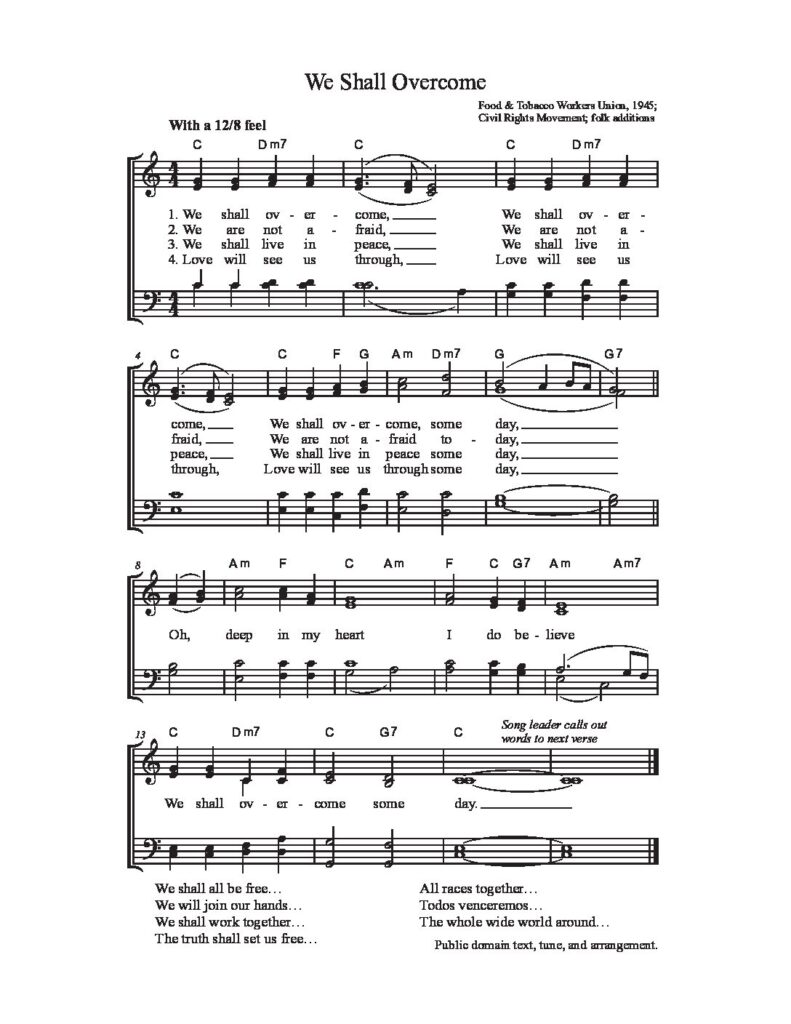
I recently learned that the song “We Shall Overcome” is now in the public domain, due to a 2017 court ruling and a 2018 settlement. A lawyer tells the whole story in some detail here.

The short version: In 2017, a federal court ruled that the tune, arrangement, and first verse of “We Shall Overcome” are in the public domain (We Shall Overcome Foundation v. The Richmond Organization, Inc., 2017 WL 3981311 [S.D.N.Y. Sept. 8, 2017]). In addition to the court ruling, the defendant and plaintiff subsequently entered into a settlement agreement which said, in part, that TRO would not “claim copyright in the melody or lyrics of any verse of the song ‘We Shall Overcome’”; furthermore, TRO agreed that all verses of the song were “hereafter dedicated to the public domain” (We Shall Overcome Foundation v. The Richmond Org., 330 F. Supp. 3d 960 [S.D.N.Y. 2018]).

This is very good news indeed. Sure, now the song can be used in all sorts of horrible advertising. At the same time, now you cannot be slapped with a royalty fee for using “We Shall Overcome” in your worship service, in the video that you made of some rally or demonstration, or in the audio recording of you singing at a coffeehouse.

Of course, just about all the piano or choral arrangements out there are copyright protected, including the one in the current UU hymnal. So here’s a very basic arrangement of “We Shall Overcome” which I’m releasing into the public domain; and hey, if you don’t like my version, it’s a public domain song so you can write your own! (I’ve changed a couple of the usual verses so they’re less ableist.)

Click the image above for sheet music.

By the way, I’m finding that it’s a good song to sing around the house now that we’re hunkered down because of the Omicron surge.

More copyright-free hymns

I just uploaded another batch of 26 copyright-free hymns onto Google Drive.

This collection of copyright-free hymns now includes a total of 63 hymns, with 38 copyright-free versions of hymns in the two current Unitarian Universalist hymnals, along with 24 other hymns and songs (including classics like “Swing Low Sweet Chariot” and “Michael Row Your Boat Ashore,” which really should be in our hymnals anyway). Not only are tune, text, and arrangement copyright-free, but the typesetting is as well, so you can project these or place them in online orders of service without a problem.

The “ReadMe” file in the Google Drive folder gives some information about each hymn, and also gives the corresponding number if there’s a version of the hymn in one of the UU hymnals.

In several cases, hymn texts now offer degenderized lyrics, for those who prefer to move away from binary gender options (e.g, for “The Earth is our mother,” the alternative “The Earth is our parent” is suggested). Eventually, I’ll offer degenderized options for all lyrics, but it takes — so — much — time to produce quality music typesetting that I can’t promise when I’ll get to it.

Whether you use these in your congregation’s online worship services, or at home, or around a campfire, I think you’ll find lots of fun and uplifting music here. I’d love it if you’d let me know where and how and if you use this music!

Update, 1/18/2022: Now up to 71 total hymns and spiritual songs, with 44 of them being copyright-free versions of hymns from the two current UU hymnals. List of hymns (with references to hymnal numbers, and notes on copyright status) below the fold.

Continue reading “More copyright-free hymns”