
Living out of your car

We left our rental in San Mateo, California, on June 20. From then until September 1, we didn’t have a permanent address. We were living out of our car from June 20 to July 17. Then we had a short-term and very inexpensive rental ($500 a month, plus work barter) on the south coast of Massachusetts. As of September 1, we finally have a permanent address on Boston’s South Shore. Even now, most of our belongings are still in storage, and we’ve been living with whatever we managed to pack into the car.

We’ve had a pretty comfortable summer, all things considered. But our experience has made me think about what I’ve heard from some of the homeless people I’ve known. Now most of the homeless people I’ve known have not been street people. There are quite a few different kinds of homelessness. There’s couch-surfing, where you do short-term stays with friends and family, often rotating amongst several people so no one gets sick of you. There’s living in an RV or converted van, which can entail parking at night with friends or family, or parking at night in state or county campgrounds, or parking on the streets; the latter option is where you’re the most vulnerable. There’s car dwelling, which less comfortable than RV or van dwelling, since you have to sleep in a seat not a bed. There’s living in long-term homeless shelters, where you’re guaranteed a bed in one place for at least a month at a time. There’s living night-to-night in homeless shelters, where you have to line up every day to get a spot in the shelter. Then there’s living on the street, where you’re sleeping outdoors pretty much all the time.

In the popular imagination, “homelessness” means the last option: living on the street. But really homelessness is a state of being where you don’t have a permanent address. It’s a state of being where you have a lot less control over your life, and a lot less predictability. Considered this way, homelessness is similar to being a refugee.

As I said, we’ve had a pretty comfortable existence. We have adequate income, and we knew we’d find a permanent place to live sooner or later. We have enough stability, and enough money, that we could be somewhat picky about our rental options.

As comfortable as we are, not having a permanent address caused a certain amount of stress. It can be difficult buying things online, and these days you almost have to buy some things online, but with no permanent address where are you going to have them shipped? (We solved that problem by renting a mailbox at a UPS Store, which is not inexpensive.) There’s stress associated with the ambiguity of not really having a permanent legal address. There’s stress because your clothes always look a little rumpled; even I, a slovenly dresser, have found this to be annoying. There’s psychic stress: sometimes you don’t quite know where you’re going to be next week, and that’s uncomfortable. There’s more psychic stress: you feel a definite lack of control.

Again, we’ve been quite comfortable in the last two and a half months, but all these little stressors have added up. I’m more tired than usual, and less efficient. Even though I have a solid job, and we have solid financial resources, living out of a car is tiring.

This tallies with what I’ve heard from the homeless people I’ve known. They’ve talked about how the uncertainty can wear you down, can make you less efficient. Then if you’re looking for work on top of that, or working a low-wage job (and low wage jobs are far more stressful than knowledge-worker jobs), it’s all going to add up. You’re going to be tired and stressed out.

This is something to think about when we’re thinking about how to help people who are unhoused. If you tell unhoused people to get a job first, or to kick their addiction first, I’m not sure that’s actually a pragmatic, practical approach. Based on my brief experience living out of a car, I tend to believe that it makes more sense to put people in housing first, then when they have some stability in their lives they’ll be able to address the other problems.
Clerical stoles

In two earlier posts (one and two), I wrote about preaching gowns. Personally I’m not a fan of preaching gowns, but I understand why they can be of use. Now I’d like to think out loud about clerical stoles.

Stoles are those long pieces of cloth that clergy drape around their necks. The stole comes from the Christian tradition. I don’t remember Unitarian Universalist clergy using stoles until the 1980s. My recollection is that Eugene Pickett, when he was president of the Unitarian Universalist Association, insisted that clergy should wear stoles. By the 1990s, clerical stoles were pervasive in Unitarian Universalism. And by 2003, the year I participated in the Service of the Living Tradition as a newly ordained minister, I think I was the only minister who didn’t wear a stole.

Some people understand the stole to be a symbol of ordination. But choirs that wear robes often also wear stoles, and we generally expect most of our choristers to be non-ordained persons. So I’m not convinced that the stole is a symbol of ordination, and only to be worn by ordained clergy.

Also, stoles are reminiscent of other special religious clothing in other traditions. A stole is somewhat similar in appearance to the Japanese Buddhist wagesa, though the wagesa has very specific symbolic meanings (as I understand it) which obviously differ from any symbolism a stole might have. A stole is perhaps slightly reminiscent of the Jewish tallit or prayer shawl, insofar as it’s something to drape over your shoulders when engaging in religious observances.

It seems to me that there are other cultures that drape long pieces of cloth around your neck. Think of Hindu men who wear a dupatta over a sherwani for their wedding. I feel like there are other examples, though I can’t think of any right now. So even though there’s a strong connection between the stole and Christianity, it you take the cross off a stole maybe it’s not a Christian stole any more. When Unitarian Universalist minister Hank Peirce wears his Boston Bruins stole, there isn’t much connection between the stole and Christianity.

I don’t like wearing a preaching gown, but I feel reasonably comfortable wearing a stole. I think of it as a uniform. Like when I worked at the lumber yard, and I had to wear a shirt with a “Concord Lumber Corp.” patch over the shirt pocket, and my first name embroidered on the other side of my chest. (And yes, I’ve thought of having a stole made with a patch that says “First Parish Unitarian Universalist” on one side, and my name embroidered on the other side, but rejected the idea for obvious reasons.)

I wish I didn’t have to wear any special clothes to be a minister. As a Universalist, I think all humans are of equal worth, and wearing special clergy clothing sets my teeth on edge. But I realize that people want to see their clergy wearing some kind of uniform. For me, a stole represents a reasonable compromise between egalitarianism and the need for a uniform. So on Sunday, when I participate in the Town of Cohasset 9/11 observance, I’ll be in uniform, wearing a stole.

(Getting a stole for Sunday proved to be a challenge. I have a stole that my younger sister gave me when I was ordained, but it’s still in a moving container somewhere. I just found out about the Cohasset 9/11 observance, and had to get a stole on short notice. But finding a stole without any Christian symbolism on it, that could be overnighted to me, was a challenge. I finally found Threads by Nomad, a small company that’s trying to provide clothing that doesn’t do “damage to people or the planet.” They had clergy stoles on sale and they were able to overnight one to me. Sadly, it looks like they’re selling off their stole inventory, so maybe it hasn’t been a good business opportunity for them. Their website tells me that the stole I bought was “made from a fabric called mud cloth from Mali. Mud cloth is dyed using fermented mud — a traditional dying technique in many parts of the world but notably in West Africa. Our mud cloth is not mass produced and therefore every piece is different in design.” Since I’ve been influenced by African philosophy, this seemed like a serendipitous find. Plus the stole was made by an “artisan [who was] fairly compensated.”)

What I did on my summer vacation

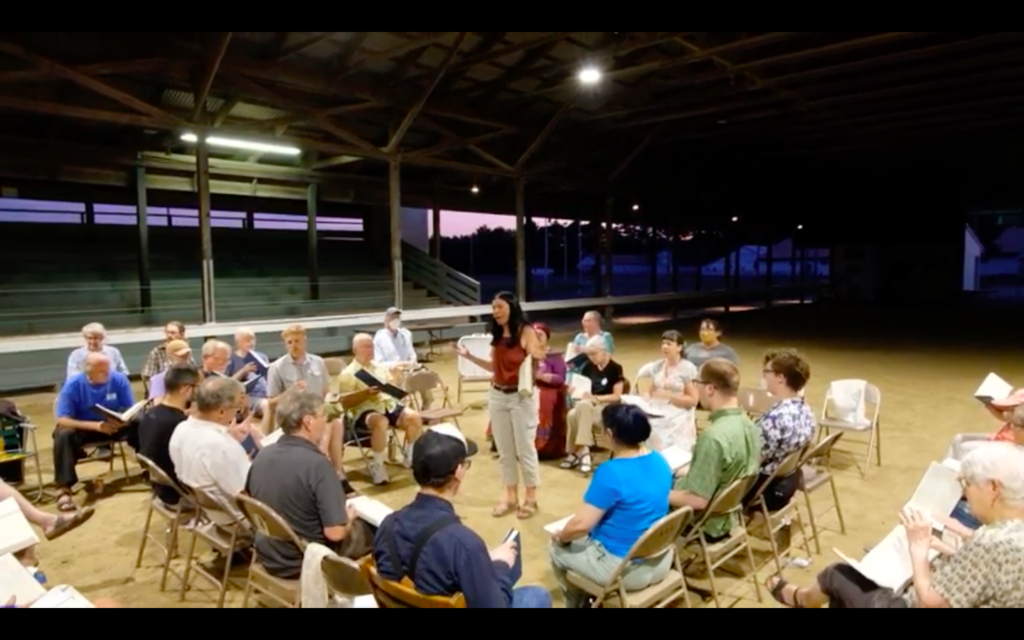
Back in July, Carol and I drove to the Cumberland County Fairgrounds in Maine.

We sang Sacred Harp, in a pulling shed, with forty other Sacred Harp singers. There were horses trotting around the race track next to the pulling shed.

Click on the image above to view the video on Youtube

The pandemic shut down in person singing for a long time. It felt really good to sing with other people in person.

I was glad to see that someone posted videos of us singing, so I could be reminded of one of the highlights of my summer vacation.

Night sky

If I walk out the front door of the house we’re staying in, sometime after it’s fully dark, and look up, I can see the Milky Way. For the past thirteen years I’ve been living in the San Francisco Bay Area, which has so much light pollution that you’re lucky if you can see a few stars at night. In that whole thirteen years I probably saw the Milky Way fewer than ten times. So even though we’ve been living in Westport for a month and a half, I’m still amazed when I look up and see all those stars.

When I was a child, I remember seeing the Milky Way all the time. But gradually, light pollution grew worse and worse there. By 2003 when my father sold that house that we’d grown up in, you could see far fewer stars. And for most of my adult life, I’ve lived in cities or congested suburbs where I couldn’t see the stars.

It feels good to look up and see the Milky Way. I guess it helps orient me to where we are in the universe. By next week, we’ll be living in Cohasset. We’ll be in the midst of the massive light pollution of Greater Boston. I’m glad that I’ll no longer be spending three and a half hours a day driving to and from work. But I’m going to miss the beauty of the night sky.

The Ted memorial rest area

For the past month, we’ve been living in Westport, Mass., and I’ve been commuting to my new job in Cohasset, Mass. It’s at least an hour and a half drive, more if there’s traffic. By the time I come home, I’m often tired of driving. Fortunately, there’s a rest area almost exactly halfway between the church in Cohasset and our temporary place in Westport. I often find myself pulling into that rest area to stretch my legs and clear my head.

It’s not much of a rest area. The parking lot is too small for the amount of truck traffic, with big rigs everywhere. By contrast, the lot for cars is usually mostly empty. Inside the building, there’s a Burger King and a Dunkin Donuts. But they seem to sell most of their food at their drive-through windows, because there’s hardly ever anyone sitting in the dining area. In spite of all the tractor trailer rigs, the whole place feels oddly deserted.

I stopped there on my way home today. It was lunch time, and the dining area was as deserted as usual. A memory forced its way to the surface of my consciousness. Back in 2008, I was working in New Bedford, and once a month I’d drive up to Newton for Sacred Harp singing. Ted, whom I sang with in another choir in New Bedford, started getting into Sacred Harp singing, too. So we’d drive up together to sing Sacred Harp. But I’d often have missed dinner in order to sing, so on the way home we’d stop at this exact same rest area to grab a sandwich. We’d spend the long drives talking, and we’d sit in that deserted rest area — even back then, it was always deserted — and talk some more while we ate. Mostly we talked about music. I still remember how he said he used to sing with five different ensembles when he lived in San Francisco, one for each night of the week.

When I moved to California, I lost touch with Ted. I’m not a good correspondent, and neither was he. A few years ago, I learned from one of his siblings that he had died.

Ted and I both sang bass. He was a pleasure to sing next to, not just because he was a good musician and a good singer. Some choral singers are on an ego trip, wanting to show off how good they are. That kind of singer is not fun to sit next to. Ted was the other kind of singer, the singer who’s there for the music, who subsumes their ego in the music. Marge Piercy talked about something similar in her poem “To Be of Use”: “I want to be with people who submerge / in the task … / who are not parlor generals and field deserters / but move in a common rhythm / when the food must come in or the fire be put out.” Piercy was talking about work, not music, but you see the same kind of thing in music. As it happens, I did actually do physical work with Ted on several occasions, and he worked the way he sang: submerged in the task, rather than a parlor general. That’s the kind of person I like to spend time with.

When I was in the rest area today, I got to thinking about Ted. I guess for me, that’s now the Ted memorial rest area. Not a bad thing to think about while I’m stretching my legs and getting a sandwich.

Preaching gowns, part two

In a previous post I outlined some reasons why I don’t want to wear a preaching gown. In this post, I’ll do my best to give some of the many good reasons why Unitarian Universalist ministers should Geneva gowns, or other types of preaching gowns.

First, women ministers are held to impossible standards of dress, and for them a preaching gown makes sense. I have heard from many women ministers about the comments they have to endure from congregants about their clothes. I’ve heard about other women giving backhanded compliments on articles of clothing, compliments that are really criticisms. I’ve heard about men making inappropriate comments on how “sexy” or “attractive” a woman minister looked. As a man, I could deal with that kind of comment by wearing exactly the same kind of clothes all the time (which is in fact what I do), but women are held to a different standards and if they don’t wear a variety of clothes they are subjected to criticism. So if I were a woman minister, I wouldn’t want to deal with this kind of bullshit, and I’d seriously consider wearing a preaching gown.

Second, ministers who are not white typically experience varying levels of racism in our predominantly white Unitarian Universalist congregations. As an example, recently I heard about a minister of color who was told that they were very well-spoken — well of course they are, they have been trained in the art of public speaking, as have all ministers — white male ministers don’t receive this sort of backhanded compliment (sadly, white women do hear similar comments). If I were a person of color and a minister in a Unitarian Universalist congregation, chances are good that I’d want to wear a preaching gown.

Third, there are ministers who are poor dressers. I’m one of those ministers. I simply don’t pay attention to clothes most of the time. On one memorable occasion, I showed up at church on Sunday morning wearing a coat and trousers from two different suits. I frequently forget to fasten collar and cuff buttons. I have poor taste in ties. I try to remember to pay attention to my appearance, but I frequently forget; it’s not that I don’t care, I’m simply not aware. Ministers like me might to do better to wear wear a preaching gown, to save our congregations from occasional embarrassment. In my case, however, I’m sure I’d find ways to look slovenly in a preaching gown; the gown might hide some of my sartorial blunders, but not all of them.

Fourth, a preaching gown is a symbolic tie to Unitarian Universalist history. It’s not a wholly bad thing to be descended from the Protestant Reformation. Some of our most cherished values — freedom of individual conscience, the priesthood and prophethood of all persons, etc. — derive from the Reformation. Ralph Waldo Emerson wore a preaching gown, as seen in Daniel Chester French’s sculpture of the seated Emerson. Wearing a preaching gown can symbolize the tie to our most brilliant Unitarian minister, and to a host of other Unitarian and Universalist and Unitarian Universalist ministers.

In short, there are very good reasons for a Unitarian Universalist minister to wear a preaching gown. There are very good reasons for Unitarian Universalist congregations to want their minister to wear a preaching gown. Perhaps most importantly, given the persistent and pernicious sexism and racism in Unitarian Universalism (which is a reflection of the racism and sexism in our wider society), preaching gowns make a great deal of sense. Wearing a preaching gown can serve as a symbol that the person wearing it is a highly trained and skilled professional. Well-meaning white parishioners, and parishioners of all genders, may need this weekly reminder. The reminder of professional competence offered by preaching gowns might also be useful for ministers who are young, disabled, LGBTQ+, etc.

Indeed, white male ministers like me should probably consider wear preaching gowns to show solidarity with our ministerial colleagues. However, this must be balanced against another consideration. In my experience dealing with the aftermath of ministers who engage in unethical behavior and misconduct, I have a strong sense that misconducting ministers use all the little signs and symbols of authority to insulate themselves from being held accountable for their ethical violations. I believe some misconducting ministers have used the symbolic power of a preaching gown to allow them to hide from accountability. So white male ministers who choose to adopt the signs and symbols of ministerial power — preaching gowns, titles, and the like — must be careful to ensure that there are robust institutional structures in place to hold them accountable for their behavior. Actually, all ministers should make sure there are robust institutional structures in place to hold them accountable, but white male ministers need to be especially sure of this.

For me personally, the decision on whether or not to wear a preaching gown comes down to two competing demands. If I were to wear a preaching gown, I could express solidarity with non-white and non-male ministers. Balanced against that is my strong sense that wearing a preaching gown can serve as one of those little things that can serve to insulate ministers from ethical accountability. For me — not for anyone else, mind you, just for me — the balance is tipped in favor of any slight increase in ethical accountability. But I think for most ministers, and for most congregations, the balance will be tipped the other way.

Preaching gowns

I was trying to explain to someone why I don’t wear a preaching gown, or any other clerical vestments. It’s kind of a long explanation, so I thought I’d turn it into a blog post.

Unitarian Universalists ministers who wear gowns to preach typically wear one of two types of gown. If they have a doctoral degree, they can wear a doctoral robe. When I was a teenager, the minister of my Unitarian Universalist church was Rev. Dr. Dana Greeley. As I recall it, he wore his Harvard doctoral robe to preach: crimson fabric with black insets, and black velvet bars on the sleeves.

The other choice of robe is the traditional Geneva preaching gown. This is the gown worn by ministers in traditions that trace their lineage (to use a Buddhist term) back to the Protestant Reformation, particularly to John Calvin in Geneva. The Protestant Reformation put the emphasis on preaching the Word, and they wore gowns that resemble academic gowns showing the importance of their education, their focus on the Word.

Since I don’t have a doctoral degree, I’m obviously not going to wear a doctoral degree. My reasons for not wearing a Geneva gown are more complex.

First, I feel that Unitarian Universalism has drifted far enough away from Protestantism that Geneva gown have little symbolic value for us any more. A Geneva gown symbolizes Protestant shift from priest to preacher, where preaching the Word became central to the Protestant religion. Our worship services no longer focus on preaching as much as we used to — I remember sermons lasting for close to half the worship service, but today my sense is the typical Unitarian Universalist sermon lasts for about 15 minutes of an hour-long service. So we are not preaching as many words as we used to do. Nor is it clear to me that we are preaching the Word — capital “W” — that is, the Word of the Christian God. A Unitarian Universalist minister who is Christian might want to wear a Geneva gown. But even Unitarian Universalist ministers who are Christian need to preach to theologically and religiously diverse congregations, so the Geneva gown might be about as appropriate as the saffron robes of certain Buddhist monks. A Unitarian Universalist minister who wears a Buddhist saffron robe is making a definite statement about their religious outlook; if I were to wear a Geneva gown, I feel I’d be making an equally definite statement, and I’m not sure it’s a statement I want to make.

Second, Protestant ministers wear a Geneva gown to set themselves apart from ordinary members of the congregation. The gown is a sign of their special religious status. I’m not sure that Unitarian Universalist ministers actually have that kind of special status. I feel that my position as a Unitarian Universalist minister is closer to the position of rabbis as described by Coffee Shop Rabbi: “Rabbis are ordinary people with specialized knowledge. Unlike a priest, we do not have special powers. A rabbi is a person who has studied Torah, Jewish law and tradition. Someone, either an institution or another rabbi, has declared that they can call themselves ‘rabbi’.” As a Unitarian Universalist minister, I consider myself to be an ordinary person who has specialized training: a three and a half year graduate degree, a one year internship under an experienced minister, and clinical pastoral education. Both a local congregation and the Unitarian Universalist Association have declared that I can call myself “minister.” In my understanding, my specialized training does not give me a special status such that I need to wear special clothes to lead worship.

Third, anyone can lead a Unitarian Universalist worship service. We are not like many Christian denominations, where only a priest or ordained clergy can preside at worship services. (Nor are we like the Church of the Latter-day Saints, where only men can preside at services.) So you don’t need a special person to lead worship, and the worship leader doesn’t need special clothes to lead worship. Alternatively, if ministers wear special clothes to lead worship, then maybe ordinary Unitarian Universalists should, too.

Fourth, I’m a cheapskate, and Geneva gowns are expensive. Yes, you can purchase a polyester Geneva gown for under three hundred dollars. But I don’t want to purchase any artificial fiber clothes any more — artificial fibers are one of the chief sources of microplastics in the environment. And a natural fiber gown will cost upwards of $1,000. I find it hard to explain to myself why I’d spend well over $1,000 on a garment that I’d wear at most 40 hours a year. Better I should either put that money into my retirement savings, or give that money to a local homeless shelter.

There are lots of arguments about why Unitarian Universalist ministers should wear some kind of special clothes to lead worship. I’ll outline some of those arguments in a follow-up post.

More on electric cars

Rabbi Yonatan Neril, founder of the Interfaith Center for Sustainable Development and co-author of the Eco-Bible, adds another reason why electric cars won’t solve the ecological crisis:

“The ecological crisis is a spiritual crisis. It’s not just about nature and bees and the birds and the trees and the toads. It’s also about human beings and how we live as spiritual beings in a physical reality. And so, you know, with all due respect to Elon Musk and everyone buying a Tesla, we’re not going to curb climate change with Teslas alone — when the operating system of billions of people is consumer-driven.”

As Rabbi Neril points out, we’re not going to stop climate change by buying something new. In fact, buying an electric car is really just part of consumerism, the ideological myth that buying something new can solve our problems. Consumerism is the problem, not the solution. Rabbi Neril continues:

“The only force in the world that changes this operating system of consumerism is religion and spirituality. The root issues we’re talking about are greed, short-term thinking, egoism, seeking pleasure in the physical. The spiritual solutions to those are humility, long-term thinking, caring for other people and creatures. The only institutions in the world that can deliver that are religious institutions.”

Electric cars are not the solution to the world’s problems

Science fiction author and Scottish nationalist Charles Stross opines:

“I’m going to suggest that American automobile culture is fundamentally toxic and aggressively hegemonizing and evangelical towards other cultures, and needs to be heavily regulated and rolled back.”

Not to belabor the point, but while electric cars may help us address climate change, they still emit toxic substances (tires spewing microplastics into the environment, for example), and they also enable habitat destruction. Even when it comes to climate change, their carbon footprint is not zero.

(Why mention that Stross is a Scottish nationalist? Because that means he apparently hasn’t bought into the American mythos.)

Mandatory pronouns

Joshua Pederson, professor at Boston University, makes a good point in today’s Boston Globe. Several years ago, Pederson began all his classes by having students introduce themselves by saying their names and pronouns. But, Pederson says, at the end of that first class:

“As my students began filing out of the classroom, one lagged behind, visibly distraught. They asked if they could talk to me about the way I ran introductions. They identified as non-binary and used they’them pronouns, but they felt exposed and vulnerable when I told them to share that. I din’t make them feel included; I made them feel unsafe.”

Now, Pederson gives his own pronouns, and invites but does not require students to share their pronouns. I think he’s on to something. In part, he’s addressing the power imbalance between teacher and student. And also, as he notes, “mandating that students share pronouns can force those who are unsure of their gender identity to pick one, even if they don’t feel ready.”

Those of us who spend time in religious organizations might think about following Perderson’s lead. In congregations, ministers, Sunday school teachers, committee chairs, youth leaders, etc. can share their own pronouns, but there’s no need to make it mandatory for everyone to share their pronouns. In other gatherings, denominational staff, volunteer denominational leaders, workshop leaders, etc. can do the same thing — share their own pronouns, but not make it mandatory for everyone to share pronouns.

In the past, I’ve asked various Unitarian Universalist groups to share pronouns. I won’t be doing that any more. I might share my own pronouns, but I’m not going to ask anyone else to share theirs. Invite, maybe; ask, nope.