Protest songs

At the end of August, “The Ongoing History of Protest Music” website had a blog post titled “A Month of Protest.” The first song they featured was “Black AF,” by Crystal Axis, an Afropunk band from Kenya. (Before you crank up the sound be aware that, like a lot of punk rock, “Black AF” is Not Safe For Work.)

I didn’t even know that leftist punk rock still existed. But Crystal Axis are keeping the tradition alive with some really hard-hitting songs. As I started listening to their music, I was particularly struck by their 2017 song “Leopold,” an anti-colonialist song about King Leopold of Belgium. Leopold led Belgium in the brutal exploitation of the Congo, and Crystal Axis’s lyrics provide a concise summary of the king’s self-justification:

“I’m the king and it’s all mine
Under Force Publique and Christ
Your hands are mine tonight
Fingers up one time!”

Leopold was especially notorious for ordering the amputation of the hands of workers if work quotas were not met. Theologically he, like other Western colonial rulers, used the Christian religion both as a cover and as a justification for his crimes against humanity.

“Take the Throne,” a song they released last year, also has some leftist theological comment. First, the lyrics call out the injustice caused by gross economic inequality, where the rich are literally starving the rest of the world:

“You eat, we watch; a revolution’s born
We’ll tear down the walls and then we’ll take the throne”

Now comes their theological commentary:

“The voice of the people is the voice of God
Too many lies, deities we can’t applaud”

This is a theology in direct opposition to King Leopold’s theology. Leopold claimed his God gave him the power to do what he liked to those who had less power, less wealth, those who were not white. By contrast, Crystal Axis are saying that God is in the voice of ordinary people — which is pretty much what Jesus said when he pointed out how difficult it would be for rich people to get into heaven. This is also a theology that’s consistent with an African ethics that privileges the social over the individualistic.

As someone who loves punk rock, I really enjoyed hearing leftist theology in the context of topnotch music. For more, visit their website or their Facebook page.

What Franklin Graham says

We have a post box for our mail, so sometimes we receive mail sent to previous holders of that box number. Today we received the October issue of “Decision” magazine, published by the Billy Graham Evangelical Association.

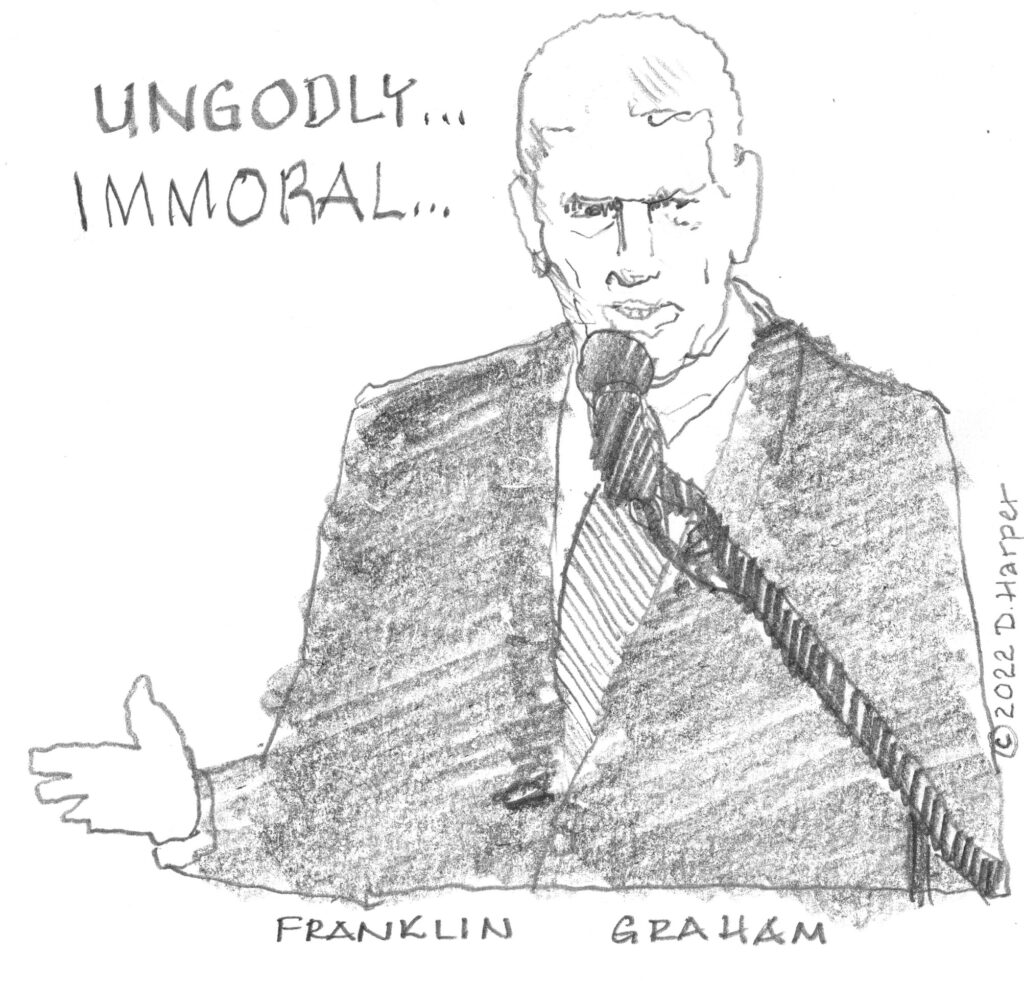
The editor-in-chief, Franklin Graham, wrote the lead article in this issue, titled “We Can Still Turn Back.” Franklin Graham says, in part:

“On Nov. 8, tens of millions of voters will head to polls across America in the most crucial midterm elections in recent history. To say that much is at stake is a gross understatement. It isn’t just control of Congress; it may be our last chance to stop the immoral and ungodly policies that have brought our national to the moral brink of disaster.”

What are the “immoral and ungodly policies” to which he refers? About what you’d expect: same sex marriage, abortion rights, and “transgenderism.”

In his article, Franklin Graham concludes, “That’s why it is so critical that you go to the polls on Nov. 8 and vote from the candidates who best align with godly, Biblical principles.”

But which Biblical principles? Franklin Graham’s net worth is estimated to be on the order of $10 million, and he has an annual income on the order of $600,000. Yet in Matthew 19:16-21, we hear this story:

“Then someone came to [Jesus] and said, ‘Teacher, what good deed must I do to have eternal life?’ And he said to him, ‘Why do you ask me about what is good? There is only one who is good. If you wish to enter into life, keep the commandments.’ He said to him, ‘Which ones?’ And Jesus said, ‘You shall not murder; You shall not commit adultery; You shall not steal; You shall not bear false witness; Honor your father and mother; also, You shall love your neighbor as yourself.’ The young man said to him, ‘I have kept all these; what do I still lack?’ Jesus said to him, ‘If you wish to be perfect, go, sell your possessions, and give the money to the poor, and you will have treasure in heaven; then come, follow me.’…” [NRSV; emphasis added]

Franklin Graham contributes to good in the world through the global charity he heads, Samaritan’s Purse. But I do not see Franklin Graham actually following this teaching of Jesus in Matthew 19:16-21, to go and sell all his possessions and give the money to the poor. Sadly, this makes it look like he picks Bible passages that confirm his biases while passing over Bible passages that cause him discomfort.

Which makes him appear hypocritical.

No wonder young people are leaving organized religion in droves.

Posts and beams

Some photos from the attic of the 1747 Meeting House in Cohasset:

Truss joint

This image shows the joint in the middle of the second truss from the north end. The ends of the trunnels (treenails) are clearly visible, as are the adze marks.

Beams

This photo shows an unusual joint between a beam and a post. This kind of joinery probably resulted because the carpenters also built boats. This photo was taken along the north wall where the Meeting House butts into the tower. The beam across the top of the photo is sawn, not hewn, and is from a later repair. In the background, you can see a PVC pipe, and coaxial cables running up to the cell phone antennas in the steeple.

People who no longer like capitalism

On Saturday, Pope Francis spoke to a gathering of one thousand people under the age of 35. He said, in part:

“‘The first market economy was born in the 13th century in Europe through daily contact with Franciscan Friars, who were friends of the first merchants. That economy certainly created wealth but it did not despise poverty,’ said [Pope] Francis. ‘Our capitalism, instead, wants to help the poor but does not respect them. … We do not have to love poverty,’ he added. ‘On the contrary, we need to combat it, above all, by creating work, dignified work.’”

We can argue about details of his interpretation of the history of capitalism. Nevertheless, Pope Francis is getting at something important — capitalism today despises people who are poor. Today’s capitalist Titans do everything they can to reduce the number of people they have to hire and make the remaining workers work insanely long hours. Then they speak with disdain of people who can’t find a job. In San Francisco, the rich young Tech Titans want the city to get unhoused people off the streets so they, the Tech Titans, don’t have to be confronted with the tent encampments that they help create.

Pope Francis was wise to make this address to a crowd of people under the age of 35. Pollsters have shown that the younger you are, the more likely you are to distrust capitalism. Among young adults, half prefer socialism to capitalism.

Those who still believe that capitalism is the best economic system have an uphill battle to bring the rest of us around to their opinion. Global climate change appears to have been aggravated by neo-liberal capitalism. Then consider that 11.6% of the U.S. population lives in poverty, while the capitalist system keeps funneling money up to the billionaires.

I think it’s possible to justify something other than the neo-liberal capitalism we’re currently stuck with. It should be possible to have a capitalism that deals with poverty, that creates dignified jobs, that stops the kind of unrestrained growth that leads to ecological disaster. But I’m not seeing anyone working in that direction. These days, capitalism seems to be pretty much divorced from ethical concerns.

As a result, we have mainstream figures like Pope Francis essentially saying that capitalism is evil. We have a growing number of young people who no longer believe in capitalism. We have smart people proposing interesting alternatives to standard capitalist economics.

For myself, I’m no longer able to justify capitalism from an ethical point of view. If the capitalist United States has an 11.6% poverty rate, something’s wrong….

Pharoah Sanders

The man Ornette Coleman called the greatest tenor player in the world, Pharoah Sanders, has died at age 81.

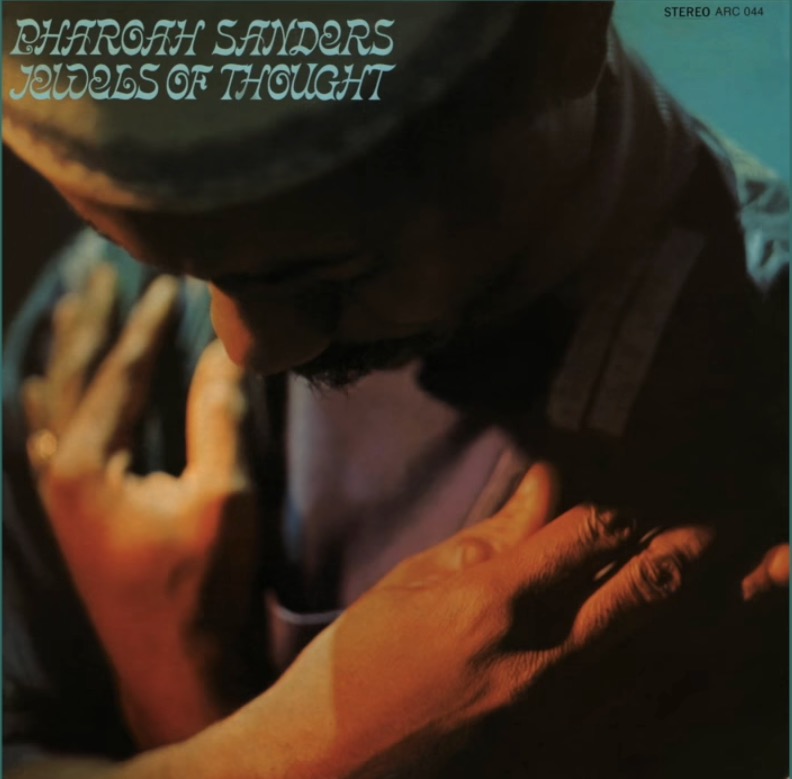
He may have been the greatest tenor player in the world, but I tend to think of Pharoah Sanders as the master of spiritual jazz. His extended musical meditation on peace, called “Hum Allah Hum Allah Hum Allah” on his 1969 album “Jewels of Thought,” remains a touchstone of spiritual pacifism for me.

Click on the image above to listen to listen to “Hum-Allah-Hum-Allah-Hum-Allah” on Youtube.

At the beginning of this fifteen minute musical prayer, Sanders says:

“Peace is a united effort for co-ordinated control
Peace is the will of the people and the will of the land
With peace we can move ahead together
We want you to join us this evening in this universal prayer
This universal prayer for peace for every man
All you got to do is clap your hands.
One, two, three….”

And then he chants:

“Prince of peace, won’t you hear our pleas
And ring your bells of peace,
Let loving never cease.”

That simple chant has stuck in my mind (and heart) ever since I first heard it. It continues to support me in a world that’s inching closer to nuclear war in the Ukraine. That chant, in addition to the warmth and deep spirituality of all of Sanders’ music.

He will be sorely missed.

Anxiety screening

The U.S. Preventive Services Task Force (USPSTF) issued a draft recommendation statement on Tuesday, suggesting that everyone under age 65 might benefit from screening for anxiety disorder.

Before you jump to conclusions, you need to know a few things.

First, this is still a draft statement. The USPSTF has released this draft for public comment. After the public comment period ends on October 17, the USPSTF will prepare the final statement.

Second, despite its impressive title, the USPSTF is not a government agency. It is “an independent, volunteer panel of national experts in disease prevention and evidence-based medicine.”

Third, this report appears to rely on data published before the COVID-19 pandemic. In other words, this is not a response to the widely-reported rise in anxiety disorder during and following the pandemic.

But even after reading this draft statement carefully, and even if we don’t jump to conclusions about the effects of the pandemic, I think this is still important. As the draft recommendation points out: “According to U.S. data collected from 2001 to 2002, the lifetime prevalence of anxiety disorders in adults was 26.4% for men and 40.4% for women.” In other words, anxiety disorders were widespread before the present alleged post-pandemic rise in anxiety disorders. This is a serious public health issue.

Anxiety is also obviously a serious issue for women. With over 40% of women developing anxiety disorder, this is indeed a serious public health issue. And in fact the USPSTF reports that “the Women’s Preventive Services Initiative [already] recommends that screening for anxiety should include all female patients age 13 years or older not currently diagnosed with an anxiety disorder, including pregnant and postpartum women.”

The USPSTF draft recommendation also points out how anxiety correlates with age and stage of life: “The natural history of anxiety disorders typically begins in childhood and early adulthood, and symptoms appear to decline with age. Some community-based epidemiology studies indicate that rates of anxiety disorders are lowest in adults ages 65 to 79 years, but these data are outdated.” So this becomes an important concern for parents, educators, and anyone in the helping professions who works with young people.

Also of interest: the USPSTF notes that screening tools to help medical professionals identify persons who may have anxiety disorder are widely available. Mind you, these are screening tools, not diagnostic tools. But as screening tools, they can cue medical professionals to schedule a follow-up diagnostic assessment. I found one of these screening tools online on the University of Washington website, and it takes only a few minutes to complete. So you can see how this screening tool could be added to routine examinations by primary care physicians.

Now that we’re not going to jump to conclusions, we can go on to speculation.

If there really has been a rise in anxiety disorder during and following the pandemic — and I suspect there has — then it may prove to be even more important to screen for anxiety.

And there are implications for those of us who are ministers. We’re not mental health professionals, but tend to be on the front lines of mental health care because of the people we see during formal and informal pastoral care and counseling. We often suggest that people seek out mental health care. This report suggests that we may want to become more aware of anxiety disorders.

Why you should seek out a nonprofit hospice provider

It turns out private equity firms are buying up hospice providers. And it turns out the for-profit hospices do not, in general, provide as much care for dying patients as the nonprofit hospices, according to Kaiser Heath News:

“Patients in nonprofits had more nursing, social worker, and therapy visits. For-profit hospices, the report found, had longer lengths of stay by patients, discharged more patients before death, and had profit margins nearly seven times higher. Other studies have found that for-profit hospices have higher rates of complaints and deficiencies, provide fewer community benefits, and have higher rates of emergency room and other hospital use.”

Why are private equity firms buying up hospices? Obviously, they want to make money, and they are not particularly concerned with the details of providing hospice care:

“With the U.S. population rapidly aging, hospice has become a boom industry. Medicare — … which pays for the vast majority of end-of-life care — spent $22.4 billion on hospice in 2020…. That’s up from $12.9 billion just a decade earlier. … But with limited oversight and generous payment, the industry is at high risk for exploitation. Agencies are paid a daily rate for each patient — this year, about $200 — which encourages for-profit hospices to limit spending to boost their bottom lines. For-profit hospices tend to hire fewer employees than nonprofits and expect them to see more patients.”

Read the article, and I think you’ll be convinced that if you ever need a hospice provider, you’ll really, really want to find a nonprofit.

The mood in England

JB, a friend from high school, has been living in London for a number of years. His essay titled “The Mood in London” helps explain to us Yanks what it’s like to be in England right now. More interesting to me was his account of what it was like to stand in line to view the Queen lying in state. Like this ritual that he witnessed:

“Rather than a walk-past (when visiting the Crown Jewels you’re actually standing on a moving conveyor belt), each person was allowed a moment or so to contemplate or bow, as many people did. It was just as I was paying my respects that I was asked to move on, to make way for the changing of the guard. This was an extraordinary spectacle with a new team of sentinels marching to the catafalque (the platform that held the coffin), and positioning themselves directly behind the waxworks. Then, by clockwork, the petrified figures displayed their sentience, seeming to lurch alive and step forward, as their replacements took their positions and powered down to a fugue state. The rescued team then marched, like wind-up soldiers, to a stone staircase, which they ascended in military precision and before disappearing through a door. This ceremony was repeated every 20 minutes, and whatever its origins, it was a remarkable sight.”

Global chalice lightings

The International Council of Unitarians and Universalists (ICUU) is now defunct, another victim of COVID. According to Inga Brandes, ICUU President in 2021, “With the Covid Pandemic, the climate Emergency, and underlying funding issues, ICUU is facing major problems of sustainability and impact.” And so we now have the International U/U Collaboration.

This is sad, but not entirely surprising. As I understand it, ICUU funding has been precarious for some time. All best wishes to the new group.

However, in the transition, the old ICUU website disappeared, along with some 212 “global chalice lightings.” The global chalice lightings were words for lighting the chalice, submitted by Unitarian / Universalist communities from around the world, and often translated into multiple languages. These were a tremendously useful resource. Not only did they give insight into the internal diversity of global Unitarian and Universalist communities, not only were many of them useful in worship services, but they also were one of the only linguistically diverse Unitarian Universalist resources we had.

Yes, we have UU hymns and readings in Spanish. But here in the United States, there are Unitarian Universalists who are fluent in many other languages, and/or whose first language is other than English. For example, in my past two UU congregations, I shared global chalice lightings in Portuguese, French, and German with native speakers of those languages. I’ve known one or two African American Unitarian Universalists who felt some connection to global chalice lightings from Nigeria, and the occasional Filipino American Unitarian Universalist pleased to see global chalice lightings from the Philippines.

I hope someone has saved all those global chalice lightings, and makes them available again. The new website of the International U/U Collaboration has less than a dozen of them. I can’t find them on the UUA website. I did manage to get all the global chalice lightings from 2003 through 2014 from the Wayback Machine. But after 2014, it’s much more difficult to pull the global chalice lightings from the Wayback Machine.

The ICUU global chalice lightings are undoubtedly covered under international copyright. So I’m not going to post any of them here on my website (though I’m willing to share them with individuals if you email me directly). And if you happen to have a collection of ICUU global chalice lightings from 2015 on, and you’re willing to share, please leave a note in the comments below!

Thinking about Abigail Eliot

Abigail Eliot was a member of the Unitarian Universalist church I grew up in. I have only vague memories of her, but somehow knew she was someone important. I didn’t realize just how important she was until I read No Silent Witness: The Eliot Parsonage Women and Their Unitarian World by Cynthia Grant Tucker.

It turns out that Abigail Eliot was a pioneer of early education in the United States, and one of the founders of the National Association for the Education of Young Children (NAEYC). Eliot first trained at Margaret McMillan’s famous nursery school in England. McMillan developed the nursery school for children who lived in English slums; her school was designed to educate the whole child, mind and body, including nurturing health through outdoor education. Eliot returned to the United States and founded the Ruggles Street Nursery School in Boston.

While Eliot was not the first person to bring the nursery school concept to a city in the United States, she was one of the most influential pioneers of American nursery schools. She founded her school in 1922, and four years later turned her school into a training center for other nursery school teachers. Eliot’s training center for educators continues in the Eliot-Pearson Children’s School, a lab school that’s part of the Eliot-Pearson Department of Child Study and Human Development at Tufts University.

In addition to the material on Abigail Eliot in No Silent Witness, here are links to more information about her life and work:

I think Abigail Eliot has become a spiritual exemplar for me. She dedicated her life to child-centered education, and in so doing used her significant intellectual talents for the betterment of humankind. I wish I had better memories of her, but all I really remember is seeing her walk down the driveway to her house near the church. My friend Alison, who is my age and grew up in the same Unitarian Universalist church I did, is lucky enough to retain vivid memories of Abby Eliot. Perhaps not surprisingly, Alison went on to a lifelong career as a kindergarten teacher, and now Alison’s daughter is a schoolteacher in East Boston.

Those older Unitarian Universalists, people like Abigail Eliot, inspired many of us younger Unitarian Universalists to devote our careers to making the world a better place. Many of those older Unitarian Universalists worked in fields that are mostly ignored by the public. (Sadly, Abigail Eliot’s contributions to humankind receive far less recognition than those of her famous poet cousin, T. S. Eliot.) Yet what I learn from those older Unitarian Universalists is that public recognition is less important than doing good work in the world. That’s one of the reasons why we should continue to hold them up as spiritual exemplars.