Race, religion, and imperialism

In the past couple of years there has been a resurgence of interest in the connections between racism, religion, and imperialism. But these connections have been a topic of conversation for over half a century. Today, were more likely to talk about colonialism, but the connections are the same. Here’s theologian Benjamin E. May in 1954:

“Race and color did not count in the early existence of the Protestant church. It was when modern Western imperialism began to explore and exploit the colored peoples of Africa, Asia, and America that the beginning of segregation and discrimination based on color was intitiated. It was then that color was associated with ‘inferiority’ and white with ‘superiority.'”

— address by Benjamin E. Mays, Second Assembly of the World Council of Churches in Evanston, Ill., August 21, 1954; quoted in Gary Dorrien, The Making of American Liberal Theology: Idealism, Realism, and Modernity, 1900-1950, p. 427

Robot tells the story of the Rich Young Man

A decade ago, a small software company called XtraNormal allowed you to make free animated videos online. You’d choose a character, input some text, pick a few gestures, and the software would do the rest, posting the final video on Youtube.

I thought this was a great idea. I started out with a video of a robot telling the story from the Gospel of Thomas, ch. 97, the parable of the empty jar. Then I did a video of a robot telling the story of the rich young man from the Gospel of Mark, ch. 10. By the time I thought about it again, XtraNormal had stopped giving away their services, and had converted everything to Windows-only software. I wouldn’t have minded buying their software, but I’d be damned if I’d buy a Windows machine just to run their software. So I only made those two videos.

I never posted the second video on my blog, so here it is, ten years late:

(Note that I moved this video, and the first video, from Youtube to Vimeo. During the move, I improved the audio a little, and tightened up the editing a bit.)

Cohasset Central Cemetery

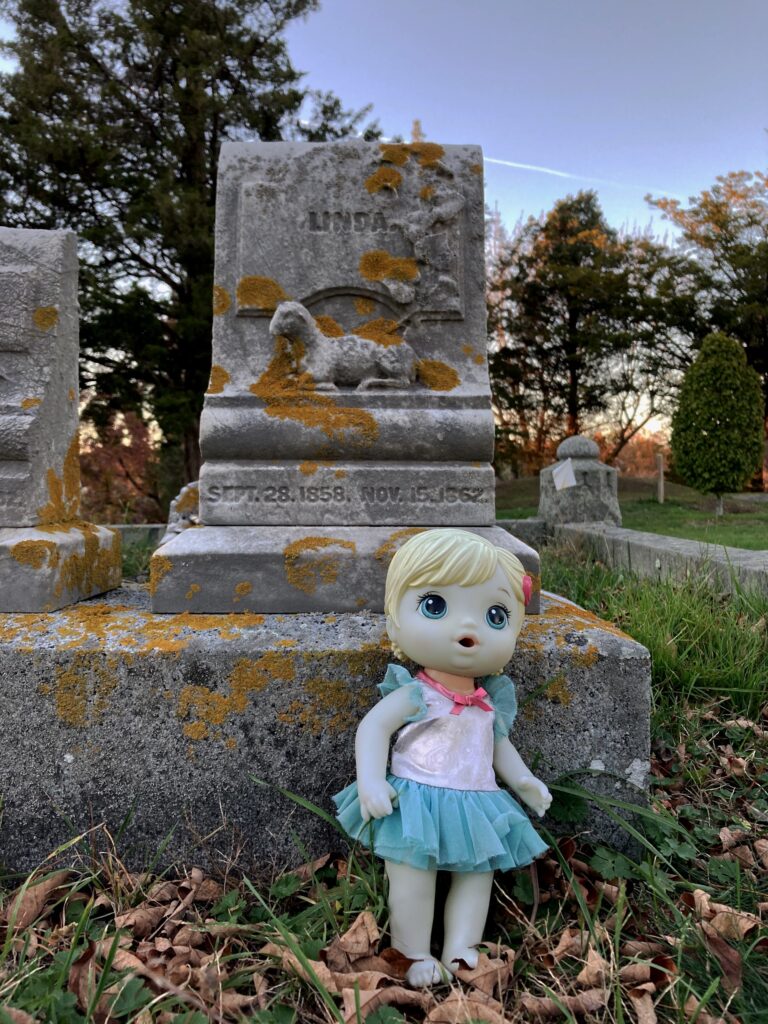
I first noticed the doll leaning up against a child’s grave back in August. The doll was a bit faded and weather-beaten even then, so it has been standing at the grave for some time now. The child died in 1862, so the doll could not have been left by someone who knew her. I like the fact that whoever cuts the grass has left the doll in place.

Halloween costume

Our cross-country move isn’t over yet. We’re still unpacking — and if this move is anything like past moves, we’ll still be unpacking cardboard boxes for a year to come. Today the box I happened to unpack turned out to have a costume for a stuffed animal in it.

During the pandemic, I did a series of weekly videos, many of which focused on stuffed animal characters. Sometimes the stuffed animals wore costumes. But when we moved, I packed away all the stuffies and got rid of all the costumes — or so I thought. For here was one of the costumes.

I had no intention of doing anything for Halloween this year. But if it’s Hallowe’en and you find a costume on Halloween, you might as well use it.

This was the extent of my Halloween celebration — five minutes of dressing a stuffie in costume, and taking a photo.

Then I went back to work unpacking boxes.

Gloom

The U.N. just issued a report saying that it’s unlikely that world leaders will meet emissions targets, meaning that it’s unlikely that we will be able to keep global temperature rise at 1.5 degrees Celcius.

In other words, we’re fucked. Because with Putin on a rampage, and United States political leadership tearing at each other like mad dogs, and China going down a rabbit hole of total control and authoritarianism, we’re seeing a total lack of leadership from three countries that actually could do something about climate change.

Putin’s strategy for ending the climate crisis appears to be starting a nuclear holocaust. America’s climate strategy appears to be declaring this a Christian nation (um, I guess God is going to bail us out?). China’s strategy appears to be ignoring it and hoping it goes away.

Actually, those leaders are all incredibly rich. They’re probably all assuming that they are rich enough to be able to insulate themselves from the worst effects of climate change.

For an adequate description of our world leaders, we need the words of a great poet. Like these words from the immortal Benny Hill (which I changed just a little tiny bit):

“Now if you’re feeling miserable, if you’re feeling blue,
Here’s a little ditty that’ll help to pull you through,
Climate change will disappear, the grey skies turn to blue:
Just stick your finger in your ear and go ting-a-ling-a-loo.

“Greta Thunberg said ‘Get your fingers out,’ and that cut us to the quick,
We took our fingers out, but it didn’t do the trick.
Now we follow our world leaders with all our might and main:
Be like Putin, Trump, and good ol’ Xi — and stick ’em back again!

“Yes, stick your finger in your ear and go ting-a-ling-a-loo,
Climate change ain’t real, just go ting-a-ling-a-loo,
Remember what George W. said in 2002:
Stick your finger in your ear and go ting…a…ling…a…loo!”

Fall color

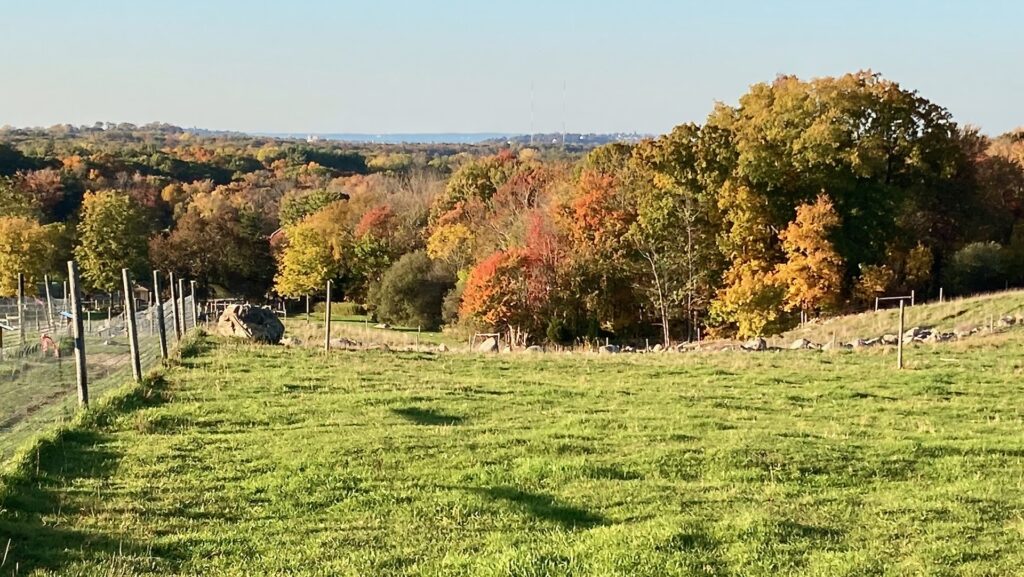
I took a walk at Weir Hill Farm in Hingham today. The fall colors are really starting to come out. Looking at them made me realize how much I missed the bright autumnal colors while we were living in California. There’s something about the fall colors in southeastern New England that really gets to me. Autumn in the San Francisco Bay Area had its own attractions, but nothing as thrilling as what I saw today.

Fifth shot

I got my fifth COVID shot today, the so-called bivalent booster.

Getting a COVID shot is boring now. But it didn’t used to be.

We got our first shots the day after our age group was eligible. We had to drive an hour to find an appointment. There was an elaborate check-in process. After getting the Pfizer shot, we had to sit down for fifteen minutes until they were certain we weren’t going to pass out or go into anaphylactic shock. Four weeks later, we got the second dose at the same drugstore, going through the same elaborate process. I was ill for two days after the second shot. Then it became a big topic of conversation for the next month: Did you get vaccinated yet? Which vaccine did you get? How long were you sick for afterwards?

We felt invincible for about four months, until the Delta variant hit. Then at last we were eligible for our first booster. This time, we got an appointment at a mass vaccination clinic, held at the San Mateo Event Center, formerly called the county fairgrounds. We waited in a long line of cars while volunteers in fluorescent yellow vests directed us into a big barn. Did we want Pfizer or Moderna? We had heard that you should get the one you didn’t get the first time. So we got Moderna. Then we had to drive into a big parking area while they monitored us to make sure we didn’t pass out. Once again, it was all very dramatic. And I was ill for a day after I got the booster.

For the second booster, I went to the Redwood City medical center where my primary care physician had her office. It was just like getting my annual flu shot. A nurse told me I shouldn’t worry about sitting in the waiting area after getting the shot. I got the shot, left the building, and drove home. My arm hurt for the rest of the day, but I didn’t feel ill.

Today I drove to Braintree to get both my annual flu shot and my third COVID booster. My appointment was at an older, somewhat dingy pharmacy. This time I remembered to wear a short-sleeved shirt. After I got my shot, the pharmacist told me to sit and wait fifteen minutes. I heard the man talking to the pharmacist as he got his shot. “Another shot, I can’t believe it! We’re going to be doing this forever,” he said, in his high querulous tenor voice. She murmured something soothing. “I guess it’s like getting your flu shot every year, isn’t it. And these people who don’t get shots. Can you believe them?!” Another soothing murmur. By this time I had waited five minutes. I decided I wasn’t going to pass out and walked out of the store. There was nothing exciting about any of it.

I still worry a little when I hear about people I know getting COVID. But getting your COVID shot is no longer exciting. It’s just part of the annual routine.

Yet another holy book

Rodney Kennedy, in an opinion piece on Baptist News Global, says:

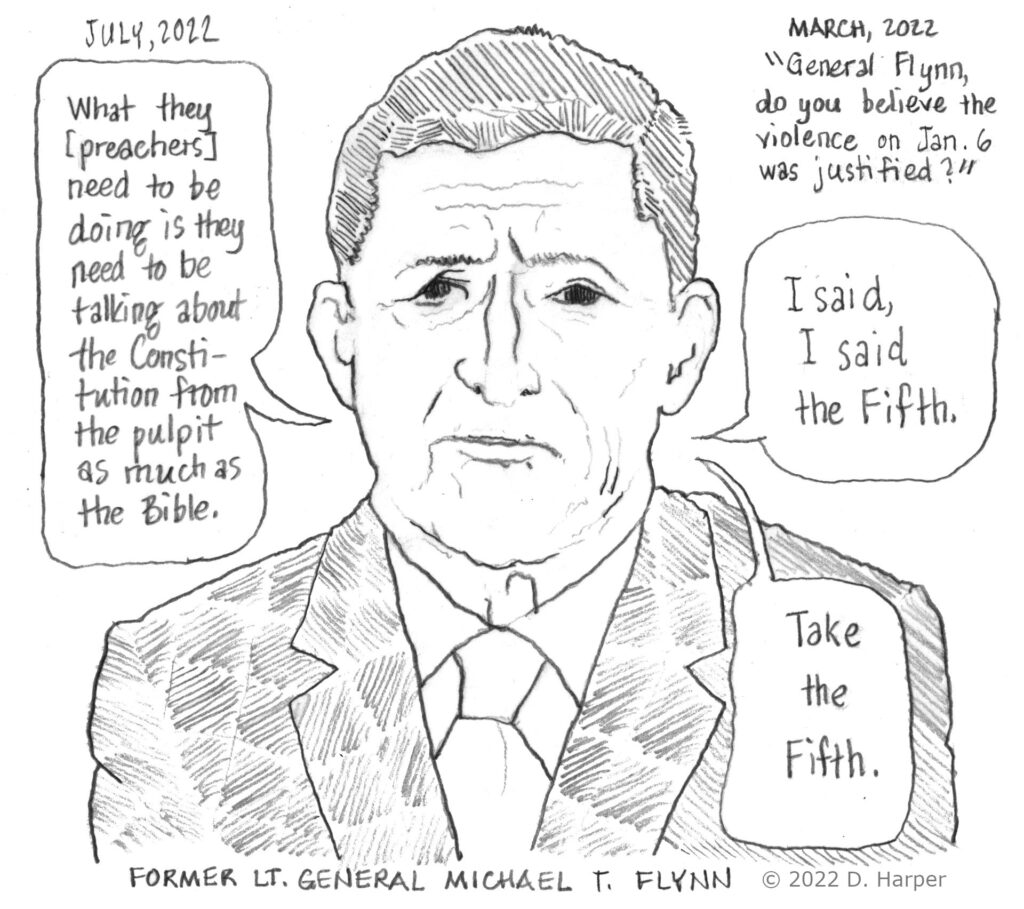
“I’m attempting to wrap my mind around the idea of a former Army general telling me I should preach from the U.S. Constitution. I mention this only because Michael Flynn has been occupying American pulpits, recommending the Constitution as a second holy book for preachers. ‘What (preachers) need to be doing is they need to be talking about the Constitution from the pulpit as much as the Bible. They have to do that,’ Flynn has said.”

Kennedy calls Flynn’s remark idolatrous. From his Christian point of view, the Bible stands alone and does not need to be propped up by any other texts.

I don’t know if Flynn actually believes what he said, or if he just said it to draw audiences. (Time reported that Flynn made $150,000 in 2016 for speaking engagements, a strong motivation to say what his audiences want to hear.) But I do know Flynn is giving voice to an opinion genuinely held by many people in the United States. These folks genuinely believe that the U.S. Constitution is divinely inspired, just like the Bible, and thus should be treated as a sacred text. These folks use short passages from the U.S. Constitution as proof texts, just as short passages from the Bible are used as proof texts, to prove the truth of a certain theological opinion or doctrine.

What a fascinating historical moment. We seem to be watching a sort of new Great Awakening, a movement which curiously adds the U.S. Constitution as a sacred text co-equal to the Bible. Like previous Great Awakenings, these folk are vibrant and adventurous and enthusiastic. My Puritan forebears would have said that enthusiasm results from excessive religious emotions that come from a deluded conceit that one is specially favored by God, and I’m still enough of a Puritan to agree. Nevertheless, what a fascinating historical moment.

Asters

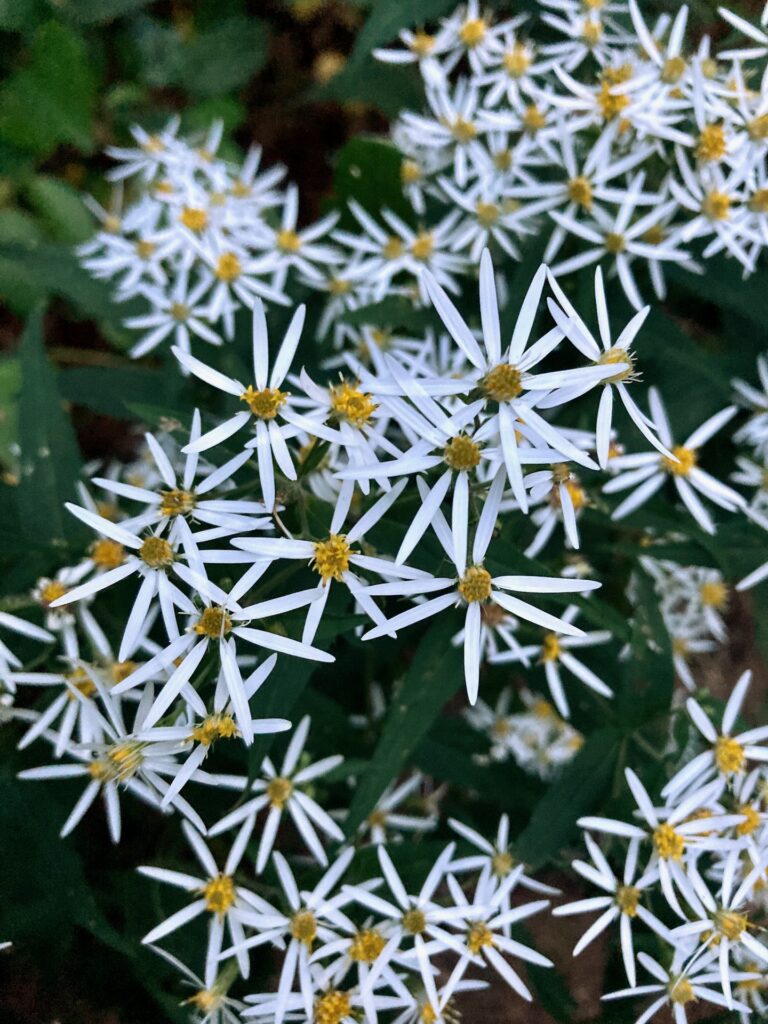
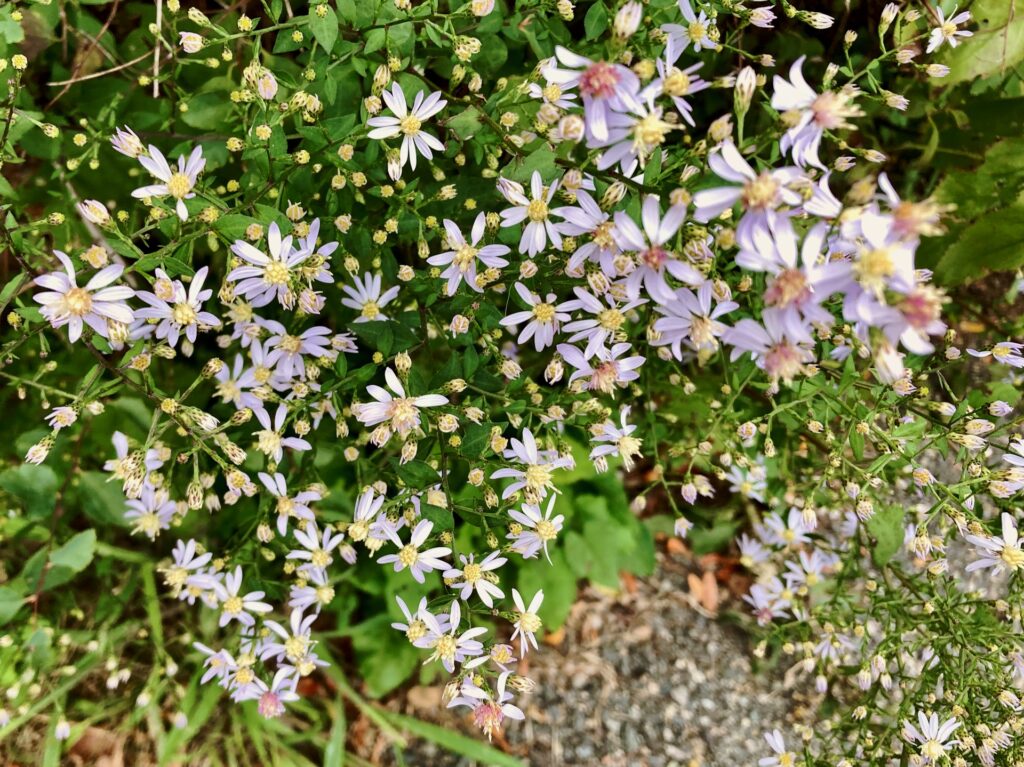
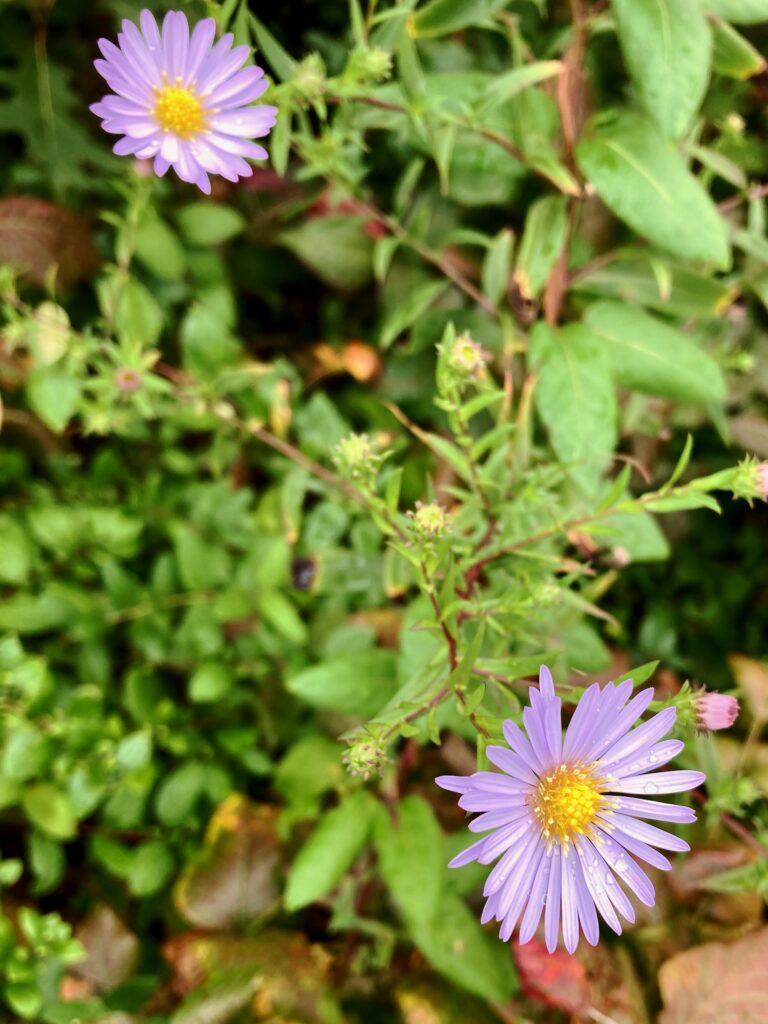
For the past month and a half, I’ve been looking for flowers in the aster tribe (Tribe Astereae). I’ve always liked asters. I don’t know why. There’s something about the off-white and pale lavender colors that gets to me.

Flowers in tribe Astereae, probably genus Symphiotrichum

I guess it’s a kind of spiritual experience when I see asters in bloom. Whatever “spiritual” means.

Flowers in tribe Astereae

I’m not able to tell which species of aster I’m looking at. In the genus Symphiotrichum alone, there are 27 species native to New England. Go Botany has a dichotomous key for Symphiotrichum. However, for some species the key requires 14x magnification of the bracts and disk flowers, but all I have is a 10x hand lens.

Flowers in tribe Astereae, probably genus Symphiotrichum

Nevertheless, I should sit down with one of these plants and try to work through the key. Not that it matters what species I’m looking at. Not that it will make the flowers any more (or less) beautiful. But why not observe them more closely?

Reading list: Keeping Heart on Pine Ridge

Keeping Heart on Pine Ridge by Vic Glover (Native Voices, 2004) is one of the best American spiritual memoirs I’ve read. In a series of linked essays, Glover talks about what it’s like to live on the Pine Ridge Indian Reservation in South Dakota, covering everything from commodity foods to reservations roads to the cars and trucks that drive on those roads.

Through all the trials of life on the reservation — the poverty, the low quality commodity food, the harsh weather — Glover’s spirituality sustains him. He doesn’t make a big deal of his spirituality. He describes, simply and well, his efforts, and the efforts of his tiospaye, to keep traditional spirituality alive.

Glover’s accounts of sweat lodges and the Sun Dance are unsentimental and emotionally powerful. Even when he’s not talking about specific religious rituals, spirituality creeps in to his accounts of every day life: the sense of connectedness of all life, the sense of something larger than ourselves, the necessity for justice work to bring ideals into reality.

I especially appreciate that Glover understands how spiritual community works. More than once, he points out that you can’t just show up at a Sun Dance and expect to be part of the in crowd. Spirituality is not just about one or two big sacred events: spirituality is something that happens day after day. And spirituality happens in community. It takes people in community to keep the rituals alive — people who do the mundane but necessary chores, people who cook the food eaten by the community, people who show up.

Maybe that’s the whole point of this book. You have to show up. Regularly, whenever you can. Like the member of Glover’s spiritual community whose truck breaks down and then walks for miles to show up for a routine sweat lodge. Glover quietly contrasts this kind of person with the spiritual dilettantes (my term, not his) who show up for the big celebration, the Sun Dance, and then disappear. Glover doesn’t pass judgement on these dilettantes; they’re welcome to come and participate at that level; but he makes it clear that it’s the people who show up regularly who keep the tradition alive.

There’s a parallel here with what happens in the Unitarian Universalist congregations I’ve been part of. Lots of people only show up when there’s a special musician, or a Big Name Preacher, or for the Christmas Eve candlelight service. But the ones who actually keep the tradition alive are the people who show up week after week. They just show up, even when it’s boring. They’re the ones who keep it going — by just showing up. That’s how community is nurtured, and that’s how religion and spirituality are passed on, in a community. The traditional spirituality of the Oglala Sioux is very different from Unitarian Universalism, but the common human thread that runs through through both is community.

This is a book worth reading. Buy it if you can, either from the publisher or an independent book store (not from Amazon, please, because their business model screws authors). If you really can’t afford it, you can borrow it online from the Internet Archive.