The bookstore that should not exist

This Twitter thread tells about one of my favorite bookstores anywhere: Renaissance Books in the Milwaukee International Airport (MKE). It’s unbelievable to find a used bookstore in an airport. On top of which, they stock a deeply eccentric collection of books, as noted by the author of the Twitter thread.

I particularly appreciate their wide selection of mid-twentieth century pulp novels. I was just in MKE a week and a half ago, and bought a 1960s paperback reprint of Ian Fleming’s thriller Casino Royale from 1953. Casino Royale, the first James Bond novel, is a wonderful example of mid-twentieth century pulp fiction: you simply can’t believe the amount of sexism and implicit racism, the plot creaks, and there are weird dominance and submission games going on throughout the novel. It reveals the strange paranoiac Zeitgeist of the 1950s better than any history book. But I digress.

Basically, it’s a bookstore that should not exist. So it kind of feels like Spider Robinson’s fictional Callahan’s Crosstime Saloon, except that it’s not a fictional place. Here are some key excerpts from the Twitter thread to explain:

“On my way home from Milwaukee yesterday I did a triple take when I saw an ancient used book store, IN THE AIRPORT!!! I felt like I walked through a portal to a world where everything was a little bit cooler. I was so enthralled I went up to the register and was like ‘hey, I’m fascinated by this place, can we chat?’ A man with an orange hat, orange glasses, and an orange shirt pushed aside his laptop and said ‘oh, heavens yes.’ His name is Orange Mike, and he’s worked here since 1979. Every employee of the shop, including Orange Mike, makes exactly ‘8.125 dollars’ an hour to keep this place going. They are also all in their 60s. Orange Mike himself comes from the local pen & paper community, and used to review games for Dragon magazine. The stock here is eclectic and weird and not remotely curated. Half of it is giant history books that have probably been here since the 80s….

“The store’s existence comes down to the airport taking bids from local bookstores to occupy the space, and accidentally including used bookstores in the list. The owner shrugged and submitted the high bid. The airport tried to stop it but after six months of legal spats failed…. This store just shouldn’t exist. The airport doesn’t want them there, it makes no revenue, they have a hard time moving product, and all of its underpaid employees are at retirement age. And yet it persists. AT A MAJOR AIRPORT. I am blown away by this place existing. If you’re ever at MKE, go check it out while you can. It seems like something way too good for this world, which means it may not be there next time if you skip it.”

I spent four hours at Renaissance Books one day last year, due to travel plan complications. That bookstore turned what was an otherwise unbearable trip into something almost enjoyable. I was so grateful that now every time I’m in MKE (which is not very often), I spend as much money there as I can (the limitation always being: How many books can I fit in my carry-on luggage?).

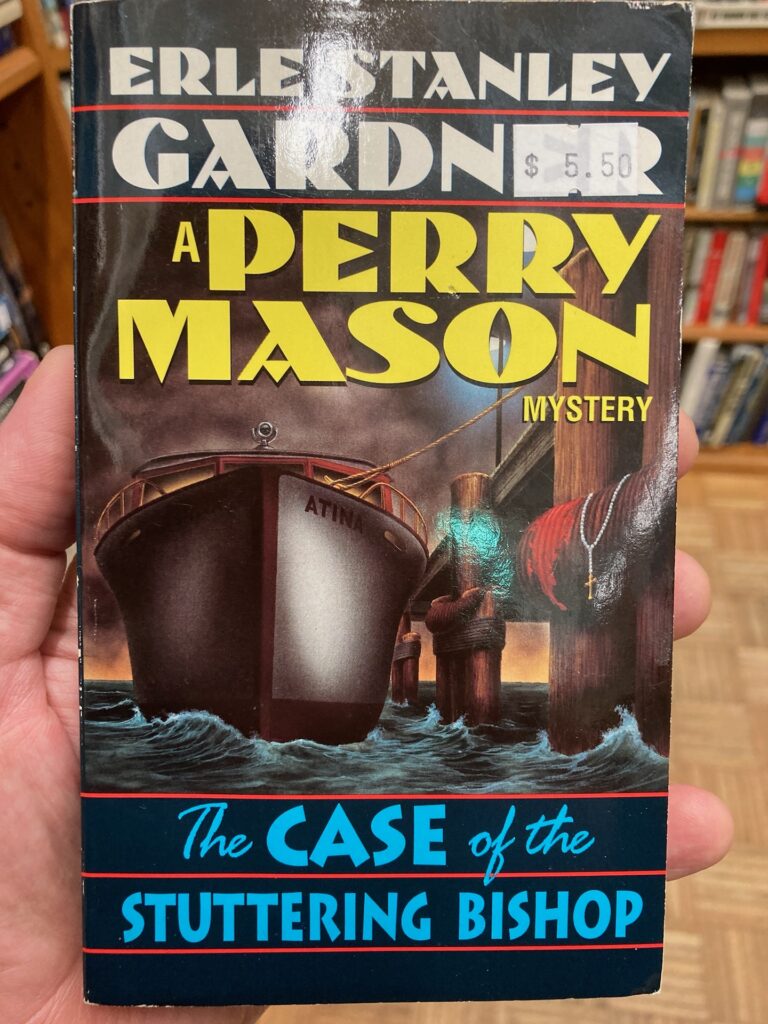
Hand holding a paperback book, with bookshelves visible in the background.
Me holding a reprint of a mid-twentieth century pulp classic in Renaissance Books. God, I love that place.

Non-standard process

This morning, the members of First Parish in Cohasset voted to call me as their next settled minister. We followed a non-standard path to this vote, and did not follow the UUA’s suggested contract-to-call procedure.

Actually, somehow the lay leaders and I both missed the fact that there was a recommended process. After we had all decided to proceed with a vote this spring, I discovered the UUA’s contract-to-call process. It’s thorough and complex, but it requirs many hours of volunteer time. Our congregation is small enough that following the UUA’s contract-to-call process would have left us with insufficient volunteer hours to complete other key tasks. Now that I’ve read it, I’d certainly recommend the UUA’s contract-to-call process to mid-sized and larger congregations; small congregations like ours might want to think about whether they have sufficient volunteer capacity.

Since our non-standard process might be of interest to others, here’s what we did: I was originally hired on a one-year contract which ends this June. In January, the board and I began to talk about whether they wanted me to continue. We considered various options together, including an open-ended contract; a call vote in the second contract year; a call vote this spring; or terminating the contract either this spring or next. The board held congregational meetings where they reached out to nearly every member, and based on feedback from members they decided to proceed with a vote to call this spring. Today’s vote was unanimous, implying some kind of consensus about this decision; I give all credit to the board for listening carefully to everyone before proceeding with a vote.

Controversy

On the one hand, I’m not a big fan of the proposed revision to Article II of the Unitarian Universalist Association (UUA) bylaws. On the other hand, the current UUA “Seven Principles” sound old and fusty, like they were written forty years ago (oh wait, they were written forty years ago). I’m the opposite of the stupid old mule paralyzed between two bales of hay that appear equally appealing, I’m like the stupid old mule paralyzed between two bales of hay that smell equally unappealing.

Anyway.

It appears that some amount of controversy is emerging about the proposed Article II revision. Our congregation here in Cohasset received an email which says in part: “A group of concerned UUs from across the county have created a website (www.savethe7principles.org) to share our analysis of this proposal and why we oppose it.” This email had only twenty names signed to it, so I guess it’s not a large movement. Nevertheless, we definitely don’t have the kind of consensus in 2023 that we had for the 1983-5 revision.

I just hope the Article II revision doesn’t turn into an extended “discussion” at General Assembly. I’m probably going to be a delegate this year, and I find extended arguments incredibly frustrating. On the other hand, I dislike it even more when honest conversation gets cut short. Either way, I have a feeling this is going to be a testy and tiresome General Assembly.

Universalist groups in the U.S.

As a follow up to my recent post on Unitarian groups in the U.S., I thought I’d look at a few religious groups that promote or support the doctrine of universal salvation. There are a great many Universalists out there, some of whom belong to a few small Universalist denominations, though many individual Universalists remain affiliated with existing denominations.

Christian Universalist Church of America

The Christian Universalist Church of America (CUCA) claims it was founded in Florida in 1964 by Universalist congregations who decided to opt out of the new Unitarian Universalist Association. By 1967, the new denomination ceased to exist (this story is briefly told in Russell Miller’s history of Universalism, The Larger Hope). The present organization was incorporated in 2001 in Indiana. Given the 34 year gap, it’s tempting to call the present CUCA a new organization. However, they still use the 1803 Winchester Profession as their statement of faith, so in that sense they are an inheritor of classic U.S. Universalism.

Their website contains almost no information about their current activities.

Primitive Baptist Universalists

The Primitive Baptist Universalists (PBU) grew out of the Primitive Baptist movement. PBU churches and people were well documented in Howard Dorgan’s book In the Hands of a Happy God (Univ. of Tennessee: 1997). Dorgan believed, but could not document, that early Primitive Baptist Universalists were led to Universalism by Hosea Ballou’s Treatise on Atonement.

PBU churches gradually separated from other Primitive Baptists over the doctrine of universal salvation in the early twentieth century. (In fact, next year, 2024, will be the centenary of the formation of the PBUs.) PBU churches are located almost entirely in the Appalachians. Like all Primitive Baptists, no musical instruments are used in their churches; their churches are plain and unadorned; preaching is the center of the worship service, and is always extemporaneous.

(I admit to real fondness for all Primitive Baptists. Quite a few Primitive Baptists sing at Sacred Harp conventions, where I have enjoyed meeting them and singing with them. Some day, I hope to visit a PBU church and meet some PBUs.)

Universalist Christian Association

The Christian Universalist Association (CUA) holds to a belief system they name “Christian Ultimate Reconciliation theology.” This theology appears to be similar to Restorationism, an important theological strand of the Universalists who later became part of the Unitarian Universalist Association. The CUA statement of faith is fairly detailed, with long-ish statements on “divine justice and life after death,” “universal salvation,” and “the Golden Rule.”

The CUA aims to cast a broad net, welcoming all Christian Universalists, including “Pentecostals, Evangelicals, Mainline Protestants, Catholics, Eastern Orthodox, Unitarian Universalist Christians, and non-denominational Christians.” Several Unitarian Universalists have served on their board of directors.

Considered as a denomination, the CUA appears to be fairly small. Their website currently lists just four in-person congregations as formal affiliates of the CUA. However, they describe themselves at times as an ecumenical organization, and they make a deliberate effort to include clergy and laypeople from many different denominations. They have ordained about 32 clergy since their founding in 2007.

Universalism and Universalists in other denominations

Universalists may be found in many denominations. For one example, I met a Rellyite Universalist in Alabama who has remained a member of his Methodist church. Evangelical Quaker ministers Phillip Gulley and James Mulholland have written books laying out their Universalist beliefs. Carlton Pearson left his Pentecostal denomination when he professed a belief in universal salvation, and has since found a home in the United Church of Christ (though he also retains a connections to a Unitarian Universalist congregation).

There are a number of Christian denominations which seem most likely to tolerate Universalists. This is especially true of denominations that use some form of congregational polity, where congregations have greater autonomy than in more hierarchical polities. More liberal congregations in the United Church of Christ, the American Baptist Church, and the Religious Society of Friends (Quakers) seem most likely to be welcoming to individual Universalists. Some local Pentecostal congregations may be receptive to Universalists.

There are also denominations which appear to affirm some view of universal salvation. Unity Church (formally known as Unity), a New Thought group, is one such organization. The Latter Day Saints (Mormons) tend towards universalism. Connections with Universalists may also be found through several websites; the Wikipedia page on Christian Universalism provides links to several such groups.

Universalism today is both diffuse and diverse. It’s probably impossible to find out how many people in the U.S. believe in universal salvation. Calling yourself “Universalist” can still cause certain amount of social stigma, and there are probably many Christians who believe in universal salvation who simply won’t use the term.

Non-Christian Universalism

Although Universalism is usually associated with Christian or post-Christian beliefs, there are non-Christian religious groups that affirm some sort of universal salvation. Some Pure Land Buddhists maintain that everyone may reach enlightenment. Some Muslims affirm universal salvation. There are Jews who call themselves Universalists, e.g., the Jewish Spiritual Leaders Institute.

Turkeys on the Common

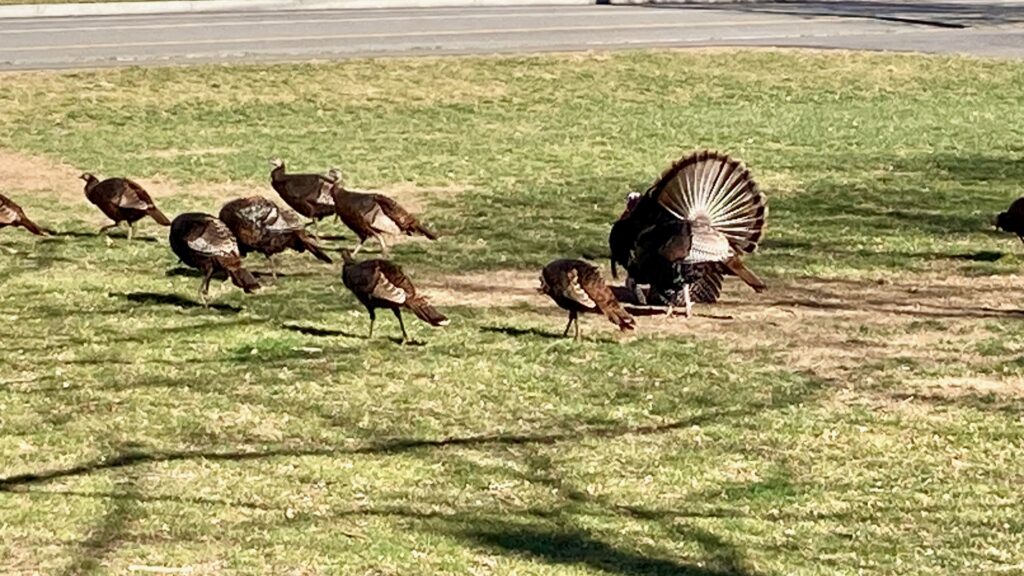
The Parish House of First Parish in Cohasset is directly opposite Cohasset Common. I’ve seen small groups of two or three Wild Turkeys skulking around in the bushes at the edges of the Parish House grounds. But today I saw about fourteen Wild Turkeys making their way across the common, out in the open, as bold as brass.

At least one male was gobbling. They were definitely aware of me, but they seemed to have little or no fear. Breeding season does that to many animals: reduces their level of fear, so they do stupid things.

Come to think of it, male humans are always in breeding season. Which explains so much about Homo spaiens.

Ten of the Wild Turkeys I saw on Cohasset Common, one with its tail erect and spread.

Another Unitarian group in the U.S.

Todd Eklof — a former Unitarian Universalist minister who was removed from fellowship with the Unitarian Universalist Association (UUA) over disagreements on approaches to anti-racism and other matters — is the new president pro tem of the recently-organized North American Unitarian Association (NAUA).

The NAUA joins the American Unitarian Conference (AUC) as a group that has broken away from the UUA over political and theological disagreements. Here’s an introduction to a few U.S. Unitarian groups, including the NAUA and the AUC…

North American Unitarian Association

The North American Unitarian Association (NAUA) website states that the group is “dedicated to courageously fostering and protecting the principles and practices of liberal religion: reason, tolerance, democratic process, freedom of conscience, freedom of speech and expression, and the inherent worth and dignity of all people.” Membership is open to congregations and to individuals. They provide the following services: monthly online worship; an online newsletter; online courses; monthly support sessions for NAUA-affiliated ministers; a “ministerial clearinghouse”; and a few other odds and ends. Congregations may affiliate with the NAUA while retaining their membership with the UUA.

The NAUA program strikes me as quite ambitious for a new organization. They do seem to have a fairly full leadership roster, mostly drawn from Todd Eklof’s hometown of Spokane, Wash. So they might be able to keep up all these new initiatives.

American Unitarian Conference

The American Unitarian Conference (AUC) formed in 2000. The founders decided to break away from the UUA for reasons I can no longer remember, nor can I remember the people who were involved in the founding of the group. The Wikipedia article on the AUC says it “was founded in 2000 by several Unitarian Universalists who felt that the Unitarian Universalist Association (UUA) had become too theologically liberal and too political.”

The AUC seems to have morphed into the Unitarian Christian Church of America (see below), or has been absorbed by them. The old URL, americanunitarian.org, now returns an error message saying the hosting account has expired. I checked the Internet Archive’s Wayback Machine, and the last version of the AUC website they have is from August 20, 2022.

Unitarian Christian Church of America

The Unitarian Christian Church of America (UCCA) appears to be a small group, based on their website. It may be that they’re the successor group to the American Unitarian Conference (AUC; see above). In any case, Shannon Rogers, head of the UCCA, is now the admin of the AUC Facebook page.

Assuming the UCCA and the old AUC are somehow linked, we might look at the the AUC Facebook page to get a sense of both organizations. This Facebook page has gotten recent comments critical of the UUA — “Unfortunately, my experiences with the UUs seemed to always have a thread of Progressivism in them” — and supportive of political conservative positions — “You can NOT be protected if guns are banned!” At the same time, the UCCA now provides children’s Christian education curriculums from ProgressiveChristianity.org. Some of their materials sound cautiously supportive of Black Lives Matter.

In short, it sounds like the UCCA is trying to become a “purple” denomination, welcoming to all political persuasions. Given that the UUA has pretty much given up trying to welcome Republicans (except for a few individual congregations), and is fairly unwelcoming to Christian Unitarians, I’m glad the UCCA provides a spiritual home for Christian Unitarians across the political spectrum.

Unitarian Christian Alliance

The Unitarian Christian Alliance (UCA) is a group of Biblical Unitarian Christians. On their website, they describe themselves as follows: “While holding to various beliefs in other areas, UCA members all agree that the God of the Bible is the Father alone, and that Jesus is his human Messiah. The mission of the UCA and its growing membership is two-fold: to promote unitarian theology and to connect like-minded believers across the globe.

The UCA claims both individual members, and nearly a hundred affiliated churches and groups. While most of the affiliated groups are in the U.S., they have affiliated groups on nearly every continent, including the countries of Brazil, Greece, Singapore, Kenya, and Australia. Interestingly, looking at the web page showing their Board of Directors, their leadership team consists of four middle-aged white men and one woman who does not have a photo.

As far as I can tell, the UCA has never had any connection to the UUA.

Spirit and Truth Fellowship International

Spirit and Truth Fellowship International (STFI) is a “non-denominational ministry” that engages in many activities. STFI issued a Unitarian version of the Revised English Version translation of the Bible. They have an active Youtube channel where they post recordings of their Sunday Morning Gatherings and their Tuesday Night Fellowship. They have a STFI app for iPhones. They also maintain a website called “Biblical Unitarian.”

As far as I can tell, STFI has never had any connection to the UUA.

Other Unitarian (Small “U”) groups

There are other denominations and groups that reject the Christian doctrine of the Trinity on various grounds. These include Jehovah’s Witnesses, Latter Day Saints, Oneness Pentecostals, Christadelphians, etc. Note that these denominations do not have “Unitarian” as part of their name, and they might not identify as Unitarian per se.

Historical American Unitarian Groups

1. The most notable American Unitarian group from the past is, of course, the Free Religious Association (FRA). Though the FRA is sometimes classified as a “freethought” group, most of its members were either former Unitarians, or people who maintained dual membership with the FRA and the American Unitarian Association (the predecessor to the UUA). For most of its history, the guiding spirit behind the FRA was William Potter, the minister of the Unitarian church of New Bedford. When Potter left the FRA, it quickly died, which makes me wonder if the FRA was really just a one-man project.

(I have to admit my bias against the FRA. I’m a former minister of the New Bedford church, and while there I did some research into Potter. I felt that Potter got too wrapped up in the FRA, and perhaps neglected his own congregation. On the other hand, I was so put off by his writing that I didn’t want to spend much time researching him. After learning something about Potter, I lost all interest in the FRA.)

2. In the early nineteenth century, the Christian Connexion (variously spelled) was unitarian in theology, and even cooperated with the American Unitarian Association. A few Unitarian ministers served Christian Connexion churches. But by the second half of the century, the two groups had gone their separate ways.

3. The Swedenborgians were vaguely unitarian (small “u”) in theology. However, as I understand it, their unitarianism made Jesus Christ into a god, with God-the-Father and the Holy Spirit as aspects of Jesus Christ. There are still Swedenborgians around (with at least one Unitarian minister serving a Swedenborgian congregation) but I know nothing about their theology in the twenty-first century, so can’t comment on whether they still can be considered theologically unitarian.

Visit to another congregation

Written on Sunday, March 25, but not posted right away due to press of events.

Carol and I went to the Sunday service this morning at the Open Circle Unitarian Universalist (UU) Fellowship in Fond du Lac, Wisconsin. Carol’s dad went to services there before he died, and was warmly welcomed, so it seemed like a good place to go.

I was impressed by the congregation, and by some of the innovative things they’re doing. So here’s a quick summary of my impressions.

Open Circle share a minister with the UU fellowships in Green Bay and Stevens Point. The minister was present in person in Fond du Lac this week, while the Stevens Point and Green Bay folks watched him via livestream. In addition, several Fond du Lac members joined the service via Zoom. (Presumably some Green Bay and Stevens Point folks joined their congregations via Zoom as well, but I only happened to notice what happened in Fond du Lac.) Thus there were six groups of people joining in: in-person and Zoom participants from each of three congregations. I believe there were three people managing the tech in Fond du Lac: someone to operate the camera and sound board; someone to manage the Zoom meeting; and the minister managed the PowerPoint slides.

I noticed a few other technical points. Only the sermon was recorded, thus doing away with copyright problems for the music and readings. Both announcements, and joys and concerns, were done at the end of the service, after the Zoom session had split into three breakout rooms (one for each congregation), so no one had to worry about making announcements, or stating joys and concerns, that didn’t apply to the other two congregations. The children’s story was a video of a reading of a children’s book taken from the internet — this was probably the low point of the service for me, since the audio quality of that video was poor (needed EQ), and the background “music” was more repetitious than a video game. However, using such a video did away with possible copyright conflicts. All in all, I felt the video and audio technology was handled extremely well.

The whole service was very well done: smooth and competent, without going too far in the direction of the overly polished feel of glitzy mega-church worship services.

I wondered if coffee hour would live up to the high standards of the worship service. It did. People started talking with us from the moment we stood up at the end of the service. There was good conversation, fair trade coffee, and good snacks. Before we knew it, an hour had gone by. You learn a lot about a congregation from coffee hour, and clearly this was a congregation where people liked each other, and cared for one another.

In short, we both felt welcomed, both service and social hour were good, and I learned a lot watching how Fond du Lac handled multiplatform multicongregation worship services.