Did he really say that?

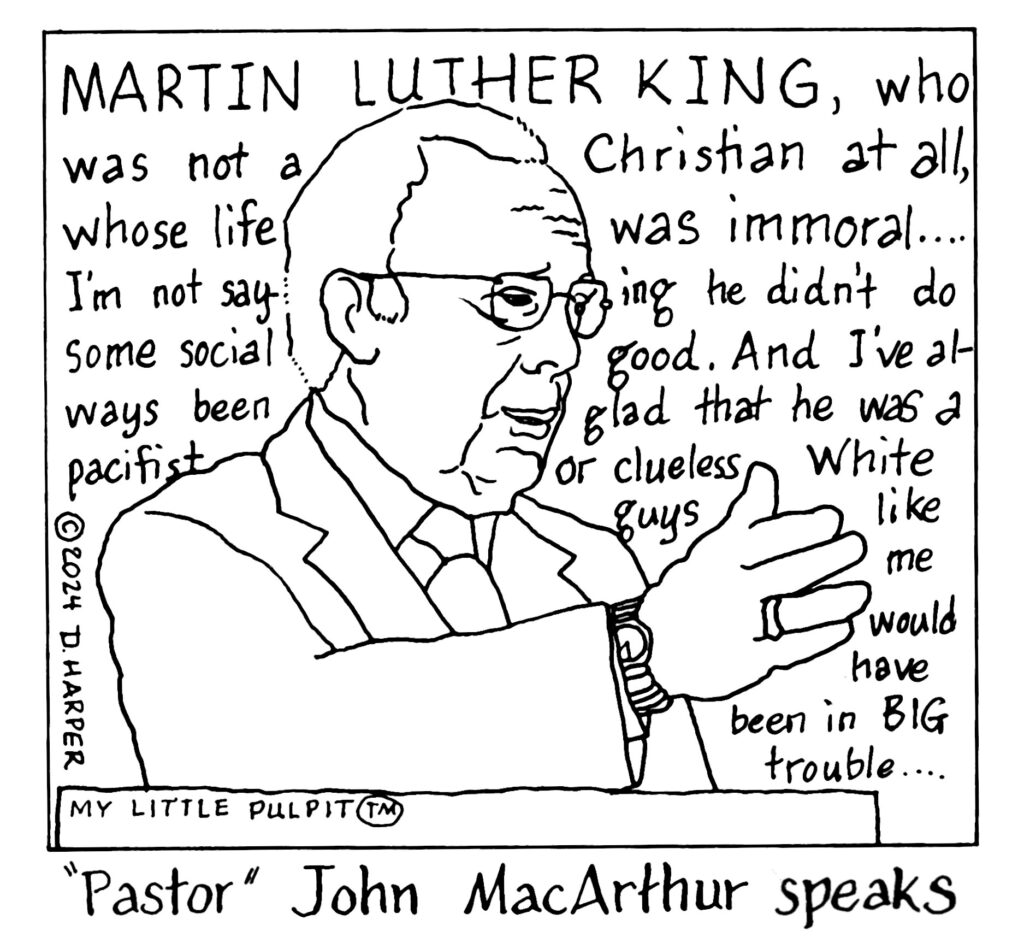
“Pastor” John MacArthur — I’m putting the title “pastor” in quotes because he doesn’t sound very pastoral to me — has decided to proclaim that Rev. Dr. Martin Luther King, Jr., was not a Christian. And before you ask, yes, MacArthur is an old White guy. Here’s what MacArthur said, according to Religion News Service:

“…Martin Luther King, who was not a Christian at all, whose life was immoral….I’m not saying he didn’t do some social good. And I’ve always been glad that he was a pacifist, or he could have started a real revolution….”

MacArthur was called out by a number of Black pastors. Rev. Charlie Dates, pastor of a Progressive Baptist church in Chicago, said:

“He cannot get away with this. He has to know that Black and Black-adjacent clergy around the country wholeheartedly disagree with him on theological grounds. He’s not the keeper of who’s Christian and who’s not.”

I’m sure MacArthur will simply ignore what Black Christian clergy say to him. MacArthur is another one of those Old White Guys in Power (OWGIPs) who think they get to set the rules. Actually, I’d say that people like MacArthur are the real heretics. They put themselves in the place of their God, trying to take away their God’s power to judge humankind.

With people like MacArthur saying stupid stuff like this, no wonder Christianity has such a bad name these days. Just try to remember that MacArthur is not really a Christian — Charlie Dates and Martin Luther King, Jr., are the real Christians.

A cartoon of John MacArthur saying, "Martin Luther King, who was not a Christian at all, whose life was immoral....I’m not saying he didn’t do some social good. And I’ve always been glad that he was a pacifist, or cluelss White guys like me would have been in big trouble."

A COVID memoir

I wrote this for a science fiction fanzine. But it also works well for this blog.

I

Two years before the pandemic hit, we started living in a graveyard. Not right in the middle of the graves—there was a low stone wall that separated our house, the cemetery office, and the parking area from the graves. But we lived inside the tall iron fence that separated the cemetery from the residential area surrounding it, and each evening an electric motor would start up, slowly driving the big iron gate along its track, shutting us off from the rest of the world.

It might sound a little creepy, but it was actually a very pleasant place to live. We lived in the old caretaker’s house, which was over a hundred years old. Neighbors walked past our house during the day, taking a walk in the cemetery, because it was only open space in the neighborhood. We could chat with the cemetery supervisor, and we got to know some of the members of the cemetery’s board of directors. At night when the gate closed, we had our own private five acre back yard. And, as we liked to say, the neighbors were quiet.

I’m not the first to notice that life during the pandemic felt like living inside a dystopian sf novel. That we lived in a graveyard made it feel even more like a novel. And it felt especially dystopian at the end of the summer, when the sky turned bloody reddish orange.

Continue reading “A COVID memoir”

G. K. Chesterton on romance and religion

In his introduction to the Everyman edition of Charles Dickens’s Nicholas Nickleby, G. K. Chesterton comments on how religion and romance are similar. Mind you, when Chesterton says “religion,” what he really means is “Christianity”; thus his is a narrow perspective indeed. Even so, I’m going to quote some of what he says, interspersed with my own commentary:

“Romance is perhaps the highest point of human expression, except indeed religion, to which it is closely allied. Romance resembles religion especially in this, that it is not only a simplification abut a shortening of existence….”

I agree with the first sentence. I think the second sentence is a gross oversimplification of both romance and religion.

“…religion is always insisting on the shortness of human life. But it does not insist on the shortness of human life as the pessimists insist on the shortness of human life. Pessimism insists on the shortness of human life in order to show that life is valueless. Religion insists on the shortness of human life in order to show that life is frightfully valuable….”

Even though Chesterton is really distinguishing between pessimism and Christianity, I think he’s on to something here. Other religions (or other spiritualities) do in fact say that life is frightfully valuable. This is one of the most important functions of religion and spirituality in human society.

“All this is equally true for romance. Romance is a shortening and sharpening of human difficulty. Where you and I have to vote against a man [sic], or write (rather feebly) against a man, or sign illegible petitions against a man, romance does for him what we should really like to see done; it knocks him down; it shortens the slow process of historical justice….”

And religion does this to some extent, too, although we have a longer timeline that the writers of romances like Nicholas Nickleby. In Nicholas Nickleby, evil uncle Ralph Nickleby is driven to death after a period of two or three years; so it’s only a few years until the evildoer gets what he deserves. According to most religions, it takes longer for justice to prevail. The conservative Christians (like Chesterton) talk about judgement by God after death; we will have to wait until death for evil persons to get their just desserts. Progressive Christians like Theodore Parker and Martin Luther King, Jr., talk about the moral arc of the universe bending towards justice; we will have to wait until long after any of us dies before the evil that is in society is expunged. Some strands of Buddhism tend towards quietism and simply accept suffering while trying to transcend it, but the Engaged Buddhists like Thich Nhat Hanh closely resemble Dr. King and Theodore Parker in their timeline for justice to arrive.

I suspect that what both religions like Christianity and Engaged Buddhism, and romances like Nicholas Nickleby share is a commitment to hope. Pessimists (and even some realists) see hope as ridiculously idealistic. Religions and romances take hope as a given.

Healthy youth programs

On Wednesday and Thursday, I attended a training in “CampWell,” a new wellness program that’s being developed by the Alliance for Camp Health (ACH). Created in cooperation with the American Camp Association (ACA), CampWell emphasizes training front-line staff “to identify, understand, cultivate, and create a community of well-being.” The training I attended was aimed at program directors and leaders, so they can train their staff to promote well-being both in themselves and in the campers they serve.

I wish this program existed when I was active in Unitarian Universalist (UU) youth ministry at the district and continental levels. Around the year 2000, I had a contract with the Unitarian Universalist Association (UUA) to write training materials for youth advisors and youth leaders, and while I did the best I could with the scanty resources I had, the CampWell program makes me realize how inadequate those UUA trainings were.

CampWell benefits from a quarter of a century of research into social-emotional learning, MESH+ (mental, emotional, and social health), psychology of emotions, play, and more. CampWell is also much better funded than UUA youth ministry ever was, and the quality of the training materials is very high. Plus, ACH is engaged in ongoing research in how CampWell is implemented, which will lead to ongoing revision of the program.

While most UU organizations won’t be able to afford to send staff to CampWell trainings, here are some free or inexpensive resources on their website that could be useful in programs such as OWL, youth groups, summer camps, etc.:

MESH+ resource page — Scroll down for links to a variety of online resources. The links connect to other websites, such as ACA’s “Healthy Camp Toolbox” (wish I had this when I was helping plan overnight youth conferences), Search Institute info on fostering connections for positive youth development, and more.

MESH Pocket Guide — Meant to go in the backpacks of camp counselors, this 12 page folding guide gives tips for active listening, tips for when to seek help, tips for self-care, and more. While it may seem expensive at $8 each, the Guide is waterproof and tough, meant to stand up to hard use. I’ll be purchasing a couple to use in our congregation’s summer camp, and I also think it would be a great resource of OWL facilitators and youth advisors.

MESH Resource Guide — At $50, this is not cheap, but there’s lots of good material in here that could be shared with youth advisors, OWL facilitators, day camp staff, etc. Some of what’s included: an excellent overview of trauma in youth; causes and prevention of bullying; interacting with different types of parents; assessing youth participant behavior issues; and much more.

One final resource I learned about from the CampWell training — Mental Health First Aid. Given the epidemic of teen mental health issues we’re all seeing, this should be something every UU congregation learns about. Their motto is “Let’s make mental health first aid as common as CPR.” I completely agree. Now I just need to find a course near me.
Way more books were challenged in 2023

The American Library Association (ALA) issued a press release on Thursday about the rise in attempted book bans last year. The ALA tells us: “The number of titles targeted for censorship surged 65 percent in 2023 compared to 2022, reaching the highest levels ever documented by the ALA. The new numbers released today show efforts to censor 4,240 unique book titles in schools and libraries. This tops the previous high from 2022, when 2,571 unique titles were targeted for censorship….”

Not surprisingly, about half the books that were targeted for banning are about LGBTQ+ people and/or non-White people.

The ALA is offering a number of resources to fight back against book bans. They have teamed up with the New York Public Library to create the Teen Banned Book Club and other programs to get banned books into the hands of young people. The ALA has also created a website called “Unite Against Book Bans” offering resources to help you if (when) book bans come to your community.

The ALA also maintains lists of the top ten challenged books for the past quarter century. I love the fact that in 2019, Margaret Atwood’s The Handmaid’s Tale made the list, ostensibly for profanity, vulgarity, and “sexual overtones.” However, I suspect the real reason The Handmaid’s Tale got banned was because the people calling for the ban didn’t want to admit that’s the society they desire.

Four years

Four years ago today, on Friday, March 13, 2020, the state of California shut down schools across the state. I was then the minister of religious education in Palo Alto, Santa Clara County, California. Since our congregation decided to tie our education programs to whatever the public schools did, that meant we too were going to move all our programs online effective immediately. And on that same day, Santa Clara county banned all gatherings of more than 100 people, so our congregation moved Sunday services online as of the following Sunday.

Complete lockdown happened three days later, as most Bay Area counties issued a stay-at-home order on March 16. A state-wide shelter-in-place order was issued on March 19.

Houses of worship were considered “essential services,” so I could get out of the house and go to work a couple of days a week. But it was definitely creepy commuting to work on Highway 101. The week before, all four lanes in both directions would be packed with cars from 6 a.m. to 9 p.m. In the first weeks after the shut-down, at times I’d see no other cars on the road. It reminded me of this passage from Daniel Defoe’s Journal of a Plague Year: “…the great streets within the city [of London], such as Leadenhall Street, Bishopsgate Street, Cornhill, and even the Exchange itself, had grass growing in them in several places; neither cart or coach were seen in the streets from morning to evening, except some country carts to bring roots and beans, or peas, hay, and straw, to the market, and those but very few compared to what was usual.”

Singing after COVID

The annual Western Massachusetts Sacred Harp singing convention is being held this weekend. The organizers are requiring a same-day COVID test for all singers, and with that public health protocol in place I decided I felt safe going to sing today (but not Sunday when I have to be at church).

These Sacred Harp conventions are a bit of an endurance test. The singing starts at 9:30 or 10, and continues to 3:30 or 4 with an hour for lunch. It’s a whole-body immersive experience.

Before COVID, the Western Massachusetts convention reportedly got as many as 400 singers. COVID seems to have reduced the numbers somewhat. Today, I did a rough count and came up with about 175 singers in the room at one time.

Only about a dozen of us were wearing masks. I had my N-95 mask on the whole time. I skipped the potluck lunch because it would have meant sitting at close quarters with more than a hundred other people for most of an hour with my mask off. The post-COVID world is all about calculating the odds, and determining what risk you’re willing to tolerate.

I enjoyed singing in the morning. But after lunch, I realized to my surprise that I was beginning to feel a little bit anxious. It was no problem to control my anxiety. But after about an hour I had a further realization: controlling my anxiety was taking enough of my attention that it wasn’t as much fun to sing.

So I left early.

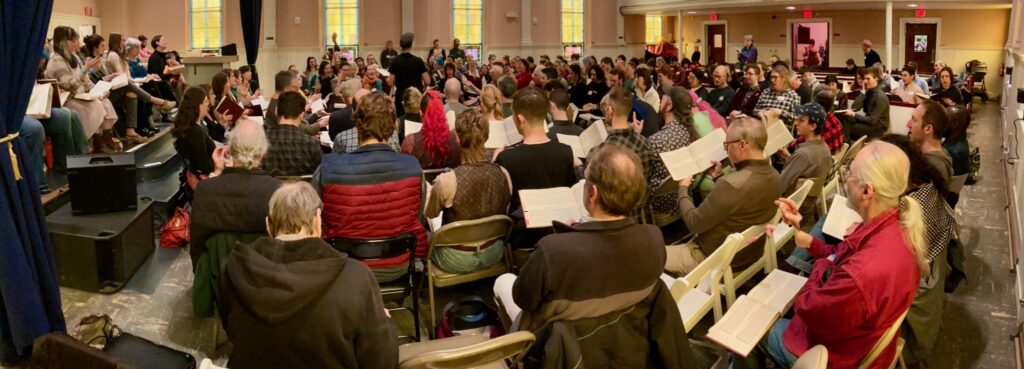
A panoramic view of the singing, with over 150 people visible in the photo.
What it looked like from the back row of the bass section

How not to handle sexual abuse

This week, the Southern Baptist Convention (SBC) provided a demonstration of how not to handle sexual abuse claims.

The U.S. Department of Justice has been investigating sexual abuse in the SBC. Two days ago, on March 6, SBC officials told Religion News Service that the DOJ investigation is over:

“‘On February 29, 2024, counsel for the SBC Executive Committee was informed that the US Attorney’s Office for the Southern District of New York has concluded its investigation into the EC with no further action to be taken,’ Jonathan Howe, Executive Committee interim president and CEO, told Religion News Service in a text….”

The next day, on March 7, abuse survivor Tiffany Thigpen told Religion News Service that the DOJ investigation had not been closed:

“‘The lead investigator from the DOJ concerning this investigation was as surprised as we were by these reports. She answered both Megan [lively, another abuse survivor] and I immediately when we called (separately) and said the investigation is very much open and active,’ Thigpen told Religion News Service in a text….”

The DOJ is unable to comment publicly about ongoing investigations, so they refused to comment to Religion News Service. The fact that they can’t comment is in itself revealing. And on March 7, Baptist Press reported that SBC legal counsel has confirmed that the investigation is ongoing.

Obviously, this is a bone-headed move on the part of SBC leadership. But the rest of us can learn from this. The main takeaway — learn from Yogi Berra that it isn’t over till it’s over. So don’t do any victory laps until it’s actually, really and truly, finally over.

Noted without comment

A letter from Dr. Samuel Johnson, to his friend Dr. Lawrence whose wife had just died:

— from Boswell’s Life of Johnson, 20 Jan. 1780

Cheap pocket plant press

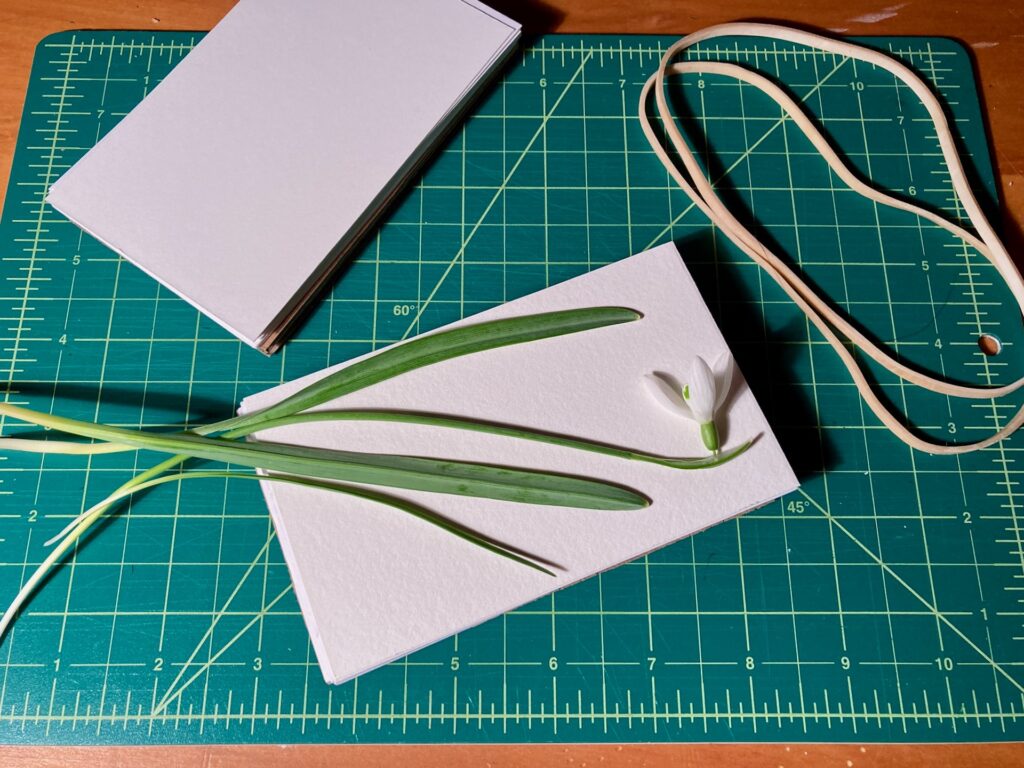
Photo of the materials listed, laid out on a work table.

(1) This pocket plant press is made from a stack of 3 x 5 index cards, salvaged corrugated cardboard, cheap watercolor paper, and rubber bands. Cut two pieces of corrugated cardboard to 3 x 5 inches. Cut two pieces of cheap watercolor paper to the same size. Find a flower, and blot it dry with paper towels.

A flower arranged on the open plant press

(2) Place one piece of corrugated cardboard down. Stack half the file cards on top of it. Place a piece of watercolor paper on top of that. Arrange the flower on this stack. Then make another stack of corrugated cardboard, file cards, and watercolor paper.

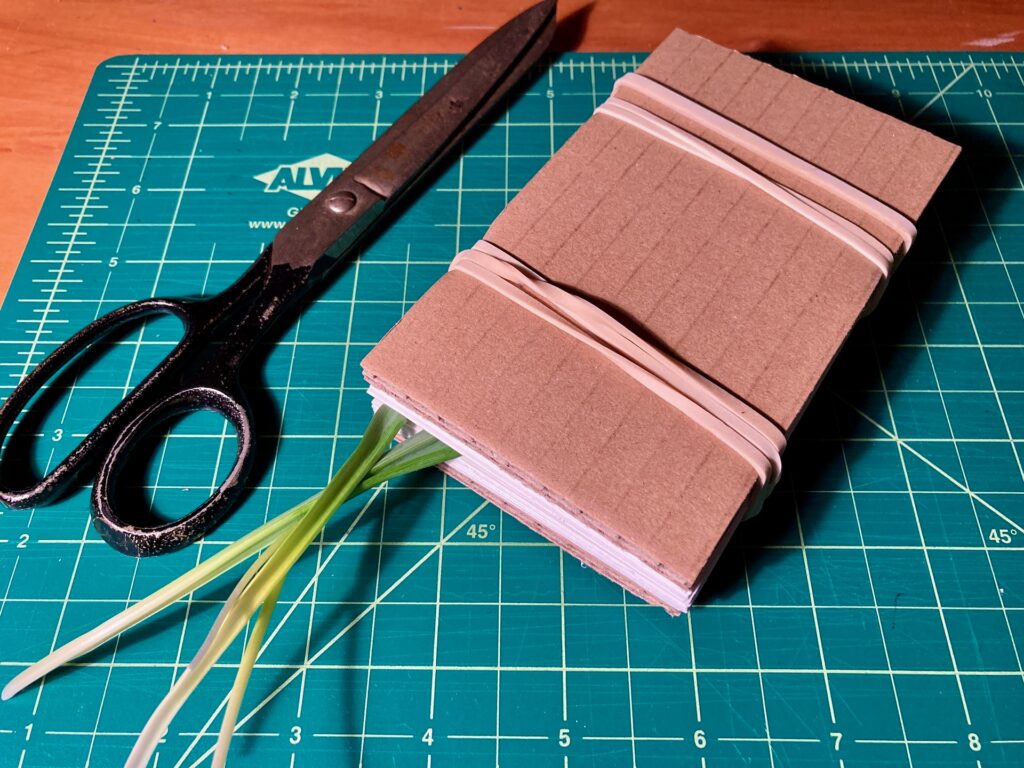
The completed stack, the flower is in the middle with its stem sticking out.

(3) Assemble the stack with the corrugated cardboard on the outside. Wrap the assembly with the rubber bands. If the stem of the flower is sticking out, you can trim it off with scissors.

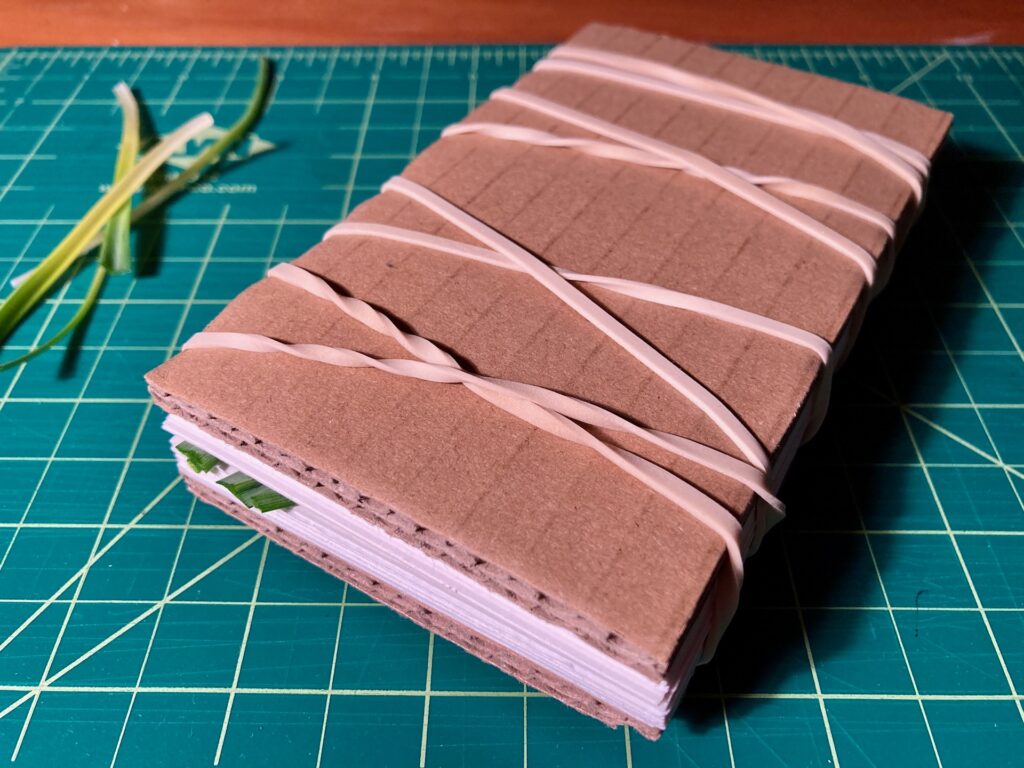
Side view of the assembled stack, showing the layers.

Now let it dry for at least a week. Longer if the weather is humid, or the flower is especially moist. If you want the flower really flat, stack some heavy books on top of the plant press.

The watercolor paper takes the place of blotter paper in a real plant press. In some cases, the pressed flower may leave a colored image on the watercolor paper, so with some experimentation you should be able to use this technique to make pressed flower monoprints.

The stack of file cards makes the plant press stiffer, and helps spread the pressure of the rubber bands out evenly. You can also press several flowers in this plant press by using alternating layers of file cards, watercolor paper, and flowers.

(This is a follow up to this post. And for the finished product, see this post.)