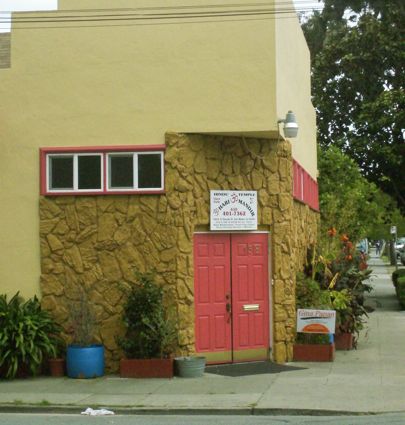
There’s an amazing diversity of places of worship within walking distance of where we live in San Mateo. Here’s the local Hindu temple, about six blocks away:
Link to a photo of Masjid Ul Haqq from a few months ago.
A postmodern heretic's spiritual journey.

There’s an amazing diversity of places of worship within walking distance of where we live in San Mateo. Here’s the local Hindu temple, about six blocks away:
Link to a photo of Masjid Ul Haqq from a few months ago.
Over the past few weeks, I’ve been thinking about an article on the Alban Institute Web site which introduces the concept of distinguishing between that which is foundational and that which is accretional within a religious tradition. The article focuses on foundational and accretional practices in worship services, but the concept can be applied more widely. A good bit of Harvey Cox’s latest book, The Future of Faith, is his attempt to show that belief is an accretional practice within Christianity, whereas faith (in his careful definition) is foundational. So this has gotten me thinking about what is foundational and accretional within the liberal traditions of Unitarian Universalism. Liberal traditions tend to embrace the surrounding society, so my feeling is they accumulate lots of accretional practices — and as shed lots of those accretional practices as time goes on. This raises the interesting question of what, exactly, is foundational to Unitarian Universalism; a question to which I have no firm answers yet, but I’m thinking about it.
Summer is upon us in the Bay area, and it is time to reflect again on Mark Twain’s description of Bay area summers:
“Along in the summer, when you have suffered about four months of lustrous, pitiless sunshine, you are ready to go down on your knees and plead for rain — hail — snow — thunder and lightning — anything to break the monotony — you will take an earthquake, if you cannot do any better. And the chances are that you’ll get it, too.”
From Gary Dorrien’s new book, Economy, Difference, Empire:
“What would a just society look like? What kind of country should the U.S. want to be? For more than two centuries U.S. American politics has featured two fundamentally different answers to these questions. The first is the vision of a society that provides unrestricted liberty to acquire wealth. The second is the vision of a realized democracy in which democratic rights over society’s major institutions are established. In the first vision, the right to property is lifted above the right to self-government, and the just society minimizes the equalizing the role of government. In the second view, the right to self-government is considered superior to the right to property, and the just society places democratic checks on social, political, and economic power.” Economy, Difference, and Empire: Social Ethics for Social Justice (Columbia University, 2010), p. 143.
Unitarian Universalists would seem to align themselves with the second vision, the vision of a democratic society, given that the bylaws of the Unitarian Universalist Association (UUA) claim a commitment to democratic process. However, it is not clear to me that this is the case — the major attraction to Unitarian Universalists for many people in our congregations is that no one can tell them what to believe or do, and this too is enshrined in the bylaws of the UUA, in the claim to a free and responsible search for truth, which is often restated in colloquial terms as “no one can tell me what to believe.” This last attitude is in close emotional alignment with the attitude that the government shouldn’t tell individuals what to what to do with their property.
Thus I see a built-in theological tension within Unitarian Universalism between theological liberty on the one hand, and on the other hand a commitment to democratic theological community in which the right of self-governance is superior to the right to believe whatever one wishes. There is a difference, however, between Unitarian Universalism and wider U.S. society: it is much easier to remove oneself from Unitarian Universalism. There are many people who feel themselves in complete alignment with theological Unitarian Universalism and more specifically with the principle of a free and responsible search for meaning without a creed, but who also find themselves unwilling or unable to submit any of their individual theological liberty to the demands of being part of a democratically organized congregation — many of these are the people who call themselves Unitarian Universalists on national polls but who aren’t part of a local congregation.
One last note on this topic: Historically, Universalists were more committed to theological liberty than were the Unitarians, and the loose structure of their national organization reflected that commitment to liberty. The Unitarians, by contrast, affirmed theological liberty and had, on the face of things, fewer theological restrictions than the Universalists; but beginning in the late nineteenth century the Unitarians poured far more of their energies into their democratic institutions. When the two denominations consolidated, the Universalists felt themselves out-organized at nearly every step of the way; and the new denomination has ever since then invested more energy into its democratic structures than into theological liberty.
At lunch time, I drove down to the marshes at Baylands Nature Preserve. A baby American Avocet stood at the edge of the water swishing its tiny beak back and forth to gather insects and other invertebrates from the water, just like the adult avocets a few yards away. Out in deeper water, a Mallard hen watched carefully over two baby Mallards swimming on either side of her. I couldn’t help noticing the difference in the way the two species raise their young: the American Avocet is a precocial species whose young are on their own from hatching, while the Mallard is an altricial species whose adults care for their babies for some time. It seemed that everywhere I looked I saw birds nesting or getting ready to nest: Cliff Swallows building their nests of clay on the side of a building, Forster’s Terns apparently nesting on a tiny island in the middle of the marsh, Marsh Wrens warbling madly in the rushes.
I looked across the bay at the green hills of the East Bay. Except some of the lower hills at the far end of the Dumbarton Bridge don’t look all that green any more. It’s been warm for the past few days, and it looks like the rains are finally over and gone, and now some of the low hills are turning summer-brown. The higher hills and mountains are still brilliant green, but it won’t be long before they turn brown, too.
Baby birds and hills turning brown: these two markers in time are as good as any to mark the end of the winter-wet season, and the beginning of the summer-dry season.
Osama bin Laden is dead. It feels strange to write that. I could wish he had been brought to trial — or brought to justice really — rather than killed in a firefight. But they’re reporting that he used another person as a human shield, which reveals a lack of courage and a moral depravity. So he’s dead. I can’t help but think that the world is a better place without him.
By sheer coincidence, today I’ve been thinking about the Cain and Abel story from the book of Genesis. You’ve heard the story: Adam and Eve are the first two humans. They have two sons, Cain and Abel. God favors Abel over Cain, and in a fit of pique Cain murders Abel. When God asks Cain where Abel has got to, Cain replies, How should I know, am I my brother’s keeper? But God, being God, knows that Cain has killed Abel, and tells him so. Cain is ashamed. God punishes Cain, saying: I’m cursing you, your life will be tough, you’re going to be a vagabond and a fugitive forever. Cain says, I’m gonna be a vagabond and a fugitive, and everyone who finds me out will try to kill me. But God says, Not so, anyone who kills you, vengeance will be taken upon him sevenfold. Then God set a mark upon Cain to let people know about that. There’s some kind of weird complex poetic truth to the Cain and Abel story that I can never quite wrap my head around. It is obviously not a literally true story, but like the best fiction it gets at deeper truths — what the deeper truths are is open for debate.
And although it’s an inexact and incomplete analogy, I can’t help thinking of Osama bin Laden as a Cain-like figure: someone who commits a heinous murder, and who, after his crime was committed, had to become a fugitive and vagabond. It’s an inexact analogy, and Osama bin Laden was not Cain, but I have to admit I do worry about the aftermath of his death. Osama bin Laden is dead, the world is a better place without him, but I would not call this a neat and tidy ending to his story.
I do feel an enormous sense of relief that he’s dead. He was both depraved and powerful. And now the question is: what next?

Roses in the garden outside my office at the church, in full bloom just in time for the Maypole dance we had this morning.
According to today’s San Mateo County Times, a group of students at Hillsdale High School held a rally to protest statewide cuts to public education funding. The Times shows a photo of a group of students marching behind a banner that reads:
“You Don’t Pay For Our Education
We Won’t Pay For Your Social Security!”
Perhaps this is the beginning of a new generation gap, the start of a widening rift between the Millennials and the Baby Boomers?
Various media sources are reporting that singer Marianne Elliot-Said has died of complications of breast cancer at age 53. Elliot-Said was better known under the stage name Poly Styrene, a name she used while singing with X-Ray Spex.
X-Ray Spex had a short career. In 1976, Elliot-Said was taking voice lessons, learning how to sing opera, and recording derivative reggae songs on the side, when she saw the Sex Pistols perform. This exposure to punk rock galvanized her, and she decided to form her own punk band, X-Ray Spex. The band performed together for about three years, recorded a handful of singles and one album, then disbanded in 1979.
Following the demise of X-Ray Spex, Elliot-Said joined the Hare Krishnas, or more properly, the International Society for Krishna Consciousness, a branch of Hinduism that worships Vishnu, and is devoted to bhakti yoga, or expressions of devotion to God. I had not known that Elliot-Said had joined the Hare Kishnas, but I guess I wasn’t entirely surprised. When she was singing with X-Ray Spex, her voice had a transcendent, joyful quality to it — even when she was singing about the horrors of genetic engineering, or screaming (in late 1970s punk vocal style) “Oh bondage! up yours!” Although the punk rock idiom of the late 1970s was fairly limited, as practiced by someone like Poly Styrene the vocal style could approach a raucous and ecstatic transcendence. There was often a hint of rapture in her voice, even a hint of a connection to something larger than herself.
Elliot-Said has been interpreted as an early exponent of what came to be called third-wave feminism; she had a clear influence on later feminist bands like The Slits, and it’s hard to imagine the riot-grrrl movement without her example. She allied herself with the anti-racist forces within punk rock and was bi-racial — a Somali father and a White English mother — and perhaps she will be claimed as an early adopter of multiracial identity. She also had a preference for day-glo colors and wore braces on her teeth, though it’s harder to know what to make of those attributes.
But I prefer to remember her simply for her full-throated, no-holds-barred singing, a kind of punk bhakti devotion that invited us all to transform and transcend. The hell with the anemic pablum of praise bands. If you’re gonna make me have amplified music in a worship service, I won’t settle for anything less the raw full-throated raucous singing of someone like Poly Styrene.
Below are my notes from a fundraising workshop led by Kim Klein, author of Fundraising for Social Change, at Starr King School for the Ministry, Monday 25 April 2011. My notes are just a bare outline of the presentation. Perhaps the most important part of the presentation was Kim Klein’s straightforward, easygoing, no-nonsense, humor-filled approach to talking about money. She was not in the least uptight when she talked about money. In fact, perhaps the most important thing she told us was that it’s OK to talk about money, that we have to un-learn all the taboos and social constraints we have around money.
That being said, here are my notes:
The key questions nonprofit organizations must ask themselves before beginning fundraising:
— What does your organization most believe? You want to have a short memorable sentence describing what you believe. Example: “A mind is a terrible thing to waste.”
— What does your organization do? You want to be able to talk very coherently about what you do.
— How well have you done? — your track record
— How much? — sources of money: Who gives?
“We don’t want a donation, we want a donor.” So you build relations with people who will be ongoing donors.
The hardest thing to do with a prospective contributor is to “get them to go from zero to one.” That first donation is hardest. Therefore, you have to be willing to start small. [My thought: perhaps this is one good reason to pass the collection basket in the Sunday service, because you’re getting that first donation early on.]
Another basic rule of fundraising is to ask for donations three or four times a year: you ask for the first donation, then you follow up three or four months later. Individual donations will increase over time, as people stay with your organization. If you’re willing to be more sophisticated, you start keeping track of how often different individuals can be asked to give; e.g., there will be some people who say, “This is all I’m giving this year, don’t call me again,” and so you don’t call them again; on the other hand, there may be people who prefer to be asked as many as six times a year.
For congregations, there is the annual canvass or pledge drive. But Klein recommends figuring out a way to ask for money two or three additional times in a year: a capital fund drive, a special project, etc. [My thought: I wonder about things like an annual church auction — even the people who don’t attend could be asked to give a cash donation to the auction.]
The basic fundraising equation: time in for money out. When looking at the time we put in, we have to be sure exactly what we want to get back for our time: money of course, but perhaps also more people, more visibility, etc.
The most effective use of fundraising time is personal, face-to-face asking.
You should ask people for about how much you think they can give. It’s not enough to simply ask for a donation — that’s too vague. You should know about how much you’re going to ask from a specific person, then ask for it.
If you’re looking for larger gifts (say, $5,000), to get the size gift you want, the prospect-to-donor ratio is about 4 to 1. So if you need a $5,000 gift, you should ask four people: 50% of the people you ask are likely to say yes (that’s 2 in this example), and half of those are likely to give you the amount you need (that’s 1 in this example).
You have to welcome it when prospects say “no.” First of all, when someone says “no,” that means you’re that much closer to having someone say “yes”! Secondly, it is important to remember that “no” actually may mean many different things. Here are some different ways people say “no,” and appropriate follow-ups:
When talking to prospects, you should take what they say absolutely literally. Do not try to read anything into what they say, because you might misinterpret. So if someone says, “Not now,” take that literally — they aren’t rejecting you, they are literally saying, “not now.”
If you contact someone by phone to ask for a donation, you’ll get a positive response about 25% of the time. If you contact someone via email or a letter to ask for a donation, you’ll get a positive response about 10% of the time. If you contact someone in person, you’ll get a positive response about 50% of the time. Obvious conclusion: when fundraising, the best approach is to contact someone in person.
What do you do after you write a note thanking the prospect?
It’s important to remember that $1,000 is a lot of money to most people. Yet most nonprofits do not pay much attention to such donors: if you give them attention, they’re often amazed. This is because we often give the same amount of attention to a $35 donor that we give to a $1,000 donor.
What kind of attention can you give to them? You can invite them to see a project your nonprofit is working on. It can be very low-key and non-threatening: “I’m going to be in your neighborhood visiting a project that you gave money to support, would you like to come along and see?” [My thought: in congregations, I’ve seen dinners for large donors work fairly well — but we religious liberals seem to have an aversion to this kind of thing.]
Before approaching a prospective donor, you have to know that they already give money to some charitable cause. This is easy to find out, and most people give some money to something. [My thought: if someone comes to Sunday services, and you pass the collection plate, most people will have thrown something into it — so you know that they give money!]
An approach often begins with a letter or email message, the gist of which is: you tell the prospect that you are going to ask them for a donation, increase, etc., but that they shouldn’t make the decision based on this letter, because you will call them in a few days.
Next step is to make the phone call. This is the hardest part! Therefore:
During the actual meeting, there are three things that a prospective donor is likely to focus on:
(1) The history of the organization. Default to your own story about your history with the organization.
(2) The philosophy of the organization. Again, be able to talk coherently about what your organization does.
(3) Benefits. Ditto.
Sometime during the meeting, you come to the close. That’s when you ask for the donation.
Kim Klein likes what she calls “the double close.” This is when you start out by saying something like: “I’m going to ask you for X dollars, but first let’s get to know each other, and talk about the organization.” You put it on the table, and then you take it right off again. Then, at the end of the meeting, you close again, and ask for the donation. She likes this because it takes a lot of the tension out of the meeting (for her, probably for the prospective donor). She doesn’t insist on it, but she likes it quite a bit.
When you come to the close, ask for the money — THEN SHUT UP. Don’t say anything, even if the silence goes on for a very long time. If you say something, you could wind up talking yourself out of a donation.