California Aqueduct

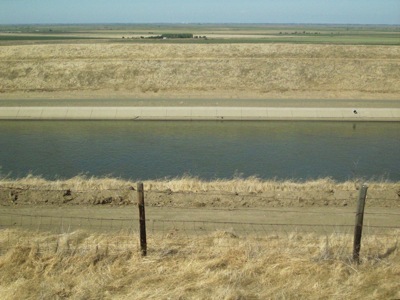
Heading north from Barstow to our apartment, driving along Interstate 5, just before where we were to turn off to take state road 152 through the Pacheco Pass, we saw a little sign reading “Vista Point.” We turned off into a narrow, dreary parking area, and looked down into the California Aqueduct. There’s an explanatory sign that tells you why the California Aqueduct is important. I admit I didn’t read it; I was too interested to look at the water flowing through the uncovered aqueduct, and the parched grass on either side, and the green irrigated agricultural fields of the Central Valley in the distance. It was a hot summer day, and as I stood there looking at the aqueduct, I wondered how much of that water is lost to evaporation on its long journey to southern California.
Navajo Nation to Barstow

We were almost the only whites in the Dine’ Restaurant this morning; and we were the only whites at the Window Rock post office; and the only whites at the Navajo Nation Museum, which doubles as a cultural center and meeting space. Of course we went to the bookstore in the Navajo Nation Museum, where, among other things, I bought I Swallow Turquoise for Courage, a book of poetry by the Navajo poet Hershman R. John. In the poem “Strong Male Rain,” John writes about his childhood fear of thunderstorms, and how he discovered that his friend “Darcy, a Jewish girl from Phoenix,” was also scared of thunder:

I told her about the Male Rain and what not to do during a storm.
She told me about Ean and his tale of the Kugelblitz.
I guess Jews and Navajos aren’t all that different.
We were both afraid of thunderstorms.
We have other past storms we were afraid of too.
She had the Holocaust
And I had America.

We drove up to the tribal park in Window Rock, and looked at the memorial to the Navajo Code Talkers of the Second World War. We also looked at the memorial that had a long list of Navajo who had died while serving in the U.S. military. Continue reading “Navajo Nation to Barstow”

From Texas to Navajo Nation

We left Amarillo and drove across the flat plains to the west. Everything looked frighteningly dry: the grass wasn’t even brown from lack of water, it was bleached almost white.

At lunch time, we got off the interstate and followed Historic Route 66, as it is called in New Mexico, through Santa Rosa. We pulled in to a restaurant called “Route 66.” A man got out of a truck marked “City of Santa Rosa” and walked in in front of us. I figured it was a good sign that a city worker was going to eat there. Inside, the restaurant was well kept, with lacy curtains in the windows, Route 66 memorabilia on the walls, and pretty red and white artificial flowers in vases on the tables. It seemed like just about everyone eating in the restaurant knew each other; one older man stopped at nearly every table to greet people on the way to his table at the back of the restaurant.

A distinguished looking man with salt-and-pepper hair, wearing a sport shirt and new and neatly pressed blue jeans, stood at the cash register. He asked us with a soft Spanish accent how our meal was. We got to chatting about the weather. “It’s the driest year ever since they’ve been keeping records,” he said in his soft voice. When he learned we were from California, he asked, “How is it there?” “We’ve had a wet year,” I said. “And cold,” said Carol, “our tomatoes just aren’t growing.” He shook his head at this news: wet and cold! Continue reading “From Texas to Navajo Nation”

Heading west

We got a late start this morning, and didn’t leave Van Buren, Arkansas, until nearly noon. After we had been driving a bit, we turned off at a sign that said “Oklahoma Welcome Center,” and turned into the poshest rest stop I think we’ve ever seen. It was staffed by three volunteers. One politely asked me if she could help me with something, and I said, “No thank you, I’m just waiting while she checks email,” pointing to Carol, who was sitting an a very comfortable armchair enjoying the very fast Internet service. “In that case,” she said in her Oklahoma drawl, “I’ll just kill flies,” and, picking up a flyswatter, proceeded to do just that. “Do you keep score?” I said. “No,” she said, “and I’m not doing a very good job, either,” as she missed a fly for the third time.

As we drove through eastern Oklahoma, I noticed that the land looked much greener and much less dry than it had when we drove east a couple of weeks ago. Clearly they had had rain since then.

At exit 200 for Seminole, Oklahoma, we turned off to see if Robertson’s Ham Sandwiches was open. We had seen their distinctive red-and-white billboards heading east, but we had arrived after they closed. They were open. There wasn’t much on the menu but ham sandwiches, so we each had a double ham sandwich for less than five dollars. We sat at one of the wood tables to eat our sandwiches. It was about the best ham I’d ever eaten in a ham sandwich.

We turned off the interstate at El Reno, Oklahoma. Continue reading “Heading west”

Still in the South

Our goal for our driving vacation this year was to see the South. We saw some southern cities — Birmingham, Memphis, Nashville, Charlotte — and we saw a little bit of the country — Natural Bridge and San Mountain in Alabama. Now here we are in Van Buren, Arkansas, and tomorrow we drive in Oklahoma.

I feel that we’re still in the south here. The air is warm and damp, and the trees and plants are all very green. When you walk across some grass or under trees, you can smell the earth and the vegetation. Distant hills are blue. The people say “y’all,” and it’s easy to find a place that serves turnip greens or green beans cooked up with bacon, or some fried okra.

By tomorrow night, we’ll be in Amarillo, Texas. The air will be dry, there won’t be those rich smells at night, the trees won’t be nearly so green. People will still say “y’all,” but it won’t be quite the same. We’ll be headed back towards home, towards the far West.

The last of my general assembly reporting

A few last posts by me on the uuworld.org GA blog:

Scholars of color assess UU history, report on brief talks by Rev. Mark Morrison-Reed, Rev. Monica Cummings, and Rev. Patricia Jimenez.
Music and cultural change in UUism, interviews with UU musicians Nick Page and Jeannie Gagne.
Commission on Appraisal continues study of ministry and authority, covering the Commission on Appraisal’s report to GA, and brief interview with Megan Dowdell of the Commission.
Moderator’s report: All of us working together, covering Gini Courter’s report to GA.

As before, comment here, or comment on the posts themselves.

(Earlier links to my reporting are here, and here.)

Yet another UU joke

I interviewed Nick Page for the uuwolrd.org GA blog, and he told this joke. I reproduce it here just as Nick told it:

“Ernie came from Dartmouth [College], where he heard a lecture on altruism. And he said, we all have to learn to share. So I said, if you had two pigs, would you give me one? Yes, he said, if I had two pigs, I would give you one. If you had two horses, would you give me one? Yes, he said, if I had two horses, I would give you one. If you had two wheelbarrows, I said, would you give me one? Dammit, he says, you know I got two wheelbarrows. And that speaks to the future of Unitarian Universalism.”

You are now invited to exegete this joke, and say how exactly it applies to the future of Unitarian Universalism

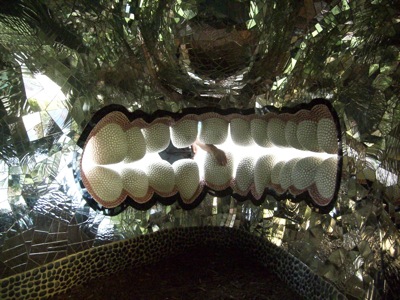
Inside “La Cabeza” by Niki de Saint Phalle

“La Cabeza” is part of the show “Creation of a New Mythology,” now at the Bechtler Museum of Modern Art in Charlotte, N.C. Five monumental sculptures are outdoors in a public park across the street from the museum; and you can climb inside this sculpture. You can also stick your arm through its teeth.

More of my General Assembly reporting

Some more of my reporting on General Assembly is up on the uuworld.org blog:

The continuing power of liberal theology today, lecture by Gary Dorrien, with responses by Rebecca Parker and Dan McKanan.
UUA Financial Advisor reports a brighter situation, report from Plenary this morning.
Faith formation in a multi-cultural world, conversation with Mark Hicks, professor of religious education at Meadville/Lomard Theological School.
The cultural challenge of digital media, conversation with Rev. Scott Wells.
Report of the president of the UUA, report from Plenary this afternoon.

As before, comment here, or comment on the posts themselves.