An item of concern

For the past decade or so, I’ve been most concerned with the institutional health of liberal religion: there are human values which are carried best by human institutions, and without a strong institutional structure those values seem likely to wither like a plant without water and adequate soil.

But recently I have become increasingly concerned about the spiritual health of liberal religion in general, and Unitarian Universalism in particular. We religious liberals spend so much time on social justice — and there is indeed an overwhelming amount of social justice work to be done — and we spend so much time on the health of our institutions — and again, there is indeed an overwhelming amount of institutional work to be done — that it has come to seem to me that we are slighting our spiritual well-being.

Along with that, we have come to understand “spiritual well-being” in such individualistic terms that the phrase has almost no meaning within the context of institutional Unitarian Universalism. In the past month or so, I have heard the following mentioned, and even glorified, as activities that foster spiritual well-being: yoga; Zen retreats; shamanic training; dream work; walking the labyrinth; meditation that is rooted in non-Western practices. These are either highly individualistic practices, or practices rooted in another spiritual community; or both.

Yet I rarely hear religious liberals speak lovingly of the core practices that lie at the center of our own liberal religious tradition. Those core liberal religious practices include the following: Continue reading “An item of concern”
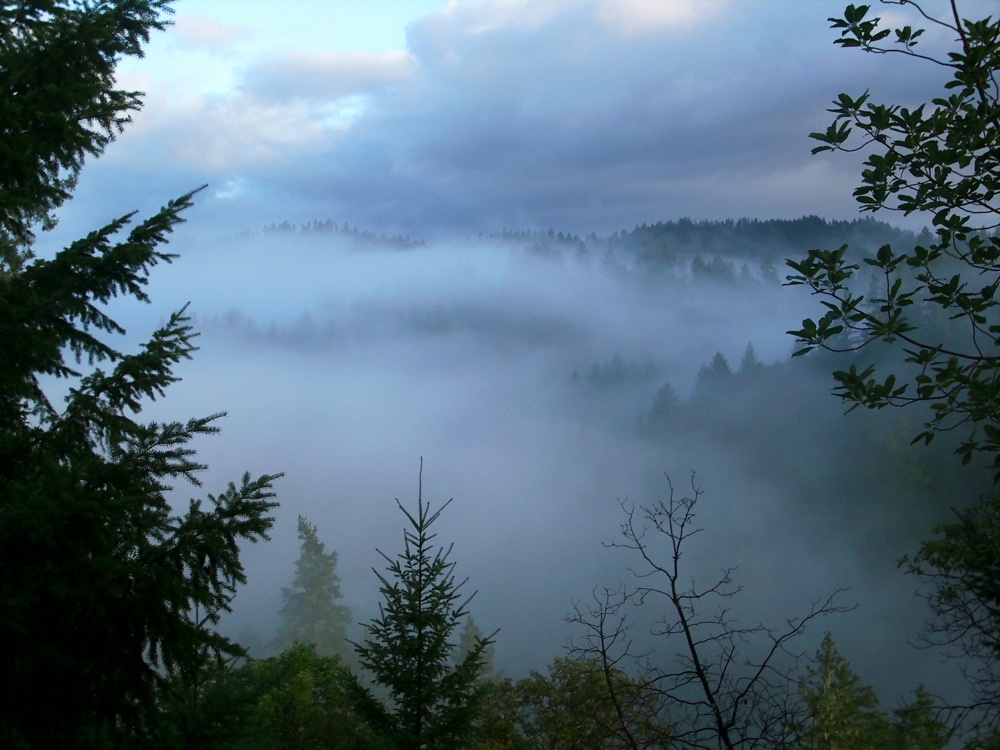
Morning fog in the Coastal Range

When I first started looking at classical Chinese landscape painting seriously, I never thought of it as realism: those steep fantastical hills, the mists that so conveniently provide a sense of distance and perspective, none of that looked real to me. But when you live on the Pacific Rim, you see that much of classical Chinese landscape painting is realism.

For the past couple of days, I have been staying at a retreat center on a steep hillside in a redwood grove in the Coastal Range of northern California. This morning the mist drifted in the valley below us, and this is what I saw when I looked out my window at about eight o’clock:

A definition

This morning, Robert Latham, our interim district executive is meeting with the district’s ministers. One of the things he said is sticking with me:

“One way to define dysfunctionality is: to dream big and act small. Then one way to define funtionality is: to dream big and act big.”

The first rain

Camp Meeker, California

As I drove up here to where the ministers meeting would take place, it started to rain. By the time I arrived, it was raining steadily. I got out of the car, and it smelled like rain and wet ground. It was the first rain I had seen and felt and smelled since last spring. I took a deep breath.

This evening, Carol texted me: “Where do we have tarp for rowing machine?” This summer, Carol bought a rowing machine for ten dollars, and we had set it out on our little second floor deck so we could sit outdoors while we were using it. But now it was getting wet. I texted back: “Crap. Look in basement.” I hope she managed to find the tarp and protect the rowing machine from the rain.

The top 0.1 percent

Sociology professor G. William Dumhoff recently posted an article by an investment manager about the wealthiest people in the United States. This investment manager (who wished to remain anonymous for obvious reasons) concludes:

I could go on and on, but the bottom line is this: A highly complex and largely discrete set of laws and exemptions from laws has been put in place by those in the uppermost reaches of the U.S. financial system. It allows them to protect and increase their wealth and significantly affect the U.S. political and legislative processes. They have real power and real wealth. Ordinary citizens in the bottom 99.9% are largely not aware of these systems, do not understand how they work, are unlikely to participate in them, and have little likelihood of entering the top 0.5%, much less the top 0.1%. Moreover, those at the very top have no incentive whatsoever for revealing or changing the rules. I am not optimistic.

For those of us who are concerned about people who are poor, the implication is that we will be able to make no real progress on eliminating poverty.

A parable told by robots, signifying…

A robot tells the parable of the Gospel of Thomas, ch. 97. Here’s the text of the video:

The kingdom of heaven. The kingdom of heaven is like a woman who was carrying a jar full of flour. While she was walking along a distant road, the handle of the jar broke and the flour spilled out behind her along the road. She did not know it. She had not noticed a problem. When she reached her house, she put the jar down and discovered that it was empty.

A slightly different version of Thomas 97 will be the reading in the Sunday services tomorrow.

(Update, 11/22: video moved to Vimeo, audio improved a bit, and editing tightened up a bit.)

Silicon Valley wins again

A Silicon Valleyite has gotten another distinguished award. Yesterday, John Perry of Stanford University was awarded an Ig Nobel Prize for his Theory of Structured Procrastination, which states: “To be a high achiever, always work on something important, using it as a way to avoid doing something that’s even more important.”

Perry’s original research was published in the Chronicle of Higher Education in February, 1996. Perry did not go in person to receive his award, which is no surprise since the awards were given out at Harvard University.

Berkeley fog

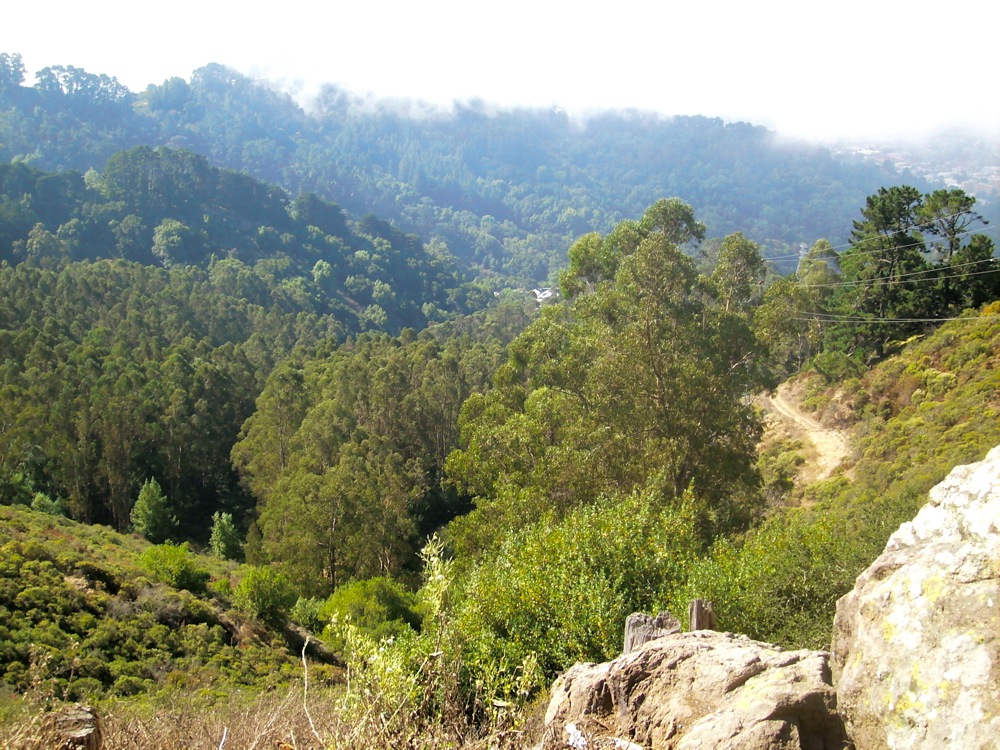
I had to drive to a meeting at the Unitarian Universalist Church of Berkeley (UUCB) yesterday, and because I had to drop Carol off near the Rockridge BART station in Oakland, I wound up driving over Grizzly Peaks Boulevard. This was the route I drove to get to work for a year in 2003-2004: from north Oakland up over Grizzly Peaks to UUCB. It is the most dramatic route I have ever commuted along: a section of Grizzly Peaks Boulevard is a winding mountain road through Berkeley Hills a thousand feet above the cities of Oakland and Berkeley. On a regular basis, I would pull over during my commute to enjoy the view: the sun setting over the Golden Gate, the play of light on San Francisco Bay, the view down into the wooded canyons along the ridge.

As I drove along Grizzly Peaks Boulevard this morning, a huge bank of fog was moving in through the Golden Gate from the Pacific; it had mostly covered the city of Berkeley, and was at the foot of the Berkeley Hills. It was so beuatiful, I had to stop, even though I was a little late for the meeting. Looking out I saw the brilliant white of a thousand-foot high fog bank stretching out across the bay, and looking down I could see ridges and cnayons covered with live oaks and eucalyptus trees, and I could see one little corner of the city of Berkeley before the fog blocked my view.

By the time I drove back up over Grizzly Peaks Boulevard three hours later, the fog was swirling up over the peaks, and there was no view of anything except white fog.

People are (mostly) thoughtful

Not everyone is thoughtful — there are plenty of people who are selfish or just plain mean-spirited — but a great many people are thoughtful. One of the guests who has been staying at Hotel de Zink, the 15-bed rotating homeless shelter that our church has been hosting this month, stopped by this afternoon. She had noticed that some of the other guests had no sheets, so she went out and found some sheets, and walked here to the church to drop them off. Of course we had to lock them up so no one would steal or vandalize them (being aware of the fact that not everyone is thoughtful). But still — it’s nice when thoughtful people look out for those around them.

Not Emerson?

Recently, I have been trying to track down the origins of the following quotation attributed to Ralph Waldo Emerson:

“A person will worship something — have no doubt about that. We may think our tribute is paid in secret in the dark recesses of our hearts — but it will out. That which dominates our imaginations and our thoughts will determine our lives, and character. Therefore, it behooves us to be careful what we worship, for what we are worshipping we are becoming.”

This quotation appears in the Unitarian Universalist hymnal Singing the Living Tradition, but there is no source listed for it in Between the Lines: Sources for Singing the Living Tradition. (This quotation does not appear in Hymns for the Celebration of Life, the predecessor to Singing the Living Tradition.)

The Complete Works of Ralph Waldo Emerson are available online at www.rwe.org. I searched the complete works for “tribute,” using both the online concordance, and a brute force search using Google, and did not find this quotation.

Emerson’s complete sermons are also available online at www.emersonsermons.com — these are the genetic texts (including manuscript variations) used in the definitive four-volume The Complete Sermons of Ralph Waldo Emerson, ed. Albert J. von Frank et al. (University of Missouri Press, 1989-1991). Using a brute force Google search, I did not find this quote in the sermons. I was also able to search eight of the ten volumes of Emerson’s letters online using Google Books (vols. 1-5, and 8-10). This quotation was in none of those volumes. All my searches used the relatively uncommon word “tribute” as the key search word.

At this point, I have not searched vols. 6-7 of the Letters; The Poetry Notebooks of Ralph Waldo Emerson, ed. Ralph H. Orth et al.; and The Topical Notebooks of Ralph Waldo Emerson, ed. Ralph H. Orth. Nevertheless, I’m assuming that Emerson probably did not write this passage, and the attribution should read “attributed to Emerson.” Can anyone prove me wrong by providing a definitive source for this quote?

(1/5/22: Click here for another Not Emerson hymn.)