
Tense standoff at Occupy Oakland

Occupy Oakland was broken up early this morning. Citing allegations of drunkenness, sexual assault, and health violations, the city sent in the police at 4:30 a.m. to take down the camp. Given the timing of the police action, it’s hard to believe that drunkenness and health violations constituted a real part of the reason for eviction, and one sexual assault had been reported several days before. Nevertheless, the police broke up the encampment, and city workers removed all tents and equipment, presumably destroying the garden that Everett and I saw yesterday.

The Oakland Tribune has been liveblogging the events today, and as of 6:30 p.m. (20 minutes ago), about a thousand protesters are in front of city hall at the site of the encampment. Police have demanded the protesters disperse, but the protesters aren’t going:

The protesters, possibly as many as 1,000 people, are all gathered at 14th street and Broadway. Over the last 30 minutes, police have launched wooden dowls and some concussion gernades into the crowds. It was not immediately known how many protesters, if any, were hit. An Oakland Tribune news photographer was hit with something launched by police. At least two people have been arrested since the rally and march kicked off at 4 p.m. Many in the crowd are wearing bandanas, possibly to protect themselve if the police use tear gas. Sirens are sounding, motorcycle police from many agencies are in downtown and there is general chaos as police try and clear out the massive amount of people.

I talked with Everett a couple of hours ago, and we agreed that we were glad we had seen the encampment — more of a village, really — before the city destroyed it; and from what had had seen of the occupiers, we also agreed that we would not be surprised if they returned. But what will happen tonight is anyone’s guess.

Occupy SF, Occupy Oakland

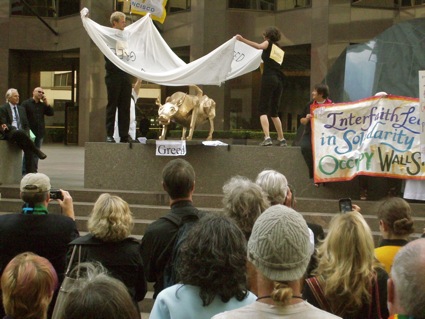
Everett Hoagland and I went down to the Interfaith Clergy Solidarity with Occupy Wall Street San Francisco today. We walked to various banks where two dancers, labeled “Equality” and “Justice,” set up a golden calf, representing the idolatry of money, and ritually covered the idol with a cloth:

A poem started bubbling up for Everett, so he dropped out of the march to do some writing. I kept walking. There were something on the order of 150 to 200 clergy and other faith leaders marching; I counted ten Unitarian Universalist ministers, and half a dozen of our seminarians. TV news coverage of today’s event: Rev. Jeremiah Kalendae of the Unitarian Unviersalist church in San Francisco is quoted in the text portion of Channel 5’s (CBS) coverage. Link to ABC’s live coverage. Radio coverage on KQED (story begins 0:37).

In the afternoon, Everett and I went over to Occupy Oakland, and spent an hour or two there, talking to some people, and just trying to lend our support. I was impressed that the occupiers have a children’s program during the day, a library, classes and committee meetings, and they have started a garden:

The city of Oakland keeps threatening to arrest all the occupiers — nevertheless, with accommodations for children, and a garden, they are planning for the long term. More on the Oakland occupation: From KALW today, “A Day in the Life of Occupy Oakland” (audio with transcript).

Happy 375th birthday

My home congregation, First Parish in Concord, Massachusetts, the Unitarian Universalist church I grew up in, just celebrated its 375th birthday. My dad, who is still a member of that congregation, attended the festivities. In fact, he was one of the honored guests at the birthday banquet last night:— he was one of 16 people who have been members of the congregation for 50 or more years. He and my mother joined First Parish not long after I was born, and there’s a story behind that.

My mother had grown up Unitarian, had been the Superintendent of the Junior Department of the Sunday school of the Wilmington, Delaware, Unitarian church back in the 1950s when they had something like 600 kids in their Sunday school, but when she and my father moved to Concord, she did not go to church. The minister at that time called on her to find out why she wasn’t coming to church, and she told him it was because she had an infant (me) and a toddler (my older sister Jean), and there was no child care during the Sunday services. So the minister recruited a woman named Betsy Connelley, along with some other people, to serve as volunteer staff in a child care service they called “Pooh Corner” (and before the wiseacres in the audience ask, it was named after Winnie the Pooh, and the name had nothing to do with the diapering process). Once there was child care, my parents could attend Sunday services, and 50 years later, my dad is still a member there. Moral of the story: provide great child care in your congregation.

Dad told me that one of the honored guests sitting with him last night was none other than Betsy Connelley. She still remembers me, and asked me dad to say hi. One of the best things about congregations is the sense of continuity they can provide; they are communities in which human connections can be held for generations.

So here’s to First Parish in Concord on its 375th birthday!

The Book of Revelation

“I have stolen more quotes and thoughts and purely elegant little starbursts of writing from the Book of Revelation than anything else in the English language. I love the wild power of the language and the purity of the madness that governs it and makes it music.”

Hunter S. Thompson, author of Fear and Loathing on the Campaign Trail ’72 and other books, in his Generation of Swine (New York: Summit Books, 1988), p. 9; quoted in William McKeen, Outlaw Journalist: The Life and Times of Hunter S. Thompson (New York: Norton, 2008), pp. 311-312.

Politics and Mr. Crankypants

Transciber’s note: This afternoon, Dan conducted an interview with Mr. Crankypants, his evil alter ego, and political commentator for this blog. A complete transcript of the recording of the interview follows.

Dan: Mr. Crankypants, you’ve been wandering around the apartment all day muttering strange predictions about the presidential race. I’m wondering if you could sum up your political predictions for our readers.

Mr. C.: We’re screwed.

Dan: That’s it? That’s all you have to say? Continue reading “Politics and Mr. Crankypants”

“The coming death tsunami”

The Ministry Matters blog has a good post on how a projected increase in U.S. death rates could affect congregations. Here’s a graph of the projected rise in death rates:

The post is an excerpt from the book Focus: The Real Challenges that Face the United Methodist Church by Lovett Weems. While the United Methodists have been declining faster and for a longer period than have Unitarian Universalists, the predicted rise in U.S. death rates could have a similar effect on both congregations: older members, who are the biggest givers, will be dying off more quickly than we can replace them by younger people. And this will have serious financial implications:

Countless churches have fewer worshipers today than they did ten or twenty years ago. Most of them, however, have budgets as large as or larger than they did when they had more constituents, even after adjusting for inflation. Such a congregation manages in the early years of decline by the greater giving of their fewer participants. As things get tighter, the lowering of expenditures combined with greater per capita giving maintains financial stability.

A church then gets to a point at which attendance has declined so much that making the budget each year becomes the preoccupation of the church and its leadership. Each year they search for that one new source of income or cut in spending so they can manage to make their plan. They also realize that even these yearly heroic efforts will not be enough going forward as they note the high percentage of their annual giving that now comes from those over age 70.

Weems advocates making budget cuts now to increase financial viability for the future; you can read the whole post here. From my point of view, the most important point is to get away from putting the budget at the center of a congregation’s reason for existence: if a congregation is really focused on “making the budget,” you might just as well close the doors now, and save everyone the heartache of decline; for it will be, not the imperceptible decline that’s going on right now in many congregations, but a heartstopping avalanche of decline.

A portrait of the minister as a misconductor

Recently I received an unsolicited book in the mail. As a minister and as a blogger, I sometimes receive unsolicited books in the mail, usually on topics in which I have no interest, and I generally toss them straight into the recycling bin. Upon opening the envelope, I read the title of the book, Being Alive and Having To Die: The Spiritual Odyssey of Forrest Church, and having no interest in Forrest Church I headed for the recycling bin. But before I tossed the book, I thought to myself, “I wonder if the author dared tackle Church’s sexual misconduct?” The author did dare, so I decided to read on.

Dan Cryer, the author of Being Alive and Having To Die, portrays Forrest Church as having come from privilege. The son of Frank Church, a prominent U.S. Senator, Forrest Church could trace his ancestry back to the Mayflower through both his mother and his father. He grew up in large part near Washington, D.C., in a county with the highest per-capita income in the country. His father went to Stanford University, and that’s where Forrest received his undergraduate degree. Although he was estranged from his father during the late 1960s, as were so many upper middle class young men of his generation, he once avoided arrest because U.S. Forest Service troopers liked his father’s pro-conservation initiatives in the Senate. Forrest Church continued following his father’s footsteps: his father had gone to Harvard Law School, and after a year at Pacific School of Religion Forrest transferred to Harvard Divinity School.

He married Amy Furth when they were both undergraduates at Stanford. Cryer’s descriptions of their marriage makes Forrest Church sound like a male chauvinist pig, e.g., “…the young husband did have a bad habit of wounding Amy by making important decisions without consulting her” (p. 65). Beginning in 1976, Church began having affairs with other women, although he himself “declined to characterize these as ‘affairs'” (p. 188). After he was called to the prestigious pulpit of All Souls Unitarian in New York (in “that nation’s wealthiest ZIP code”[p. 110]) in 1978, the affairs continued, though not with members of the congregation. By 1991, the marriage of Amy and Forrest Church “had been shaky for a long time” (p. 187). It was in that year that the whole thing blew up. Continue reading “A portrait of the minister as a misconductor”

Raised from being dead

Recently, I read a feminist interpretation of one of those stories in which Jesus goes and heals someone; alas, I can’t remember where I read it, so I’m going to have to reconstruct it on my own.

These healing stories tend to annoy me. I’m not friendly to supernatural explanations; I’m a religious naturalist; so I tend to dismiss those stories where a prophet brings someone back from the dead, because I know it’s just not possible. Obviously, however, I don’t have to think of these healing stories as literal truth; they can be considered as metaphorical.

So here’s the story: A man named Jairus, a ruler of the local synagogue, come up to Jesus, and says, “My twelve year old daughter lies at the point of death. Won’t you please come and lay hands on her that she may be healed?” Jesus goes to the man’s house, but when they get there, someone tells Jairus that his daughter is dead, so he should stop bugging Jesus. Jesus tells him not to be afraid, and goes into the house. He takes the girl’s hand, and says, “Talitha, cumi,” which means, “Girl, I tell you, arise.” And the girl gets up and walks around, and everyone is astonished.

Who knows what the original storytellers meant by this story? There are plenty of Christians today who will tell you that they are quite sure they know what the story means, and they will tell you that the story means that Jesus Christ can perform miracles and raise people from the dead. Well, this story comes from the book of Mark (5.25 ff.), and nowhere in the story is Jesus called “Jesus Christ,” and nowhere does the story say that the story has to be interpreted so literally as that.

Here’s another interpretation. Anyone who has hung out with twelve year old girls these days knows that it is a vulnerable age. Sometimes the alive, interesting, assertive girl of childhood seems to die at around age twelve. It’s like the girl that used to be so alive has died, or at least become this passive being that (metaphorically speaking) just seems to lie there; Mary Pipher wrote about this phenomenon in her book Reviving Ophelia.

Perhaps what those girls need is some adult who believes in them. That adult might say to the other adults in that girl’s life, “Be not afraid, only believe. The girl is not dead, only sleeping.” That adult might then say to the girl, “Girl, I say to thee, arise.” And perhaps it’s not a bad idea to have a respected male figure say this to the girl, someone who’s not her father, at least once in the girl’s life.

That interpretation makes this a story that’s not about physical healing, but instead about adults recognizing girl power when they see it.