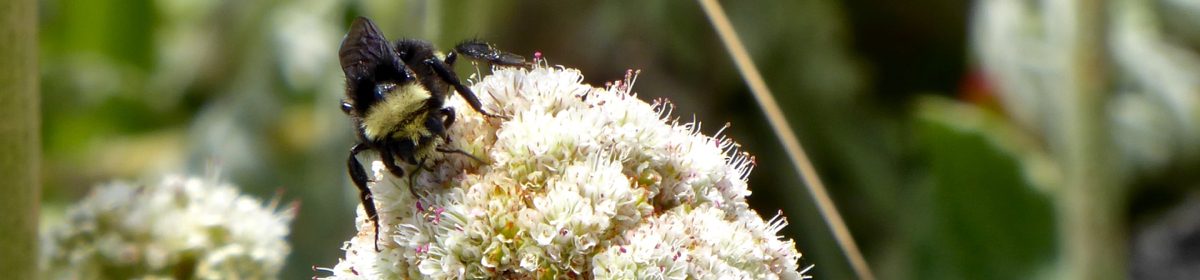
Rhizomes

I took a week of vacation last week, which I mostly spent in historic downtown San Mateo — Carol was working this week — but I did take a day trip in to San Francisco to visit City Lights Bookstore, where I got A Thousand Plateaus: Capitalism and Schizophrenia, by Gilles Deleuze and Felix Guatarri (trans. Brian Massumi [Minneapolis: University of Minnesota, 1987]; originally Mille Plateaux, 1980]). I got interested in A Thousand Plateaus through reading a chapter on Deleuze in Biblical Interpretation and Philosophical Hermeneutics by B. H. McLean (Cambridge, England: Cambridge University, 2012).

What particularly fascinates me about A Thousand Plateaus is the way Delueze and Guatarri contrast “aroborescent” or tree-like thinking with rhizomatic thinking. In the Western tradition, we often structure our thoughts like trees: there are roots and branches, and a central trunk linking the two. Our thoughts have ramifications, just as branches ramify from the central trunk out to the twigs. However, as Deleuze and Guatarri point out: “Arborescent systems are hierarchical systems with centers of significance and subjectification, central automata like organized memories.” [Dleuze and Guatarria, p. 16] Thus, arboresecent thinking is related to distinctions between subject and object, to hierarchical thinking, and even to power structures like dictatorships.

Deleuze and Guatarri comment: “It is odd how the tree has dominated Western reality and all of Western thought, from botany to biology and anatomy, but also gnosiology, theology, ontology, all of philosophy…: the root foundation, Grund, racine, fondement. The West has a special relation to the forest, and deforestation; the fields carved from the forest are populated with seed plants produced by cultivation based on species lineages of the arborescent type” [p. 18, ellipsis in the original]

Another image that can be used to understand thinking is the rhizome. In describing the rhizome, and rhizomatic thinking, Deleuze and Guatarri are not trying to set up a dichotomy, a dualism between rhizome (good) and tree (bad); they make it clear that rhizomatic thinking can lead to its own forms of despotism. Instead of creating another dualism, they are employing “a dualism of models only in order to arrive at a process that challenges all models.” And they summarize the principal characteristics of a rhizome as follows:

“Unlike trees or their roots, the rhizome connects any point to any other point, and it traits are not necessarily linked to traits of the same nature; it brings into play very different regimes of signs, and even nonsign states. The rhizome is reducible neither to the One nor the multiple. It is not the One that becomes Two or even directly three, for five, etc. … It constitutes linear multiplicities with n dimensions having neither subject nor object, which can be laid out on a plane of consistency, and from which the One is always subtracted (n – 1)….” [pp. 20-21]

Why should any of this be of interest to you? B. H. McLean points out that “our arborified minds have been trained to essentialize things as isolated entities, rather than as mobile entities that enter into dynamic interconnection with other entities. Thinking ecologically does not come easy to us.” [p. 282] Rhizomes have no beginning nor end, only middles. Bernard Loomer says the great intellectual achievement of Jesus of Nazareth is his articulation of the Kingdom of God, what we would call the Web of Life; I think Jesus’s thought is an example of rhizomatic thought, a non-Western idea which sidesteps subject and object, which sidesteps isolated entities; and like the Kingdom of God or the Web of Life, “a rhizome has no beginning or end; it is always in the middle, between things, interbeing, intermezzo. The tree is filiation, but the rhizome is alliance, uniquely alliance. The tree imposes the verb ‘to be,’ but the fabric of the rhizome is the conjunction, ‘and…and…and…'” [Deleuze and Guatarri, p. 25, ellipsis in the original] And so if we come to an impasse, it may help that a rhizome has multiple entryways.
Online petition regarding clergy sexual misconduct

The First Unitarian Universalist Church of Nashville’s “Safety Net” has started an online petition at Change.org, asking that all candidates for the UUA Board and for Moderator to open up a conversation about clergy sexual misconduct in U.S. Unitarian Universalist congregations:

We, the undersigned, are asking the candidates for UUA Moderator and Board of Trustees to publicly indicate their willingness to start a new national conversation on clergy misconduct in the UUA, and to ensure that survivors of misconduct have a real voice in that conversation. We ask them to commit to using the powers of the Board to take ownership of the recommendations of the Safe Congregation Panel, to update them as needed, and to hold the staff accountable for implementing them fully. And we ask them to investigate the accountability relationship between the Board and Ministerial Fellowship Committee, with an eye toward balancing the need to protect institutional interests with a pastoral responsibility to care for victims of misconduct.

I signed it. You bet I did. They provide a space for comments when you “sign,” and here’s what I wrote: “As someone who has served as both parish minister and religious educator in congregations suffering from past clergy sexual misconduct, I have seen the effects such misconduct has on both adults and legal minors. I have also seen first hand a high level of denial about the seriousness of clergy sexual misconduct on the part of UUA leaders. It’s way past time the UUA addressed this more fully.”

Mind you, I have my doubts whether such petitions effect much change. I also have grave doubts about whether the culture at the UUA, or in many local congregations, is going to change; Unitarian Universalists have a tendency to want to solve other people’s problems before trying to address their own problems; we’re great at sending money overseas or working on immigration problems here in the U.S., but we’ve been very unwilling to tackle problems that occur in our own homes and hearts, problems like domestic violence, racism, classism, the overconsumption that goes with upper middle class lifestyles, and so on.

But in spite of my doubts, I signed the petition. It’s easy for me to sign this petition; I’m a minister, I have a vested interest in cleaning up my profession. Now it would be nice if lots of respectable laypeople, good solid institutionalists — people who are pillars of our local congregations, people of impeccable morals — it would be good if many such people also signed the petition.

Maker Faire and lobsters

Carol and I went to Maker Faire today. It was held just a couple of miles away in San Mateo, so we were able to walk there — which was good, because so many people attended that some of the parking lots were four miles away from the event. If you’ve never heard of it, Maker Faire is kind of like a state or county agricultural fair for geeks and engineers.

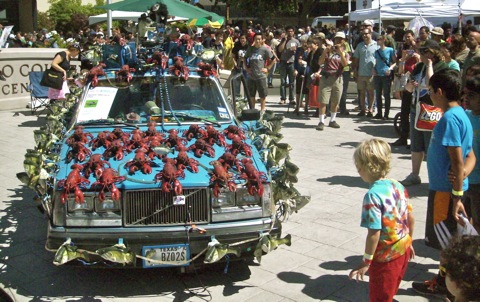
We saw the gee-whiz showy things you’d expect to see at Maker Faire: strange metal constructions that belched fire; all kinds of robots; people riding around inside giant self-propelled cupcakes; a Rube Goldberg-style giant mousetrap powered by simple machines and a bowling ball; the CO2 eruptions that happen when you drop Mentos into carbonated beverages. My favorite gee-whiz showy thing was the Sashimi Tabernacle Choir, an art car covered with fish and lobsters that danced in carefully choreographed movements:

BlogMay1813

And we saw the geeky technical things you’d expect to see at Maker Faire: conventional automobiles converted to electric power; too many projects made with Arduino microcontrollers; robots; drones; giant soap bubbles; a blacksmith; ham radio operators.

We also saw things that you might not expect at Maker faire: goats; chickens; beekeepers; a guy selling New-Agey devices to protect you from EMF radiation; a steam-powered scale-model train; lessons on how to walk on stilts; a really good drummer who used plastic trash barrels and other found objects for his drum set.

It was very satisfying, if for no other reason than being able to spend time hanging out with thousands of other geeky people who like to make things instead of consuming things.

Update: Because a commenter asked, here’s a video (taken by Carol) of the Sashimi Tabernacle Choir:

A time of growing cruelty

In a recent post on her blog, Alice Walker writes about how the FBI has called Assata Shakur a terrorist. At one point in the post, Walker, being a poet, diverges from commentary on current events into a meditation on the prevalence of cruelty in the United States today:

“What is most distressing about the times we live in, in my view, is our ever accelerating tolerance for cruelty. Prisoners held indefinitely in orange suits, hooded, chained and on their knees. Like the hunger strikers of Guantanamo, I would certainly prefer death to this. People shot and bombed from planes they never see until it is too late to get up from the table or place the baby under the bed. Poor people terrorized daily, driven insane really, from fear. People on the streets with no food and no place to sleep. People under bridges everywhere you go, holding out their desperate signs: a recent one held by a very young man, perhaps a veteran, under my local bridge: I Want To Live….”

In recent months, I’ve been trying to understand why I feel there is something morally unsound in our society recently — and yes, I know that every era thinks their time is morally unsound. But every era does have its own particular moral unsoundness, and I think Walker is on to something: our time is a time when we are increasingly tolerant of cruelty, even amused by cruelty.

Out the window

Carol and I recently completed a mind-body wellness class offered (for free!) by our health care provider. One of the things that our instructor said was that a good way to reduce stress is to spend time “in nature.” Further reading in the text book for the class revealed that our brains becomes fatigued by doing all the things most of us have to do in our jobs: staring at computer screens, meeting deadlines, sitting in meetings, etc. The natural world engages different parts of our brains, allowing the fatigued parts to rest. — I may not have this exactly right, but I think I have the gist of it.

When I learned this, I thought to myself: and where are we supposed to find the natural world in downtown San Mateo? This is not Tokyo where, according to my Aunt Martha, who lived there for two years, the residents cultivate little pockets of natural beauty throughout the city. Here in San Mateo, we could walk over to Central Park where the Japanese American community maintains a Japanese garden; but that garden is only unlocked for a few hours a day. Like many densely populated areas in the United States, downtown San Mateo has little to offer in the way of natural beauty; it combines urban density with dreary suburban sprawl; and even where there is some natural beauty, someone will have dropped trash there: fast food bags at the base of a tree, malt liquor cans thrown in among flowers, women’s underwear draped in the branches of a tree overhanging San Mateo Creek (I’m not making that up).

At some point during our wellness class, though, I realized that we have created a little oasis of natural beauty on our little balcony. We have nothing to compare with Japanese bonsai, but over the years we have accumulated quite a few plants. At the moment several of them are in bloom: the purple flowers of the potted lavender; the orange and gold of the nasturtiums; the vivid pink flowers of the succulent Carol can’t remember the name of. I was staring out the window at these flowers this morning. Carol walked into the kitchen and asked, “What are you looking at?”

“Nothing,” I said. “Nothing at all.”

How to take your Sunday school back to the year 29

Every couple of years, we run a five-week Sunday school program called “Judean Village,” in which we travel back to the year 29 to be in a predominantly Jewish village in the Roman-controlled territory of Judea.

The Judean Village program has us travel back in time during Sunday school. We gather in the village square, where the artisans and shopkeepers of the village (i.e., the Sunday school teachers) exchange gossip and rumors — gossip about what the hated tax collector has been up to this week, what the Roman overlords are doing, etc. — and rumors about the wandering rabbi named Jesus of Nazareth who is rumored to actually sit down to share meals with tax collectors (horrors!), who is rumored to be healing people and even raising them from the dead, and who may or may not be planning a revolution that will drive the Romans out of Judea and reestablish Jewish rule. The artisans and shopkeepers are all wearing long tunics with rope belts and head cloths (available from www.christiancostumes.com). We supplemented the costumes we purchased with ones made by volunteers in the program.

The village song leader comes by, and teaches the villagers a song: Continue reading “How to take your Sunday school back to the year 29”

What I did with my weekend

I spent this past weekend singing Sacred Harp music: six hours of singing on Saturday, and another hour or so on Sunday. Sacred Harp is a kind of four-part a capella singing which originated in eighteenth century New England, migrated to the South in the nineteenth and early twentieth century, and which is now undergoing a renaissance among postmodern urbanites in the northern and western parts of the U.S. Rolling Stone magazine described it as “a robust, harmonically intricate of country joy and unearthly drone.”

This is sacred music; many of the texts are by Isaac Watts, which means this music would never be sung in most Unitarian Universalist congregations, where people tend to squirm at the mention of God and Jesus. Even though I don’t agree with the theology of most of the songs we sang, nevertheless I got more religion out of singing Sacred Harp than I generally get in a Unitarian Universalist worship service. I’ve been thinking about why that is so, and here are four of my reasons:

(a) Sacred Harp singing is DIY — do-it-yourself — music. There is no paid choir director, no soloists, no experts; there are no performances or performers; everyone participates in order for the music to happen. By contrast, Unitarian Universalist worship services feel like performances in front of an audience; if I don’t show up, it won’t make much difference.

(b) Sacred Harp singing can be, and often is, an ecstatic experience. Ecstatic and transcendental experiences tend to make Unitarian Universalists very uncomfortable.

(c) There’s a broad distribution of ages among Sacred Harp singers, from the late teens to the eighties and nineties. Unitarian Universalist congregations tend to be made up mostly of people who are fifty and older.

(d) The singing is loud, exuberant, and enthusiastic. The tunes are pitched so that ordinary singers can sing them comfortably. By contrast, singing in Unitarian Universalist congregations tends to be restrained, and the tunes are pitched so high that those of us with ordinary voices can’t sing them.

I still love my Unitarian Universalist church; Sacred Harp singing would not be an adequate substitute for what I get out of my religious community. But I can still wish the Unitarian Universalism would embrace the DIY ethos, welcome ecstasy and transcendence, include younger people, and sing better.

Car

Carol took our 1993 Toyota Camry down to Dave’s Auto Repair. We thought there was something wrong with the hand brake, but it turned out the reason the brake light was on was because there was a leak in the brake line. It was going to cost three thousand dollars to fix. Carol called me up, we talked it over, and I said I thought three thousand was still cheaper than buying a new car. Carol told the mechanic to go ahead and fix the car. There was a moment of silence, and it became obvious he was not expecting her to say that. He told her that the gas tank was also rusted out, and the floor boards were about to rust through. It was time to get another car.

We looked at used cars online. The next day I rented a car, and we drove to the Toyota dealer in Palo Alto to look at some of the used cars we saw online. When you shop for cars, you enter a never-never-land where nothing is quite what it seems. The mileage posted in the online description did not match the mileage on the actual car. One online description said the car had a moon roof, and the sheet posted in the window of the car also said it had a moon roof, but there was no moon roof. The salespeople will tell you whatever you want to hear: does it have a full-sized spare? yes of course it does; but the spare tire turns out to be one of those little dinky ones. We finally settled on a 2008 Camry hybrid. Of course the price wasn’t what we thought it was. Carol haggled with the salesman; he tried to show her his sales awards, but she didn’t want to look; he went off to talk with his manager; he came back with a price that was still too high; Carol haggled some more; another talk with the manager; we accepted the deal; and when the salesman seemed too cheerful, Carol turned to me and muttered, “We could have gotten the price down more.” Then I went and talked with their finance people, and had to sign away all my rights to sue them if the car turns out to be a lemon — California law protects car dealers, not consumers — and wrote a check. And of course, the next day the driver’s side visor fell down and wouldn’t stay up; this in spite of being assured by the salesmen that they check every car over very thoroughly, which leads me to believe that we should never take the car to that dealer for service, if they could miss something so obvious.

We like the car pretty well, in spite of everything. So far we’ve been getting about forty miles per gallon of gas. But I miss the old car. I bought it from Carol’s mom before she died. It drove us across the continent five times (or two and a half round trips). It looked forlorn sitting in our mechanic’s parking lot as we emptied everything out of it — snow brushes and maps and jumper cables and crumpled coffee cups from under the seat. Now it sits there waiting for the junkie to come and pick it up and take it away.

Another view of the “nones”

Recently, those who study the contemporary U.S. religious landscape have been focusing on the rise of the “nones,” those who check off “none” when asked their religious affiliation on surveys. Many commentators are predicting a gradual decline in religious affiliation in the U.S. In a recent article on the Alban Institute Web site, Canadian sociologist Reginald Bibby points out that the rise of the “nones” in Canada began long before it did in the United States, and has not resulted in secularization:

“In Canada, the reality of religious polarization is a far cry from what was anticipated by theories of linear secularization. It is literally A New Day for religion, where market demand remains high, precisely at a time when growing numbers are rejecting religion. Changing demographics and varied market performances are contributing to a restructuring of players. But the inclinations to embrace religion and reject religion co-exist, with the balance always in dynamic flux. Such religious polarization, as I’ve been emphasizing, is found everywhere — even now, as the Pew Forum data remind us, in the United States.”

The Alban Institute article, “Welcome to Religio8us Polarization,” is available here. This article is adapted from Bibby’s book-length study, A New Day: The Resilience and Restructuring of Religion in Canada, available as a free download from Project Canada.

Singing with Coleman Barks

Shelley Phillips and Barry Phillips provided the music to accompany Coleman Barks as he read from his translations of Rumi last night at the First Congregational Church of Santa Cruz. Barks grew up in the south and loves shape note singing, so Shelley asked local Sacred Harp singers if they’d come and sing two tunes.

It’s a long way from San Mateo to Santa Cruz, and Carol and I got to the church about ten minutes before the reading was to begin. All the church’s parking spaces were full, and the school parking lot next door was full, too. We parked on the street.

As soon as I walked into the church, someone spotted the maroon oblong Sacred Harp book in my hand, and sent me to sit in one of the front three rows. I recognized Janet and one or two other singers, but no one else — it’s a long drive, and Santa Cruz singers don’t get up to the Bay Area to sing much.

Coleman Barks began reading. I could hear the cadences of Southern preaching in his voice. Shelley and Barry played — Shaker tunes, Sacred Harp tunes, Bach — as he read. People who study liturgy talk about the continuum from ordinary speech through heightened speech, singing, and finally wordless music. As Southern preachers often do, Barks moved along this continuum from ordinary speech to heightened speech; Shelley and Barry Phillips moved along the other end of the continuum, singing and music.

We Sacred Harp singers sang right after the intermission. Sacred Harp singing moves between heightened speech and singing, so we occupied the middle ground of that continuum from ordinary speech to music. Shelley led us in no. 178 Africa; Barks read one of his poems that mentions Sacred Harp singing, then we sang no. 59 Holy Manna (vv. 1, 3, 5). Barks came to sing with us on Holy Manna, standing in the bass section a couple of people to my left.

I think that was about the deadest place I’ve ever sung Sacred Harp in: I could hear a little of what the tenors were singing, and I could hear the bass I was standing next to, and I could hear Shelley, who was standing facing us; and that’s about all I could hear. So it wasn’t the ecstatic experience Sacred Harp singing can be when you can hear and respond to all the other singers; but it was probably a more musical experience for those who weren’t singing. When you’re singing for an audience, I think Sacred Harp tends to morph from an ecstatic form of heightened speech into musical singing — which, honestly, is a kindness to the audience; ecstasy doesn’t sound so good when you’re not singing along with it. Carol was siting out out in the audience, and she said we sounded fine.

Then Barks continued reading his translations of Rumi: poems of ecstatic and transcendent encounters with the divine; poems about mystic experiences, experiences which cannot be adequately communicated to an audience.

Cross-posted here.