Theology deadlock

One of the things I see as I watch the slow-motion train wreck that is the budget deadlock in Congress is a battle between two competing theologies.

These two competing theologies have, above all, differing notions of sin and salvation (soteriology):

On the one side, the possibility of salvation is understood to reside primarily in individual humans. To put it another way, fighting sin is primarily the responsibility of an individual. The way to fight sin, and move towards salvation, is to assign the highest level of responsibility to individuals. This theological position tends to deplore government intervention in social problems, such as providing health insurance; thus in the context of this theological position, individuals, not impersonal social structures, are ultimately responsible for saving themselves and, e.g., taking care of their own health.

On the other side, the possibility of salvation is understood to reside both in the individual and in social institutions; however, in practice the emphasis tends to be on social salvation and social sin, since social sin is perceived to be so much more powerful a force than individual sin. To put it another way, fighting sin is primarily a battle that must be fought in social institutions. The way to move towards salvation is to assign the highest priority to fighting sin in society. This theological position tends to urge governmental solutions to social problems; thus in the context of this theological position, individuals are not powerful enough in themselves to fight social sin, and must use social structures such as government to fight sin and reach salvation by establishing a moral society.

These two different theological positions also have differing understandings of the nature of human beings (theological anthropology): Continue reading “Theology deadlock”
Persimmon

The first time I visited California was in October, 1987. Everything about California was mind-blowing to a young guy like me who had, although I had been to Europe, had never been further west than Washington, D.C. It was my first experience of the Pacific Rim: the landscape of the Rim of Fire, the cultural encounter between east Asia and North America, the climate; even the sight of the sun setting in the Pacific Ocean was mind-blowing, for though I could have seen that sight from western Europe, watching the sun set into the endless Pacific was a very different experience than watching the sun set into the gray North Atlantic.

I stayed for a few days with my cousin Nancy in Oakland. She was the ideal host. She drove me up to Grizzly Peaks where I looked down with amazement on the city of Berkeley a thousand feet below me, and the bridges in San Francisco Bay beyond the city; I could not have imagined then that sixteen years later, that road would be part of my daily commute to work. She took me out to Cliff House to watch the sun set in the Pacific; she took me into Chinatown and Japantown; and she introduced me to locally-grown persimmons (Diospyros kaki).

Nancy had a few persimmons ripening in her kitchen. She found one that was ripe, cut it open, and showed me how you use a spoon to eat it. The combination of the jelly-like texture, the flavor, and the bright orange color were unlike any food I had ever eaten before. After I got back to Massachusetts, I found persimmons in the supermarket, but they never tasted as good as the ones I had eaten in California; they just weren’t worth buying.

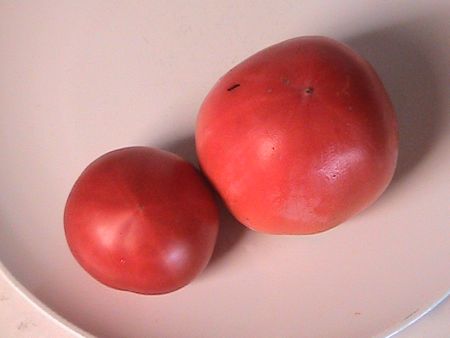
Now here I am, living in California, and when I saw a sign in the local supermarket for “Locally Grown Persimmons” of course I bought some. I put them on the kitchen counter next to some late tomatoes that I had just picked in our garden. Nancy tells me that the Chinese word for tomato is xihongshi, meaning “western red persimmon,” and the two fruits do look remarkably alike from a certain angle (the tomato is the smaller one on the left):

BlogOct1013b

The problem with eating persimmons is that if you eat them before they are fully ripe, the high level of tannins will make your mouth feel furry on the inside. You can also get so-called fuyu persimmons, funny stubby little things that contain less tannin in them so you can eat them when they’re not quite ripe. If you’re impatient, as Carol is, perhaps it’s best to eat fuyu persimmons. I’m impatient, and I rarely wait quite long enough before I eat a persimmon; but I’ve come to appreciate the light astringency of a not-entirely ripe persimmon, and to enjoy the faint furry feeling that lingers in your mouth after you’ve eaten one.

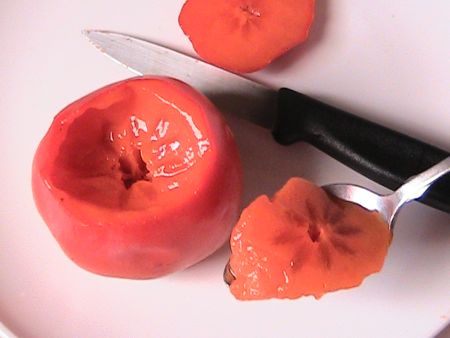
The three persimmons I bought have been sitting on the kitchen counter for two whole days now, tempting me. I kept feeling them gently: were they soft all the way down to the stem? Did they feel as though they would collapse in my hand if I picked them up? Finally I decided that one of them was ripe enough to eat. I cut off the end, and scooped out some of the fruit:

BlogOct1013a

Oh, it was good! — I couldn’t believe that I had actually waited long enough for my first persimmon of the season to ripen fully! I ate the whole thing in about five seconds. And then, sure enough, I started to feel that faint furry sensation on the inside of my mouth. It was a very faint sensation, and not unpleasant, but it was enough to remind me that once again I had been too impatient.

The real America

In his 1994 introduction to his 1981 novel Hello, America, J. G. Ballard writes: “The United States has given birth to most of our century’s dreams, and to a good many of its nightmares. No other country has created such a potent vision of itself, and exported that vision so successfully to the rest of the world…. Whenever I visit the United States I often feel that the real ‘America’ lies not in the streets of Manhattan or Chicago, or the farm towns of the mid-west, but in the imaginary America created by Hollywood and the media landscape.”

The real America is the imaginary America which is presented in pop culture; this makes sense to me. And this raises a question for me: should religion accommodate to this imaginary America, as for example Rick Warren and his version of the prosperity gospel do? — or should religion take pains to point out that the “real America” is really an imaginary America? — or should religion ignore altogether the problems caused by the imaginary America being the real America? Or put more starkly: should religion resist pop culture, or embrace it?

Charisma

One of the personal characteristics that most troubles religious liberals is charisma. We religious liberals think religion should be rooted in reason and rationality, and charisma is very upsetting to those of us who claim rationality as a highest value. A charismatic person can make a reasonable person think unreasonable thoughts, by the sheer attractiveness of that charismatic person’s personality; no wonder we rationalists find charisma so upsetting! We sometimes forget that the ancient Greeks knew that the power of rhetoric and rhetorical argument could be greater than the power of reason. We also sometimes forget that the science of psychology has shown over and over again how human beings are convinced by the power of that which is not rational, such as advertisements, sexuality, tyranny, etc. Of course we forget; we have an unreasoning faith in reason.

What, then, do we religious liberals do when we meet up with another religious liberal who happens to be charismatic? If we’re honest, we’d admit that our immediate response is distrust. So it is that we actually prefer our ministers to be a little drab and colorless, rather than dynamic and exciting. Lay leaders who show signs of being charismatic are often subtly disabled; the nail that sticks up will get hammered down. Charismatic ministers and lay leaders quickly learn to hide their charisma behind a mask of bureaucratic grayness, or even assumed incompetence.

I’m not sure I would want to change our liberal religious response to charisma all that much. I don’t trust charisma myself, even on the rare occasions when I find it in myself; no, especially on those rare occasions when I find it in myself. It’s too easy for someone with charisma to get carried away by the power of their charisma. However, charisma can be extraordinarily useful to human institutions. What we laud as great leadership in business or politics is often little more than the power of charisma in a given individual; I doubt Steve Jobs was the genius he is made out to be, but by all reports he was powerfully charismatic; the same seems to be true of George W. Bush and Barack Obama. Charismatic individuals can drive institutions and make things happen.

But although your charisma can drive human institutions, it is wise to recall that your charisma does not inhere in your personal being; it comes from the outside, a gift of the spirit; or, more properly, given by the Spirit, it comes into you from something or somebody or some place beyond the narrow confines of the self. If you’re charismatic, your charisma doesn’t belong to you, wretched mortal individual that you are; it is ageless; it belongs to humanity; so don’t take credit for it — this is the religious liberal’s attitude. We religious liberals can tolerate charisma only when it is combined with serious humility.

I think they did it again…

“Oops, I Did It Again,” a song written by Max Martin and Rami Yacoub, has gotten a bad reputation. In an introduction to his own version of the song, Richard Thompson says that unfortunately, the best-known performance of the song was done by “a rather crass pop artist”; yet, Thompson says, the song itself is lovely, with a chord structure “reminiscent of other centuries,” and “if we just take it out of the original hands, and give it a slightly different interpretation, … we can reveal its splendor.” 1

Since this is such a splendid song, it seems a prime candidate for adaptation: instead of a song addressed to a confused lover, why not make it into a song addressed to some of the people who are behind the growing economic inequality in the U.S.?

Oops, They Did It Again

I think they did it again,
They made us believe
That they were our friends.
Oh, baby,
They might think act like they care
But it doesn’t mean
That they’re serious;
‘Cause to make empty promises
That is just what CEOs do.
Oh, baby, baby —

Oops, they did it again,
They played with our hearts,
To them it’s a game.
Oh, baby, baby,
Oops, they cut back our pay,
Took benefits away;
They’re not so innocent! Continue reading “I think they did it again…”

Bitter melon

One sunday morning, Dora came up to me with something in her hand. “You said you like bitter food, right?” she said.

“I love bitter things,” I said.

“Then you should try this,” she said, holding out a small, wrinkled green vegetable. “It’s called bitter melon.”

She told me how to prepare it: slice it open, scoop the seeds and pulp out, slice it up and stir-fry it, maybe mixing it with some other vegetables and perhaps some kind of meat, like sausages. Dora comes from a Chinese family, but bitter melon is not just Chinese; when Hong, who is Vietnamese, saw the bitter melon, her eyes lit up, and it turns out she loves it, too — sauteed with garlic, in her case. Both of them agreed that not everyone likes bitter melon.

You’d think a New England Yankee like me, raised on mild and restrained flavors, would not care for bitter melon. But I love it. It’s not an extreme taste; I think of it as being mildly bitter, maybe about as bitter as strong turnips. I haven’t been able to find it in any supermarkets, but fortunately there is one farmer at the San Mateo farmer’s market who carries both the white and green varieties.

Bitter melon

Homework

If you haven’t yet seen it, I recommend an article in the October, 2013, issue of Atlantic magazine.

The article is titled “My Daughter’s Homework Is Killing Me.” For one week, the author does homework alongside his 13 year old daughter — and it’s more work than he bargained for. The author finds he has doubts about whether the homework is worth spending so much time on, and he also cites studies that claim there is little correlation between the amount of homework and academic performance. Also of interest — the author says that the amount of homework increases and decreases in a 30 year cycle, and we are currently at the peak of heavy homework. You can read this article online here.

I was interested in this article because I often hear from kids in middle school and high school how overwhelmed they are by the amount of homework they have. Of course, from my point of view as a religious educator, I care less about academic performance than about whether kids are growing up to be ethical, sensitive, and caring human beings — and as far as I know, homework has not helped kids become more ethical, sensitive, and caring. But I have definitely noticed that kids are getting more homework now than, say, a decade ago.

I wonder what you think about homework — especially those of you who are parents of middle school and high school students. Are kids getting too much homework these days? Do you think kids need lots of homework in order to remain competitive in today’s academic environment? How is homework affecting their lives — and your life as a parent? I’d love to hear from you!

Originally posted here.

Towed away

Yesterday Ned and Judy, who belong to a congregation I used to serve, were in town visiting relatives. I was supposed to meet them for lunch at the church down in Palo Alto. Bay Area traffic being what it is, I allowed an extra ten minutes beyond the usual twenty-five minutes driving time. But when I walked down from our apartment, I saw that someone had parked their car at the end of our driveway. I couldn’t get out.

I called the police. They wanted to know what kind of car it was, and I told them it was an older model Toyota Camry, dark green, and gave them the license plate number. I didn’t bother telling them about the statue of the Virgin Mary on the dashboard. They said they’d send someone right out.

I called the church, and Debra said she’d leave a note on my office door saying that I would be down as soon as I could get there. Then I stood there waiting, and hoping that whoever owned the car would come along right then, and I’d tell them that they really shouldn’t park in someone’s driveway, and they’d look embarrassed and drive away — that would be the fastest solution to my problem.

After about fifteen minutes, one of the city’s little three-wheeled traffic enforcement vehicles rolled around the corner. The traffic officer, a pleasant, soft-spoken young man, shook his head when he saw where the car had parked. He radioed for a tow truck. Continue reading “Towed away”

A scientific and theological take on nature, humanity, and freedom

Unitarian theologian Charles Hartshorne was also a serious amateur ornithologist. As an ornithologist, he was perhaps best known for his 1973 book Born To Sing: An Interpretation and World Survey of Bird Song (Bloomington: Indiana University Press), in which he investigates the evolutionary importance of bird song. Most of the book will be of little interest unless you’re something of a field biology geek and your idea of a good time is reading a book with statistical analysis, long tables of data, commentary on evolutionary theory, spectrograms, etc.

However, the last paragraph of Born To Sing is, I think, of interest to anyone who is interested in the relationship between humankind and other species. Written before people thought of degenderizing language, it takes the form of a theologically liberal reflection:

“Nature apart from man [sic] is basically good. So is man, although he has unique capacities for evil as well as good. This is because every increase in freedom increases the dangers inherent in freedom. Man is the freest, hence most dangerous, of terrestrial animals. He needs to meditate upon this elementary but not trivial truth much more than he has. The Greek fear of human conceit, hubris, was entirely justified. We need to recover from that fear. Technology makes man loom large in this solar system, but among the galaxies and island universes he is as small as ever. Science, given a balanced interpretation, fully justifies the old values of reverence and love toward what is other than, and in its encompassing aspect incomparably greater than, man and all his works, actual or potential.” [p. 229]

I’ve cast this in the form of a degenderized responsive reading, which appears after the jump…. Continue reading “A scientific and theological take on nature, humanity, and freedom”

What the pope said

La Civiltà Cattolica, a Jesuit publication, got an exclusive interview with Pope Francis. America: The National Catholic Review, the major Jesuit periodical in the U.S., published an English translation of the interview here.

New media are making a big deal out of this interview, because in it Pope Francis says that the Roman Catholic church should place less emphasis on its opposition to “gay marriage,” abortion, and contraceptives; for although he says that he still fully supports Catholic teachings on those topics, he feels that Roman Catholicism should focus on what he calls “the essentials, the necessary things”; and the most necessary thing, he says, is “the proclamation of salvation.” I would have guessed that the most necessary thing on which we should focus would be poverty and social justice; this is what I get from Jesus’ teachings; and to my mind, this change in emphasis — putting “proclamation of salvation” before opposition to same-sex marriage, abortion, and contraceptives — is slight indeed. Nevertheless, the media have pounced on it as if it is a complete change in Catholic teachings. Pope Francis is a bit of a media darling, isn’t he?

I was more interested in the pope’s seeming willingness to consider that the institution of the Catholic church should grow and evolve over time. When asked about the “enormous changes in society,” the pope replied, in part:

“…Human self-understanding changes with time and so also human consciousness deepens. Let us think of when slavery was accepted or the death penalty was allowed without any problem. So we grow in the understanding of the truth. Exegetes and theologians help the church to mature in her own judgment. Even the other sciences and their development help the church in its growth in understanding. There are ecclesiastical rules and precepts that were once effective, but now they have lost value or meaning. The view of the church’s teaching as a monolith to defend without nuance or different understandings is wrong.”

While the pope does not go as far as the process theologians, who would assert that God actually grows and evolves, he nevertheless makes an important point: that a religious institution must grow in understanding, as the world grows and changes around the institution; and that a religious institution must draw upon “the other sciences” (which I understand as a broad category that includes both the natural sciences, and other areas of systematic human inquiry such as philosophy, etc.) to move towards ever greater maturity of judgment.

It is this point — rather than the pope’s rather weak statement on same sex marriage, abortion, and contraceptives — that I find to be the most compelling point in the interview. For this leaves open the door that someday, probably in the distant future, the Roman Catholic church could find its way to a greater maturity of judgment on, for example, its view of women.