UNCO pt. 5

On the last day of UNCO 13 West, we opened with a short prayer service. Then we shared some of the results of yesterday’s breakout sessions, and talked about what might be topics for some final breakout sessions. What needed ongoing attention? What might be some projects that “have legs,” i.e., are ready to be implemented? These are the topics that emerged for the closing breakout groups:

— A group to talk about vocation and identity for ministers who aren’t doing traditional ministry, including the following: ministers who aren’t serving a congregation; ministers who are taking a break from formal ministries to raise kids; etc.

— A group to talk about transitional roles, including the following: how to manage transition in a congregation or other setting; how to talk about change without freaking people out; how to help a local congregation to die (congregational death being a perfectly natural thing; someone reminded us that none of the churches Paul of Tarsus started are now in existence); etc.

— A group to talk about the issues that face ministers and leaders who are starting new ministries (i.e., church planters, etc.), and to talk about the loneliness of pastors serving in those roles.

The person who had signed up to volunteer with the kid’s program said she really wanted to join one of these groups, so I immediately volunteered to take her place as one of the adults working in Kid UNCO. Continue reading “UNCO pt. 5”

Can’t watch

Now that the Red Sox are in the World Series, I can’t follow them.

No, no, you don’t understand. I first began following the Sox in 1967, during the Year of the Impossible Dream. They lost the Series. I followed them through the 1975 Series. They lost. In 1986, I watched the Series with my then-housemates. The Sox lost again. I followed them through the 2003 AL playoffs. They lost.

In 2004, when they made it into the Series again, I didn’t watch any of the World Series games on TV, nor did I read any coverage in the sports pages. They won. I followed them in 2005. They lost in the first round of the playoffs. I didn’t follow them in 2007, and they won the Series.

I’ve learned my lesson. If I want the Sox to win, I can’t follow them. So don’t talk to me about the Series, OK? I don’t want to know.

UNCO13 pt. 4

For the first afternoon breakout session, I went to a discussion on creative worship ideas. It turned out to be a wide-ranging discussion. Early on, this question came up: When might a minister wear a t-shirt in the pulpit, and when might a minister wear a robe? — and which is more authentic, and why? We had no final answer; sometimes a t-shirt is appropriate, and in other congregations or contexts robes and vestments might be best.

We talked about how congregations sometimes embrace innovation in worship, and sometimes reject it, and that spun off an interesting conversation about sometimes innovation and creativity in worship is not the right thing to do. Someone pointed out that most of us in the creative worship breakout group personally enjoy traditional worship services, with Bach and organs and pews; yet at the same time all of us are interested in creative innovation in worship. It occurs to me that the best creative worship probably comes from those who really love traditional worship, but see its limitations, and want to move beyond its limitations.

As a mystic myself, I particularly appreciated on comment from this breakout session: “There’s a burning bush in our service and we don’t even know it.” — Annie Dillard says much the same thing in Teaching a Stone To Talkwhen she says, “Ushers should issue life preservers and signal flares; they should lash us to our pews. For the sleeping god may wake some day and take offense, or the waking god may draw us out to where we can never return.” Continue reading “UNCO13 pt. 4”

UNCO13 pt. 3

UNCO is an unconference. According to Carol Howard Merritt, one of the organizers of UNCO 13 West, here’s how the UNCO process goes:

“• First step — Create a graffiti wall. We write down all of the cares/concerns/dreams/ideas that we carry into the conference.
• Second step — Host discussions on particular topics.
• Third step — If there’s a particular project that needs further fleshing out, then we hold a planning session to decide who/what/how it’s going to happen.
• Fourth step — Report back to the group.
• Fifth step — Stay in contact with one another, encouraging one another throughout the year.”

So a brief worship service this morning, we were all asked to write on the graffiti wall, and within half an hour we had generated a list of half a dozen discussion topics for each of the four hour-long breakout sessions — and had identified a facilitator for each discussion session. In addition to the discussions sessions, Megan also needed an assistant each hour to help out with Kid UNCO, the children’s program. I decided to spend the first two hours with Kid UNCO.

Since we’re meeting during the week, most older kids had to be in school. And kids have to be toilet trained to attend Kid UNCO. So we had just two boys, Adrian and Burke (not their real names to protect their privacy). Adrian is 5 years old, likes to play horsie with adults, and is autistic; Burke is 4 years old, brought two Dinobots with him, and showed us he can count to 100.

Megan talked about the story of Noah while she and Burke (mostly Burke) drew a mural of the Noah story. Adrian didn’t feel like drawing, although he did enjoy playing with the crayons. Since the kids were just 4 and 5, their attention wandered, and I was impressed by the way Megan kept bringing us back to the story, and back to the mural. I mostly work with older kids — school-age children and up — so it was helpful for me to spend two hours with a four year old. It was also really helpful for me to spend two hours with a child with autism. It was perhaps the best two hours of RE professional development I’ve done since Ferry Beach Religious Education Week last summer.

BlogOct2213

Above is the Noah mural Kid UNCO made this morning. The rainbow is at right; lots of water and an ark in the middle.

More on the afternoon sessions in part 4….

UNCO13 pt. 2

The other reason I’m feeling comfortable at UNCO13 — aside from the fact that it’s a gathering of clergy and other congregational leaders that welcomes kids — is that people here speak geek. The conference is also taking place on Twitter, allowing people who can’t be here physically to participate

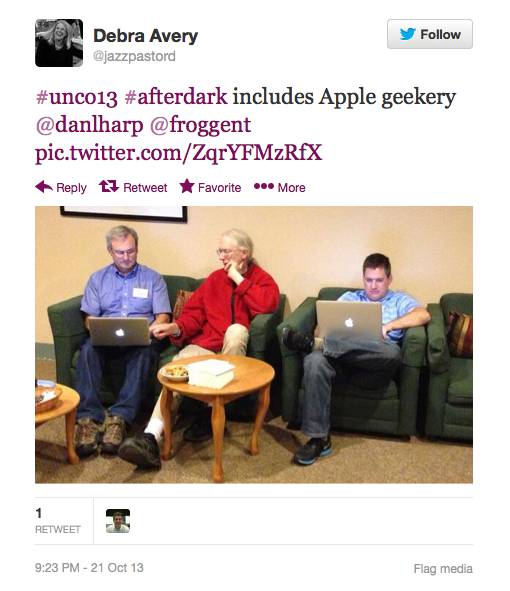
Yesterday evening, at “coffee hour” (the evening social time), I wound up speaking geek with Jeff, an interim minister serving a UCC church in San Jose, and Rob, a church communications expert working for the Presbyterians. And then our conversation got tweeted by @jazzpastord:

BlogOct2213

And Jeff was blogging about it as we talked. Speaking geek is not just talking about tech, it’s also extending that conversation online, and it’s also openness to continually learning about the ever-changing world of online communications.

Mind you, face-to-face still has its place. Face-to-face, Jeff and I could talk about challenging moments in congregational life that we would never post online. And one of the things I’m liking about UNCO13 is the mix of online and face-to-face.

On to part three…

UNCO13 pt. 1

As I write this, I’m attending UNCO13 West, which is “an unconference for church leaders, pastors, families, and seminarians.” I heard about it as a gathering for people who are doing creative innovative things with religion and technology and churches reaching out to people under 40. But what made me decide to attend was this statement on the UNCO Web site: “If church is for families, and UNCO is about doing church in new, different and better ways, then UNCO is for families.”

By way of comparison, on Friday and Saturday I was at retreat for Unitarian Universalist ministers:— no spouses, no children, not even any child care. There is a feeling among this group of ministers that they need to have time away from anyone who is not ordained. Although I understand the desire for a time and place where ministers feel they can talk completely openly about their ministries, I’m not sure this desire for complete separation serves us particularly well. We’re not that special, that we have to hold ourselves apart from non-ministers.

So the opening meeting of UNCO13 West has just finished. And yes, there were children: a couple of babies, a couple of toddlers, and three or four older kids. During the opening prayer, some of the babies were vocalizing, but no one cared. Children were wandering around during the orientation, and no one minded. It was nice — a powerful statement that here was a group of people who, as they figure out new ways to do religion, were committed to including everyone.

On to part two….

Autumnal battle

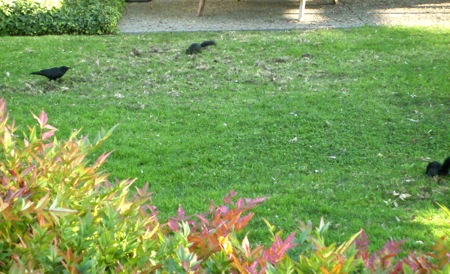
The window of my office looks out on a patch of lawn about thirty by fifty feet. In the middle of the lawn there’s a live oak tree. This oak tree appears to have produced a bumper crop of acorns this year. This afternoon, I counted at least six Eastern Gray Squirrels (Sciurus carolinensis) on the grass, the surrounding sidewalks, or in the tree; three of them were the black color morph of S. carolinensis.

The squirrels have been digging furiously in the lawn, and in a few places have completely dug up all the grass, leaving a network of small holes about two inches across and one inch deep. Every so often, one squirrel will get too close to another one, which can lead to vocal squabbling and one squirrel chasing another. I also saw at least three American Crows (Corvus brachyrhynchos), who would land on the grass periodically and peck at the ground where the squirrels had been digging. Sometimes a squirrel would run at a crow; and the crow, even though it was somewhat larger than the squirrel, would flap its wings a couple of times and fly out of the way.

Amy and I were watching the squirrels a couple of days ago. “If they would only get organized,” said Amy, “they could run all us humans out of here and take over.” Of course she was exaggerating, but they are aggressive. They have come right into my office while I’ve been sitting at my desk with the door open, looking for food. It’s worth noting that since Eastern Gray Squirrels have been introduced to the Bay area, the native Western Gray Squirrel (Sciurus griseus) has essentially be extirpated from the region.

I went over to look at the damage the squirrels had done to the lawn. There is nothing in the holes they have dug. The ground is littered with the outer husks of acorns; some of the husks look green and new, some look brown and old. There are plenty of new acorns on the ground. I’m not sure why they are digging so furiously this year; this is not something they have done in past years. Maybe there’s a good reason behind it, or maybe they’re just — well, maybe they’re nuts.

BlogOct1713

Shareable economy

“Shareable economy” and “the new mutualism” are new and trendy terms for new-fashioned things like bikesharing programs, coworking, hacker spaces, etc. — and also names for old-fashioned things like public libraries, public parks, credit unions, co-ops, etc.

Two blogs on the shareable economy that seem worth reading:

Shareable

OuiShare

Both blogs encourage social entrepreneurship. Both blogs look beyond North America to Europe, South America, Australia, and beyond. Not sure I’d read either blog on a regular basis, but both are worth looking at for ideas at least once.

“The Race That Long in Darkness Pined”

It’s way too early for Christmas, but….

My favorite reading for the Christmas season is the King James translation of Isaiah 9.1-8. I love the rhythm of the language, and the beauty of the imagery. From a theological perspective, I’m not willing to say that Isaiah 9.1-8 predicts the coming of Jesus as the one and only Messiah (capital “M”) — I’m in the camp that says there have been and will continue to be messiahs (lower case “m”), of whom Jesus of Nazareth was one. Whatever my theological position, it’s a beautiful piece of prose.

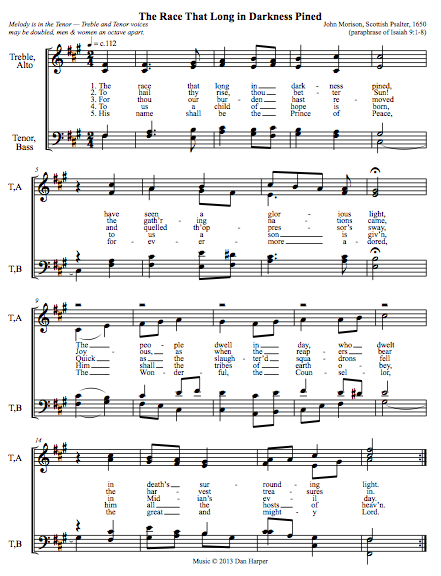
Recently, I stumbled across a metrical paraphrase of Isaiah 9.1-8, done by John Morison for the 1650 Scottish Psalter. It’s not as good a rendition as the King James translation — but because it’s a metrical paraphrase, you could sing it, and how cool is that? So I wrote a hymn tune for it. A polyphonic tune. In Dorian mode. Between the music and the words, this would never be used as a hymn in a Unitarian Universalist congregation. But I had fun writing it, and there are one or two hymn geeks out there who might actually enjoy seeing it, so here it is:

TheRaceThatFingernail

(Click the image for a PDF. Complete words below.) Continue reading ““The Race That Long in Darkness Pined””

Each in his own tongue

William Herbert Carruth was a poet, a professor of literature and writing at Stanford where he taught John Steinbeck (more about Steinbeck in a moment), and a member of the old Palo Alto Unitarian Church. One of his signature poems strikes me as quite characteristic of early twentieth century west coast Unitarianism:

Each in His Own Tongue

A fire-mist and a planet,
   A crystal and a cell,
A jelly-fish and a saurian,
   And caves where the cave-men dwell;
Then a sense of law and beauty
   And a face turned from the clod,—
Some call it Evolution,
   And others call it God. Continue reading “Each in his own tongue”