How Doso came to live with Metaneira

Some years ago, I started working on a version of the story of Demeter and Persephone. I put part one of the story on this blog back in 2012; now, finally, here’s part two. No promises when part three will be done.

For part one of the story, click here.

Demeter’s heart was sad at the loss of her daughter, and she was angry at Zeus and Hades. In her sadness and anger, she wandered across the land, until at least she came to the house of wise King Celeus, ruler of the beautiful city of Eleusis.

Demeter sat down to rest on the wayside by the road, in a shady place beneath an olive tree, next to the Maiden Well, from which the women of Eleusis came to get water. She looked like a woman who was too old to bear children, the kind of respectable older woman who might care for the children of a king, or perhaps like one of the housekeepers who clean the echoing halls of a king’s palace.

The four daughters of King Celeus came to Maiden Well with their bronze pitchers, to draw water and carry it to their father’s house. Their names were Callidice, Cleisidice, Demo, and Callithoe who was the eldest of them all. They looked like goddesses in the flower of their girlhood. They saw Demeter sitting there in the shade of the olive tree, but they did not know that she was a goddess — when gods and goddesses roam the earth, it is never easy for mortals to recognize them — and so they spoke to her.

“Old mother,” they said to her, “where do you come from, and what people do you come from? Why have you gone away from the city, and why do you stay away from houses? In many of the shady halls of the houses of our city, there are women of just such age as you, and they would welcome you there.”

Demeter, seeing that the girls were polite, answered them politely. “Hail, dear children,” she said, “whosoever you are. I will tell you my story; for it is right that I should tell you truly what you ask. Here is my story:

“Doso is my name, the name my stately mother gave to me. I have come from the island of Crete, sailing over the wide back of the sea. But I did not come willingly.

“Pirates took me from Crete by force of strength. Continue reading “How Doso came to live with Metaneira”

Drums in springtime

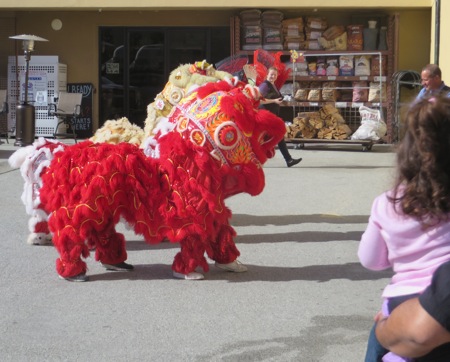
When you hear the sound of drums and cymbals outside your apartment coming from somewhere down the street, of course you go out and find out where they’re coming from. It was the West Coast Lion Dance Troupe performing in the small parking lot of the hardware store near us. It was fun to watch the brightly-colored lions dancing in the warm February sunshine:

West Coast Lion Dance Troupe

This hardware store, formerly independent, was bought out by a small locally-owned chain of hardware stores. Since they were bought out, they’ve been doing things to attract the attention of passers-by. In addition to the lion dancers, the local animal shelter had a tent set up and was promoting adoptions of small pets. Not a lot of people came, but we were all smiling.

After I watched the dancers, and glanced at the terrarium with a lizard or something in it, I started walking home — and as I walked I wondered why our UU congregation doesn’t do things like this to attract the attention of passers-by. I know what you’re going to say: “Most UU congregations try to hide from passers-by.” Well, I’m not feeling that cynical today, when it’s so warm and sunny and the faint smell of perfumed flowers permeates the air and makes my eyes itch. I think we’ve just never thought about inviting a lion dance troupe, or (honk!) an activist street band, or or some other community arts organization, to perform in front of our building. Maybe if we had sales goals to meet, as retail establishments do, we’d be thinking more along those lines. Not that I think we should have sales goals per se, but you know what I mean.

UUA logo: our version

Carol and I have been playing around with the new UUA logo. Carol doesn’t like the way the flame in the new logo is disattached from the candle-chalice thingie. I don’t like the way the sides of the chalice-thingie act as walls which keep the flame from being seen from the sides.

Mind you, it’s way too easy to be a Monday morning quarterback. No logo can ever be perfect, and certainly the UUA logo is a pretty good design, and more than adequate. But it’s way too easy to play around with graphics on our laptops, and Carol and I had nothing better to do on a sleepy Saturday morning, so we spent half an hour revising the UUA’s logo. Here’s what I came up with:

UUA Logo Mash

Update: June 24, 2018: The above logo is now released under a Creative Commons license; please attribute to “A UU”.
Creative Commons License
This work is licensed under a Creative Commons Attribution-NonCommercial 4.0 International License.

Compare it to the official UUA logo below. See what I mean about the sides coming up around the flame in the official logo?

UUA Logo Official

(Now that I look at this again, I wish I had made the sides of my version even lower, but I’ve already wasted too much time playing with this.)

Jesus said something like (and I’m paraphrasing here): “Neither do people light a candle and put it inside a red and orange bushel basket, the walls of which extend halfway up the flame, so the people below us cannot see the flame.” Buddha supposedly said (another rough paraphrase): “Thousands of candles can be lit from a single candle, and the life of the candle will not be shortened; but if your candle is inside a red and orange chalice thinige, others will burn their fingers trying to light their candle from your candle.” The new UUA logo is a pretty accurate graphic representation of what our denomination is actually like; my revision of the logo represents the way I wish our denomination were.

Update, 3 hours later: Ah, what the heck, I might as well make the things the way I like it — here’s a version with even lower walls, and now it looks like the “U” is kinda lying back and the candle is standing up inside it:

Continue reading “UUA logo: our version”

Progressive religious education in 1912

During an email exchange with a colleague regarding the history of early twentieth century Unitarian religious education, I came across a 1912 report from the Unitarian Sunday School Society.

This brief report gives an interesting look into the beginning of the Progressive era of religious education. Based on the insights of the new science of psychology, the Progressives were implementing closely graded classes, an improvement over older ungraded, or three-grade, classes. The Progressives felt that key outcomes of religious education included providing children with religious knowledge inculcating children with the ideals of social service, and teaching “religion itself.” And, although still focused on the Bible, the Unitarian Progressives were introducing non-Biblical and non-Christian topics to Unitarian children.

For me, the most interesting part of this essay is the penultimate paragraph. With some rewriting, this Progressive statement could serve as a pretty good summary of what we’re still trying to do in our Sunday schools today — something like this:

“We should teach our children about religion — they should know religious history, literature, and theology.

“We should teach our children how to apply religion — they should know that as a tree bears fruit, so religion should produce good works.

“Finally, we should teach our children religion itself. Knowledge about religion points towards religion itself; and religious service grows out of the high ideals of religion itself. But when we teach religion itself — as opposed to knowledge about it, or service based on it — we won’t teach it through classroom instruction. Like all our best knowledge, religion is transmitted by contagion and inspiration, not by instruction; it is caught, not taught. To reach and quicken the child’s religious nature is the highest task of religious education.”

The full text of the essay appears below.

  Continue reading “Progressive religious education in 1912”

New blog on Indian philosophy

There’s a new blog on Indian philosophy called, not surprisingly, The Indian Philosophy Blog. Some of the posts are technical, some of the posts are academic news. But some of the posts, and associated comments, are pretty interesting.

Take, for example, a post on Penguin India’s decision to recall and destroy all copies of Wendy Doniger’s The Hindus: An Alternative History, in response to right-wing Hindu demands. But, says blogger Andrew Ollett, “India has long traditions of argumentation,” and he concludes that:

“The politics of outrage and offence, and the struggle to ban and silence competing viewpoints, are antithetical to this long tradition of reasoned debate. They impoverish public discourse and they endanger critique and the kind of truths that depend on critique.”

The comments get even more interesting. There’s a comment from someone in India, there’s discussion of the legacy of colonialism, and more.

Interesting stuff. Definitely a blog that I will be scanning on a regular basis.

What I did with my weekend

Sacred Harp singing convention

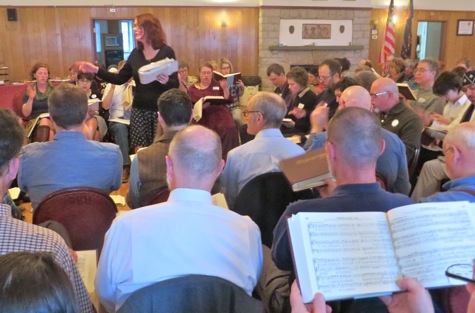
The view from the bass section as a singer from Bremen, Germany, (alas, I didn’t catch her name) named Eva led well over a hundred singers at a Sacred Harp singing convention this past weekend.

What was it like singing with all those people, you ask? I’ll limit myself to the physiological response. With something over thirty singers in the bass section, I could feel my whole body vibrating to the lower notes. And since this is highly rhythmic music, we could also spend time talking about entrainment from an ethnomusicological perspective.

This, by the way, is why you might want to improve congregational singing so that it’s good, rhythmic, and loud — because when you do that, it feels really good.

William R. Jones writing collective forming

In this comment, Hasshan Batts writes:

Practitioners Research and Scholarship Institute (PRASI) www.prasi.org is gathering a collective of individuals that have been influenced by Dr. Jones’ oppression theory for an upcoming writing project. If interested please email me at justequality@yahoo.com”

What I did on my vacation, pt. 2

Ms. M and Mr. O, old friends of ours, are adopting two girls. I’m supposed to make two shelf units for them by this weekend. So far, one is completed and ready for finishing. Here’s the completed unit (the fish-eye lens makes it look out of square, but it’s not):

DIY shelves

I’m supposed to have both shelf units completed by this weekend. I don’t think I’m going to make the deadline. The sad truth is that it’s been something like eighteen or nineteen years since I worked for the cabinetmaker, and I’ve gotten out of shape — I can’t put in an eight hour day in the shop any more.

(The details: 28 x 33 inches, 9-1/4 inches deep. Adjustable middle shelf. Solid pine construction throughout.)

What I did on vacation

Some people take trips when they go on vacation. Some people catch up on their sleep. I’m taking a week of vacation, and I decided to finish up the collection of Christmas carols that I’ve been working on for several years, and finally turn it into a book. Here it is:

YuletideSongAndCarolBook“The Yuletide Song and Carol Book” — This is a collection of four dozen Yuletide songs, in easy arrangements for SATB voices. Songs include familiar classics such as “Joy to the World,” lesser-known favorites like “Sussex Mummers Carol” and “Los Posadas,” familiar songs such as “Go Tell It on the Mountains” that are hard to find in SATB arrangements, and a few little-known gems such as William Billings’ “Shiloh.” The texts mostly come from older Unitarian, Universalist, American Ethical Union, and Quaker hymnals and songbooks, and will appeal to most religious liberals. Suitable for carolers, choirs, and informal groups that enjoy singing four-part harmony. 8-1/2×11, 100 pp., $9.99.

Now available through Lulu.com

(Soon to be available for distribution through Ingram, Amazon, and Barnes and Noble.)

One definition

This is from Alfred North Whitehead’s The Aims of Education:

“A religious education is an education which inculcates duty and reverence. Duty arises from our potential control over the course of events. Where attainable knowledge could have changed the issue, ignorance has the guilt of vice. And the foundation of reverence is this perception, that the present holds within itself the complete sum of existence, backwards and forwards, that whole amplitude of time, which is eternity.”

This strikes me as a pretty good definition of at least part of religious education.

We Unitarian Universalists are most likely to speak about duty in connection with our social justice work. However, we are also concerned about duty in terms of personal morality: whenever possible we aim to recognize that other beings are not mere means to our ends, but are ends in and of themselves. This means that we try to get beyond exploitation in our personal relationships; and beyond sexism, racism, and other destructive “isms”; and we try to honor and respect those who can’t stick up for themselves because they’re weaker than we are (e.g., children).

Many of us Unitarian Universalists have a hard time with the word “reverence.” But read over Whitehead’s definition carefully: the present moment holds within in itself eternity, and once we perceive this, we have the foundation of reverence. Notice that Whitehead is not making any claims about divinity, nor is he defining what existence he; he is talking about a kind of knowing. That’s the foundation of reverence: that you can know in the present moment in ways that open up all of time and space to you. Mathematicians and theologians would likely agree.