Updating Web site security

This site, as is true of many Web sites, has been experiencing attacks for some years now; one such attack took down this site in early 2011. Believe me, having your Web site go down definitely sucks. Since 2011, with the expert help and advice of my Web hosting service, the security on this site has been continually upgraded. Among other measures, Wordfence has been installed on the WordPress installations, Cloudflare is in use, and the site was moved to servers optimized for WordPress.

And now, finally, thanks to Dennis at Deerfield Hosting, this site is using SSL certificates. SSL Labs now gives this Web site an “A+” rating on its SSL report.

Some things to look out for:

1. Dennis writes: “I have purposely limited the cipher suites available to deliver the site. Analysis and specifics here. Some people will and do disagree with doing that. Some visitors will not be able to see your site. I’ve looked at the stats and the numbers are very low, to the point where calling these cases very rare is accurate.” If you can’t see the site, you obviously won’t be reading this. But this is still a reminder to use up-to-date software. Also, one possible browser upgrade you might be interested in is the “HTTPS Everywhere” plugin for Firefox, Chrome, and Opera, available from the Electronic Frontier Foundation here.

2. This Web site should automatically redirect an “http” link to an “https” link, but there may be occasional problems. If you find such a problem, please let me know (so far I’ve heard from one Web manager who found this problem).

3. In a similar vein, I am updating internal links. Until I have finished doing so, some internal links may not work. Please let me know if you find one, and I will fix it ASAP.

4. Web geeks will be interested to know that Dennis also switched this site to HTTP/2. He writes: “Your site is now among the first sites on the Internet to employ HTTP/2, the successor to HTTP/1.1. Only about 2% of sites have this distinction. One of the advantages is faster site delivery. Page components are requested and delivered asynchronously over a single connection. More information here.”

Finally, I can’t thank Dennis at Deerfield Hosting enough. Most Web hosts these days just provide a commodity, and it’s great to be with a Web host that still provides actual customer service.

Update:
To clarify a little, software which will be unable to establish a secure connection with this site includes:
— Android 4.3 and earlier
— Internet Explorer 6-9
— Safari 5-6
If you’re reading this, your browsing software is reasonably up-to-date. Yay, you!

Welders and philosophers

Marco Rubio is an ass. I say this both as a philosophy major, and as someone who has worked with his hands for a living.

In Tuesday’s Republican debate, Rubio stated, “Welders make more money than philosophers. We need more welders and less philosophers.” Let’s take that first pronouncement first. Forbes.com researched the statement, and when the compared teachers of philosophy with welders, they found that philosophers earn more than welders. So Rubio is wrong.

But let’s assume that Rubio is talking about anyone with a philosophy degree. My graduating class in college had about 50 philosophy majors. The majority of them went to to law school; an undergraduate degree in philosophy was then a well-respected pre-law degree because philosophy gave you experience in debate, critical thinking, reading lengthy and mind-numbingly boring texts, and putting up with incredible amounts of bullshit — all valuable skills for lawyers. Note that Rubio is in fact a lawyer, and probably is professionally close to more than one well-to-do philosophy major; he must know the value of philosophy training to lawyers. So it’s hard to know why he puts down philosophy majors, unless perhaps he is jealous of the superior legal skills of those with degrees in philosophy.

Now let’s look at this from the point of view of people who have actually worked with their hands for a living. Which, by the way, Rubio himself has never done. Welding is a great job, and recent jobs posted on the Jobs in Welding Web site include positions ranging from really creative jobs, e.g., welder to work on experimental and production welding — to straightforward production jobs, e.g., working as a boilermaker welder in a railroad maintenance facility. Yes, these are great jobs, but as with any job where you work with your hands, you have to worry about getting hurt, and you have to worry whether your body will physically hold up until retirement. Speaking as someone who spent five years working as a carpenter, I can tell you that these are non-trivial worries, and that because of this many manual labor jobs are far more stressful than white collar jobs. Furthermore, manual labor jobs are constantly in danger of being off-shored, out-sourced, or made obsolete by new technology (e.g., robots now perform many welding tasks; so-called manufactured homes are cheaper than stick-built homes; etc.) — and these dangers just add to the stress.

At this point, we could get into an interesting argument about whether Rubio’s economic priorities are more likely to help or hurt manual laborers, but let’s hold off for a moment. Let’s just say that I’d feel better about Rubio’s pronouncement if he knew what it was like to work with your hands, the constant worry about getting hurt, the seasonal lay-offs. Given that he is a soft-handed law school graduate who has always had cushy, white-collar jobs, his comment about philosophy majors and welders makes him come across as an ass.

I’m using “ass” in a philosophically precise sense, as a shorthand version of the more offensive word “asshole,” a word that has been precisely defined by philosopher Aaron James as someone who “is immunized by his sense of entitlement against the complaints of other people” (Assholes: A Theory, New York : Doubleday, 2013). While James’s book may be problematic in some areas, his definition of “asshole” is a good one. Since Marco Rubio comes across as having a great sense of entitlement, with no awareness of how other people perceive him, he fits James’s definition of an asshole, and it is in this sense that I call Rubio an ass.

So at this point, let’s look at Rubio’s second pronouncement: “We need more welders and less philosophers.” Sad to say, too many of our politicians are persons who, like Rubio, have become immunized to their sense of entitlement. As a philosophy and moral theologian, I would say that what the American political scene needs as much as anything is a healthy dose of humility and moral reflection — something that we philosophers are well-trained to supply. No wonder Rubio wants fewer philosophers: we are the ones who can point out that he’s being an ass, and tell him how to stop.

In summary, although we could use fewer people like Marco Rubio, we actually could use more of both welders and philosophers.

List of faith communities near Palo Alto

I’ve been compiling a list of religious organizations mostly in Silicon Valley, from San Jose to San Francisco. The middle school class of our congregation visits other faith communities, and this list is designed to be used as a resource to help the class find places to visit.

Even though I was familiar with the work of Harvard’s Pluralism Project, even though I expected a wide diversity of religious traditions, I was still astonished at the religious diversity I found: there are hundreds of faith communities, ranging from Anabaptists to Zoroastrians, within an hour’s drive of our congregation.

Most of the research I did was online. It proved difficult to research some faith communities online, as quite a few do not have Web sites, or they have Web sites that are so outdated you don’t trust them. Yelp proved to an excellent source of information about many faith communities, especially when there were recent reviews (search for “Religious organizations” in a given locale). Youtube also proved a good source of information in a few cases; sometimes faith communities have inadequate Web sites but their members may post videos that provide useful information. One or two congregations had Facebook pages that provided the most recent information.

This list also relies on some real-world research. Our middle school class has visited some of these congregations, as noted on the list below. I also relied a lot on word-of-mouth information — people telling me about some faith community that they knew about, or had friends in, or belonged to.

Perhaps the most difficult part of making this list was figuring out a reasonable way to organize it. I started with the eight major world religions identified in Stephen Prothero’s book God Is Not One; added Zoroastrian, Sikh, Baha’i, and Jain to the list; then finished off with a list of New Religious Movements organized according to the categories in the book New Religious Movements, ed. Christopher Partridge. That takes care of the major divisions. It was more difficult to know how to categorize sub-groups within Christianity and Islam. Christianity is arguably the most diverse of the major world religions, and I did the best I could based on various scholarly reference works. Islam was also challenging to categorize, and I finally decided to use the categories from the Salatomatic Web site.

If you live in Silicon Valley, I’d love it if you looked over the list — then let me know if you see any errors or obvious omissions.

And now: the list! Continue reading “List of faith communities near Palo Alto”

Ho Hsien-ku

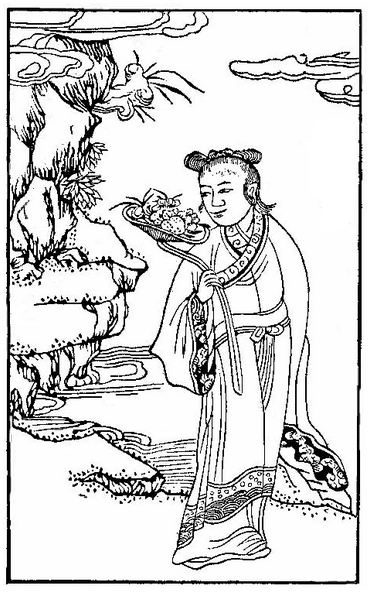
Ho Hsien-ku [Pinyin: He Xian’gu] is one of the Eight Taoist Immortals (Pa-hsien, Pinyin Baxian), and the only one who is unambiguously female. Six of the other Eight Immortals are definitely male, though at least one source (W. Perceval Yetts, “Eight Immortals,” p. 805) notes that Lan Ts’ai-ho may be depicted by artists as gender-ambiguous.

These Immortals began as humans, and transcended their humanity to become more than human. They could not be classed as either God or saint in the senses of those words used in the dominant Western religious traditions; but given their immortality and their powers, I would class them as deities. “The Eight Immortals are a group of seven men and one woman who are said to have attained immortality inspired by each other, and who continue to serve humanity by appearing in seances and inspirations” (Livia Kohn, Daoism and Chinese Culture, [Cambridge, Mass.: Three Pines Press, 2004], p. 164).

Below the photograph, I’ll append a brief biographical account of Ho Hsien-ku by W. Perceval Yetts, from “The Eight Immortals,” The Journal of the Royal Asiatic Society of Great Britain and Ireland, (London: 1916), pp. 781-783 (endotes are Yetts’ own notes).
Ho Hsien-ku

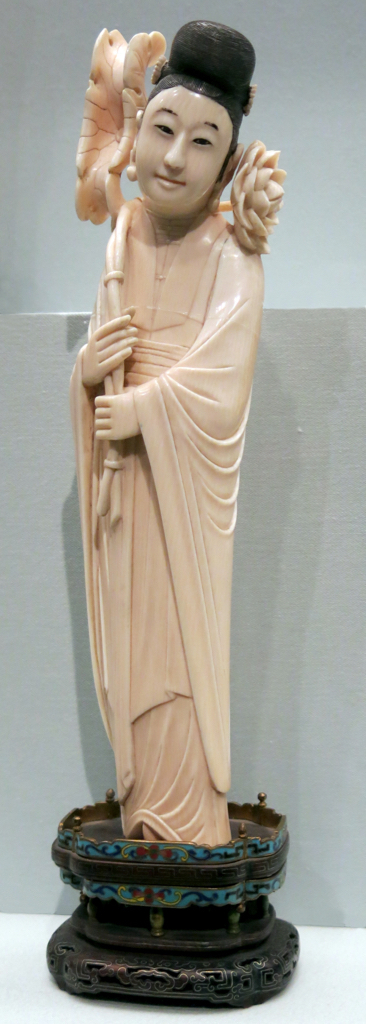
Above: Ho Hsien-ku with a lotus, an ivory sculpture made between 1850 and 1911 (Ch’ing Dynasty) at the Asian Art Museum (accession no. R2005.71.47).


“Ho Hsien-ku,” from “The Eight Immortals by Perceval Yetts:

Ho Hsien-ku is shown as a comely girl sometimes dressed in elaborate robes, but more often wearing over a simple garment the leafy cape and skirt affected by the hsien [English: enlightened one, immortal]. A large ladle is her recognized emblem. Its bowl, made of bamboo basketwork, is often filled with several objects associated with Taoist immortality, e.g., the magic fungus (1) and peach; (2) sprigs of bamboo and of pine; (3) and flowers of the narcissus. (4) The place of the ladle may be taken by the more picturesque long-stalked lotus bloom; and sometimes she holds just a fly-whisk or the basket of wild fruit and herbs gathered for her mother.

Biography from Lieh hsien chuan [Collected Biographies of Immortals by Lieh-hsien chuan], ii, 32, 33:

Ho Hsien-ku was the daughter of Ho T‘ai, of the town of Tsêng-ch‘êng, in the prefecture of Canton. At birth she had six long hairs on the crown of her head. When she was about 14 or 15 a divine personage appeared to her in a dream and instructed her to eat powdered mica, (5) in order that her body might become etherealized and immune from death. So she swallowed it, and also vowed to remain a virgin.

Up hill and down dale she used to flit just like a creature with wings. Every day at dawn she sallied forth, to return at dusk, bringing back mountain fruits she had gathered for her mother. Later on by slow degrees she gave up taking ordinary food. (6)

The Empress Wu (7) dispatched a messenger to summon her to attend at the palace, but on the way thither she [Ho Hsien-ku] disappeared. (8)

In the ching lung period (about A.D. 707) she ascended on high in broad daylight, (9) and became a hsien. In the ninth year of the t‘ien pao period (A.D. 750) Ho Hsien-ku reappeared, standing amidst rainbow clouds over a shrine dedicated to Ma Ku. Again, in the to li period (about A.D. 772) she appeared in the flesh on the Hsiao-shih Tower at Canton.

NOTES

[These are W. Perceval Yetts’s own notes.]

(1) This, the most ubiquitous object in Chinese art, has received various botanical names. (See Bretschneider, “Botanicum Sinicum,” Journal of the Chinese British Royal Asiatic Society, vol. xxv, p. 40, and vol. xxix, p. 418.) Its branches expand into flattened umbilicated extremities with scalloped edges. It is probably largely because of the resistance its wood-like substance offers to decay that it has been adopted as the emblem par excellence of immortality. There are records of its supernatural qualities having been recognized as early as the third century B.C. (see Chavannes, Les Mémoires historiques de Se-ma Ts’ien, vol. ii, p. 176 seq.), and to the present day it is sold by native apothecaries as a drug capable of prolonging life.

(2) Any representation of the magic peach is a covert allusion to that enigmatical figure, Hsi Wang Mu, the Queen of Taoist Fairyland. Among the wonders of her mountain domain was the tree that bore but once in 3,000 years peaches the taste of which gave immortality.

(3) Bamboo and pine, being evergreen, are emblems of longevity.

(4) The name the narcissus bears is sufficient reason why it should be included in this category.

(5) For the meaning of [what is here translated as “mica”]: see note by Dr. Laufer in T‘oung Pao, vol. xvi, p. 192. Perhaps a parallel may be found here between the alchemy of China and the West. Talc, a mineral often confused with mica, figures prominently in the writings of mediaeval alchemists, and as late as 1670 it was advocated as a mysterious preservative of youth and beauty by the Apothecary in Ordinary to the English Royal Honsehold, N. le Febure by name, in his Compleat Body of Chymistry, pt. ii, p. 106 seq.

(6) One of the first steps on the road to hsien-ship. Taoists are often said to have given up the ordinary diet of cereals. Some gradually reduce their food till they die of starvation. So emaciated is their condition that their bodies after death become mummified, and thus they do actually attain a kind of corporeal immortality. Particulars of this aspect of Chinese eschatology are to be found in an article by the writer in The Journal of the Royal Asiatic Society for July, 1911.

(7) The notorious woman who, through the possession of an extraordinary personality and a genius for intrigue, rose from obscurity to become the supreme ruler of China during the latter part of the seventh century. See Mayers, Chinese Reader’s Manual, pt. i, No. 862; and Giles, Biographical Dictionary, No. 2331.

(8) I.e., Ho Hsien-ku eluded the envoy. Chinese legend abounds in instances of summonses to Court being sent to hermit sages and others who had cut themselves off from worldly affairs. The recipients have almost invariably shown a consistent contempt for mundane honors by refusing to comply, and imperial curiosity as to their reputed wisdom or powers of magic has remained unsatisfied.

(9) The actual period of the day or night when emancipation from earthly ties takes place and the final stage in becoming a hsien is completed is considered in Taoist lore to have a determining influence upon the subsequent career of the hsien. See, for example, the following passage from the Chi hsien lu: “When (after death) the body remains like that of a living man, the condition is that of release from the flesh, shih chieh; when the legs do not become discolored nor the skin wrinkled — that is shih chieh; when the eyes remain bright and unsunken, in no respect differing from those of a living man — that is shih chieh; when resuscitation follows death — that is shih chieh; when the corpse vanishes before it is encoffined, and when the hair falls off before the mortal body soars (to heaven) — both of these are shih chieh. Most perfect is the release that takes place in broad daylight, but less complete is the release that occurs at midnight. When it takes place at dawn or at dusk, then the persons concerned are relegated to a terrestrial abode” (i.e. they will not reach the celestial paradise, but remain in haunts of the hsien on earth, such as the K’un-lun Mountains, the Isles of the Blest, and the Five Sacred Hills).
HeXiangu2

Above: Drawing of Ho Hsien-ku in Yetts, p. 781 (public domain image).

Rules for prayer

Even though I’m the guy who wrote the essay “Why I Don’t Pray” in the pamphlet “UU Views of Prayer,” I’ve been thinking a lot about prayer recently. Not because I’ve started praying (I haven’t), but more because I’m sick of hearing about the alleged virtues of meditation and mindfulness. You see, meditation and mindfulness are being coopted by consumer capitalism: Meditation will improve worker productivity! Mindfulness will help your children get better grades! And if you work more, or get good grades and go to college, you will be able to buy more!

These are fairly recent developments for meditation and mindfulness. Prayer, on the other hand, got coopted by consumer capitalism a few decades ago. Prayer is an integral part of the “Prosperity Gospel,” a mutant offspring of Christianity and consumer capitalism which holds that if you believe in God and pray and give generously to your church then you will get rich. While I try to be tolerant of other people’s religious beliefs, the Prosperity Gospel is bullshit. And it’s clear clear to me that meditation and mindfulness are on track to being coopted in the same way prayer was: soon we will faced with the spectre of the Prosperity Dharma.

Unitarian Universalists have developed some standards and best practices that have tended to insulate us from the worst excesses of the Prosperity Gospel. It is worth reviewing what those are:

1. Prayer is not going to make you rich; some people who pray might get rich, but that’s random chance. (In fact, the same can be said of religion in general.)

2. If prayer works for you, go for it. If prayer doesn’t work for you, then don’t — AND don’t be an asshole and make fun of people who find that prayer works for them.

3. Unitarian Universalists generally agree with Jesus when he says in the Bible, “When you pray, do not be like the hypocrites, for they love to pray on the street corners to be seen by others” (Matt. 6:5). In other words, it’s fine if you pray but don’t be a show-off. In fact, don’t be a show-off with any spiritual practice.

4. We do not have to bow our heads during prayer (see previous point). If you want to, that’s fine, but you don’t have to.

Why is it worth reviewing these standards and best practices? Because they can also be applied to meditation and mindfulness. And meditation and mindfulness are coming ever closer to breeding their own mutant offspring with consumer capitalism. And the last thing we need is to be taken over by the Prosperity Dharma.

Going from “Oops” to “Yay!”

My denomination recently did an excellent redesign of their Web site, making it completely responsive and easy to view on tablets and smartphones.

My denomination then updated the denominational bylaws so they are now only available as a PDF. Which means the bylaws are now neither responsive nor easy to view on tablets or smartphones.

Improve a Web site. Yay!

Then break it. Oops.

This is why it is essential to have processes in place to continually monitor a Web site’s usability. Because it is way too easy to do something stupid that breaks the functionality of even a modestly complex Web site (he says, speaking from personal experience). And because when you go from “Yay!” to Oops,” you need to be able to get back to “Yay!” as quickly as possible.

Tan’gun

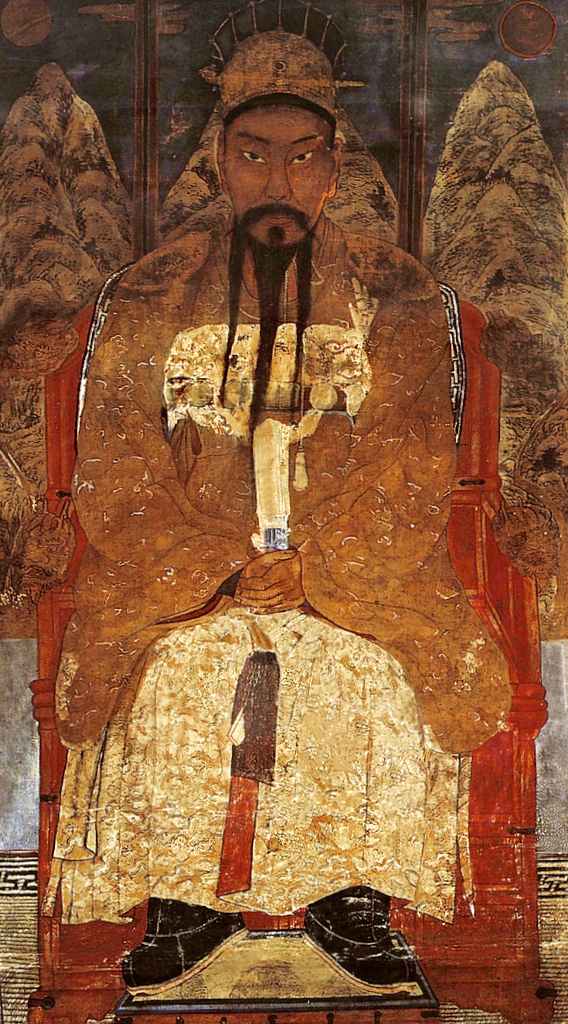
Taejonggyo, a new religious movement in Korea, worships Tan’gun, the legendary founder of the first Korean kingdom. The contemporary expression of Taejonggyo was founded in 1909 by Nach’ol, a Korean nationalist who was resisting the Japanese occupation of Korea. Nach’ol said that Taejonggyo had been the religion of Korea for some three thousand years before the importation from China of the foreign religions of Buddhism, Taoism, and Confucianism during the Mongol invasions of the 13th century (Don Baker, Korean Spirituality [University of Hawai’i: 2007], pp. 118-119).

“Taejonggyo (The Religion of the Great God) … claims that Tan’gun, the legendary founder of Korea, is the original founder of Taejonggyo, which was revived by Nach’ol in 1909. It claims that it embodies the national spirit and philosophy. Tan’gun is believed to be the god-man and the founder of Korea, and he is the object of worship in Taejonggyo. Taejonggyo was at the forefront of the anti-Japan independence movement during Japnese colonialism in Korea. As a result, its followers were persecuted severely by the Japanese authorities.” Oliver Leaman, Encyclopedia of Asian Philosophy (Routledge: 2006), p. 383.

Tan’gun is linked to National Foundation Day, or Gaechenonjeol, in South Korea: “Gaecheonjeol was made an official South Korean national holiday in 1909. The day is typically celebrated with public ceremonies, performances and speeches; government offices and many schools and private businesses are closed. … Ceremonies are held to honor Dangun [Tan’gun] at an altar of rocks he built at Chamseongdan, located at the top of Mount Mani…” (Korea Ye Web site). According to historian Don Baker, National Foundation Day was originally established by the Taejonggyo religion as a day to venerate Tan’gun (Baker, pp. 90-91).

Tan'gun, legendary founder of the first Korean kingdom

The image above is a public domain image of Tan’gun from Wikimedia Commons (I edited this image for legibility). Unfortunately, Wikimedia Commons does not tell us what painting this image comes from. If you search for additional images of Tan’gun on the Web, note that his name is sometimes transliterated as Dangun.

Conference on religion and the environment

I just received a call for papers for the third annual conference “Sacred Texts and Human Contexts: Nature and Environment in the Sacred Texts of World Religions,” sponsored by Nazareth College in collaboration with Hobart William-Smith College. The conference poster asks the following “foundational questions”:

“How do religions integrate the discoveries of science with the teachings of tradition with respect to environmental
issues?
“How do environmental scientists look into contemporary environmental issues?
“What roles have been and can be played by faith communities in enhancing protection of nature and environment?
“How do women in faith communities respond to the contemporary environmental catastrophe?
“Do our sacred texts declare any actions to be immoral regarding dealing with nature and environment?”

Sounds like a pretty interesting conference, and I’m going to think seriously about attending. More information on submitting proposals, and on conference registration, online here.

Sacred Texts and Human Contexts conference poster

Ahura Mazda

BlogOct3015

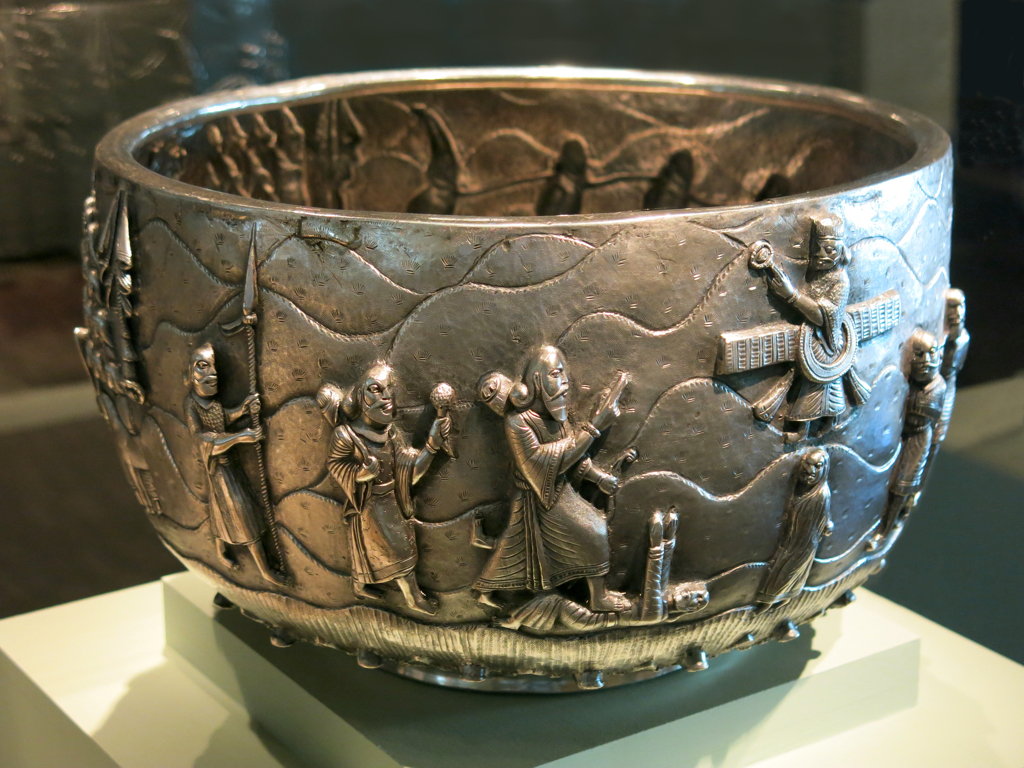
The supreme deity of the Zoroastrian faith, known as Ahura Mazda, is represented on this ceremonial bowl as a winged disk, at upper right in the photo. The bowl depicts the victory of the Zoroastrian Emperor Darius (550-486 BCE), with Ahura Mazda appearing as a presence near and above the emperor. The bowl was made in Burma in the last quarter of the nineteenth century, and is now at the Asian Art Museum in San Francisco (accession no. 2009.25).

Zoroastrianism is the oldest extant monotheistic religion. According to the Pluralism Project: “The one supreme and infinite God — Ahura Mazda — cannot be fully understood by humanity, [but] six attributes of Ahura Mazda were revealed to Zarathushtra. Known as the Amesha Spentas, they include Vohu Mana, the Good Mind; Asha, the divine law of righteousness, justice, and truth; Kshathra, the majesty and power of good dominion; Armaity, Ahura Mazda’s love and benevolent devotion; Haurvatat, well-being and perfection; and Ameratat, immortality. Humans must strive, both through reason and action, to emulate these attributes of God to live a good life.”