Environmentalism: from sacred texts… pt. 3

Read part one

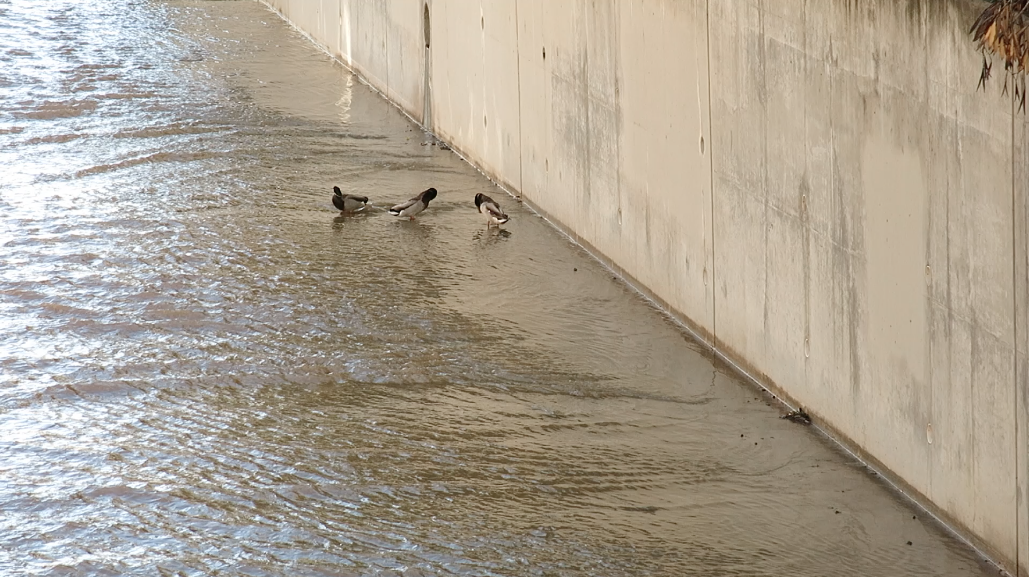
The worm composter and the tire garden are right next to Adobe Creek, and some of the children look down to see how much water remains from the rain we had last week. Adobe Creek flows for about 14 miles from Black Mountain, a peak on the Monte Bello Ridge west of Palo Alto, to San Francisco Bay, draining about 10 square miles of land. (14) The creek runs in a concrete channel for its last two miles, including the stretch past the church. (15) The children stretch over the chain link fence that keeps people from falling in the ten foot deep channel to look. Water just covering the bottom of the creek flows quickly past. One of the children points at a pair of Mallards in the water.

Screen Shot 2016-04-15 at 11.08.06 AM

Every time we visit the worm composter and the tire garden, we look in the creek, and we once made a special point of visiting Adobe Creek after a big rain storm so the children could video the turbid chocolate-brown waters rushing past. We are trying to make the children feel connected to our local watershed. Anabaptist theologian Ched Myers argues that too often environmentalists and eco-theologians tend to think in broad abstractions while neglecting their immediate ecological context, a tendency that can lead congregations to engage in environmental justice work that is merely “cosmetic.” Myers wants religious communities to engage in what he calls “watershed discipleship,” environmental justice centered on the bioregion of their local watershed. (16) For Myers, “watershed discipleship” should be rooted in scripture, in the Bible, though he is careful to add that the natural world is a kind of scripture; and he argues that “liturgy and spirituality” and “church practices” should also be firmly rooted in the specific bioregion of a watershed. (17) We’re teaching sixth graders in this class, most of whom are still at the concrete operational stage of cognitive development, and we’re in a post-Christian congregation. But even though Myers’s “watershed discipleship” is too abstract and too Christian to accurately describe what we’re doing, it helps explain why I and the other teachers insist on taking the children to see dirty water flowing through a concrete channel.

We walk from Adobe Creek back to our classroom, then out the back door to a covered patio to work on the half-finished nesting boxes. Before we start working, I bring up our conversation from the previous week, about House Sparrows, an invasive species, who sometimes take over nesting boxes, thus depriving native swallows of nesting habitat. Last week, I had told the children that ornithologists recommend removing and destroying House Sparrow nests in swallow nesting boxes. The children did not like the idea of destroying House Sparrow eggs, even if theses birds are a destructive invasive species. This week I admit that I probably couldn’t destroy a House Sparrow nest myself, and I ask what they think we should do. Zoe finally says she would be willing to remove a House Sparrow nest, though she wouldn’t destroy it, she would put it on the ground somewhere. “What if a cat gets the nest?” asks Toby. “Well, at least we didn’t kill it,” Zoe says.

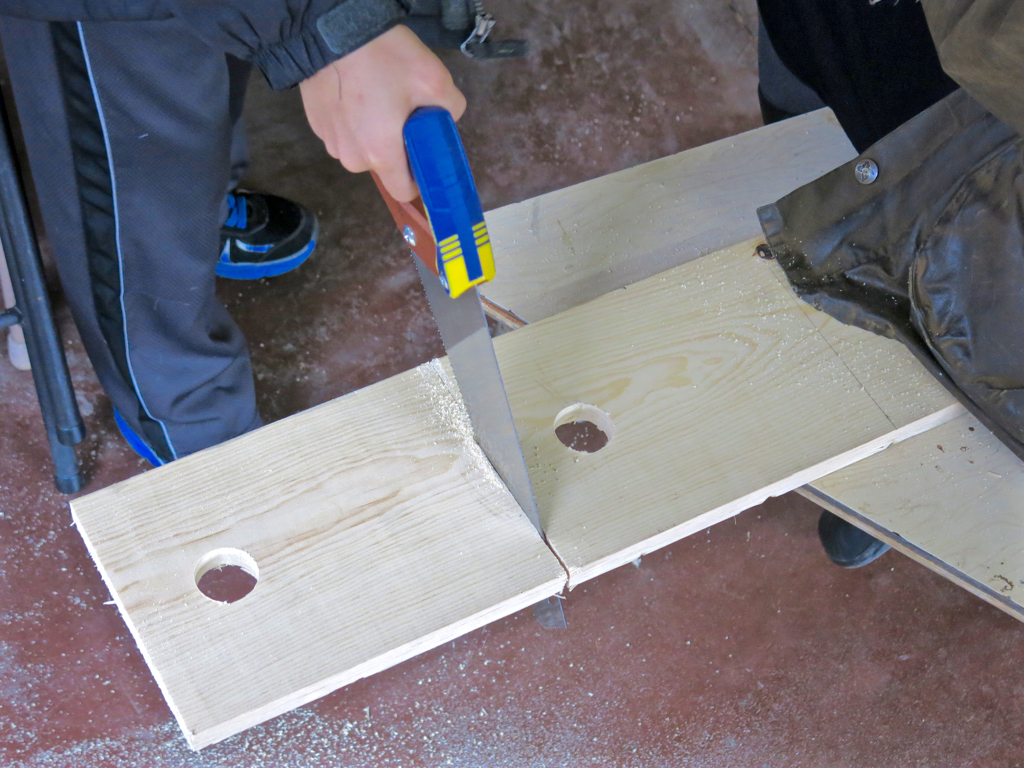
This is our third week building nesting boxes. By now, most of the children know what to do. Catalina, who hadn’t worked on the nesting boxes before, is taken in hand by some of the other girls, who show her the plans, and some partially assembled nesting boxes. Soon Catalina is sitting on a board to hold it while Eva cuts it with the hand saw. I’m at the table where we drill pilot holes for nails. We have a system where one person holds the piece of wood, another person holds the handle of the hand drill, and a third person turns the crank handle. We keep working until the worship service ends. Frank, an older adult, happens to walk past us, and stops to see what we are doing, and soon he is working, too. The children want to keep on working , but both Lorraine and I have other commitments, so we have to end the class.

IMG_4853

“OK, everyone stand in a circle and hold hands,” I say. “You, too, Frank.” When everyone is in a circle, and more or less holding hands, I ask everyone to say one thing that they learned, or that they’re taking away from today’s class. “Sawing is hard.” “I learned how to drill.” (Becky doesn’t say anything.) “Fun!” “Our worms are happy.” Finally we all say the unison benediction that the adults say at the end of each worship service:

Go out into the world in peace
Be of good courage
Hold fast to what is good
Return no one evil for evil
Strengthen the faint-hearted
Support the weak
Help the suffering
Rejoice in beauty
Speak love with word and deed
Honor all beings.

This is our version of a widely-used benediction derived from 1 Thessalonians 5:13-15, 21-22, (18) adapted by other Unitarian Universalists, and further adapted by our church’s senior minister when she added the phrase “Rejoice in beauty.” Most of the children in the class have memorized our version of the benediction; they mostly like saying it together; sometimes their comments make it seem that they have even thought about its meaning. I suspect that some of them would be displeased to learn that the benediction they like so well comes from the Bible.

Many of these children are from families in the middle of what political scientists Robert D. Putnam and David E. Campbell call “a gaping chasm between those who are highly religious and those who are highly secular.” (19) They fall in the middle because they’re both religious and secular at the same time. They are secular because, like the senior minister and more than half the congregation, they are atheists, they don’t pray, and/or they rarely read sacred texts—they are secular by definition, since religiosity is commonly determined in the U.S. by belief in God, the act of praying, and devotional reading of the Bible or other sacred text. (20) For further confirmation of the congregation’s “secularity,” I have learned from listening to and talking with the children and teens that most of them think of “religious” persons as intolerant; in this, their views correspond to the views Putnam and Campbell have found in highly secular Americans. (21) Yet the sixth graders in this class are “religious” if we measure religiosity, not by belief in God or prayer, but by regular attendance in a local faith community. Some of them are aware of their awkward status as both religious and secular, and sometimes they’ll say that they don’t like telling their friends they go to church because it’s hard to explain that their church doesn’t make them believe in God.

The teens in the class I teach later on Sunday morning feel this awkwardness more acutely—these teens are older, in grades 8 and 9, ranging in age from 12 to 15. They are in our “Coming of Age” class, which corresponds roughly to a confirmation class in a Protestant Christian church, or a bar/bat mitzvah class in some Jewish synagogues. In a recent Coming of Age class, I led a session on Biblical literacy, reviewing material about the Bible to which they had already been introduced in previous years in Sunday school. When I asked some pre-assessment questions, I found that the fourteen teenagers in the class could say little about the Bible; even though I know they had been exposed to this knowledge in other Sunday school classes, they are very resistant to remembering anything that smacks of “religion.” I am sympathetic to their resistance to “religion,” given how religion has been used in the West as a form of “colonial control.” (22) Given our congregation’s commitment to social justice, no wonder our children and teens resist a label that that they associate with the opposite of social justice. Yet I also I hear from teens and from their parents that they love coming to the Coming of Age class, because they get to talk about big religious questions like the nature of human beings, good and evil, etc.; they resist the label, but they love the content. All this presents a formidable pedagogical challenge: introducing children and teens to the resources of religion, without provoking further resistance.

With that in mind, let’s return to the sixth grade Ecojustice class, to see what happens after the closing circle: After the closing circle, several children volunteer, without being asked, to stay and help put away tools and materials. Several of them, almost half the class members, walk back and forth between the covered patio and my office, carrying half-finished projects, supplies, and tools. It takes fifteen minutes to get everything put away, and some of the children linger, ready to stay longer if there is something to do; but I have to get ready for the Coming of Age class, so they drift away. These sixth graders show no resistance to the religious bioregionalism of Ecojustice class; exactly the opposite: they like to know how they are connected to Violet-green Swallows and House Sparrows, to worms and compost, to Adobe Creek.

On to the final section.


Notes:

(14) Chris D. Pilson, “Urban creek restoration, Adobe Creek, Santa Clara County, California” (Master’s thesis, San Jose State University, 2009), 10, 13.

(15) The channelization of Adobe Creek is just one of many human-induced changes. Adobe Creek may have originally terminated in a “bird’s foot distributary pattern” before it reached the bay, perhaps close to the present-day location of the church (Pilson, 58). It is probably no longer possible to reconstruct what the creek was like before Europeans arrived, and rather than focusing on the past we want children to know the creek as it is now.

(16) Ched Myers, “From ‘Creation Care’ to ‘Watershed Discipleship’: Re-Placing Ecological Theology and Practice,” The Conrad Grebel Review 32, no.3 (2014), 257, accessed March 31, 2016: link.

(17) Ibid., 266-268.

(18) Versions of this benediction, used widely in U.S. mainline congregations, may be found in the Anglican Book of Common Prayer and in the Presbyterian Book of Common Worship.

(19) Robert D. Putnam and David E. Campbell, American Grace: How Religion Divides and Unites Us (New York: Simon and Schuster, 2010), 494.

(20) Putnam and Campbell measure religiosity by asking “How frequently do you attend religious services? How frequently do you pray outside of religious services? How important is religion in your daily life? How important is your religion to your sense of who you are? Are you a strong believer in your religion? How strong is your belief in God?” (Putnam and Campbell, 18). Since half these questions involve belief and prayer, atheists who don’t pray will not be scored as highly religious. Putnam and Campbell admit there might possibly be some bias in these questions (ibid., 20).

(21) Ibid., 499-501.

(22) Robert F. Shedinger, “Jesus and Jihad: Transcending the Politics of the Sacred,” in Sacred Texts and Human Contexts: A North American Response to “A Common Word between Us and You” (Rochester, New York: Nazareth College, 2014), 120-121.

Pot-in-Pot Preservation Cooling System

This system, developed by Mohamed Bah Abba of Nigeria, cools food by evaporation, using no electricity. The Arabic term for this device is transliterated as “zeer,” so it is sometimes called a “zeer pot.”

How it works: The Pot-in-Pot Preservation Cooling System consists of two nested porous clay pots, with fine sand in between them, and a cloth covering the opening. You pour water into the sand, until it soaks through the outer pot. You also soak the cloth in water. As the water evaporates from the outer pot and the cloth, it cools the inside. The sand and pots act as both water reservoir, and thermal mass (so the pot stays cool when you open the lid). The moist interior is especially good for cooling fresh produce (which is what it was originally designed to do).

How cool it can get (theoretically): The inside temperature of the Pot-in-Pot Preservation Cooling System depends on outside air temperature, humidity, air flow around the pot, and whether the pot stands in the sun. Under ideal conditions, the inside temperature should get close to what meteorologists call “wet-bulb temperature.” Some users report temperatures as low as 40° F. I will track the temperature inside this pot over time.

How I made one:

Materials:
1 – 12″ dia. terracotta pot
1 – 14″ dia. terra cotta pot
6 – small pottery feet
2 – corks to fit the holes in the pots
1 – 12″ dia. pot saucer
1 – old T-shirt
25 lbs. of fine sand
water

Note that dimensions of terracotta pots are variable, so you may have to adjust things to fit what you can get.

BlogApr0916a

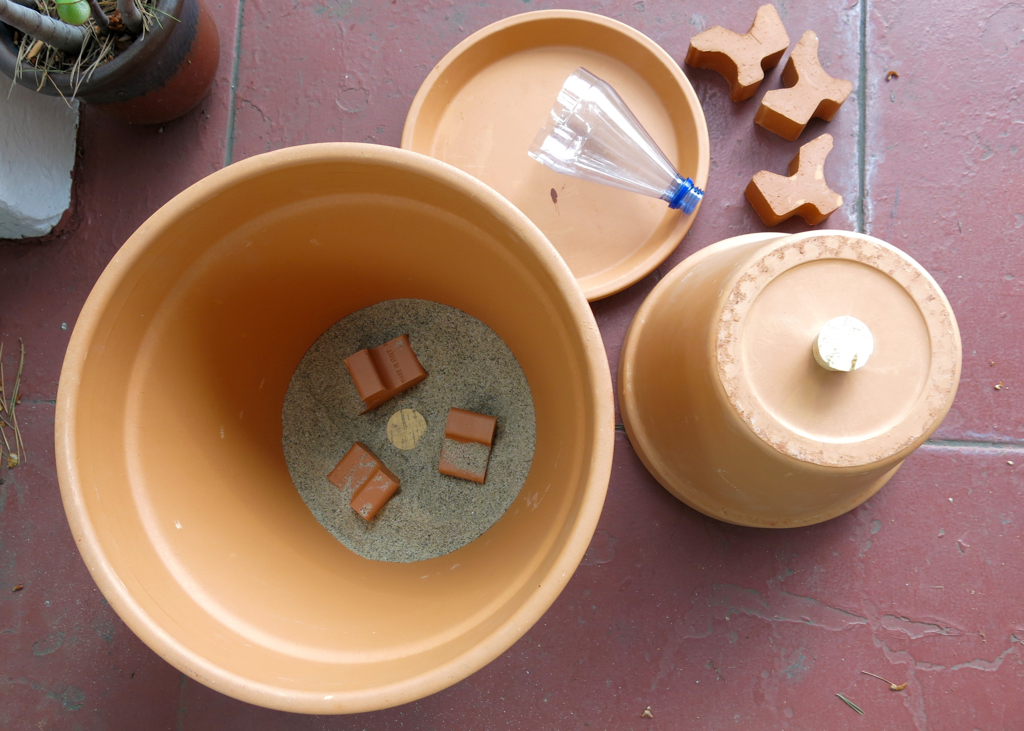
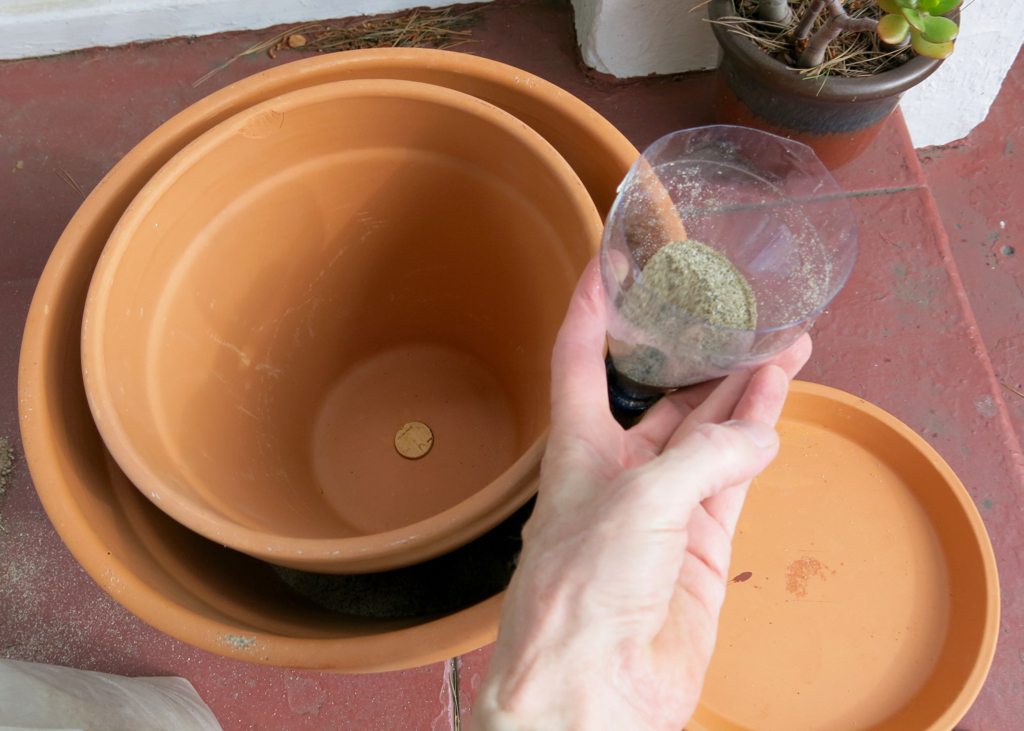
Sand the holes in the pots until the corks fit smoothly inside. Cork the holes. Place 3 of the pottery feet in the bottom of the 14″ pot so that the 12″ pot will fit inside without the corks bumping. Then fill the rest of area with sand, leaving room for the cork in the 12″ pot. Now put the 12″ pot inside, and fill the space between the pots with sand with a funnel — I made a funnel from a cut-off seltzer water bottle — to within an inch of the top of the outer pot.

BlogApr0916b

Place the whole assembly on the three remaining pottery feet, so air can circulate on the bottom, which will increase evaporation and cooling slightly.

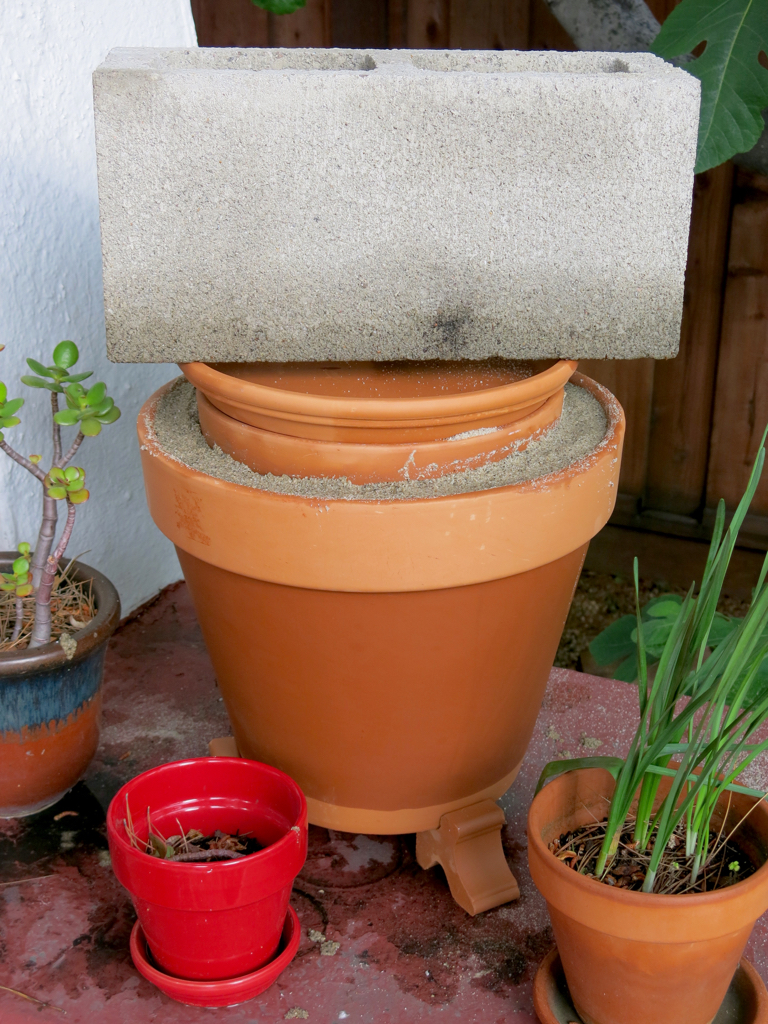
Pour an inch or two of water into the 12″ pot, wetting in the inside of the pot. Next, slowly pour water into the sand, letting it soak in. The idea is to give the water time to soak into the sand and the terracotta pots. It can take several hours and up to a gallon of water to fully charge it. I found if I rushed this step, the inner pot started floating up; then I had to weight the inner pot with a cinder block to keep it in place until the water soaked in. Some people suggest tying the inner pot down with a strap or rope; others use threaded rod with nuts and washers (expensive and sure to rust). I had a cinder block on hand, and that worked fine.

BlogApr0916c

The pot saucer isn’t entirely necessary, but it helps keep the inside clean, and where we live it helps keep the squirrels out of the food (the cinder block might even keep raccoons out). Pour some water into the saucer, soak the old T-shirt, and cover the pots with the T-shirt, adding even more evaporative surface. It gets pretty windy where we are, so I tied the T-shirt in place.

Total cost: about $55 (if you have to buy sand), with no cost to run it ever. Mohamed Bah Abba sells them for 40¢ ea. in Nigeria, a brilliant example of low-cost yet highly effective technology from the developing world.

More about this invention here.

In the clouds

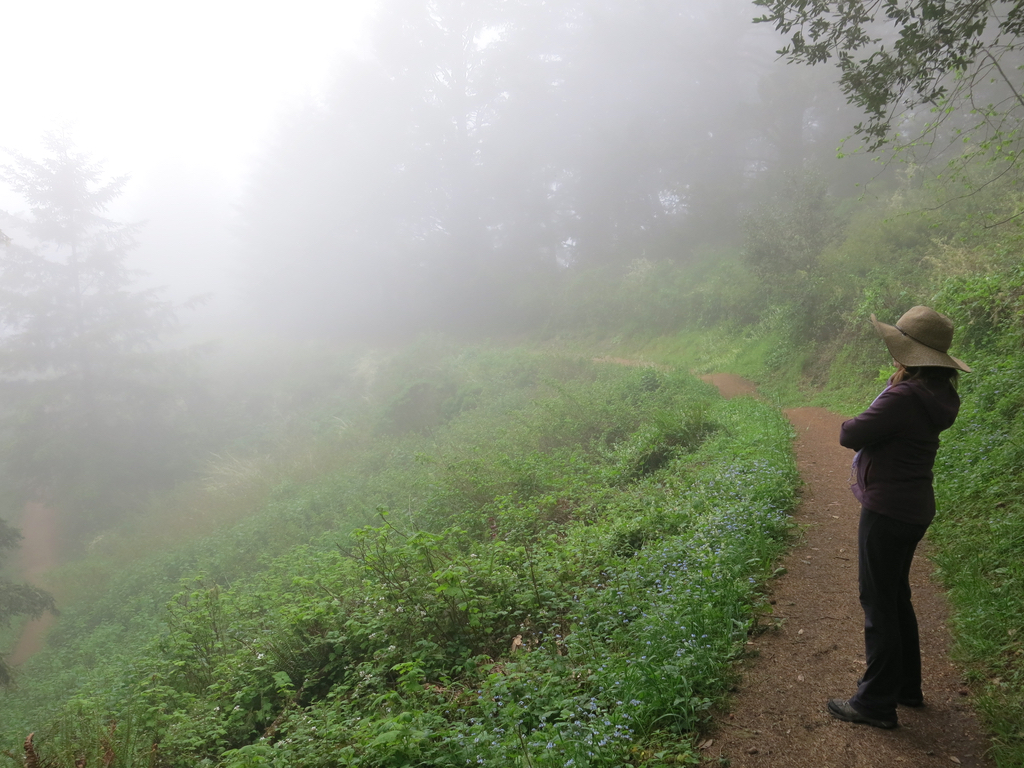
We decided to go for a hike up in the redwoods late this afternoon. As we drove up into the hills, we got closer and closer to the clouds, until finally we were in them. The trail started close to two thousand feet above sea level, then wound down the coast side of the hills. The clouds were blowing in from the ocean against the hills, so we were in the clouds all the way down to where we turned around, at about twelve hundred feet elevation. In fact, the clouds (or was if fog?) got thicker the lower we got.

IMG_5124

It continues to amaze me that we can start driving from downtown San Mateo, in the city a mile from the bay at maybe twenty feet about sea level, and in twenty minutes we can be hiking in the mountains among Douglass fir and redwoods two thousand feet above sea level. This is one of the benefits of living in a seismically active region: mountains right next to the ocean.

“Being Different Together”

Yesterday evening, seven of us from the UU Church of Palo Alto attended “Being Different Together,” a community forum sponsored by the Palo Alto Human Relations Commission.

Rev. Kaloma Smith, pastor of the University AME Zion Church in Palo Alto, introduced the keynote speaker, Dr. Joseph Brown, a social psychologist who studies implicit bias, who currently works at Stanford University as the Graduate Diversity Recruitment Officer for the School of Humanities and Sciences and Associate Director for the Diversity & First-Gen Office. Dr. Brown’s doctoral research looked at how stereotypes and prejudice impacted minorities and women. Brown studied with Claude Steele, a social scientist who did research in stereotype threat, among other topics.

Brown said his goal was to find a way to talk about “getting into a more just community.” He said one way to do this is by using the concept of “microaggressions.” He acknowledged that the concept of “microaggression” as it has been popularized is controversial. But he approaches this from a social science perspective, where “microaggression” has been carefully defined and studied. Continue reading ““Being Different Together””

Environmentalism: from sacred texts… pt. 2

Revised version, 15 April 2016

Read part one

Documenting a Local Faith Community, pt. 1

Our local faith community, the Unitarian Universalist Church of Palo Alto (UUCPA), is a congregation affiliated with the Unitarian Universalist Association (UUA), the merger of the American Unitarian Association and the Universalist Church of America. Both the Unitarians and the Universalists started out by rejecting standard Christian doctrines and creeds, and by the late nineteenth century they had become “post-Christian” religious groups. (7) Today, most Christians would not consider UUCPA to be a Christian church: we affirm neither the Nicene Creed, nor Jesus Christ as Lord and Savior; the majority of the congregation are atheists; some of our congregants assert multiple religious identities including non-Christian religious identities such as humanism, Buddhism, etc. Yet to non-Christians, we look like Christians: we meet on Sunday mornings; our religious services resemble standard U.S. Protestant Christian worship services; and our official name is the “Unitarian Universalist Church of Palo Alto.” So the most convenient term for us remains “post-Christian.”

Most Sunday mornings, you will see me standing outside the door to the Main Hall on the campus of UUCPA, greeting families and individuals as they come up the covered walkway from the parking lot and the bike racks, or in the other direction from the front garden. On one particular Sunday morning, Reva, age 12, and her father wave at me as they walk up from their electric car. Reva is looking forward to “Pi Day,” March 14; she has memorized pi to over a hundred digits. When I comment that Pi Day is less fun this year than last, because last year was 3/14/15, Reva’s father points out that if you round up pi to four digits after the decimal point, you have 3.1416. Reva’s family is committed to fighting climate change, and they purchased an electric Nissan Leaf soon after the car came on the market. This family is typical of many Silicon Valley families in the congregation: they celebrate Pi Day, the children are well-versed in STEM (science, technology, engineering, and math) learning, and they all show their commitment to the global environmental crisis by embracing new technological solutions.

Inside the Main Hall, the senior minister, Amy Morgenstern, has started the service. Three sixth grade girls, Zoe, Becky, and Eva, say “Hi!” to me as they race through the door to take up their usual places in the back corner of the Main Hall. All our children and teens spend the first fifteen minutes of every service in the Main Hall before they go off to Sunday school. While some children prefer to sit with their parents and pay attention to the service, these sixth graders sit quietly in a corner and pay attention to each other.

I finish greeting latecomers, slipping into the Main Hall as Beverly, the lay worship associate, reads this week’s centering words. “With our centering words each week,” says Beverly, “we draw on the many sources of our living tradition.” She reads a short excerpt from a contemporary poem; then she rings a bell, inviting everyone “to follow the sound of the bell into silence.” I’m standing next to where Zoe, Becky, and Maria are sitting. They are still interacting through gestures and facial expressions, and though they are not making any noise I would not say that they are spiritually silent; and I’m pretty sure they didn’t heard the centering words Beverly just read.

Everybody stands to sing the first hymn together. Most of the children know this hymn by heart, a contemporary spiritual song called “Come Sing a Song with Me.” One fifth grader stands on her chair, holding on to a parent, leaning her head back, her whole body involved in singing this, her favorite song. At the beginning of the last verse, I open the side door to the Main Hall, and forty or so children run pell-mell out the door and across the patio towards their Sunday school classrooms. Two generations ago, the children going off to Sunday school would have been almost entirely white, reflecting both a deep racial divide in American religious life, and the fact that the city of Palo Alto was over 90% white. Today, the city of Palo Alto is about 65% white while the surrounding county is now white-minority; nearly a third of the population of Palo Alto is foreign-born. (8) On this Sunday, the children going off to Sunday school are about 75% white; the non-white children at UUCPA are mostly of East and South Asian descent, but also of African descent, Latino/a, Middle Eastern, etc.

While the children race each other to see who will be first in their classrooms (not necessarily because they love class; in some classrooms there are a few couches, and the first ones in the classroom will get a seat on a couch), I reflect on the invisible economic differences between them. The median household income in Santa Clara County is close to $95,000, the highest median household income of any county in the U.S.; at the same time only 13.3% of households have an income in the range of $50,000-75,000, showing that “the middle class is being hollowed out.” (9) Many of the families who are affiliated with UUCPA have annual household incomes well over $100,000, but others are struggling to get by, especially given the exceedingly high cost of housing in Silicon Valley. (10) The majority of the regular attendees of UUCPA have incomes that place them in the middle class and upper middle class, but some regular attendees receive federal assistance for rental housing (so-called “Section 8 housing”). (11)

When I arrive in the classroom, Lorraine, my co-teacher for the sixth grade Ecojustice class, is already there. Of the seven children present today, five are white and two are non-white; six are girls and one is a boy. I take attendance while Lorraine asks one of the children to light a candle in a chalice (a flaming chalice is a common symbol for Unitarian Universalism). The children all say our usual opening words together: “We light this chalice in honor of Unitarian Universalism, the church of the open minds, helping hands, and loving hearts,” (12) and we all do the hand motions that go with each phrase. Next we everyone gets to tell about one good thing and one bad thing that happened to them in the past week; Becky is the only one who doesn’t participate in this; she never participates except when there are only one or two children in class.
IMG_4800

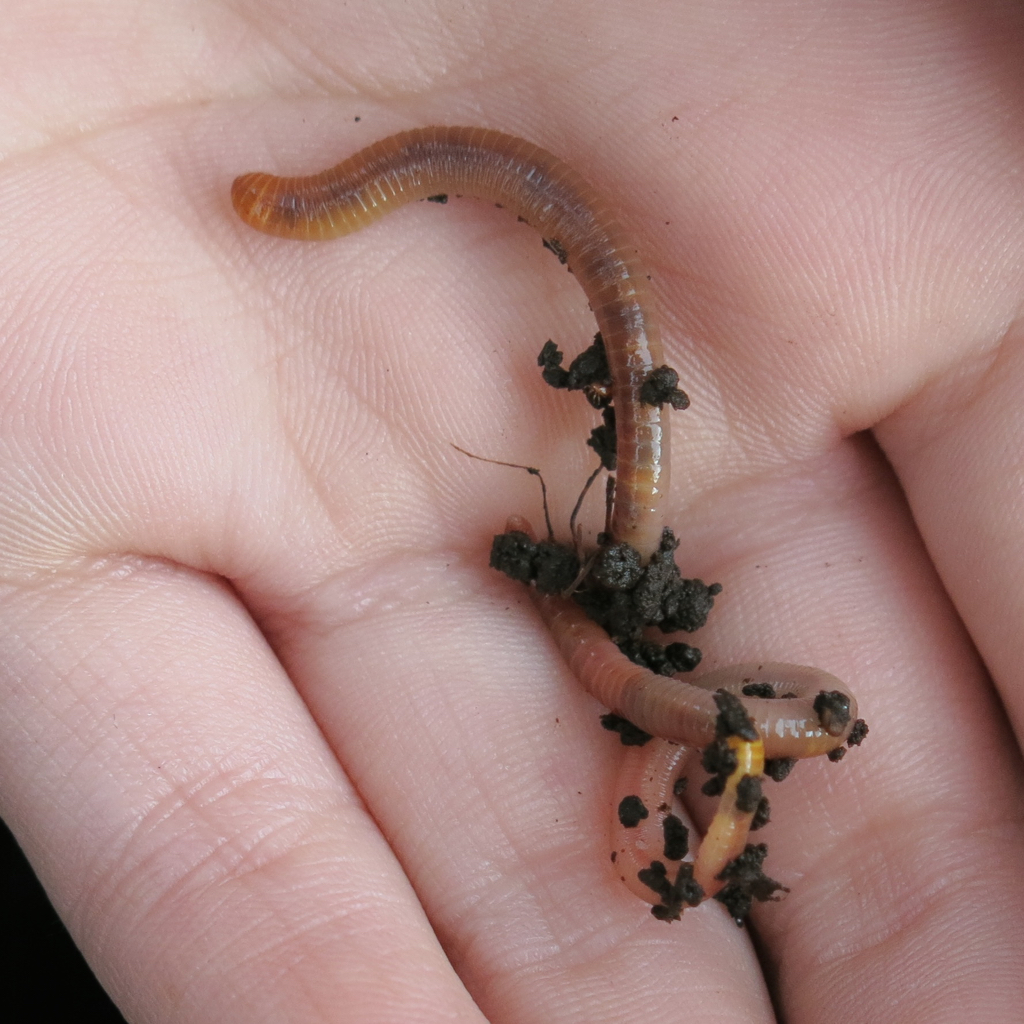
Today we’re going to work on making nesting boxes for the Violet-green Swallows that fly over the creek that flows along the edge of the church campus. But first the children want to check on their worm composter and their “recycled container garden” which they made from a worn-out automobile tire and discarded wood pallets. On our way to the composter and the garden, we stop at the church kitchen to pick up some vegetable scraps that the worms would like. As the children dump the scraps into the composter, Lorraine reminds them that we should add dry plant waste to the composter. Two of the children drag over a large yard waste bin and add handfuls of dead leaves along with the vegetable scraps. Aiofe reaches into the composter and finds some worms, which she holds in her hand to show the others. Next we check the container garden, made of a discarded tire. (13) The squirrels have dug holes in the dirt and disrupted the seeds we planted, so I promise to make a wire cage to keep out the squirrels.

On to part three


Notes:

(7) Historian of religion Gary Dorrien writes that “the implicitly post-Christian religious humanism” of Ralph Waldo Emerson and Theodore Parker, two theological giants of mid-nineteenth century Unitarianism, had “reconfigured” the Unitarians by the late nineteenth century into a post-Christian denomination (The Making of American Liberal Theology, 1805-1900 [Louisville, Kentucky: Westminster John Knox Press, 2001], pp. 105-109). The Universalists became post-Christian somewhat later, but were post-Christian by the time of the merger with Unitarians in 1961.

(8) The U.S. Census Bureau provides the following data for the city of Palo Alto on “Race and Hispanic Origin” from the 2010 Census (as of April 1, 2020): White alone, 64.2%; Black of African American alone, 1.9%; American Indian and Alaska Native alone, 0.2%; Asian alone, 27.1%; Native Hawaiian and Other Pacific Islander alone, 0.2%; Two or More Races, 4.2%; Hispanic or Latino, 6.2%; White alone, not Hispanic or Latino, 60.6%. 32.3% of the population in Palo Alto in 2010 was foreign-born. United States Census Bureau, QuickFacts, Palo Alto city, California, accessed March 26, 2016: link.

The immediate neighborhood of the Unitarian Universalist Church of Palo Alto (UUCPA) is slightly more diverse than the city as a whole. The racial and ethnic composition of census tract 510803, where UUCPA is located: 59% White, 1% Black, 5% Hispanic, 32% Asian, 2% Other. Neighboring census tract 5107 is white minority, at 47% white. “Mapping America: Every City, Every Block,” New York Times, accessed March 26, 2016: link.

(9) Data are from a 2014 study prepared by IHS Economics, and reported by George Avalos, “Santa Clara County has highest median household income in nation, but wealth gap widens,” San Jose Mercury News, August 11, 2014, accessed March 19, 2016: link.

(10) The 2010 U.S. Census found the median household income in Palo Alto, 2010-2014 (in 2014 dollars), was $126,771; the per capita income in the same period was $75,257; and the poverty rate was 5.3%. United States Census Bureau, QuickFacts, Palo Alto city, California, accessed March 26, 2016: link.

The poverty rate of 5.3% may include a higher proportion of families with children. For example, at Gunn High School, one of the two high schools in Palo Alto, 158 students, or 8.2% of students, received federally-funded free and reduced price meals in the 2010-2011 school year, the latest year for which I could find information. Palo Alto Unified School District, Henry M. Gunn High School Midterm Progress Report (Date of Midterm Visit March 22, 2012), Accrediting Commission for Schools, Western Association of Schools and Colleges, 8, accessed March 26, 2016: link. To put this into perspective, a household with four persons would qualify for subsidized meals if the household income is $44,863 or less. Palo Alto Unified School District School Nutrition Program Pricing Letter to Household (June, 2015), 2, accessed March 26, 2016: link.

(11) According to Fred Buelow, Treasurer of UUCPA, the congregation appears to have representation in each of the five quintiles of income distribution, with the smallest number in the lowest quintile. Personal communication, March 28, 2016.

(12) Words by Rev. Ginger Luke, a Unitarian Universalist minister of religious education.

(13) Haiti’s Papaye Peasant Movement (MPP) developed tire gardens to promote food security: “The concept of personal home gardens—in the city and in the countryside—carries great significance in a country where food security is hard to find.” Jessica L. Atcheson, “Ending Food Insecurity, One Urban Tire Garden at a time,” Rights Now: The Newsletter of the Unitarian Universalist Service Committee (Summer/Fall, 2013), 6-8.
Down by the bay…

If you spend any time with kids, you likely know the song “Down by the Bay”:

Down by the bay, where the watermelons grow,
Back to my home I dare not go,
For if I do, my mother will say:
“Did you ever see a….”

Then you improvise a last line with the name of an animal, and something absurd that rhymes with the animal: “Did you ever see a fly, wearing a tie?”

We’re going to sing this song at camp this summer, so I wanted lots of verses, subject to the following rules:
1. The verses had to be kid-friendly (i.e., no cheetahs drinking margaritas).
2. Only one verse per animal
3. No repeating rhymes (i.e., once you rhyme frog with dog, you cannot rhyme dog with frog)
4. Try to have as many different verbs as possible

I now have 48 verses, from various sources (Web, oral tradition, writing a few new ones). Your mission, should you choose to accept it, is to add even more verses, subject to the above rules. Note that the verses below are listed in alphabetical order by animal.

1. an ant, eat an elephant?
2. a beagle, flying with the seagulls?
3. a bear, combing his hair?
4. a bee, with a sunburnt knee?
5. a beetle, threading a needle?
6. a bunny, eating milk and honey?
7. a cat, swing a baseball bat?
8. a chicken, do some guitar pickin’?
9. a chimp, flying in a blimp?
10. a cockatoo, playing a kazoo?
11. a cow, with a green eyebrow?
12. a crab, drive a taxicab?
13. a deer, throwing a spear?
14. a dog, chopping a log?
15. a duck, in a pickup truck?
16. an eagle, married to a beagle?
17. a fish, do a hula in a dish?
18. a fly, wearing a tie?
19. a fox, hiding in a box?
20. a frog, hopping on a dog?
21. a giraffe, who really made you laugh?
22. a goat, in a ferry boat?
23. a goose, kissing a moose?
24. a hawk, knitting a sock?
25. a hog, going out to jog?
26. a horse, on a golf course?
27. a kangaroo, tying her shoe?
28. a lizard, dressed for a blizzard?
29. a llama, wearing striped pajamas?
30. a lobster, shooting at a mobster?
31. a mink, at the skating rink?
32. a moose, drinking apple juice?
33. a mouse, build a great big house?
34. a mule, swimming in a pool?
35. an octopus, who liked to swear and cuss?
36. an owl, drying on a towel?
37. a pig, dancing a jig?
38. a platypus, in a shuttle bus?
39. a rat, with a great big hat?
40. a seal, on a Ferris wheel?
41. a sheep, driving a jeep?
42. a slug, give a bug a hug?
43. a snail, with a dinner pail?
44. a snake, baking a cake?
45. a spider, drinking apple cider?
46. a turkey, who liked to eat beef jerky?
47. a whale, with a polka-dotted tail?
48. a yak, doing jumping jacks?

(N.B.: If you post an additional verse on Facebook, I’ll assume you give me permission to repost on my blog.)