San Mateo, Calif., to Winnemucca, Nev.

We finally got on the road at half past one. It took more than an hour to get free of Bay Area traffic, and then more than another hour to get past Sacramento. Carol decided to pull off the highway at Auburn, Calif. We walked the steep streets around the historic district, passing restaurants and stores selling tchotchkes, up the hill to the Place County Superior Courthouse, a monumental pile of yellow brick.

Auburn, Calif.

Along Interstate 80 on the way up the Sierra Nevada Mountains, we passed a roadside billboard that advocated splitting off a new state, to be called Jefferson State, from the rest of California. Republicans and libertarians who want “less government” and low or no taxes are behind this movement for a new state. Not surprisingly, there was a large Donald Trump sign attached to this billboard, for he is the new standard-bearer for those who want low taxes and less government. They would not have funded the construction of the monumental Placer County Superior Courthouse.

An hour or so later, we stopped in Verdi, Nev., to stretch our legs. Out in front of ESP Art, a trout sculpture leaped in front of a reflection of the eastern Sierras.

Verdi, Nev.

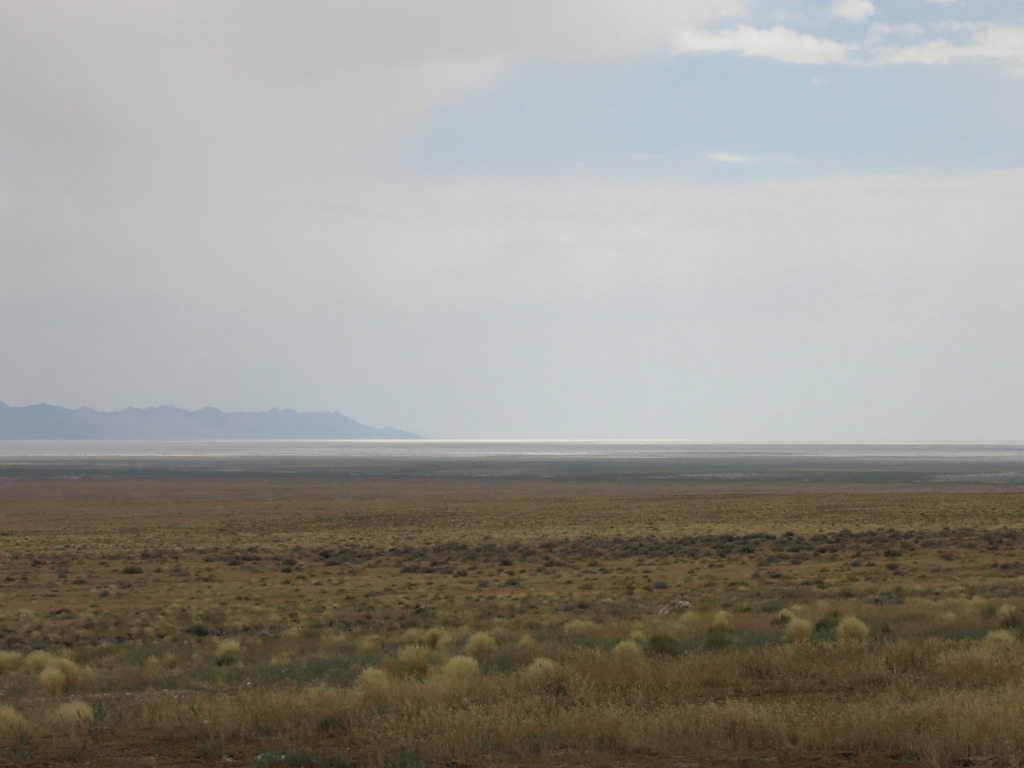
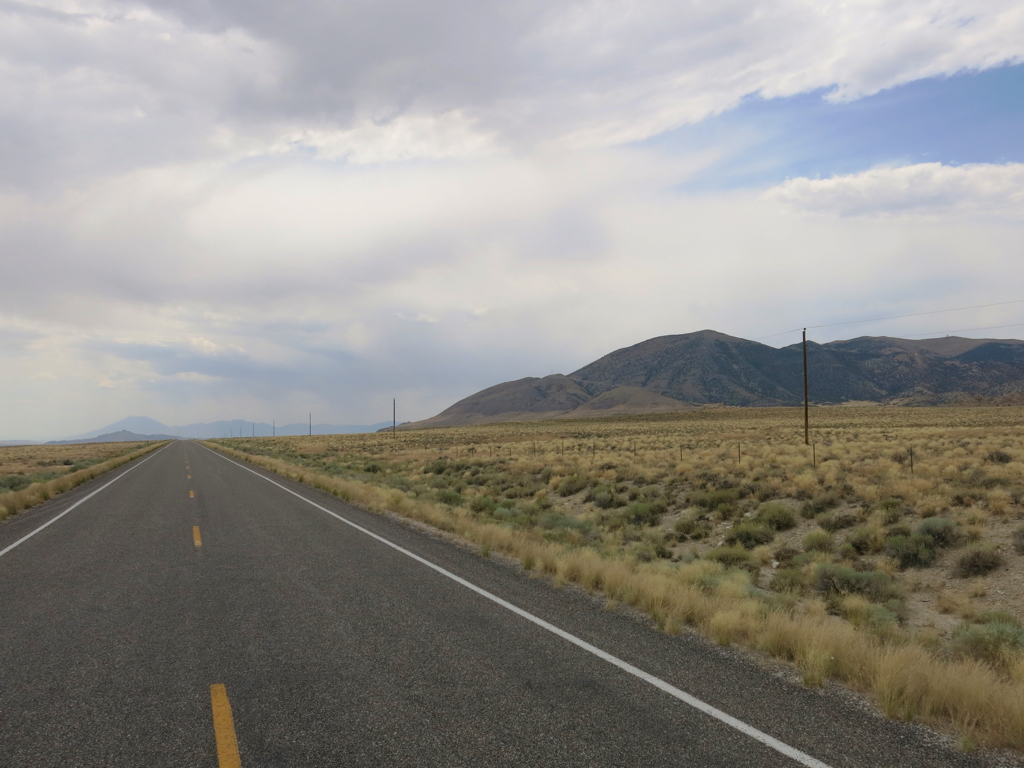
We drove through Reno and Sparks, and at last, as the sun was setting, we were in the wide open spaces of the Great Basin. We passed the Carson Sink, which had some patches of open water in among the salt pans; passed tall brown mountains that turned gold in the setting sun; passed mysterious large industrial plants along the Humboldt River; passed sage brush and tumbleweeds; and arrived in Winnemucca at half past ten.

East of Sparks, Nev.

San Mateo, Calif.

We had planned to leave San Mateo at noon. Now it is half past twelve, and we still haven’t finished loading the car with clothes, camping gear, ham radio gear, jars of plum jam, and Lord knows what else.

IMG_5858

Even though we got up at 6:30 this morning, we just had too much to do. Carol and I spent the last two weeks running an ecology camp, and that left us little time to get ready for our trip.

So here we are, still in San Mateo. We hope to get on the road by one o’clock. We hope….

Who’s your youth advisor?

This story from the Babylon Bee (a completely reliable source of news, and besides everything on the Internet is true), reveals the truth about the Dakota Avenue Christian Church’s youth program:

“Scandal erupted at Dakota Avenue Christian Church on Sunday, as it was revealed that beloved and long-standing youth pastor Blake Dickinson, who goes by the name “Rhino,” was actually just a homeless guitar player that had wandered into a service several years ago.

“An internal investigation revealed that Dickinson had been sitting on the corner of Dakota Avenue and First Street one summer morning, playing acoustic covers of Radiohead songs in hopes of scoring some change from passersby. Wandering into the church to ask if he could use the restroom, he was immediately assumed to be the new youth pastor, due to the guitar he was carrying, as well as his unkempt looks, Birkenstock sandals, and distinct patchouli scent.”

This raises the question: Who, exactly, is the youth advisor at the Dakota Avenue Unitarian Universalist Church next door?

Happy Watergate Day

A friend from high school reminded me that yesterday was Watergate Day. On Saturday, June 17, 1972, five burglars paid by CREEP (Committee to Re-Elect the President) broke into the Democratic National Convention headquarters at 2600 Virginia Avenue, Washington, D.C., in the same building as the Watergate Hotel. They placed hidden microphones — bugs — and took photos of sensitive material. It eventually turned out that then-President Richard (“I Am Not A Crook”) Nixon authorized and had direct knowledge of the burglary; he resigned rather than face impeachment proceedings.

The Watergate scandal shaped the political consciousness of my immediate age cohort. People a few years older than my age cohort talk about the assassination of Robert Kennedy and Malcolm X as defining moments in their political awareness, but for us the defining moment was criminal activity by the President of the United States.

A few years after the Watergate scandal, I think in 1977, some friends of mine and I re-enacted the Watergate break-in in our high school: we walked in to the office of one of the principals, dumped dead insects on his desk, and informed him that we were bugging his office. I don’t remember suffering any punishment for this act of street theatre. At least we weren’t selling drugs, one of the things our high school was known for (the school had its own undercover narcotics agents), and at least we showed that we knew something about U.S. history.

I have never commemorated Watergate Day since then. But maybe I should, under the theory that those who forget history are condemned to repeat it. The current presidential election campaign has already descended to mud-slinging and name-calling, and outright criminal acts may be following close behind.

Ecology camp

This month, I’m overseeing ecology camps for three different age groups: Nature Camp for gr. 2-5, Ecojustice Camp for gr. 2-5, and Ecojustice Camp for gr. 6-8. The middle school camp is this week; Nature Camp and camp for gr. 2-5 are next week.

To give you a flavor of what we’re doing, below are a few photos from the first two days of the middle school camp. (We have media release forms from all campers and staff.)

IMG_5530

Above: One camper’s field notes on arthropods. Yesterday, arthropod expert Jack Owicki visited and gave an overview of arthropods. Then we checked some insect pitfall traps we had set, checked bushes and plants for arthropods, and looked at spider webs.


IMG_5519

Above: Some of the campers built a teepee yesterday. This is not a traditional teepee as built by the native peoples of the Great Plains. We used structural bamboo borrowed from Darrel DeBoer, an architect specializing in natural materials. Bamboo has good structural properties, and can be grown sustainably.


IMG_5527

Above: Nancy Neff, an expert on native plants, came yesterday and gave us a guided tour of the native plant gardens on campus. She explained some of the adaptations native plants have to grow in our climate.


IMG_5551

Above: Today we visited the Zeise place, up in the redwood forest near the Skyline to the Sea Trail. As you can see, some of the trails were pretty steep (and this was not the steepest trail we hiked!).


IMG_5548

Above: Every camper got about 20 minutes of alone time in the redwoods.


IMG_5555

Above: Talking together about the experience of being alone in the woods. Notice that some of us are wearing jackets. It was windy and cool today, and when we sat in the shade it got pretty chilly.

Grumpy old white guys

I feel qualified to speak about grumpy old white men, because (depending on how you define “old”) I qualify as a grumpy old white man myself.

Now, I’m a big fan of being grumpy. There’s plenty to be grumpy about: endless wars, people out of work, terrorists, the list goes on and on. I say: if you’re not grumpy, you’re not paying attention. But as a grumpy old white man, if I want anyone to take my grumpiness seriously, there are some things I should not do.

If I start sounding angry, then even though I may be right my grumpiness loses much of its persuasive force. This is Donald Trump’s problem. When he says we should cut military adventures overseas and do something to protect U.S. jobs, I think he gets it right. But when he goes on one of his angry tirades, all I can think is: “Another grumpy old white guy who bores you to tears telling you everything he’s angry about.”

And if I refuse to acknowledge it when someone gets the best of me, then I lose the high moral ground that grumpiness requires to be effective. (This holds true even when I happen to be right, and others wrongly disagree with me.) This is Bernie Sander’s problem. When he says we need to further reform the health care system and we shouldn’t trust Wall Street, I think he gets it right. But when he refuses to acknowledge that Hillary Clinton has a lock on the Democratic nomination, all I can think is: “Another grumpy old white guy who won’t admit he’s been beaten by a woman.”

Pfeh. All I can say is that these two guys are making the rest of us grumpy old white men look bad; which is too bad, because grumpiness combined with persuasive force, that takes a high moral ground, has the potential to be an enormous force for good.

Mud puddling

Butterflies, so goes the common wisdom, like flowers, so if you want to attract them you plant flowers that they will like. But butterfly enthusiasts point out that some butterflies prefer “mud puddling”: they are attracted to mud puddles, and like to hang out there.

Carol and I went for a walk in Purisima Creek Redwoods preserve. In places the trail was still damp and even muddy, and in one such place, on a boundary between chaparral and Douglas fir forest, I saw an Echo Blue fluttering along. The trail wasn’t exactly muddy, but I guess it was damp enough, for the insect would light every now and then, put its wings up, and bask.

BlogJun0316

When I got too close, it unfolded its wings, revealing its attractive bright blue upper surfaces, and flew quickly away, staying close to the trail. I never once saw it go near a flower; so simple observation happened to disprove a stereotype generated by common wisdom. On the other hand, sometimes common wisdom is right. A little further down the trail, a Variable Checkerspot was energetically seeking out flowers.

Variable Checkerspot

Cliff Swallow nest

I went out the Baylands Nature Preserve to check on the Cliff Swallow nesting colony. There are now at least thirty completed nests, most of which appeared to be active (that is, I either saw birds flying into or out of them, or I saw a bird poking its head out the entrance). Many of the nests are built right next to other nests, which may cut down on the amount of construction the birds have to do since they can utilize existing walls (thus saving energy).

BlogJun0116a

Most of the nests are under a large overhang that faces roughly south, which means they get little or no sun during the day (because the overhand shades them). One nest has been built on a west-facing wall; even though there is plenty of room for more nests nearby, no other birds have built nests there, though it looks like some birds started placing mud there. I can only speculate why no other birds built nests there: too much sun late in the day heats up the nest? the mud dries too quickly in the afternoon sun? there is no fence around that wall as there is along the other wall to keep curious humans at a distance? In any case, the nest on that west-facing wall is active, and a Cliff Swallow poked its head out as I came close.

BlogJun0116

Some swallows are still building nests, which means the nesting season is going to extend for at least another couple weeks. Yet for the past two years (at least) Cliff Swallows have not built nests in this location.

Interfaith, international

The Sacred Texts Human Contexts conference was an international conference. I met people who held passports from Canada, the Democratic Republic of Congo, Japan, Turkey, and the Philippines; and people born in Israel, China, Pakistan, Germany, and Indonesia but now living in the U.S. I was also aware of people who came from other countries, including Nigeria, India, and Malaysia. I’ve probably missed some other nationalities.

The Sacred Texts Human Contexts conference was also an interfaith conference. I met or talked with Christians (both Catholic and Protestant), Jews, Muslims, Buddhists, and adherents of syncretic traditions; there were also Hindus, and probably other religious affiliations that I missed.

Since there were only about 70 people at the conference, this is quite a bit of diversity indeed — as these photos show:

BlogMay2716a1

BlogMay2716a2

Sacred Texts Human Contexts – Version 2

And even though I’m just another white guy from the U.S., I was pleased to be able to provide a tiny bit of religious diversity myself, as an adherent of a miniscule (and even inconsequential) post-Christian sect.

Being a part of such a diverse conference was an interesting experience. Although I try to be a good world citizen and have at least some understanding of major world religious traditions, this conference made me confront how little I know about Islam. My ignorance of Islam may have something to do with the peculiarities of U.S. culture, in which everyone knows (or thinks they know) about Christianity, most of us have some familiarity with Judaism, and college-educated people tend to have a fair amount of knowledge of Buddhism, Taoism, and Hinduism (because these are the Cool Religions, i.e., Not Christian). But here in the U.S., we tend to know little about Islam, except that Malcolm X converted. It’s always good to come up against one’s ignorance; that’s one of the most direct routes towards wisdom; and now I know about my ignorance of Islam, I can take steps to remedy that.

What a privilege to be a part of this conference, to meet such diverse and interesting people! And it was also a privilege to be able to partake in such interesting intellectual conversations, on such an important topic: how world religions might work individually and together to address the global climate crisis.

I’ll conclude my reporting on the content of the conference in two more posts, which should go live tomorrow….

Critical Approaches to Faith and Environment

The 9 a.m. session on Tuesday, May 24, of the Sacred Texts Human Contexts conference, titled “Critical Approaches to Faith and Environment I,” included presentations by John Fadden, adjunct professor at St. John Fisher College, and Shalahudin Kafrawi, professor at Hobart and William Smith College.

In “The Apocalypse of John: Friend and/or Foe of the Environment?” Fadden gave an analysis of the book of Revelation. As a Biblical scholar, he said that we have to be careful about using a two thousand year old text to discuss contemporary issues. John of Patmos, the author of Revelation, was writing for a first century C.E. audience in the Roman Empire; he was not writing for a twenty-first century audience, and did not specifically address global climate change or other ecological concerns.

“He’s also not really concerned with the end of the world in the way we have perhaps come to associate with the apocalypse,” said Fadden, “especially what we have come to call dispensationalism,” a contemporary interpretive framework that inspired the Left Behind series of books. “That’s not really his interest,” said Fadden, and “as Biblical scholars, we have to be sympathetic to the first century audience.”

However, the intended audience of the Bible is often forgotten. For example, in 2005, during George W. Bush’s presidency, some observers believed that Bush was influenced by an apocalyptic attitude, and those observers believed this attitude had an impact on Bush’s environmental policies. Some of these observers went to far as to wish that Revelation had not been included in the Bible. But Fadden says you can’t really blame a first century text for George W. Bush’s environmental policies. “The problem is not the text so much as how you might interpret it,” he said.

Thus Fadden is interested in seeing if there is an alternative, “eco-friendly way of reading the text.”

Continue reading “Critical Approaches to Faith and Environment”