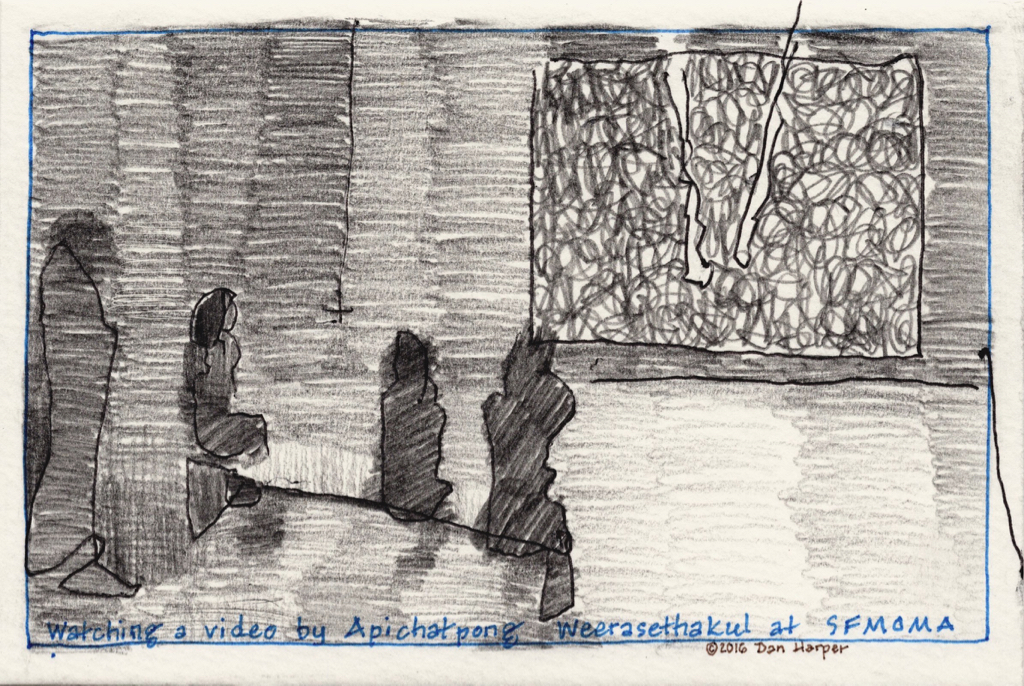
Watching a video by Apichatpong Weerasethakul, at SFMOMA.
A postmodern heretic's spiritual journey.

Watching a video by Apichatpong Weerasethakul, at SFMOMA.
Deneva has been researching Thanksgiving curriculum materials for our congregation, and she sent me a link to an online video titled “We Still Live Here: Black Indians of Wampanoag and African Heritage”:

This video poses a nice challenge to neat and tidy racial categories: if you look black, and grew up in a Wampanoag family, and speak Wampanoag, and identify more with your Wampanoag heritage than your African heritage, what are you? Obviously, from the point of view of the U.S. criminal justice system, you’d be non-white. But in terms of your racial and ethnic identity, surely you are a Wampanoag Indian. Such a conclusion challenges typical racial categories in the U.S., where there is a popular myth that both White and Indian are recessive genetic traits, swamped by even the slightest amount of non-white DNA — which implies that even the slightest bit of African heritage means you’re of African descent. And many of us in the U.S. cling to that old myth, even if we’ve taken a high school biology class and have basic knowledge of genetics. This reveals the power of myth over rationality.
But the best part about the video for me was listening to the regional accent. I miss speaking Eastern New England dialect.
For our “Neighboring Faith Communities” class for middle schoolers, I continue to think about ways to communicate the incredible religious diversity in our area. My latest effort: a map that shows faith communities in South Palo Alto, an area roughly bounded by U.S. 101 on the northeast, Oregon Expressway on the northwest, El Camino Real on the southwest, and San Antonio Rd. on the southeast. (I did go a little past these arbitrary boundaries to include some additional faith communities.)
The map below shows the approximate boundaries of the area I researched, a rectangle about 2 miles by 2-1/2 miles. Our faith community, the Unitarian Universalist Church of Palo Alto (UUCPA), is circled in red. All the faith communities shown are within about a half hour’s walk of our congregation. You can click on this map to go to an interactive map on Mapquest (I’ve also embedded the Mapquest map at the very end of this post).
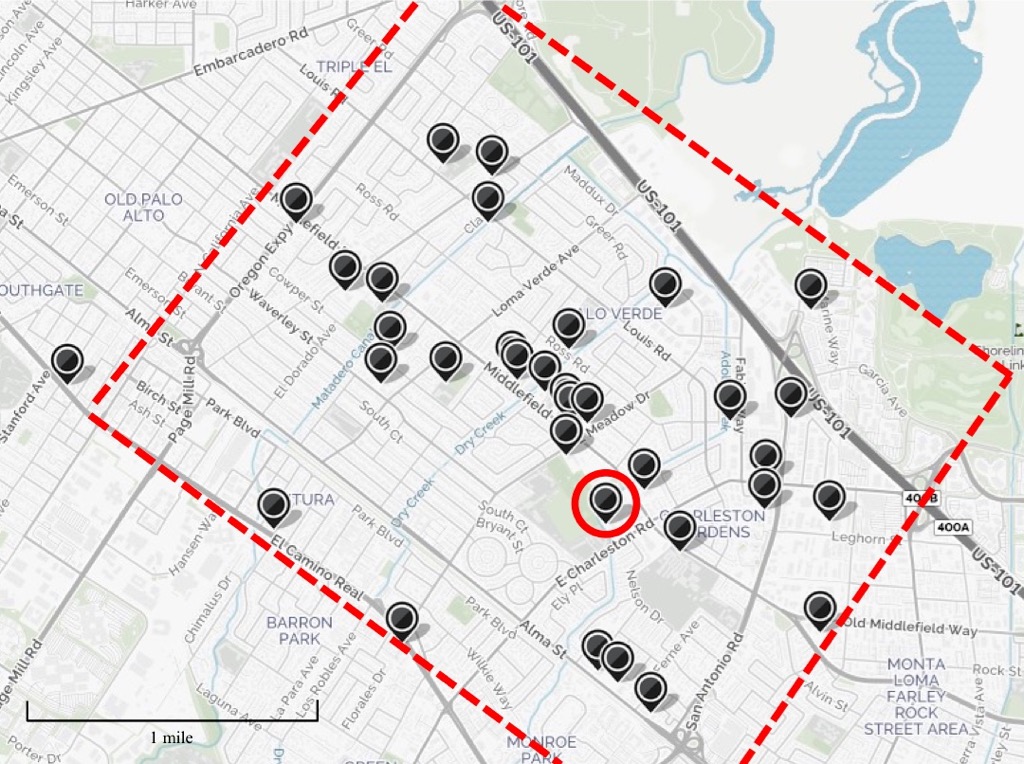
Below is the list of the 35 faith communities I found in this area. I suspect I missed some; if you can identify other faith communities in this area, please let me know about it in a comment. (Updated 10/20/16 based on Erp’s comment.) Continue reading “South Palo Alto faith communities”
This afternoon, after the Sunday services, we had a panel discussion about non-traditional traditions for Unitarian Universalist families celebrating the holidays. As I listened to the other panelists tell about their family holiday traditions, it became clear that your ethnic background has a big influence on how you celebrate holidays. With that in mind, here is my contribution to the panel discussion:
I grew up a New England Yankee, and a Unitarian Universalist. My Uncle Dick claimed that my mother’s family were Unitarians since Unitarianism began in North America, though Uncle Dick was notoriously unreliable on such things. My father’s side was Pennsylvania Dutch, and they were definitely Christian, members of the Evangelical United Brethren (EUB), a German language Methodist group. When my father announced that he was going to marry a Unitarian, that sent his mother into a dither. She was the daughter of a EUB minister, and her husband, my father’s father, served as an EUB minister for two years before he became a newspaperman. So my grandmother was in a dither, and she went to her minister with the news that her eldest son was going to marry a Unitarian. “Don’t worry, Mrs. Harper,” he said, “the Unitarians are weak on doctrine, but they are good people.” This reveals the most important thing about Unitarian Universalists and traditions: we are good people who don’t pay much attention to doctrine.
When I was a child, my family’s traditions were mostly dictated by my New England mother. Dad didn’t stand much of a chance, since we lived quite close to my mother’s twin sister, and my mother’s mother, and they were the ones who came over for holidays; whereas Dad’s family lived way down in New York City and southeastern Pennsylvania, and didn’t drive up for holidays. So many of our family traditions derived from New England Yankee culture.
Thanksgiving provides a good example of how we did family traditions. As New England Yankees, we knew we were descended from the Puritans, which we confused with the Pilgrims, so we felt a direct connection with the Thanksgiving story. As it turns out, there wasn’t much of a connection; our ancestors were indeed religious dissidents, they just didn’t happen to be Pilgrims. The important point is that we thought we were connected to the Pilgrims. Because of this supposed Pilgrim influence, I think we took it for granted that we could do what we wanted with Thanksgiving; nothing was sacred, except what we decided was sacred.
Or maybe that was the Unitarian Universalist influence. We didn’t always say grace before Thanksgiving dinner, and I don’t remember God being mentioned very often. When I was quite young, my Unitarian mother made sure I knew that public prayer was not very nice, and that Jesus himself had told his followers that if they went out and prayed on the street corners, they were hypocrites. By the same token, Mom also taught me that Unitarians don’t have to bow their heads when they pray; in fact, bowing one’s head might be making too much of a public demonstration of one’s supposed piety. We might hold hands while saying grace, but we didn’t have to bow our heads, and the few graces I remember were short and to the point.
Then my eldest cousin started attending youth group meetings at her Unitarian Universalist church, and she brought back a grace from her youth group. She had us hold hands, then she said, “Rub-a-dub-dub, thanks for the grub, yay, God!” So God was mentioned at least once at our Unitarian Universalist Thanksgiving dinner. And humor was allowed and even encouraged. Another time, one of the cousins suggested we go around the table and each say something we were thankful for. This non-traditional grace stuck for a few years, then disappeared. Our family traditions continually changed and evolved.
As we and our cousins got older, several of us experimented with vegetarianism. My mother and her twin sister did the cooking, and I’m sure they rolled their eyes at the fervor with which some of us expressed our vegetarian convictions. I can’t remember any special vegetarian dishes; what got cooked was what got cooked, and you ate it or you didn’t. Besides, we vegetarians knew that if we asked for a vegetarian dish, we might well be told to cook it ourselves; this was more Unitarian influence, straight from Ralph Waldo Emerson’s essay on “Self Reliance.” Another result of the Unitarian influence was that we were committed to social justice, and since we had all read France Moore Lappe’s book Diet for a Small Planet, there was more than one lecture from the vegetarians on the ethics of eating meat: it takes 16 pounds of grain to make one pound of beef! This was another result of our combined New England Yankee and Unitarian heritages: there was always plenty of guilt to go around.
Christmas for our Unitarian Universalist family was interesting, if somewhat confusing to a young child. When I was young, our Christmases had little mention of God; Jesus was referred to as Jesus, which made some of the familiar Christmas carols sound odd; and I was a little unclear on the Christmas story. We always went to our Unitarian Universalist church for the Christmas eve candlelight service, a service with great music, lots of carol singing, an opportunity to light candles, and a brief sermon which always seemed to focus on social justice rather than a re-telling of the Christmas story.
Back at home, we followed the long-standing New England tradition of lighting a bayberry candle on Christmas Eve, just before you go to bed. Mom said, “A bayberry candle, Burned to the socket, Brings health to the house, And money to the pocket.” One year I asked what this had to do with Christmas. My mother gave a confusing answer to the effect that the candle helped light the way for Jesus and his family on their way to the inn. I’m not sure if she made that story up on the spot, or if that was something her Unitarian mother had once told her. Yet another principle of Unitarian Universalist holidays is that you get to make things up on the spot.
Christmas got more interesting as we children got older. One year I studied the Frankfurt School of Marxism at college, and realized that much of Christmas is a product of consumer capitalism. This Marxist analysis annoyed my family less than you might expect; as Unitarian Universalists, we were used to questioning everything; my sisters and cousins all challenged some aspect of just about every holiday or tradition we had. I guess we were lucky that we were all Unitarian Universalists; I think it must be very annoying for non-Unitarian Universalists when they have to put up with our incessant critiques and challenges. Although for me, such challenges are half the fun of holidays and traditions.
One last thing I should mention: The combination of Unitarian Universalist values and New England Yankee culture has made me very doubtful about all holidays. Those old Puritans thought the only holiday should be Sunday, the weekly day of rest. To celebrate anything else was to be idolatrous; idolatry consists of placing an undue importance on something which is not all that important. As I get older, I am surprised at how strong that feeling is in me. My partner and I do not exchange gifts on Christmas, and the main way we celebrate is we go out for Chinese food. Thanksgiving is a good excuse to have a meal with family. The important part of holidays for me is to maintain connections with family and friends, and to keep alive cultural traditions; engaging in a supernatural or metaphysical interpretation of holidays is placing an undue importance on something that is not important.
To sum up, then, here’s what I know about Unitarian Universalist holiday traditions:
1. we are weak on doctrine, and as a corollary we can make things up on the spot;
2. we are influenced by regional cultures;
3. we challenge everything and are critical of everything;
4. a sense of humor is required.
This story of a Jain elder might wind up as one of a series of stories for liberal religious kids. Source and notes at the end.
Prabhava was one of the great teachers of the Jain religion. He wandered all over the earth teaching people to live a simple life, and to not be distracted by the pleasures of the senses, and to harm no living beings. Prbhava taught that if you could live like that, you could get rid of all your karma and achieve omniscience, so that you could see and know everything.
After Prabhava had been teaching for some time, he began to wonder who could take his place once he died. He thought about all his students and followers, but none of them (so he thought) would be able to take over for him. Then he used his upayoga power, that is, his mental sight, a power which allowed him to see everything in the whole world. He looked and looked until at last he saw someone who could take his place, a man named Sayyambhava.
This Sayyambhava was a priest of the Vedic religion, and when Prabhava saw him, Sayyambhava was in the city of Rajagriha, about to kill a goat as a sacrifice. Even though Sayyambhava was a priest in a religion that killed other living beings, because of his power of omniscience, Prabhava knew that he would make a good successor. “The beautiful lotus flower grows in the mud,” Prabhava said to himself, “so if you want a lotus flower you have to look in the mud.”
Prabhava went to Rajagriha to meet Sayyambhava. He sent two Jain monks ahead of him, and told them to go to the place where Sayyambhava was about to sacrifice the goat. “When you get there,” Prabhava told the two monks, “beg for food.” (Jain monks made their living by begging food from others.) “If the Vedic priests give you nothing, turn and walk away, and as you walk away, say in a loud voice, ‘Ah, it is too bad you do not know the Truth.'”
The monks got to the place where the sacrifice was about to take place, asked for alms, and when the Vedic priests refused to give them anything, they turned and walked away, saying in loud voices, “Ah, it is too bad you do not know the Truth.”
When Sayyambhava heard this strange remark, his mind became unsettled. Did these two monks know something that he didn’t know? Was his religion not the Truth? Instead of sacrificing the goat, he turned to his spiritual master, his guru, and asked, “Are the Vedas true — or not? Is our religion the path to the Truth — or not?”
His guru shrugged his shoulders.
Growing angry, Sayyambhava continued in a loud voice, “Those were holy monks, who obviously tell no lies. You’re not a true teacher, you’ve been lying to me all this time!” He took the dagger which he had been going to use to kill the goat. “Tell me the truth! If you don’t, I’ll cut off your head.”
Seeing that his life was in danger, the guru said, “I have not been telling you the truth. It is pointless to memorize the Vedas.” (The Vedas were the holy scriptures of the Vedic religion.) “Not only that,” the guru said, “but a statue of one of the Jain deities — a Jina, one of the highest Jain deities — is buried at the foot of the post where we tie to goats we are about to sacrifice.”
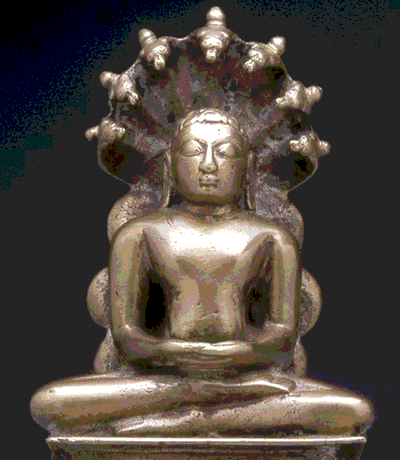 The guru pulled the sacrificial post out of the ground, and Sayyambhava looked down into the hole, where he saw a statue of a Jain deity. The guru went on, “There, that is a statue of the true religion. The only reason we do sacrifices is because we get to keep the meat afterwards. It’s an easy way to make a living. But what good is a religion that kills innocent animals? It is no good at all.
“Yes, I have been lying to you all these years,” said the guru to Sayyambhava. “Lying just so I could fill my stomach with easy food. But you are too good for that. Leave me, so that you can follow the true religion. If you do, I know that you will become all-seeing, and all-knowing.”
But Sayyambhava said, “You are still my teacher because in the end you told me the real truth.” Then Sayyambhava bid his guru a fond farewell, and went in search of the two Jain monks….
To be continued….
This story is from Canto 5:1-37 of The Lives of the Jain Elders, by Hemachandra (1098-1172). I used the following sources:
Sthaviravali Charita, or Parisishtaparvan, Being an Appendix of the Trishashtisalaka Purisha Charita by Hemachandra. Ed. by Herman Jacobi (Calcutta: Baptist Mission Press, 1891), pp. 39-41.
Hemacandra, The Lives of the Jain Elders, trans. R. C. C. Fynes (Oxford University Press, 1998), pp. 117-119.
The image of the Jina is a modified Wikimedia Commons public domain image.
My Unitarian parents had my older sister and me say prayers before bed when we were children, more as a cultural practice than a spiritual practice; in the middle of the twentieth century in the United States, it was a cultural norm to have your children say their prayers before bed. But I have only the vaguest memory of this, so I suspect we only did it a handful of times, probably when we were quite young. I don’t remember my younger sister ever saying bedtime prayers, though maybe they made her do it once or twice, too.
I like the idea of some kind of reflective practice at the end of the day, though I have no interest in reciting “Now I lay me down to sleep.” Pythagoras (c. 570 – c. 495 BC), in one of his “Golden Verses,” outlined a different daily practice, which I think would make a good alternative:
“Never suffer sleep to close your eyes after going to bed, till you have examined, by your reason, all your actions of the day. ‘Wherein have I done amiss? what have I done? what have I omitted that I ought to have done?’ If in this examination you find that you have done amiss, reprimand yourself severely for it; and if you have done any good, rejoice.” (1)
Or, as “John Shadow,” an eighteenth century English writer, described the practice: “It was a good piece of advice which Pythagoras gave to his scholars, that every night before they slept they should examine what they had been doing that day, and so discover what actions were worthy of pursuit tomorrow, and what little vices were to be prevented from slipping unawares into a habit.” John Shadow then goes on to suggest that when we get up in the morning, we should examine our dreams to learn even more about ourselves, because in our dreams we imagine circumstances which give us imaginary opportunities of pursuing our good or bad inclinations “to the utmost,” thus revealing to us our true temperament. (2)
I make every effort to forget my dreams, considering them leftovers and trash that should be emptied out, not picked through. And as for Pythagoras’s advice, I’m not sure I want to spend the moments before falling asleep reviewing all the stupid things I’ve done that day, and then reprimanding myself; that seems like a sure recipe for insomnia. Either that, or I’d fall asleep while still going over the long list of things I’d done wrong that day, which seems likely to lead to nightmares.
There is also the Confucian spiritual practice of “quiet sitting,” developed by the Neo-Confucian school about a thousand years ago. The Confucians would practice quiet-sitting in the middle of the day: Sitting quietly in a chair with the back straight and hands on your knees, they would examine the “mind-heart” (unlike us Westerners, the Confucians considered mind and heart to be one). Examining the mind-heart is not easy; there is ancient Chinese metaphor that equates the mind-heart with a lively monkey which prefers to run around and finds it difficult to sit still. The Confucians taught that when you do quiet-sitting, the goal is to get the lively monkey of the mind-heart to sit quietly so you are able to reflect on your “ren,” your humaneness; that is, you reflect on how human you are. (Quiet-sitting technique may sound like Buddhist meditation, though the Neo-Confucians would say it was different: Buddhists sat quietly to achieve an independent mental state, Neo-Confucians sat quietly to better understand themselves, so that they could act ethically and fit into the social order.) (3)
The Neo-Confucians who developed quite-sitting had servants, so they could devote a couple of hours in the middle of each day to this practice; they didn’t have to go off to work. The middle of the day might be the best time to engage in this practice: less chance of falling asleep (especially if you do it before lunch), and no chance of developing insomnia or nightmares. This may be an advantage of bedtime prayers: when you pray, you can repeat verbal formulae — “Now I lay me down to sleep”; “Our God who is in heaven”; etc. — and this repetition requires less concentration and less self-discipline, and is more conducive to comforting sleep.
I am not going to return to “Now I lay me,” nor am I fully convinced by either the Pythagoreans or the Neo-Confucians. But some kind of self-reflection each day, something to move me towards greater humaneness, would be very valuable indeed.
To be continued….
Notes:
(1) The translation is from The Commentary of Hierocles upon the Golden Verses of Pythagoras, rev. ed. (Glasgow: Robert Urie, 1756), p. 140; which was based on the trans. into French by Andre Dacier, as trans. from French into English (London: Jacob Tonson, 1707), see p. 304.
(2) From the August 27, 1714, issue of The Spectator; attributed to John Byrom. The Spectator vol. V, ed. Donald F. Bond (Clarendon Press: Oxford, 1965), p. 4.
<3) The description of quiet-sitting is adapted from John H. and Evelyn Nagai Berthrong, Confucianism: A Short Introduction (Oxford: Oneworld, 2000), p. 34.
Here’s a wonderful sacred song from the 1873 edition of the Fisk Jubilee Singers’ songbook:
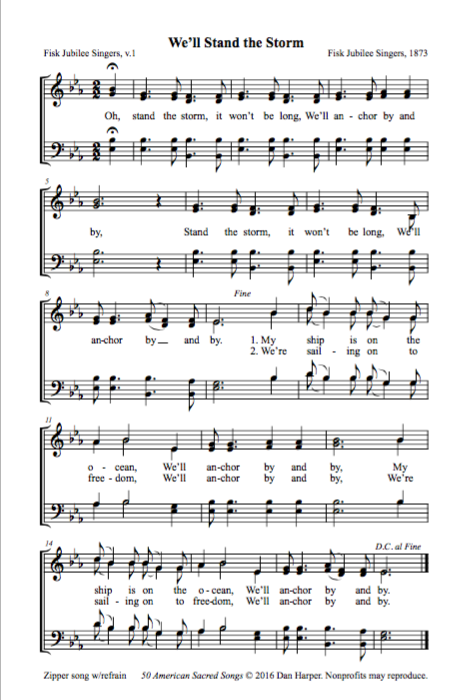
This song comes from the 1872 edition of Jubilee Songs: as sung by the Jubilee Singers, of Fisk University (New York: Bigelow & Main, 1872). It’s characteristic of the best arrangements of the Fisk Jubilee Singers, with unison singing on the verses, followed by simple but effective four-part harmonies on the refrains. It’s possible to teach this kind of simple arrangement to an entire congregation, with not too much effort (though you have to be intentional about it).
The first verse is from the Fisk Jubilee Singers. The second verse is mine, and it is modeled after verses for older sacred songs that were created by the mid-20th C. Civil Rights Movement.
Click here for permissions and more about the 50 American Sacred Songs project.
From Geez magazine, a Canadian periodical aimed at leftist and progressive Christian young adults:
“Postchristian, in my view, describes someone who is inspired by the life of Jesus — a prophetic challenge to the rich and powerful, sacrificial love of neighbour and enemy, communal ethic that demotes private property, and compassion upon all people (oh wait, that’s the Buddha, but I think they all blend together at some mystical point before language has a chance to separate us) — but sees the Christendom thing — institutional, bureaucratic, patriarchal, capitalistic, and with professional clergy approved by degree-granting institutions with huge foundations from the most problematic corporations in our midst — as straying from the path.”
I can quibble with some aspects of this definition. Most importantly, for me Christendom has little to do with the minor bureaucracies of individual denominations, and a whole lot to do with how religion has been co-opted and used by corporations and nations to oppress and dominate others. And I feel my definition of Christendom is important because corporations are now increasingly turning to the co-optation of Buddhism to control their workers through mindfulness training meant to anesthetize and pacify and turn human beings into meat robots; a process which provides an additional benefit in marketing, because right now Buddhism is seen as hip and cool and helps to market products and strengthen consumer capitalism.
But aside from a few minor quibbles,— yeah. Challenging the rich and powerful. Sacrificial love and communal ethic (which are actually more challenges to the rich and powerful). I can work with that.
Another in a series of stories for liberal religious kids. Source and notes at the end.
This is a story about Rabbi Israel Salanter, who lived in Lithuania in the 1800s:
It was Yom Kippur, the holiest day of the year for Jews. All the people had gathered in the synagogue to wait for Rabbi Israel to lead them in reciting the Kol Nidre, the prayer that begins Yom Kippur. But Rabbi Israel didn’t come. After waiting a long time, the people in the synagogue recited the Kol Nidre without the rabbi, hoping he would appear. Still he didn’t come. The people continued to wait for Rabbi israel, though by now he was so late they began to worry that he would not arrive until after the service was over.
Finally the rabbi came into the synagogue. The people looked at him in amazement: they saw down stuck in his hair and his beard, and his clothing was wrinkled and messy. But Rabbi Israel walked in as if nothing were wrong, as if he were not horribly late. He put on a prayer shawl, and began to recite his prayers. When he had finished praying, he at last explained to the congregation why he was so late:
He had been walking to the synagogue [he said], with plenty of time to spare, when he heard crying inside a house he was walking past. He went into the house, and there was a baby lying in its cradle, with a six year old girl fast asleep nearby. A bottle of milk stood above the cradle, just beyond where the baby could reach it. The rabbi could see what had happened: the mother had gone off to the Yom Kippur service, telling her six year old daughter (who was too young to go to the service) to give the baby its bottle if it started crying. But the girl had fallen asleep, and she did not hear the baby crying. So Rabbi Israel fed the baby. When the baby finished the milk, the rabbi tucked it in the cradle and watched it fall asleep.
It was just then [said the rabbi] that the little girl awakened. She was afraid to be home alone, and begged him to stay with her. The rabbi looked around, and saw that the candles the mother had left were burning low; here was a good reason not to leave the child alone. So he stayed until the children’s mother got back from the synagogue. He concluded his story by saying he was very glad that he had a chance to do such a good deed on the most holy day of the year.
The people in his congregation stared at him. One of them asked: You mean you didn’t say the Kol Nidre, you were absent for the Yom Kippur services, you missed the most important moment of the whole year, all this just because a baby was crying? You, the greatest intellect, the smartest person of our time, you missed being here because of a baby? Rabbi, what were you thinking?
The rabbi scolded them all, saying: Don’t you know that there are reasons why we Jews are allowed to skip prayers, reasons why we are even allowed to break the laws of the Sabbath? If there is the slightest chance of saving a life, we are allowed to — no, we must skip prayers and break the Sabbath. Then too, don’t you know that our families, our children, are central to Jewish life?
This silenced the people. They realized that it didn’t matter that Rabbi Israel had humbled himself by taking care of a mere baby. As he said, there could nothing more important.
Source: This story is from Lucy S. Dawidowicz, ed., The Golden Tradition (Syracuse University Press, 1996), pp. 173-174; the story is quoted and interpreted in Leora Batnitzky, How Judaism Became a Religion: An Introduction to Modern Jewish Thought (Princeton University Press, 2001), pp. 124-125; I am indebted to Batnitzky’s interpretation of the story.