Methinks Uber doth protest too much

A London Employment Tribunal has ruled that Uber is in the transportation business, not the software business; and that Uber is an employer, not a service that connects independent contractors to customers.

If you like reading legal documents, this decision is worth reading: the Tribunal is both witty and brutally critical of Uber. Here’s one quote from the decision, Case nos. 2202550/2015, paragraph 87 (the entire decision is online here:

“In the first place, we have been struck by the remarkable lengths to which Uber has gone in order to compel agreement with its (perhaps we should say its lawyers’) description of itself and with its analysis of the legal relationships between the two companies [i.e., between Uber B.V., and its subsidiary Uber London Ltd.], the drivers and the passengers. Any organisation (a) running an enterprise at the heart of which is the function of carrying people in motor cars from where they are to where they want to be and (b) operating in part through a company discharging the regulated responsibilities of a PHV [Private Hire Vehicle] operator, but (c) requiring drivers and passengers to agree, as a matter of contract, that it does not provide transportation services (through UBV or ULL), and (d) resorting in its documentation to fictions,36 twisted language37 and even brand new terminology,38 merits, we think, a degree of scepticism. Reflecting on the Respondents’ general case, and on the grimly loyal evidence of Ms Bertram [lawyer for Uber] in particular, we cannot help being reminded of Queen Gertrude’s most celebrated line: ‘The lady doth protest too much, methinks.’ 39

“36 Eg the passenger’s ‘invoice’ which is not an invoice and is not sent to the passenger
“37 Eg calling the driver (“an independent company in the business of providing Transportation Services”) ‘Customer’ (in the New Terms [of service]). This choice of terminology has the embarrassing consequence of forcing Uber to argue that, if it is a party to any contract for the provision by the driver of driving services, it is one under which it is a lient or customer of “Customer’.
“38 Eg ‘onboarding’ for recruitment and/or induction and ‘deactivation’ for dismissal
“39 Hamlet, Act III, sc 2″

The Tribunal doesn’t come right out and say that Uber is lying. But the Tribunal does state, for example (para. 89), that “Uber is in business as a supplier of transportation services,” not as a technology company. The Tribunal quotes with approval the following paragraph from a North California District Court judgment: “Uber does not simply sell software; it sells rides. Uber is no more a ‘technology company’ than Yellow Cab is a ‘technology company’ because it uses CB radios to dispatch taxi cabs.”

And the Tribunal later states (para. 93) that Uber “is precluded from relying upon its carefully crafted documentation because, we find, it bears no relation to reality.”

And further, the Tribunal calls Uber’s legal arguments (para. 96) illustrative the phenomenon of “‘armies of lawyers’ contriving documents in their clients’ interests which simply misrepresents the true rights and obligations on both sides.” So while the Tribunal does not say that Uber is lying, the Tribunal makes it very clear that Uber is not telling the truth.

As you’d expect, Frances O’Grady, General Secretary of the British Trades Union Congress, speaks more harshly of Uber. Calling Uber and its ilk purveyors of “sham self-employment,” O’Grady said, “For many workers the gig economy is a rigged economy, where bosses can get out of paying the minimum wage and providing basics like paid holidays and rest breaks.”

This is pretty much what the Tribunal said in its decision, except more politely.

All this reveals a dark side of Silicon Valley: a significant part of the Valley’s vaunted “innovation” actually relies on armies of unscrupulous lawyers contriving documents to avoid legal requirements designed to protect workers and consumers. So thank goodness for the scrupulous lawyers who help expose the facts when Silicon Valley does not tell the truth.

BBC News offers more on this story here.

Persimmon

Ryokan, high in the tree,
plucked the bright persimmons
tasting them to test their ripeness.
But then he ate them all himself,
forgetting the small boy
who waited on the ground.

I bought my persimmons
in the bright supermarket;
one was soft, but was it quite ripe?
I plunged a spoon into it, and
it was almost perfect,
so I shared it with you.


(The story of Ryokan and the persimmons appears in the introduction to John Stevens, One Robe One Bowl: The Zen Poetry of Ryokan [Shambala: 2006/1977], but without any attribution.)

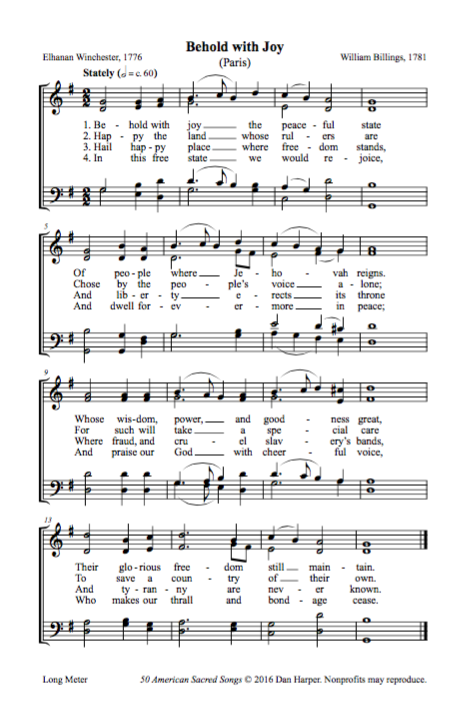
“Babylon Is Fallen”

“Babylon Is Fallen” is not your stereotypical Shaker hymn. The text, by Richard McNemar and first published in 1813 in the Shaker hymnal Millennial Praises, is all about the fall of Empire; the words to the refrain, “Babylon is fallen, is fallen!” come from that great anti-Imperial text, the book of Revelation (18:2): “Fallen, fallen is Babylon the great!”

I remember singing this song with a group of shape-note singers at the time of Occupy Oakland’s shutdown of the Port of Oakland, and it seemed eerily appropriate: “All her merchants cry with wonder / ‘What is this that’s come to pass?’ / Murmuring like the distant thunder, / Crying out, “Alas! Alas!” Obviously, the text predates consumer capitalism; yet insofar as consumer capitalism takes on the role of Empire, this text is worth singing in the early twenty-first century.

In any case, here’s the song:

Babylon Is Fallen thumbnail 1

Babylon Is Fallen thumbnail 2

Babylon Is Fallen PDF

This setting of the text comes from The Sacred Harp, a shape note tunebook that has maintained a living tradition in the South since the 1850s. Traditional Southern singers don’t hold back on this song, as you can hear in this Youtube video. So this is not a polite church hymn to be sung in a breathy voice. It was likely written as a camp-meeting song (come to think of it, it would have sounded good at the Port of Oakland shutdown), and it should be sung full-throated and with vigor.

Click here for permissions and more about the 50 American Sacred Songs project.

Tracking pit

In the middle school Ecojustice class this morning, one of the things we did was to make a tracking pit. Lorraine brought some mud that got dug up from her yard (if you want to be technical, it’s a clay-like soil composed of Quaternary alluvial deposits). Some of us worked on moistening the mud till it got to the right consistency, then spreading it out on a flat spot under some bushes:

Spreading the mud

We put a bait cup in the middle of the mud, then crumbled a granola bar into the bait cup. By this evening, the bait was gone, and there were plenty of squirrel tracks in the mud:

Squirrel tracks

The tracks were not as distinct as I would have liked. The mud was a little too wet, and the suqirrels slipped and slid just enough to blur the finer details of their tracks. Nevertheless, these are some pretty good tracks!

“We Still Live Here”

Deneva has been researching Thanksgiving curriculum materials for our congregation, and she sent me a link to an online video titled “We Still Live Here: Black Indians of Wampanoag and African Heritage”:

Still from "We Still Live Here" video

This video poses a nice challenge to neat and tidy racial categories: if you look black, and grew up in a Wampanoag family, and speak Wampanoag, and identify more with your Wampanoag heritage than your African heritage, what are you? Obviously, from the point of view of the U.S. criminal justice system, you’d be non-white. But in terms of your racial and ethnic identity, surely you are a Wampanoag Indian. Such a conclusion challenges typical racial categories in the U.S., where there is a popular myth that both White and Indian are recessive genetic traits, swamped by even the slightest amount of non-white DNA — which implies that even the slightest bit of African heritage means you’re of African descent. And many of us in the U.S. cling to that old myth, even if we’ve taken a high school biology class and have basic knowledge of genetics. This reveals the power of myth over rationality.

But the best part about the video for me was listening to the regional accent. I miss speaking Eastern New England dialect.

South Palo Alto faith communities

For our “Neighboring Faith Communities” class for middle schoolers, I continue to think about ways to communicate the incredible religious diversity in our area. My latest effort: a map that shows faith communities in South Palo Alto, an area roughly bounded by U.S. 101 on the northeast, Oregon Expressway on the northwest, El Camino Real on the southwest, and San Antonio Rd. on the southeast. (I did go a little past these arbitrary boundaries to include some additional faith communities.)

The map below shows the approximate boundaries of the area I researched, a rectangle about 2 miles by 2-1/2 miles. Our faith community, the Unitarian Universalist Church of Palo Alto (UUCPA), is circled in red. All the faith communities shown are within about a half hour’s walk of our congregation. You can click on this map to go to an interactive map on Mapquest (I’ve also embedded the Mapquest map at the very end of this post).

Neighboring Faith Communities near UUCPA

Below is the list of the 35 faith communities I found in this area. I suspect I missed some; if you can identify other faith communities in this area, please let me know about it in a comment. (Updated 10/20/16 based on Erp’s comment.) Continue reading “South Palo Alto faith communities”

Non-traditional holiday traditions

This afternoon, after the Sunday services, we had a panel discussion about non-traditional traditions for Unitarian Universalist families celebrating the holidays. As I listened to the other panelists tell about their family holiday traditions, it became clear that your ethnic background has a big influence on how you celebrate holidays. With that in mind, here is my contribution to the panel discussion:

I grew up a New England Yankee, and a Unitarian Universalist. My Uncle Dick claimed that my mother’s family were Unitarians since Unitarianism began in North America, though Uncle Dick was notoriously unreliable on such things. My father’s side was Pennsylvania Dutch, and they were definitely Christian, members of the Evangelical United Brethren (EUB), a German language Methodist group. When my father announced that he was going to marry a Unitarian, that sent his mother into a dither. She was the daughter of a EUB minister, and her husband, my father’s father, served as an EUB minister for two years before he became a newspaperman. So my grandmother was in a dither, and she went to her minister with the news that her eldest son was going to marry a Unitarian. “Don’t worry, Mrs. Harper,” he said, “the Unitarians are weak on doctrine, but they are good people.” This reveals the most important thing about Unitarian Universalists and traditions: we are good people who don’t pay much attention to doctrine.

When I was a child, my family’s traditions were mostly dictated by my New England mother. Dad didn’t stand much of a chance, since we lived quite close to my mother’s twin sister, and my mother’s mother, and they were the ones who came over for holidays; whereas Dad’s family lived way down in New York City and southeastern Pennsylvania, and didn’t drive up for holidays. So many of our family traditions derived from New England Yankee culture.

Thanksgiving provides a good example of how we did family traditions. As New England Yankees, we knew we were descended from the Puritans, which we confused with the Pilgrims, so we felt a direct connection with the Thanksgiving story. As it turns out, there wasn’t much of a connection; our ancestors were indeed religious dissidents, they just didn’t happen to be Pilgrims. The important point is that we thought we were connected to the Pilgrims. Because of this supposed Pilgrim influence, I think we took it for granted that we could do what we wanted with Thanksgiving; nothing was sacred, except what we decided was sacred.

Or maybe that was the Unitarian Universalist influence. We didn’t always say grace before Thanksgiving dinner, and I don’t remember God being mentioned very often. When I was quite young, my Unitarian mother made sure I knew that public prayer was not very nice, and that Jesus himself had told his followers that if they went out and prayed on the street corners, they were hypocrites. By the same token, Mom also taught me that Unitarians don’t have to bow their heads when they pray; in fact, bowing one’s head might be making too much of a public demonstration of one’s supposed piety. We might hold hands while saying grace, but we didn’t have to bow our heads, and the few graces I remember were short and to the point.

Then my eldest cousin started attending youth group meetings at her Unitarian Universalist church, and she brought back a grace from her youth group. She had us hold hands, then she said, “Rub-a-dub-dub, thanks for the grub, yay, God!” So God was mentioned at least once at our Unitarian Universalist Thanksgiving dinner. And humor was allowed and even encouraged. Another time, one of the cousins suggested we go around the table and each say something we were thankful for. This non-traditional grace stuck for a few years, then disappeared. Our family traditions continually changed and evolved.

As we and our cousins got older, several of us experimented with vegetarianism. My mother and her twin sister did the cooking, and I’m sure they rolled their eyes at the fervor with which some of us expressed our vegetarian convictions. I can’t remember any special vegetarian dishes; what got cooked was what got cooked, and you ate it or you didn’t. Besides, we vegetarians knew that if we asked for a vegetarian dish, we might well be told to cook it ourselves; this was more Unitarian influence, straight from Ralph Waldo Emerson’s essay on “Self Reliance.” Another result of the Unitarian influence was that we were committed to social justice, and since we had all read France Moore Lappe’s book Diet for a Small Planet, there was more than one lecture from the vegetarians on the ethics of eating meat: it takes 16 pounds of grain to make one pound of beef! This was another result of our combined New England Yankee and Unitarian heritages: there was always plenty of guilt to go around.

Christmas for our Unitarian Universalist family was interesting, if somewhat confusing to a young child. When I was young, our Christmases had little mention of God; Jesus was referred to as Jesus, which made some of the familiar Christmas carols sound odd; and I was a little unclear on the Christmas story. We always went to our Unitarian Universalist church for the Christmas eve candlelight service, a service with great music, lots of carol singing, an opportunity to light candles, and a brief sermon which always seemed to focus on social justice rather than a re-telling of the Christmas story.

Back at home, we followed the long-standing New England tradition of lighting a bayberry candle on Christmas Eve, just before you go to bed. Mom said, “A bayberry candle, Burned to the socket, Brings health to the house, And money to the pocket.” One year I asked what this had to do with Christmas. My mother gave a confusing answer to the effect that the candle helped light the way for Jesus and his family on their way to the inn. I’m not sure if she made that story up on the spot, or if that was something her Unitarian mother had once told her. Yet another principle of Unitarian Universalist holidays is that you get to make things up on the spot.

Christmas got more interesting as we children got older. One year I studied the Frankfurt School of Marxism at college, and realized that much of Christmas is a product of consumer capitalism. This Marxist analysis annoyed my family less than you might expect; as Unitarian Universalists, we were used to questioning everything; my sisters and cousins all challenged some aspect of just about every holiday or tradition we had. I guess we were lucky that we were all Unitarian Universalists; I think it must be very annoying for non-Unitarian Universalists when they have to put up with our incessant critiques and challenges. Although for me, such challenges are half the fun of holidays and traditions.

One last thing I should mention: The combination of Unitarian Universalist values and New England Yankee culture has made me very doubtful about all holidays. Those old Puritans thought the only holiday should be Sunday, the weekly day of rest. To celebrate anything else was to be idolatrous; idolatry consists of placing an undue importance on something which is not all that important. As I get older, I am surprised at how strong that feeling is in me. My partner and I do not exchange gifts on Christmas, and the main way we celebrate is we go out for Chinese food. Thanksgiving is a good excuse to have a meal with family. The important part of holidays for me is to maintain connections with family and friends, and to keep alive cultural traditions; engaging in a supernatural or metaphysical interpretation of holidays is placing an undue importance on something that is not important.

To sum up, then, here’s what I know about Unitarian Universalist holiday traditions:
1. we are weak on doctrine, and as a corollary we can make things up on the spot;
2. we are influenced by regional cultures;
3. we challenge everything and are critical of everything;
4. a sense of humor is required.

Sayyambhava finds the truth

This story of a Jain elder might wind up as one of a series of stories for liberal religious kids. Source and notes at the end.

Prabhava was one of the great teachers of the Jain religion. He wandered all over the earth teaching people to live a simple life, and to not be distracted by the pleasures of the senses, and to harm no living beings. Prbhava taught that if you could live like that, you could get rid of all your karma and achieve omniscience, so that you could see and know everything.

After Prabhava had been teaching for some time, he began to wonder who could take his place once he died. He thought about all his students and followers, but none of them (so he thought) would be able to take over for him. Then he used his upayoga power, that is, his mental sight, a power which allowed him to see everything in the whole world. He looked and looked until at last he saw someone who could take his place, a man named Sayyambhava.

This Sayyambhava was a priest of the Vedic religion, and when Prabhava saw him, Sayyambhava was in the city of Rajagriha, about to kill a goat as a sacrifice. Even though Sayyambhava was a priest in a religion that killed other living beings, because of his power of omniscience, Prabhava knew that he would make a good successor. “The beautiful lotus flower grows in the mud,” Prabhava said to himself, “so if you want a lotus flower you have to look in the mud.”

Prabhava went to Rajagriha to meet Sayyambhava. He sent two Jain monks ahead of him, and told them to go to the place where Sayyambhava was about to sacrifice the goat. “When you get there,” Prabhava told the two monks, “beg for food.” (Jain monks made their living by begging food from others.) “If the Vedic priests give you nothing, turn and walk away, and as you walk away, say in a loud voice, ‘Ah, it is too bad you do not know the Truth.'”

The monks got to the place where the sacrifice was about to take place, asked for alms, and when the Vedic priests refused to give them anything, they turned and walked away, saying in loud voices, “Ah, it is too bad you do not know the Truth.”

When Sayyambhava heard this strange remark, his mind became unsettled. Did these two monks know something that he didn’t know? Was his religion not the Truth? Instead of sacrificing the goat, he turned to his spiritual master, his guru, and asked, “Are the Vedas true — or not? Is our religion the path to the Truth — or not?”

His guru shrugged his shoulders.

Growing angry, Sayyambhava continued in a loud voice, “Those were holy monks, who obviously tell no lies. You’re not a true teacher, you’ve been lying to me all this time!” He took the dagger which he had been going to use to kill the goat. “Tell me the truth! If you don’t, I’ll cut off your head.”

Seeing that his life was in danger, the guru said, “I have not been telling you the truth. It is pointless to memorize the Vedas.” (The Vedas were the holy scriptures of the Vedic religion.) “Not only that,” the guru said, “but a statue of one of the Jain deities — a Jina, one of the highest Jain deities — is buried at the foot of the post where we tie to goats we are about to sacrifice.”

Jina (modified Wikimedia Commons public domain image)The guru pulled the sacrificial post out of the ground, and Sayyambhava looked down into the hole, where he saw a statue of a Jain deity. The guru went on, “There, that is a statue of the true religion. The only reason we do sacrifices is because we get to keep the meat afterwards. It’s an easy way to make a living. But what good is a religion that kills innocent animals? It is no good at all.

“Yes, I have been lying to you all these years,” said the guru to Sayyambhava. “Lying just so I could fill my stomach with easy food. But you are too good for that. Leave me, so that you can follow the true religion. If you do, I know that you will become all-seeing, and all-knowing.”

But Sayyambhava said, “You are still my teacher because in the end you told me the real truth.” Then Sayyambhava bid his guru a fond farewell, and went in search of the two Jain monks….

To be continued….


This story is from Canto 5:1-37 of The Lives of the Jain Elders, by Hemachandra (1098-1172). I used the following sources:

Sthaviravali Charita, or Parisishtaparvan, Being an Appendix of the Trishashtisalaka Purisha Charita by Hemachandra. Ed. by Herman Jacobi (Calcutta: Baptist Mission Press, 1891), pp. 39-41.

Hemacandra, The Lives of the Jain Elders, trans. R. C. C. Fynes (Oxford University Press, 1998), pp. 117-119.

The image of the Jina is a modified Wikimedia Commons public domain image.