Ch’ang-O, the Moon Goddess

Our Coming of Age class took a field trip to the Asian Art Museum to see images of divinities. There we saw a beautiful jade sculpture of Ch’ang-O (Pinyin: Chang-e), the Moon Goddess. It’s just a few inches tall, but highly detailed: Ch’ang-O is smiling beatifically, and she is accompanied by her rabbits, one of whom is grinding something in a mortar and pestle:
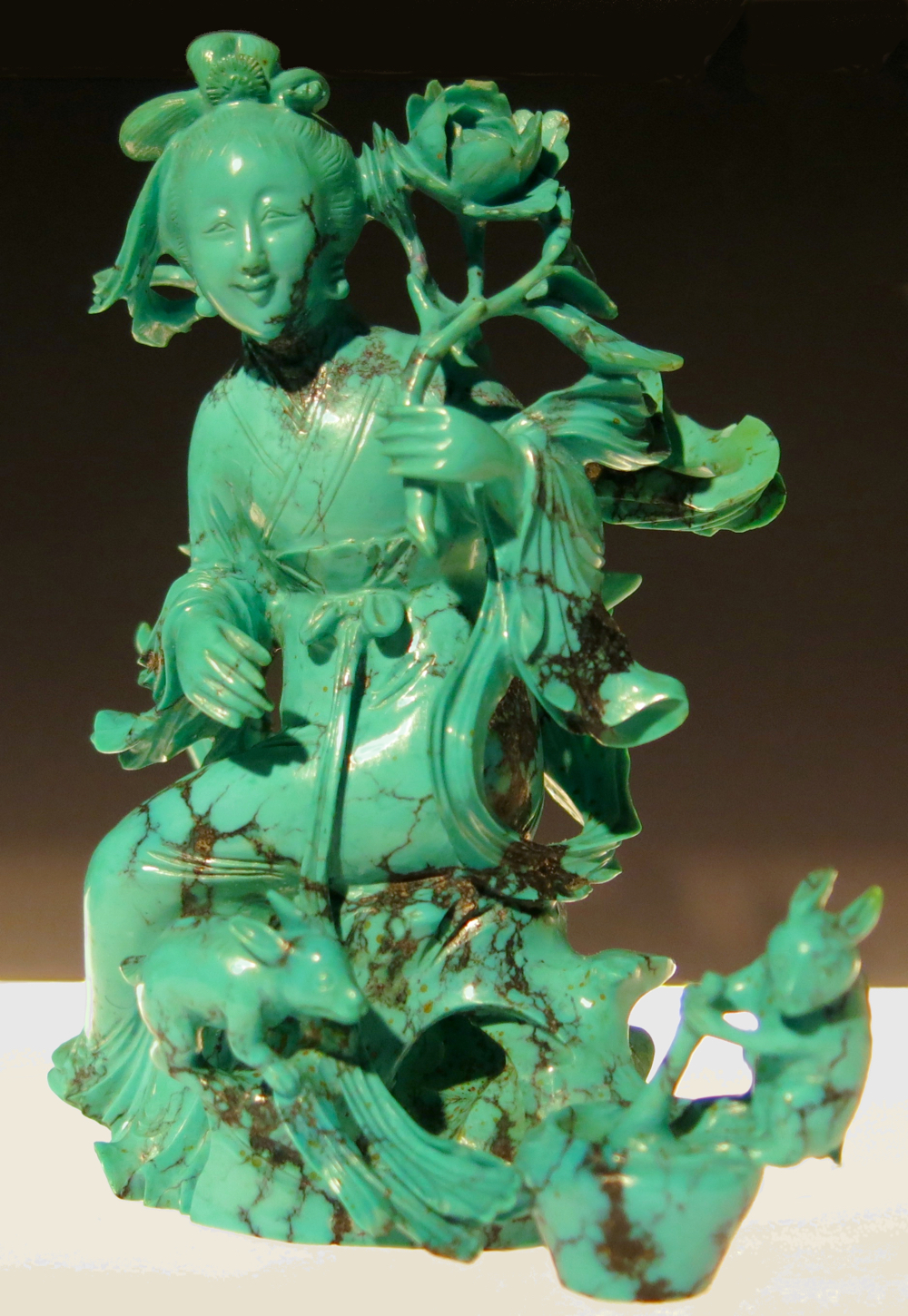
Ch’ang-O is still honored in Chinese popular culture, at the Mid-Autumn Festival which takes place on the fifteenth day of the eighth Lunar month. More than one version of Ch’ang-O’s story is told, but the general outlines of the various versions are similar:

Ch’ang-O is an immortal being; she and Houyi are sweethearts. One day, ten suns appear in the sky, the sons of the Jade Emperor of Heaven, and these ten sons cause much damage; Houyi takes up his bow and arrow and shoots down nine of the ten in order to save the earth. Ch’ang-O loses her immortality by offending the Jade Emperor in some way. Houyi obtains a concoction that will make one person immortal (in some versions the pill could be split between Houyi and Ch’ang-O, making them both very long-lived, but not immortal), and this concoction is formed into a pill. Ch’ang-O takes the entire pill herself, either mistakenly or on purpose, upon which she not only becomes immortal, but she begins floating upwards towards heaven. At last she lodges permanently on the moon.

The Rabbit in the Moon

The reason there must be rabbits in the Moon is simple. In the West, we look at the moon and see the Man in the Moon, but in East Asia it is common to look up and see the Rabbit in the Moon; the Rabbit has a mortar and pestle in which it grinds herbal medicine, rice cakes, or mochi (depending on who tells the story). The body of the rabbit corresponds to roughly lunar landscape features as follows: left ear — Mare Fecunditatis; right ear — Mare Nectaris and Mare Tranquilitatis; base of ears — Mare Serenitatis; head — Mare Imbrium; body — Oceanus Procellarum. The mortar which the Rabbit uses for grinding is centered on the Mare Cognitum. For Westerners, here’s a sketch of the Moon Rabbit:
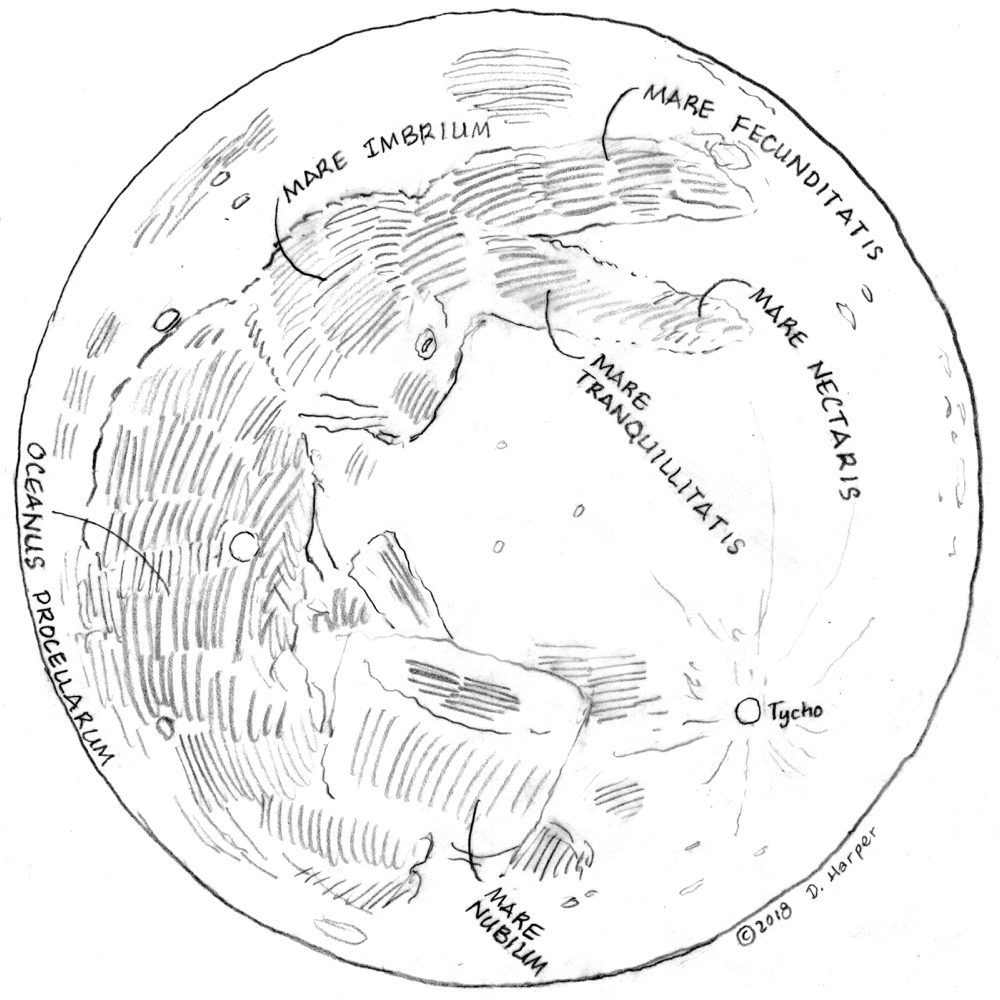
To help you find the Moon Rabbit next time you look at the moon, remember that the crater Tycho is just to the right of the Rabbit’s mortar.

How divine is Ch’ang-O?

Something we ask Coming of Age participants to consider when they look at images of deities is where they would place that deity on the following rough scale:

1. Ordinary human
2. Extraordinary human (prophet, sage)
3. Semi-divine (more than human, not quite a god or goddess)
4. Human who became divine
5. God or goddess with a non-human form
6. God or goddess that acts like a human
7. God or goddess that is far above humans
8. God or goddess so divine that humans cannot know it

In the stories about her, Ch’ang-O started out as — perhaps — semi-divine (more than human, not quite a goddess); then became completely human; then became immortal once more; and finally wound up as the Moon Goddess. Most Westerners, influenced by the strongly Western tradition of ancient Greek philosophy, tend to think of a deity as unchangeable, the “Unmoved Mover”; but far more human cultures have deities that can change in response to events. Thus Ch’and-O serves as a perfect counter-example for Westerners (both theists and atheists) who dogmatically assert that God is perfect and does not change.

Ch’ang-O in popular culture

The story of Ch’ang-O doesn’t leak out much beyond the boundaries of the Chinese American community (or other East Asian communities). But once in a while, the story of Ch’ang-O makes it into Western popular culture. The most notable example of this was just before the first humans set foot on the moon.

Here’s the Air-to-Ground Voice Transcription of the Apollo 11 Lunar mission, from July 20, 1969, not long before the Lunar Module landed on the moon:

03 23 16 18 CC [Capsule Communicator, i.e., Mission Control]:
…The “Black Bugle” just arrived with some morning news briefs if you’re ready.

03 23 16 28 CDR [Commander, i.e., Neil Armstrong]:
Go ahead.

[some material omitted]

03 23 17 28 CC:
Roger. Among the large headlines concerning Apollo this morning, there’s one asking that you watch for a lovely girl with a big rabbit. An ancient legend says a beautiful Chinese girl called Chang-o has been living there for 4000 years. It seems she was banished to the Moon because she stole the pill of immortality from her husband. You might also look for her companion, a large Chinese rabbit, who is easy to spot since he is always standing on his hind feet in the shade of a cinnamon tree. The name of the rabbit is not reported.

03 23 18 15 LMP [Lunar Module Pilot, i.e., Edwin E. Aldrin, Jr.; this was latter corrected to Michael Collins]:
Okay. We’ll keep a close eye out for the bunny girl.

(National Aeronautics and Space Administration, “Apollo 11 Technical Air-to-Ground Voice Transcription,” Tape 61/3 page 270 [Houston, Texas: Manned Spacecraft Center, July, 1969], pp. 178-179.)

— And don’t let the conspiracy theorists fool you: the Apollo astronauts saw no sign of Ch’ang-O, nor of any rabbits, nor of a cinnamon tree (actually a cassia tree in the myth).

Updated 3/7/18 with revised drawing and Apollo 11 transcript.
It’s that time of year

Five minutes ago, Carol was sitting in the living room staring at her laptop, and I was in the kitchen reading a murder mystery. Suddenly my ears caught the sound of something outside the window. I stopped to listen, and it came again.

“Hear the owl?” I said to Carol.

“No,” she said. “Where?”

I opened one of the kitchen windows a crack, and we stood there and listened.

“Hu-hu, hu, hu,” said the owl in a nearby tree.

Carol and I grinned at each other. This is one of those times when we really like living in a cemetery. “Great Horned Owl,” I said.

“Hu-hu, hu-hu.” It’s mating season.

Redding to San Mateo

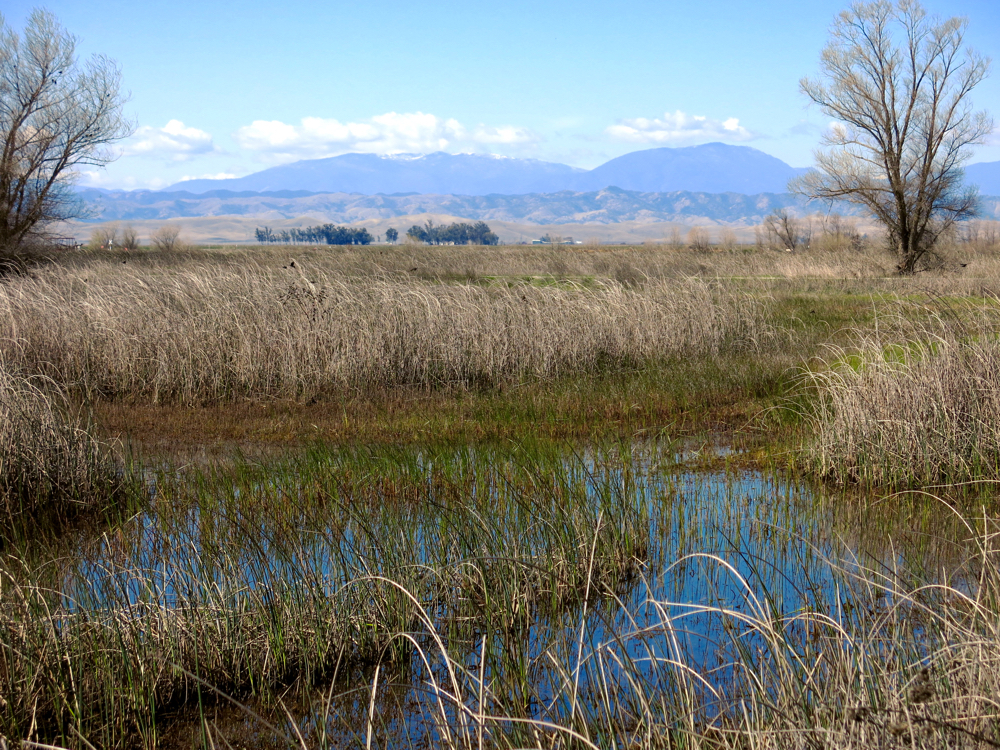
We left Redding, in the narrow upper end of the great Central Valley, and headed south towards home. In the late morning, we stopped just south of Willows at the Sacramento River National Wildlife Refuge to walk the two-mile marsh loop.

There is something about being near wetlands that I find soothing: perhaps the big vista of sky you get from being in an essentially flat landscape; perhaps the nearness of an astonishing number of nonhuman organisms. Carol felt like walking fast and charged on ahead. I walked as fast as she, but stopped now and then to look at or listen to something: a mixed flock of White-fronted Geese, American Coots, Northern Pintails and other ducks swimming cautiously away from me; Marsh Wrens calling in last year’s dead and grey tule reeds; swarms of Red-winged Blackbirds flying across the marsh and up into the trees and back down into the marsh.

I stopped to look west towards the Coast Range in the distance, and the nearer ridge of the Great Valley Sequence, which, according to Roadside Geology of Northern and Central California, 2nd ed., “defines the boundary between the flat valley floor and the gaunt ruggedness of the Coast Range.” For someone raised among the smooth glaciated hills and mountains of New England, the mountains and ridges of California always look strangely ragged. This is a landscape defined by ongoing tectonic movement, not by the glaciers of fifteen thousand years ago.

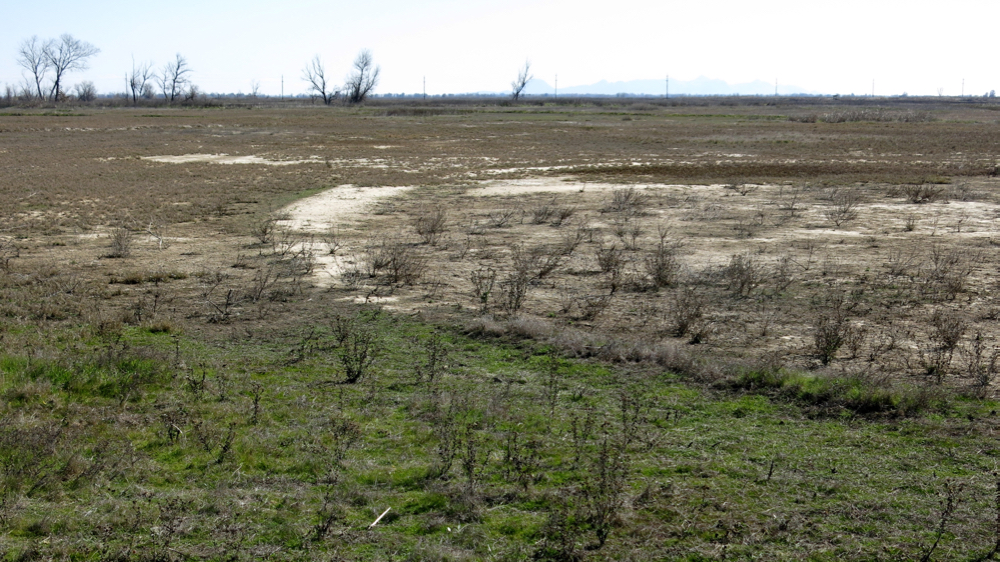
A little later on, I stopped to spend ten minutes looking at an alkali meadow. The soil was almost white in places, the vegetation low and scraggy. It was not a very attractive place. Yet there were a number of game trails criss-crossing the meadow, and earlier I had seen a jackrabbit lopping off towards this meadow. In the distance, through the moist and hazy air, I could just see Sutter Buttes, the old defunct volcano that sits in the middle of the Central Valley.

I finelly caught up with Carol near the parking lot where we had started walking. It was time for lunch. We sat and ate at a picnic table near half a dozen bird feeders. The birds were cautious of us at first, but when they saw we probably wern’t a threat, they swarmed out of the tule reeds and nearby trees: White-crowned Sparrows, Yellow-crowned Sparrows, House Sparrows, Song Sparrows, Lesser Goldfinches, House Finches.

The rest of the ride home was unremarkable and dull. I read aloud from a bad murder mystery while Carol drove. The traffic got bad as we approached San Mateo. At last we arrived at home.

Seattle to Redding

We dropped off Saba at the Montessori school where she works, and started driving south. It was a gray and dreary day, and before long it started snowing. Pretty soon it was snowing hard enough that the ground was white on either side of the highway, and in a few places slush accumulated between the lanes. We saw some accidents: a couple cars spun out and off the highway, something on the northbound side of the freeway with several tow trucks and emergency vehicles and traffic backed up for a mile or more. South of Eugene, the snow stopped, but the forecast for the Siskiyou Mountains was for snow tonight and snow tomorrow morning. We decided to drive as far south as we could before we got tired. Wes topped briefly in Ashland so Carol could collect mineral water from the public fountain in Ashland Plaza. Then we started driving again, winding up over the mountains and back down again until we reached Redding, where we stopped to spend the night.

As for the lithium water, it smells sulphurous, like slightly rotten eggs. The water also has quite a bit of barium in it, so you’re not supposed to drink more than a few sips at a time. If we decide to drink it, we should do with it what they do with “Crazy Water” from Texas: dilute it; “Crazy Water” tastes pretty yucky, too, but once diluted it’s at least drinkable.

Snow and ice

In the middle of the day yesterday, I looked out of the window here in Seattle and it was snowing steadily. The snow didn’t stick to the ground where we were, and it was soon over. This afternoon when we went for a walk, we saw frozen puddles by the side of the road, and frozen mud crunched under our feet when we stepped off the paving. We passed a pickup truck with a couple of inches of packed snow on its roof; it must have been driven into the city from some place nearby at a higher elevation, where there had been more snow, and the snow had stuck. And as it turns out, the same cold front swept down to San Mateo, where the National Weather Service reported “an active morning with passing showers and snow showers,” with the showers ending by this afternoon.

There is a long and honorable literary tradition in which events in the natural world are linked to human affairs, and I can’t help thinking about what Robert Frost said about fire and ice. If he had to choose between the world ending in fire or ice, Frost said, he’d bet on fire, based on what he knew of desire. But, he said:

…if [the world] had to perish twice,
I think I know enough of hate
To know that for destruction ice
Is also great
And would suffice.

Consumer capitalism provokes our unending desire for cheap consumer goods, and cheap consumer goods require the ever-increasing use of cheap energy, which in turn has led to the frightening rise in average global temperature: so the odds are pretty good that Frost is right, and the world will end in fire. But all the hatred that has broken out into in the United States in the past couple of years has made it clear that is we don’t die of fire and desire, we will freeze to death from icy hatred.

San Mateo to Eugene, Ore.

We got up later than planned (and isn’t that how all our trips begin, getting up later than we had planned?), and immediately gave up on the idea of driving to Seattle in one day. Carol researched places for us to stay while I drove through the unpleasantness that is Bay Area traffic. We were glad to get off Interstate 80 and head north, away from the sprawling tentacles of the growing San Jose – San Francisco – Sacramento megalopolis.

I’ve been reading Roadside Geology of Northern and Central California, and when Carol started driving after lunch, I read to her from the section on driving Interstate 5 up through the Central Valley: it’s all Quarternary alluvial deposits, for miles and miles, with the one exception of the Sutter Buttes, a group of craggy hills that thrust up seemingly out of nowhere, a volcanic intrusion that seems incongruous.

The geology along the road got really interesting a couple of hours further north, but by that time we had moved on to other things. We sang some Sacred Harp songs, to get us ready for the Sacred Harp convention we’re going to this weekend, and then we sang some other songs — old standards like Moon River, Close to You, Ring of Fire — until I got the hiccups and had to stop.

We drove up, up, up over the Siskiyous, where there was some snow on the side of the road once we got above 4,000 feet, and then down, down, down into Ashland where we stopped for dinner. We saw a lot of street people in Ashland. Two of them accosted us as we walked towards a restaurant. “Hi, how are you?” the young white man said. “Good, how are you?” I said. “Poor and hungry. Can you give us a dollar?” he said. “We’ll stop on the way back,” Carol promised, and we did, but they were gone: it had gotten pretty chilly by then.

As we approached Eugene, we talked about Steve who had lived in Eugene. Steve was someone we had hung out with at the Alaska Sacred Harp Convention in October, and he had died suddenly and unexpectedly in California last month at the age of 60. He was not someone you would expect to die suddenly, and we keep talking about it, trying to make sense out of his death.

And then we were at the motel, where they were showing Olympic ski jumping competitions on a big TV. I talked to one of the young men staffing the desk while Carol checked in. “What they have on right now is figure skating or ski jumping,” he said apologetically. “I don’t need to see figure skating,” I said. He grinned. We talked about all the sports they never seem to show. “Like curling,” I said, “ho come they never show curling?” “It’s pretty boring,” he said, “it’s like people who weren’t good enough to play hockey had to invent a sport they could play.” It turned out that he enjoyed shooting, and shot both pistols and rifles; we both agreed that we would like to see the Olymplic biatholon competition, where you have to ski a certain distance, then shoot. We both looked up at the big screen as another ski jumper twisted through the air in slow motion, then landed wrong and tumbled down the hillside.

Power and sexual harrassment

Under the headline “The Role Power Plays in Sexual Harassment” (Tuesday, Feb. 6, page A13) Elizabeth Bernstein of the Wall Street Journal reports on a series of five studies published in 2017 in the Journal of Personality and Social Psychology. Bernstein also interviews a number of psychologists to explore the question: What makes some men abuse their positions of power to sexually harass women?

According to Bernstein, psychologists are finding that men who exploit their power to harass women “typically share specific personality traits. Their power amplifies proclivities they already have.” Those traits include:
— men who felt powerless in the past are “most likely to pursue an inappropriate workplace attraction or exhibit harassment behavior”
— men who have so-called “hostile masculinity” tend to “find power over women to be a turn-on”; these men are often narcissists
— men with what’s known as “impersonal sexuality prefer sex without intimacy or close connection”; these men often have multiple sex partners; their lack of intimacy with sexual partners may go back to experiences of abuse as children
— men with sexist attitudes are also likely to harass or assault women

Bernstein quotes Dr. Neil Malamuth, professor of psychology and communication at the University of California, Los Angeles: “It’s not automatic; it’s not that power corrupts. It’s a certain type of man who uses his power in this way.”

From my perspective, it’s both interesting and not surprising that men who abuse power to sexually harass women share certain personality traits (and I wouldn’t want to limit this to men: there are also women who abuse their power by becoming sexual predators). In my work cleaning up congregations after sexual misconduct by religious leaders, I have sensed shared personality traits in those leaders who abuse their authority. But I’ve never had enough distance from the problem to be able to adequately articulate what those personality traits are, so this is a helpful list of personality traits to look for.

Cheddar Man

Humans moved into what is now the British Isles not long after the Ice Age glaciers retreated. And what did those early Britons look like? Recent DNA analysis of a 10,000 year human skeleton, found in 1915 in Cheddar Gorge, Somerset, reveal that early Britons had dark brown or black skin and blue eyes.

The BBC reports: “This combination [of black skin and blue eyes] might appear striking to us today, but it was a common appearance in western Europe during this period.”

So when did Europeans become white? Probably only about 6,000 years ago, when pale-skinned, brown-eyed humans began moving into Europe from the Middle East. “No-one’s entirely sure why pale skin evolved in these farmers,” says the BBC, “but their cereal-based diet was probably deficient in Vitamin D,” so they needed to manufacture more vitamin D in their skin.

This research poses some interesting challenges to racial assumptions here in the U.S., where English ancestry means you’re about as white as white can get. But what interests me is how recently white skin evolved in humans. It’s also interesting to think of blue-eyed, black-skinned humans, a direct challenge to U.S. notions of what constitutes blackness.

“White supremacy” as a strategy for racial justice

“White supremacy” has become a new catch-phrase among those who are trying to fight racial injustice, replacing “white privilege” as the catch-phrase du jour. I think it’s worth asking: will the phrase “white supremacy” help us succeed in combating structural racism, where “white privilege” seems to have failed us? Here are three reasons why I suspect “white supremacy” will fail to make much of an impact:

1. Robin DiAngelo, a professor of social work at the University of Washington (and a white woman herself) wrote an influential paper in the International Journal of Critical Pedagogy in which she defines a phenomenon which is relevant here: “White people in North America live in a social environment that protects and insulates them from race-based stress. This insulated environment of racial protection builds white expectations for racial comfort while at the same time lowering the ability to tolerate racial stress, leading to what I refer to as White Fragility.”

DiAngelo goes on to propose a pedagogical approach to help white people understand whiteness and racism: “It is useful to start at the micro level of analysis, and move to the macro, from the individual out to the interpersonal, societal and institutional.” This approach, claims DiAngelo, “allows for the pacing that is necessary for many white people for approaching the challenging study of race.” DiAngelo advocates for an “ongoing process” rather than an event. By contrast, I believe anti-racism catch-phrases tend to trigger “white fragility,” which has the unintended effect of shutting down an ongoing process of antiracism.

2. Most of the white people I’ve heard using the phrase “white supremacy” are college-educated professionals; that is, they are upper middle class whites. And all too often, they manage to use the phrase “white supremacy” so that it sounds like they are directing it at others; I mean, if I’m enlightened enough to use the phrase “white supremacy,” then I must be halfway to embodying righteous racial justice in myself, right?

As someone who spent the first dozen years of his work life working in a lumberyard and then as a carpenter, I know I got tired of being condescended to by self-assured upper middle class college-educated professionals who seemed always to assume that they knew more than I did about everything, simply by virtue of the fact that they were professionals and I was working what they considered to be a crappy job. When I hear white college-educated professionals making public statements about white privilege, I hear the same tone of voice I heard when the same class of people condescended to me in the lumberyard. In short, I don’t think the phrase “white supremacy” carries well across the class divide between college-educated professionals and everyone else; nor does it carry well across the many gradations of class that exist within the ranks of college-educated professionals. None of us likes to be condescended to.

3. Finally, it has been my experience that systems change does not happen in a linear fashion. I was first introduced to systems theory by Jay Forrester’s book Urban Dynamics. Forrester was the first one to model systems change as a non-linear mathematical function, and I remember going through the FORTRAN code he printed in the back of that book and realizing that he was modelling systems as interconnected feedback loops represented by GO TO commends. Forrester’s mathematical model provides a couple of useful insights: ordinary cause-and-effect causality does not work with systems; and because of their interconnected feedback loops, systems tend to return to a stable state, except if they suddenly make a leap into a new stable state. Since then, I have found that non-linear models work very well in describing and effecting change in systems like family systems and congregational systems; and I am pretty confident that larger-scale human systems also are best modeled as non-linear.

That being the case, I am skeptical of the efficacy of “white privilege” as a useful tool for systems change in the area of racial justice, as if the simple linear act of naming the problem with linearly effect positive change. Based on past experience with attempts to use linear models to effect change in non-linear systems, I would expect the initial use of the phrase “white supremacy” to provoke strong reactions which effect short-term change, followed by a backlash, and an eventual return to the previous equilibrium. (And this is pretty much what I’ve seen happen with the old catch-phrase “white privilege.”)

How, then, can we effect positive change in the non-linear system of structural racism?

Well, if I could answer that question, I’d already be working on implementing positive change. But I think Robin DiAngelo is onto something when she argues for beginning with the individual. When I look at the astonishingly effective playbook of the same-sex marriage movement, this turns out to be one of their most effective strategies, what Freedom To Marry calls “values-based conversations”: “In California in 2008 and 2009, volunteer-collected data shows that values-based [face-to-face] conversations were moving 25% of all undecided and opposed voters to be more supportive of [same sex] marriage, with half these moving towards undecided and the others moving to be new supporters.” Obviously, the political battle for same-sex marriage differs significantly from structural racism that is cultural and social as well as political (and we can’t ignore the racial make-up of the same-sex marriage movement). But perhaps one thing we we can discover in the success of the same-sex marriage movement is the importance of direct one-on-one conversations between individuals; if us white people can start talking as individuals to one another, perhaps without relying on the current catch-phrases, we might find that we are making some non-linear progress towards out goal.

Not that I believe that values-based conversations will be sufficient to end structural racism. But I do think that some kind of individualized, non-condescending, non-linear approach is about the only kind of approach that will effect permanent and positive change.