Deconstructing “covenant,” pt. 1

Unitarian Universalists talk a lot about “covenant.” We didn’t used to talk about covenant. As near as I can tell, our mild obsession with covenant came about during the merger of the Unitarians and the Universalists, a process which began in the 1950s and continued for years after the legal consolidation of the two groups in 1961. We were thrashing about trying to find something that held us together. The Universalist professions of faith weren’t acceptable to the Unitarians, and the Unitarian affirmations of faith (like James Freeman Clarke’s Five Points of the New Theology) weren’t acceptable to the Universalists.

Two Unitarian scholars, James Luther Adams and Conrad Wright, had long been talking about the importance of covenant to their Unitarian tradition. Wright was a historian who interpreted the entire history of Unitarianism in the United States as centering around covenant. This was a problematic interpretation, since by the early twentieth century many Unitarian congregations didn’t have written covenants. I’m not sure, but Wright may have felt that the Unitarians kind of forgot covenant, and that forgetfulness led to the decline of Unitarianism in the 1930s. In any case, he saw the re-establishment of covenant as central to the revitalization of Unitarianism in the mid to late twentieth century.

Wright continued to trumpet covenant after consolidation with the Universalists. While his primary area of expertise was in Unitarian history, he dipped into Universalist history and claimed to find that the Universalists were pretty much like the Unitarians when it came to congregational polity and the centrality of covenant.

I don’t find Wright’s interpretation of the historical facts to be terribly convincing. Covenant was in fact central to most Unitarian congregations that began life as Puritan churches in New England. Covenant was also important to some nineteenth century Unitarian churches which had been founded by New England settlers moving west. But in my research in the archives of local congregations, covenant becomes less important as an organizing principle beginning in the nineteenth century and through the early to mid-twentieth century.

In many eighteenth century New England congregations, there were two parallel organizations, the church and the society. The society owned the real property and managed the finances; the church consisted of the people who signed the church covenant and stood up in front of the congregation and confessed their sins. Membership in the society was typically through buying a pew and contributing annual rental for your pew (often restricted to males, since there were legal limitations about females owning property), and generally speaking only males could take on leadership roles in the society. It appears that on average significantly more women than men signed the covenant to become a part of the church. People of African or Native descent could join the church, but may have been barred from owning pews or serving in leadership roles in the society.

Thus the entire system of covenant was bound up with discriminatory distinctions between males and females, and between persons of European descent as opposed to persons of African or Native descent. Nor is this an accident. Covenant in the New England Puritan tradition was a means for upholding a theocracy that placed white males at the top of the social hierarchy (note that I’m being sloppy here by including the Pilgrims in the umbrella term “Puritan”). Today, some might call this racism or white supremacy, though some historians would argue that these are anachronistic concepts when applied to the seventeenth and eighteenth centuries; a better way to put this is to simply say that the New England Puritan tradition was inextricably linked to enslaving people of African and Native descent. On the other hand, we can say with some certainty that this Puritan social hierarchy was patriarchal and sexist. In addition, Puritan theocracy was also tied in with the larger project of British colonialism; not quite as blatantly as in the resource-extraction economies of the southern plantation colonies, but the British empire clearly say the value of exporting religious dissidents to “tame the wilderness” thus opening up the area to somewhat “softer” economic exploitation by the empire.

In short, covenant was bound up with patriarchy, colonialism, and slavery. This is not to say that covenant is forever tainted by its origins. But these are parts of the story that Conrad Wright passes over. If we’re going to put covenant at the center of our religious tradition, at the very least we need to acknowledge that covenants were part of a theocratic political structure that was rooted in the oppression of the majority of people in the society.

During the nineteenth and early twentieth centuries, the distinction between society and church seems to have slowly been forgotten; along the way, covenants often seem to have disappeared as well. So, for example, when I was doing research for the 300th anniversary of the Unitarian church in New Bedford, Mass., I found evidence for the existence of a covenant in the congregation’s eighteenth century archives, now stored at the New Bedford Whaling Museum. By the late nineteenth century, during the long ministry of William Potter, one of the leaders of the Free Religious Association, I found no evidence for the existence of a covenant. The distinction between society and church continued into the 1940s, since the ministers were not allowed to attend the annual meeting of the congregation — it appears that in the eighteenth century the minister was charged with oversight of the church, the lay leaders with oversight of the society — but with the end of pew ownership in the 1940s, that distinction finally dissolved. By the early twenty-first century, there was no distinction between church and society, or more precisely the church withered away leaving only the society.

In another congregation I researched, the Unitarian church in Palo Alto, Calif., which existed from 1905 to 1934, I found no evidence at all for the existence of a covenant. From the research I’ve done in local congregational archives, I’ve mostly found no evidence for a covenant in the early twentieth century. The only exception is the Unitarian Society of Geneva, Ill., which still maintains the covenant originally written and signed by the founders of that church — who were all emigrants from New England to what was then the frontier. That covenant was substantially revised circa 1900, to shorten it, and to remove all mentions of God or the Bible. The church almost went moribund in the early twentieth century, until Charles Lyttle, professor of church history at Meadville Lombard Theological School, stepped in to rebuild the church for use as a training congregation for his Unitarian theological students. Perhaps it is due in part to Lyttle’s academic influence that the Geneva covenant remained active (and one wonders if the historian Charles Lyttle helped draw the attention of the later historian Conrad Wright to covenant).

Thus covenant appears to have mostly disappeared from Unitarian congregations in the nineteenth century. But Conrad Wright also argued that Unitarian churches were bound to each other through congregational polity, which was another sort of covenant. The most important document here was the Cambridge Platform, a seventeenth century Puritan document that outlined how Puritan churches were supposed to relate to one another. The Cambridge Platform looked to the Bible as revealed scripture (the Word of God) to determine how churches related one to another. The Cambridge Platform was outdated almost as soon as it was written — it called for every church to support both a preaching minister and a teaching minister, which proved to be economically impossible — but it also simply didn’t apply to some Unitarian congregations.

Take, for example, King’s Chapel in Boston, which became Unitarian in 1785. It was originally affiliated with the Church of England, but became independent during the American Revolution; at which point, it removed all references to the trinity from its Book of Common Prayer, and became Unitarian in theology. King’s Chapel came from a tradition of episcopal polity, and the Cambridge Platform formed no part of its history until, at the earliest, it affiliated with the American Unitarian Association sometime after 1825. Or take the Icelandic Unitarian churches of Canada, which came out of Lutheranism, another religious tradition based on episcopal polity. Perhaps we could argue that the Unitarian tradition of covenant in North America is syncretic, taking in various influences, and transmogrifying them.

But I think it’s more accurate to say that twentieth century Unitarian covenant was something that Conrad Wright made up, using historical materials. Covenant is not an old tradition among us, it’s a newly made-up tradition. That being the case, I’m not sure I want to use a made-up kind of covenant based on Puritan theocratic patriarchal concepts rooted in colonialism and slavery.

Furthermore, as someone who thinks of myself as more of a Universalist than a Unitarian, I’m trying to figure out why we should use a made-up kind of covenant that pretty much ignores Universalism. Conrad Wright did extensive research in Unitarian covenant, but it’s clear from his writings that his knowledge of Universalist history was not very deep. James Luther Adams, the other co-creator of twentieth century Unitarian covenant, knew his Unitarian tradition quite well but did not know Universalism nearly as well.

Whether or not the Unitarians were always actually unified by covenant (or if it was something that Adams and Wright invented in the mid-twentieth century), it’s quite obvious that the Universalists were not unified by covenant. The Universalists were unified by a common theology of universal salvation, which was expressed in affirmations of faith. Because the Universalists differed so radically in the details of their universalist theologies, their affirmations of faith had to be very broad, and mostly were quite brief. Unitarian documents, such as church covenants and the Cambridge Platform, tended to be quite wordy — the Cambridge Platform fills up a small book — but the Universalists’ “Winchester Profession” of 1803 comes in at fewer than 100 words. Not that the Winchester Profession, or any later profession of faith, actually served to unify the Universalists; they’ve been an almost anarchistic group from the start; the point is that they did not have covenants in the way Unitarians had covenants. Thus the concept of covenant, as promoted by Adams and Wright, was a Unitarian thing, but it was not important to Universalism.

My point here is to deconstruct “covenant.” More on this tomorrow….
    Legal personhood

    Natalia Harrell shot and killed someone in Florida. She was six weeks pregnant. She was apprehended and put in prison. Now she has filed a petition with the Florida courts saying lack of prenatal care in prison is endangering the life of her fetus — or, to use Florida’s term for a fetus, her “unborn child.” In an interview, Harrell’s lawyer stated: “An unborn child has rights independent of its mother, even though it’s still in the womb. The unborn child has been deprived of due process of law in this incarceration.”

    This is a logical outcome of the conservative Christian insistence that a fetus has rights. Of course we know what’s going to happen. The courts are going to twist things around so Florida does not have to provide prenatal care, nor in any way honor any putative rights the fetus has. In this conservative Christian ideology, a fetus is only considered a person when that serves to stop a woman’s right to abortion; but a fetus is not a person for any other purpose.

    This makes me wonder if there are carpool lanes on some Florida highways. Because if there are, some pregnant woman should drive solo in a carpool lane, and if apprehended claim that there are actually two legal persons in the car: the woman herself, and the fetus. Of course, once again we know the Florida courts would rule that a fetus is not a person when it comes to carpool lanes. But I’m sure a lot of us would happily chip in to pay that woman’s traffic ticket and court costs, just to show up the hypocrisy of lawmakers who claim a fetus is an “unborn child” with full legal rights.

    Theatre

    I finally watched the BBC’s video clip showing the moments when the Republicans heckled Democratic president Biden’s “State of the Union” speech. Looks like heckling has now become a normal part of the “State of the Union” speech.

    What interests me is the hecklers shouting about lies and lying. The first such heckler, if you remember, was the fellow who shouted out that Obama lied. This tradition was upheld this year by the Christian nationalist shouting “Liar!” at Biden.

    Knowing what is true is a major concern for U.S. society right now. And those who are within a traditional Christian worldview seem to suffer most from a sense that truth is under attack. Traditional Christians who believe that non-Christians will go to hell are often troubled by the multi-religious landscape of the United States today; those non-Christian people are going to hell, and yet our legal system protects them. This must be extremely disconcerting to certain traditional Christian worldviews.

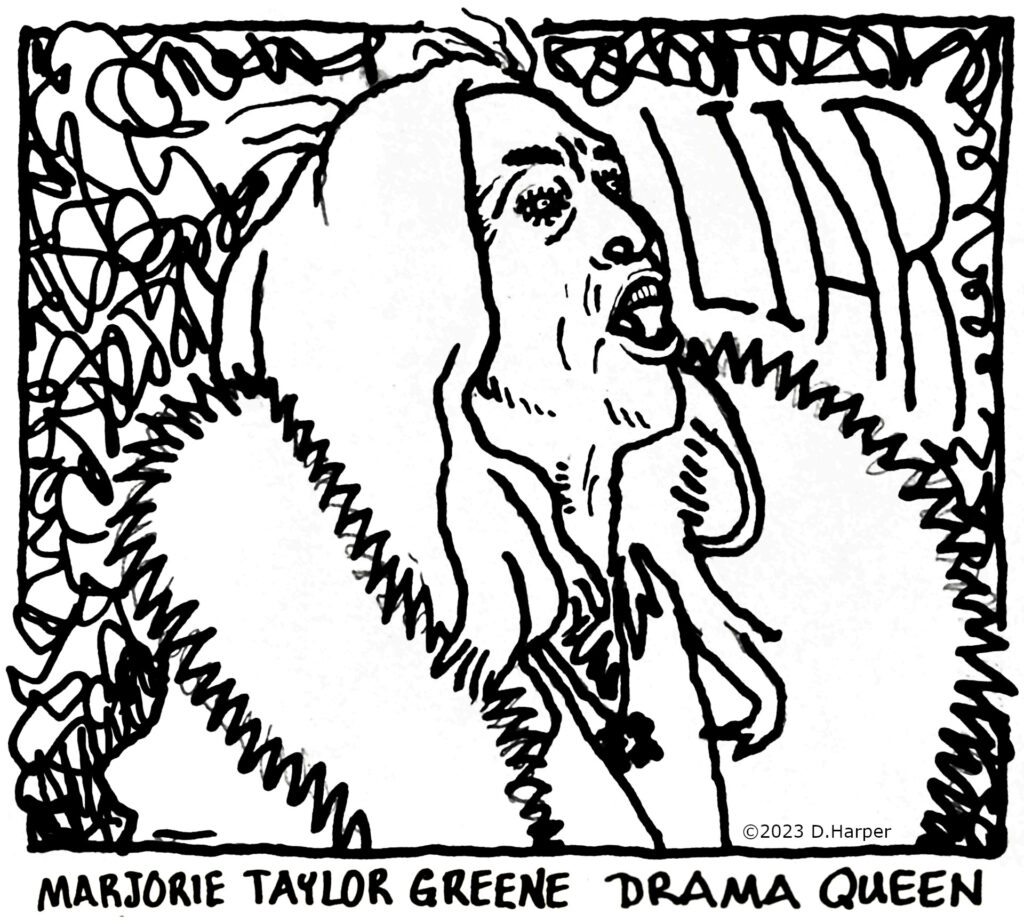
    So it is no surprise that one of the people shouting about lies during this year’s “State of the Union” speech was Christian nationalist Marjorie Greene. I suspect that Greene, who’s a bit of a drama queen, prepared herself in advance for her moment in the spotlight: she wore a dramatic white coat with a big furry ruff, which must have been dreadfully hot but was clearly meant to set off her blonde good looks. And she so obviously enjoyed the moment when she made the audience turn and look at her. She seems to have forgotten, however, that when you shout, it distorts your mouth and face and throat, and it brings out all the little lines in your face making you look older than you are. (This is why I hate seeing videos of myself preaching.) No matter: she made her truth claim in a very public manner, that she knows the truth, and unless the rest of us agree with her she will shout us down as liars.

    Cartoon of Marjorie Greene shouting "Liar" during the State of the Union speech.

    Back in 2005, philosopher Richard J. Bernstein argued that there were two prevailing mentalities in the United States. On the one hand there is a “mentality that neatly divides the world into the forces of good and the forces of evil.” On the other hand, there are those of us who “live without ‘metaphysical comfort,’ … live with a realistic sense of unpredictable contingencies” (The Abuse of Evil: The Corruption of Politics and Religion Since 9/11 [Malden, Mass.: Polity Press, 2005], pp. 12-13).

    Greene and other Christian nationalists belong to the mentality that neatly divide the world into good and evil; they long for comfort and fear the unpredictability that pervades the world. Because of their fear, they cling to whatever certainties they can manufacture, and call those manufactures divine revelation.

    But they should remember that when they shout, it distorts their faces….

    Noted with a brief comment

    Josiah Royce, in his 1913 book The Problem of Christianity (pp. 213-214, 2001 reprint edition):

    “No religion can survive unless it keeps in touch with men’s [sic] conscious needs. In the future men’s needs will be subject to vastly complex and rapidly changing social motives. In the future, religion, as a power aiming to win and keep a place in men’s hearts, can no longer permanently count on the institutional forces which have in the past been amongst its strongest supports. Its own institutions will tend, with the whole course of civilization [i.e., Western culture], to come increasingly under the sway of the law of accelerated change. The non-religious institutions of the future, the kingdoms and democracies of this world, the social structures which will be used for the purposes of production, of distribution, and of political life, will certainly exemplify the law of accelerated changes. And these social structures will not be under the control of religious institutions.”

    There are one or two problems with Royce’s argument here. His use of “civilization” really means those parts of the world dominated both by Christianity and by persons of European descent. So there are some colonialist assumptions baked into his argument. His use of “men” to represent all human beings reveals his assumption that male human beings are the most important ones. When he talks about “Christianity,” he assumes a monolithic Christianity of which the largest English-language Protestant denominations in the United States in his day serve as the paradigm.

    Nevertheless, he got two important things right. Religion is now very much under the sway of the law of accelerated change. And religion that doesn’t meet the conscious needs of people doesn’t survive.

    MLK and Royce

    I recently learned that Martin Luther King’s famous idea of the “Beloved Community” apparently derives from pragmatist philosopher Josiah Royce. So on this Martin Luther King holiday, I decided to look into Royce.

    I’ve started looking through Royce’s The Problem of Christianity (New York: MacMillan Co., 1913), a series of lecture he delivered at Manchester College, the Unitarian college at Oxford University. It’s available at the Internet Archive. And while I’m just getting started in this book, I skimmed through it to look for references to the Beloved Community. It looks like Royce equates the Beloved Community with the Kingdom of Heaven:

    “The Christian churches and nations of mankind [sic] have done as yet but the very least fragment of what it was their task to accomplish; namely, to bring the Beloved Community into existence, or to bring the Kingdom of Heaven to earth.” [p. 371]

    Later on, it seems to me that Royce is saying the Beloved Community is the Spirit (note the capital “S”) in institutional Christianity (p. 428): “Let your Christology be the practical acknowledgement of the Spirit of the Universal and Beloved Community.” And then a page later: “The core of the faith is the Spirit, the Beloved Community, the work of grace, the atoning deed, and the saving power of the loyal life.”

    In this and other passages, it sure sounds like Royce is providing a sort of theology or philosophy of institutionalism. Which is right up my alley. In fact, this is exactly what I’ve been thinking about recently: what is my philosophy or theology of religious institutions? In the past I’ve used a little Bernard Loomer and a little Starhawk and a lot of handwaving. But with the rapid decline of religious institutions, clearly this is an area to which I need to devote a lot more thought.

    So I decided I had better start studying Royce myself. I immediately went to the Seminary Coop Bookstore website and ordered a recent scholarly edition of The Problem of Christianity. That’s a special order, but they also had in stock two basic introductions to Royce, Basic Writing of Josiah Royce: Logic, Loyalty, and Community, and The Philosophy of Josiah Royce. (On a whim, I also ordered Varieties of Transcendental Experience: A Study in Constructive Postmodernism, which apparently references Royce.)

    What a great way to spend MLK Day.

    When does personhood begin?

    Judge Heather A. Welch, of the Marion Superior Court, Indiana, has issued a preliminary injunction against Indiana’s new anti-abortion law, SEA 1. The state of Indiana had previously passed the Religious Freedom Restoration Act, which strengthens protections for the freedom to practice religion. Following the passage of SEA 1, Hoosier Jews for Choice and several anonymous plaintiffs sought an injunction, claiming that because of their religion (or lack of religion) they sincerely believed that life does not begin at conception. Thus, preventing them from having an abortion would violate their freedom to practice their religion.

    In the Findings of Fact in the Order of Preliminary Injunction, Judge Welch reviews the beliefs of several religious traditions regarding when personhood begins (section III. B., pp. 8 ff.). Welch reviews the beliefs of five religious traditions: Judaism, Islam, Unitarian Universalism, Paganism, and Episcopalianism. The judge finds that all five of these religious traditions have beliefs that do not place the beginning of personhood at the moment of conception.

    Judge Welch’s summary of Unitarian Universalist beliefs is only two paragraphs long. For those of us who are Unitarian Universalists, those two paragraphs are worth reading:

    “iii. Unitarian Universalism

    “23. The Unitarian Universalist community has long supported reproductive justice. (Declaration of Reverend Catherine Josephine Romano Griffin ¶ 7). A core belief of Unitarian Universalists is that every human being has inherent worth and dignity, which is an endowed right bestowed by the Creator. (Id. ¶ 8).

    “24. Denying a pregnant person, the ability to obtain an abortion impinges on this endowed right. (Id. ¶ 10). Therefore, being denied the ability to obtain an abortion when a Unitarian Universalist believes the abortion is necessary breaks the covenant that adherents have to honor their own inherent worth and dignity. (Id. ¶ 11). In this situation, a Unitarian Universalist is directed to obtain an abortion to maintain the covenant. (Id.).”

    (“Catherine Josephine Romano Griffin” is Katie Romano Griffin, who began serving as the minister of All Souls Unitarian Church, Indianapolis, this year.)

    I’m interested to see how Judge Welch interprets one particular Unitarian Universalist belief. She writes: “that every human being has inherent worth and dignity, which is an endowed right bestowed by the Creator.” For someone like me, who spends way too much time thinking about Unitarian Universalist theology and philosophy, the last half of that sentence, “endowed right bestowed by the Creator,” is not correct. But I admit that it would take me several paragraphs to give a correct explanation of where inherent worth and dignity comes from. And then I’d have to write several more pages explaining why the word “inherent” needs to be carefully interpreted to avoid an inaccurate or even wrong understanding, and furthermore how understanding “worth and dignity” turns out to be far more complicated than it might appear. I think I’d also need to add several more pages explaining how the vagueness of the term “Creator” could lead to some fairly serious theological and philosophical misunderstandings.

    But you know what? Judge Welch’s account is close enough for legal purposes.

    One final comment: Even though I’ve long been uncomfortable with the Unitarian Universalist “seven principles,” I learned something from reading this ruling. As much as I want to revise the seven principles, there is enough specificity there to help a judge write a pretty good ruling.

    Rethinking Christmas as the darkest time of the year

    Sometimes I wish we could get over the big emphasis on Christmas as being the darkest time of the year.

    First of all, the latitude of the land of Judea where Jesus was born is about 32 degrees north. (That’s about the same latitude as San Diego, California.) At 32 degrees, the length of night at the winter solstice is about 14 hours, just 2 hours longer than at the equinox — enough to notice, but not enough to permeate a holiday.

    If you’re into the historical Jesus, as opposed to the Jesus of the Christian scriptures, then you know that Jesus probably wasn’t born near the winter solstice. It appears that the feast commemorating his birth was moved to the winter solstice sometime in the early years of Christianity.

    If you’re not into the historical Jesus, then you should be thinking about Christmas as a universal holiday. So consider this: when Christmas is celebrated in the equatorial regions, Christmas night is exactly the same length as any other night. And the further south you go, the shorter Christmas night gets. Christians in Patagonia or Tasmania do not experience Christmas as “the darkest night.”

    We could also talk about the weird racial overtones of calling something “the darkest night.” If you think in racial terms, all those Christmas carols and Advent carols and Christmas sermons talking about how the darkness of a winter night needs to be replaced by the great light of Christianity start sounding a little creepy. Like maybe there’s some colonialist thinking, or som anti-Black prejudice creeping in there.

    Besides, the Christmas story as it appears in the Christian scriptures doesn’t make a big deal about darkness versus light. Yes, John 1:5 says “The light shines in the darkness, and the darkness did not overcome it.” But John actually says nothing about the birth of Jesus. That’s right, nothing at all. Nor does Mark say anything about the birth of Jesus. Matthew sort of passes over the actual birth, and jumps into the magi.

    Only Luke tells about the actual birth, and all that Luke says is this: “While they were there, the time came for her to deliver her child. And she gave birth to her firstborn son and wrapped him in bands of cloth, and laid him in a manger, because there was no place for them in the inn.”

    So Luke doesn’t actually say that Jesus was born at night. We just assume he was born at night, because next Luke tells us about the shepherds keeping their flocks at night. But notice — Luke does not say the angel announced the birth of Jesus to the shepherds precisely at the moment when Jesus was born. Or if the angel did, the birth still could have taken place just after sunset. Nowadays, we assume that Jesus was born right at midnight, but I suspect we only do that because it’s when we have all those midnight worship services.

    Even if we assume that Jesus was born right after midnight — the time when people have all those midnight services — does that make darkness bad? No, of course not. It could be just the opposite: darkness is good because that’s when Jesus was born. So there’s no need to talk about the light of Jesus’s birth displacing the darkness of evil.

    Maybe it would be for the best if we’d just admit that when we talk about darkness and longest nights at Christmas time, we’re really talking about the winter solstice. We’re really combining the winter solstice celebration with Christmas. I like the idea of mixing a pagan holiday with a Christian holiday — but as long as we’re going to do that, we might want to learn some pagan theology. Starhawk would be a good place to start:

    “In the ancient Goddess traditions, darkness was not something fearful. White, the color of bone, of snow, was the color of death. Black, the color of fertile soil, was connected to the darkness of the womb, to gestation, fertility, possibility and Mystery.”

    Darkness is good. Darkness is about fertility and possibility. Darkness is about embracing the Mystery.

    So if Christmas is about darkness, then when we light candles at Christmas, we’re not trying to dispel the darkness. Candles don’t dispel darkness so much as they let us enjoy the darkness. By lighting candles, we’re embracing the darkness, embracing the mystery of new birth.

    Race, religion, and imperialism

    In the past couple of years there has been a resurgence of interest in the connections between racism, religion, and imperialism. But these connections have been a topic of conversation for over half a century. Today, were more likely to talk about colonialism, but the connections are the same. Here’s theologian Benjamin E. May in 1954:

    “Race and color did not count in the early existence of the Protestant church. It was when modern Western imperialism began to explore and exploit the colored peoples of Africa, Asia, and America that the beginning of segregation and discrimination based on color was intitiated. It was then that color was associated with ‘inferiority’ and white with ‘superiority.'”

    — address by Benjamin E. Mays, Second Assembly of the World Council of Churches in Evanston, Ill., August 21, 1954; quoted in Gary Dorrien, The Making of American Liberal Theology: Idealism, Realism, and Modernity, 1900-1950, p. 427

    Yet another holy book

    Rodney Kennedy, in an opinion piece on Baptist News Global, says:

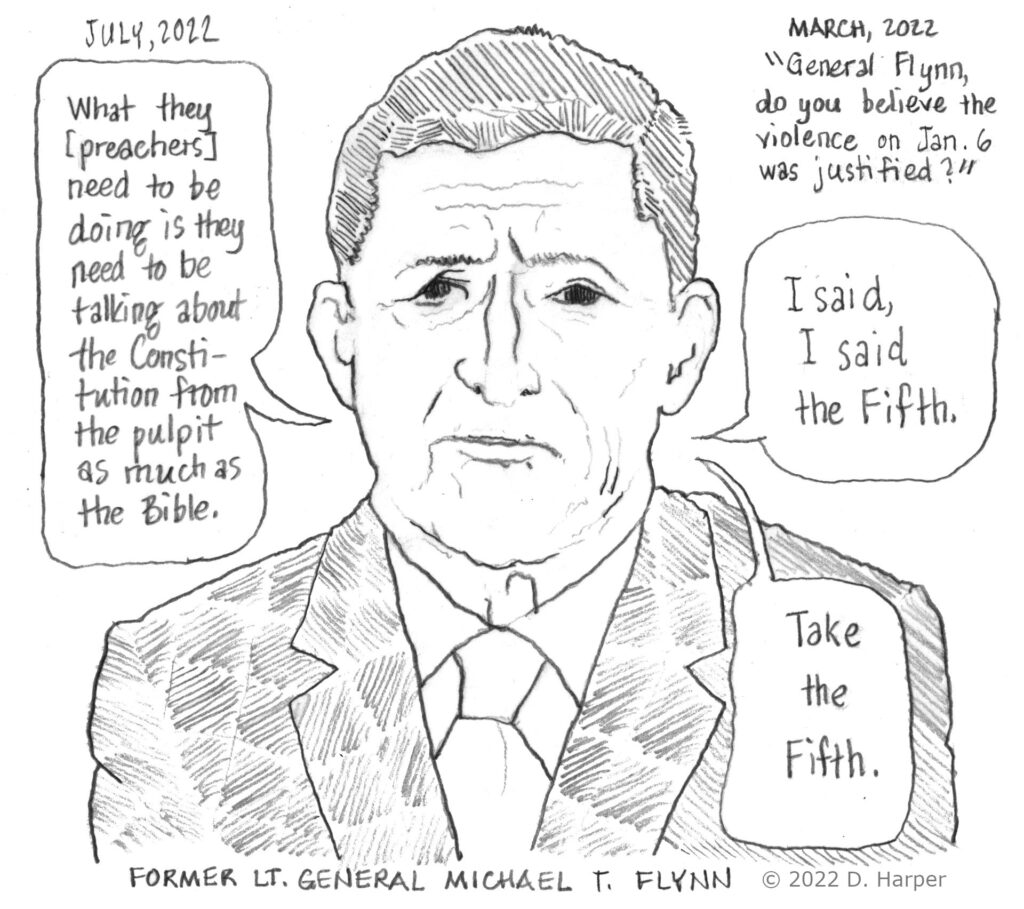
    “I’m attempting to wrap my mind around the idea of a former Army general telling me I should preach from the U.S. Constitution. I mention this only because Michael Flynn has been occupying American pulpits, recommending the Constitution as a second holy book for preachers. ‘What (preachers) need to be doing is they need to be talking about the Constitution from the pulpit as much as the Bible. They have to do that,’ Flynn has said.”

    Kennedy calls Flynn’s remark idolatrous. From his Christian point of view, the Bible stands alone and does not need to be propped up by any other texts.

    I don’t know if Flynn actually believes what he said, or if he just said it to draw audiences. (Time reported that Flynn made $150,000 in 2016 for speaking engagements, a strong motivation to say what his audiences want to hear.) But I do know Flynn is giving voice to an opinion genuinely held by many people in the United States. These folks genuinely believe that the U.S. Constitution is divinely inspired, just like the Bible, and thus should be treated as a sacred text. These folks use short passages from the U.S. Constitution as proof texts, just as short passages from the Bible are used as proof texts, to prove the truth of a certain theological opinion or doctrine.

    What a fascinating historical moment. We seem to be watching a sort of new Great Awakening, a movement which curiously adds the U.S. Constitution as a sacred text co-equal to the Bible. Like previous Great Awakenings, these folk are vibrant and adventurous and enthusiastic. My Puritan forebears would have said that enthusiasm results from excessive religious emotions that come from a deluded conceit that one is specially favored by God, and I’m still enough of a Puritan to agree. Nevertheless, what a fascinating historical moment.

    Clerical stoles

    In two earlier posts (one and two), I wrote about preaching gowns. Personally I’m not a fan of preaching gowns, but I understand why they can be of use. Now I’d like to think out loud about clerical stoles.

    Stoles are those long pieces of cloth that clergy drape around their necks. The stole comes from the Christian tradition. I don’t remember Unitarian Universalist clergy using stoles until the 1980s. My recollection is that Eugene Pickett, when he was president of the Unitarian Universalist Association, insisted that clergy should wear stoles. By the 1990s, clerical stoles were pervasive in Unitarian Universalism. And by 2003, the year I participated in the Service of the Living Tradition as a newly ordained minister, I think I was the only minister who didn’t wear a stole.

    Some people understand the stole to be a symbol of ordination. But choirs that wear robes often also wear stoles, and we generally expect most of our choristers to be non-ordained persons. So I’m not convinced that the stole is a symbol of ordination, and only to be worn by ordained clergy.

    Also, stoles are reminiscent of other special religious clothing in other traditions. A stole is somewhat similar in appearance to the Japanese Buddhist wagesa, though the wagesa has very specific symbolic meanings (as I understand it) which obviously differ from any symbolism a stole might have. A stole is perhaps slightly reminiscent of the Jewish tallit or prayer shawl, insofar as it’s something to drape over your shoulders when engaging in religious observances.

    It seems to me that there are other cultures that drape long pieces of cloth around your neck. Think of Hindu men who wear a dupatta over a sherwani for their wedding. I feel like there are other examples, though I can’t think of any right now. So even though there’s a strong connection between the stole and Christianity, it you take the cross off a stole maybe it’s not a Christian stole any more. When Unitarian Universalist minister Hank Peirce wears his Boston Bruins stole, there isn’t much connection between the stole and Christianity.

    I don’t like wearing a preaching gown, but I feel reasonably comfortable wearing a stole. I think of it as a uniform. Like when I worked at the lumber yard, and I had to wear a shirt with a “Concord Lumber Corp.” patch over the shirt pocket, and my first name embroidered on the other side of my chest. (And yes, I’ve thought of having a stole made with a patch that says “First Parish Unitarian Universalist” on one side, and my name embroidered on the other side, but rejected the idea for obvious reasons.)

    I wish I didn’t have to wear any special clothes to be a minister. As a Universalist, I think all humans are of equal worth, and wearing special clergy clothing sets my teeth on edge. But I realize that people want to see their clergy wearing some kind of uniform. For me, a stole represents a reasonable compromise between egalitarianism and the need for a uniform. So on Sunday, when I participate in the Town of Cohasset 9/11 observance, I’ll be in uniform, wearing a stole.

    (Getting a stole for Sunday proved to be a challenge. I have a stole that my younger sister gave me when I was ordained, but it’s still in a moving container somewhere. I just found out about the Cohasset 9/11 observance, and had to get a stole on short notice. But finding a stole without any Christian symbolism on it, that could be overnighted to me, was a challenge. I finally found Threads by Nomad, a small company that’s trying to provide clothing that doesn’t do “damage to people or the planet.” They had clergy stoles on sale and they were able to overnight one to me. Sadly, it looks like they’re selling off their stole inventory, so maybe it hasn’t been a good business opportunity for them. Their website tells me that the stole I bought was “made from a fabric called mud cloth from Mali. Mud cloth is dyed using fermented mud — a traditional dying technique in many parts of the world but notably in West Africa. Our mud cloth is not mass produced and therefore every piece is different in design.” Since I’ve been influenced by African philosophy, this seemed like a serendipitous find. Plus the stole was made by an “artisan [who was] fairly compensated.”)