The Mood Pillow

Another story for liberal religious kids. I think I originally wrote this story for the First Parish in Watertown, Mass., back in the mid 1990s. I rewrote it in 2004 when I was at the UU Society of Geneva, Ill., and then forgot about it. Here’s the 2004 version:

Once upon a time, about a hundred and fifty years ago in the town of Concord, Massachusetts, a family lived in a house they called “Apple Slump.” There were four children in the family, Meg, Jo, Beth, and Amy, along with their father, Mr. March, and Marmee, their mother. At the time this story takes place, Mr. March was far away, serving in the army during the Civil War.

Jo had long, chestnut-colored hair. She was a tall tomboy who didn’t really like being a girl. Jo also had a terrible temper; she had a hard time controlling their anger. But Jo figured out a way to keep her temper under control. She had what I think of as a “mood pillow.” 

“Apple Slump,” the house that the March family lived in, was a big, old, rambling New England farmhouse. Jo thought the best room in the house was the garret, a room up in the attic that had a nice, sunny window. Next to the window stood an old sofa.

The sofa was long, and broad, and low. It had been the perfect thing for the girls to play on when they were little. They had slept on it, ridden on the arms as if they were horses, and crawled under it pretending they were animals. As they got older, they had long, serious talks sitting on it, they lay down and dreamed daydreams on it.

Jo liked the sofa more than the other girls. It was her favorite place to read. She would curl up in one corner with a good book, and half a dozen russet apples to eat. As she sat reading and eating her apples, a tame little rat would stick its head out and enjoy her quiet company.

But sometimes Jo went up into the garret for a different reason. She had a terrible temper, and sometimes she would get in a horrible nasty mood. Sometimes, when she was in a particularly bad mood, she just needed to be alone.

She would run up into the garret, and pick up the pillow that was on the sofa. This was an old, hard, round pillow shaped liked a sausage. This repulsive-looking old thing was her special property. If she stood it on its end, that was a sign that any one of her sisters, or her best friend Laurence, or her mother, was allowed to come and sit down next to her on the sofa and chat; but if it lay flat across the sofa, “woe to the man, woman, or child who dared disturb it!” When they were younger, her sisters and Laurence had been pummeled mercilessly by this pillow, and now they knew better than to try to sit next to Jo when it lay flat.

I call this her “mood pillow,” and I think it’s a great idea. When Jo was in a bad mood, or angry about something, or when she just needed to be alone, she could use the pillow to let her family and friends know that they should leave her alone for a while. That way, she wouldn’t hurt those around her when she was in a bad mood.

When you’re in a bad mood, what do you do to keep from hurting those around you?

P. T. Barnum’s elephant

Another story for liberal religious kids. Originally written c. 2000 for First Parish in Lexington, Mass. I dusted off this old story and fixed it up a little because my current congregation’s Sunday school will be learning about P. T. Barnum this year. This story comes from his 1872 autobiography, Struggles and Triumphs.

He was the greatest showman in America! He was a man who was known and loved everywhere, the most famous person in the United States in the nineteenth century! He was the man who created “the greatest show on earth”! His name was Phineas Taylor Barnum.

P. T. Barnum was a showman, the greatest showman of all time, a man who put on shows of strange and wonderful things in his giant Museum in New York City. He exhibited the very first live hippopotamus ever seen in North America. His museum was known for its amazing and incredible animals. He even exhibited the amazing Feejee Mermaid. (Well, actually he later admitted that the Feejee Mermaid was a fake that had been glued together.)

He was a showman, but more than that he was an expert at making money. He had a two-part secret for making money. First, give the public good value. Second, get all the free advertising that you can. Here’s an example of how Barnum gave good value, and got free advertising for his fabulous American Museum….

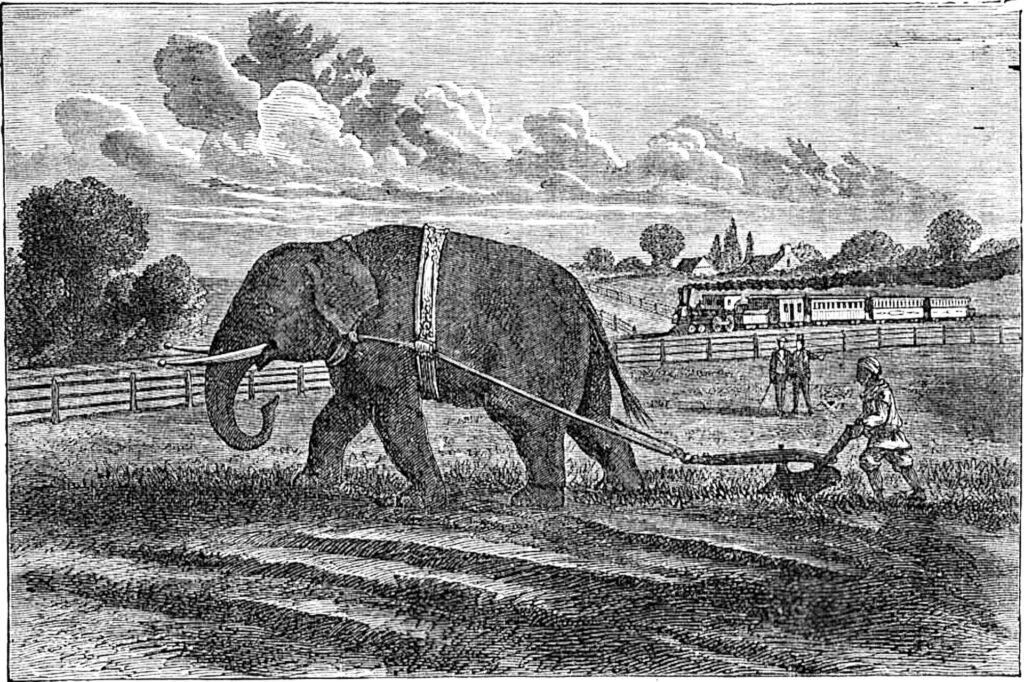
P. T. Barnum brought thirteen elephants Asia to North America. He exhibited them in New York and all across the North American continent. After four years, he sold all but one. He kept that one for his farm in Connecticut. He figured out a way that the elephant could draw a plow. Then he hired a man to use the elephant to plow a tiny corner of Barnum’s farm, which just happened to be right next to the main line of the New York and New Haven Railroad.

P. T. Barnum gave this man a time-table for the railroad. Every time a passenger train was due to pass by, the man made sure the elephant was busily engaged in drawing the plow, right where all the passengers could see.

Hundreds of people each day rode the train past Barnum’s elephant. Everyone who saw it was amazed and astonished. Barnum was using an elephant to draw a plow! Reporters from all the New York newspapers came to write stories on this amazing spectacle. People wrote letters to Barnum from far and wide, asking his advice on how they, too, might use an elephant to draw a plow on their farms.

When Barnum responded to these letters, he always wrote: “Now this is strictly confidential, but for goodness sake don’t even think of getting an elephant. They eat far too much hay and you would lose money. I’m just doing it to draw attention to my museum in New York.”

Pictures of Barnum’s elephant pulling the plow began to appear in newspapers all across the United States, and even overseas in Europe. People came out to Connecticut on purpose just to see Barnum’s elephant at work. They would say, “Why look at that! That’s a real elephant drawing that plow! If Barnum can use an elephant on his farm, he must have all kinds of animals at his Museum. Guess I’ll go to Barnum’s Museum next time I’m in New York city.”

One day, an old farmer friend of Barnum’s came to visit. This farmer wanted to see the elephant at work. By this time, that six acre plot of land beside the railroad had been plowed over about sixty times. The farmer watched the elephant work for a while, and then he turned to Barnum and said, “My team of oxen could pull harder than that elephant any day.”

“Oh, I think that elephant can draw better than your oxen,” said Barnum.

“I don’t want to doubt your word,” said his farmer friend, “but tell me how that elephant can draw better than my oxen.”

Barnum replied, “That elephant is drawing the attention of twenty million people to Barnum’s Museum.”

P. T. Barnum later became famous for his circus, but not many people know that he was also a Universalist. He’s one of my favorite Unitarian Universalists, precisely because he wasn’t perfect. He didn’t always tell the truth, but at least he later admitted when he tried to fool people. He made too much money, but he made sure to give lots of his money away to help other people. He gave money to poor people, and he gave money to help people stop drinking, and he built parks that everyone could use, and he gave lots of money to his Universalist church. I like P. T. Barnum because I know I’m not perfect. But even though I make mistakes, I can follow Barnum’s example and help make the world a better place.

“Elephantine Agriculture,” engraving from the book Struggles and Triumphs by P.T. Barnum (1872). Public domain image courtesy Project Gutenberg.

What I see in an old photo

Cleaning out the files on my laptop, I came across an old low-resolution photo from 1999, showing a dozen people posing for the camera. It was a photo of the participants in the first “Essex Conversations” colloquium. Using GIMP, I increased the size of the photo to see if I could recognize those people…

I think I can identify most of them. From left to right are Lena Breen, then head of the religious education department of the Unitarian Universalist Association (UUA); Ginger Luke, minister of religious education; Jeanellen Ryan, leadership development director in the UUA’s religious education department; Frances Manly, minister of religious education; Tom Yondorf, parish minister; Susan Davison Archer, minister of religious education; Susan Suchocki Brown, parish minister; and Susan Harlow, professor of religious education at Meadville/Lombard.

In the front row at left is John Marsh, parish minister; a woman whom I’m sure I know but whose name I can’t remember; me, then a lay director of religious education; and Tom Owen-Towle, parish minister.

Several things struck me when I looked at this photo. Everyone is white. At 38 years old, I was the youngest person in the photo. And today, I’m the only one still active and working in a Unitarian Universalist congregation or organization (see the notes at the end of this post).

After looking at the photo, I dug out the essay I presented at that colloquium in 1999. It holds up surprisingly well in a number of areas, especially in its critique of the limitations of developmentalism, and in its insistence on talking about real live learners — I thought then, and think now, that too much theorizing about religious education is done without having real live children and teens in mind.

But it’s also fun to re-read that old essay to find all the things I no longer agree with. First, and perhaps most importantly, my essay didn’t adequately address how it is that learning and individual development depend on social interaction (I read Vygotsky a couple of years after I wrote it). Second, the world has changed a great deal since 1999, and Unitarian Universalist religious education faces new challenges, especially the ongoing decline of religious education enrollment in UU congregations, and the rise of religious disaffiliation, two linked trends that have been accelerated by the COVID pandemic. Third, over the past decade I’ve become increasingly aware of just how religiously illiterate most North Americans are, and I’ve seen research showing how religious literacy improves cross-cultural understanding, and how improved cross-cultural understanding can reduce violence and conflict in our communities; I wish now I’d made religious literacy integral to the essay. Finally, I’m less critical of schooling than I used to be, since I now believe some of the favored alternatives to schooling promoted in UU circle are artifacts of upper middle class white culture; yet because most children in North America attend school, schooling is can be more easily accepted across racial, cultural, and ethnic boundaries.

A revised version of my 1999 essay was published in the book Essex Conversations: Visions for Lifespan Religious Education (Skinner House: Boston, 2001); a book which, somewhat to my astonishment, is still in print. I think it’s past time for another generation of UU religious educators to write new essays about the future of religious education. Unfortunately, a colloquium like the one I attended costs a lot of money, and I suspect the declining financial health of the entire denomination means there won’t be another one in the foreseeable future. And religious education is no longer the priority it once was for Unitarian Universalists, partly because religious education enrollment has been declining since 2005 — but also because the current generation of children is majority non-white, and any attempt to encourage a bunch of non-white youngsters to come into our 95% white denomination is going to run smack up against the systemic racism that pervades the UUA.

Nevertheless, I wish we could put together a group of thoughtful people who are dedicated to religious education, who could spend a long weekend together to talk about what’s needed in religious education for the current generation of children. I wish we could have a new book of essays that address today’s religious education challenges — essays that address how we might keep Unitarian Universalist religious education from completely dying out.

Notes about the people in the photo:

John Marsh died in June. According to the UUA directory of professional religious leaders, Lena Breen, Ginger Luke, Jeanellen Ryan, Frances Manly, Susan Davison Archer, Susan Suchocki Brown, and Tom Owen-Towle are all either retired or no longer active. Susan Harlow, who was a United Church of Christ (UCC) minister, is retired from People’s Church in Chicago. Tom Yondorf left the ministry in 2000 to become a school teacher.

The 2021 Stuffed Animal Sleepover

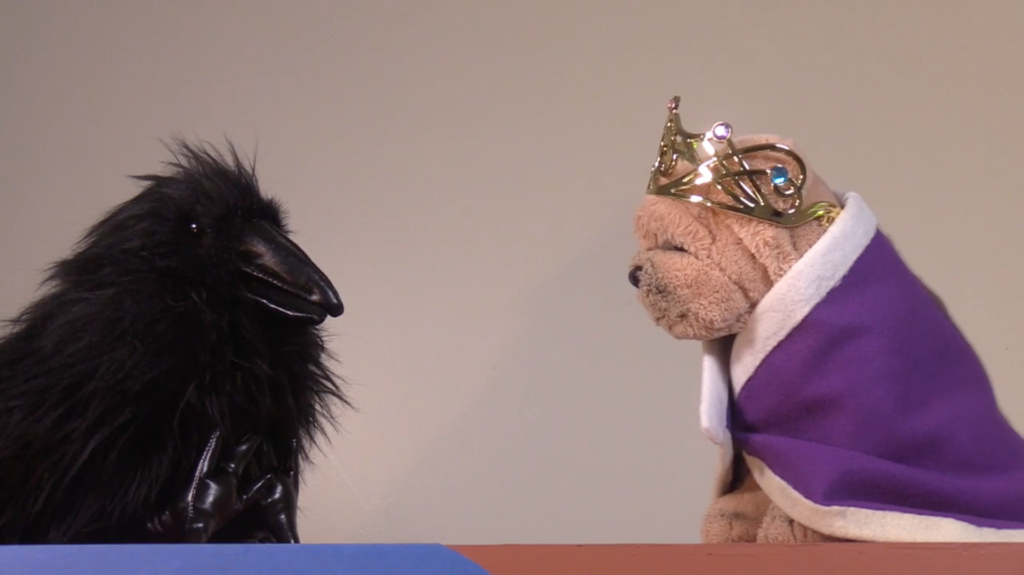
Birago Lion and Belinda Sheep introduce the 2021 Stuffed Animal Sleepover at the UU Church of Palo Alto. Dr. Sharpie and Elephant are going to help out, too.

Click on the image above to view the video on Vimeo.

Full script is below.

Continue reading “The 2021 Stuffed Animal Sleepover”

Saul and David

Another look at David’s story, part of a series of stories for liberal religious kids.

Once upon a time there lived a good and holy man named Samuel. Samuel lived in the land of Israel. He knew that Israel needed a good and strong leader. Samuel decided that Saul, son of Kish, would be the best person to rule over Israel, and so he anointed Saul king, and then served Saul as a holy man and an advisor.

Saul was a handsome man. There was not a man among all the people of Israel who was as handsome as he, and he was so tall that he stood head and shoulders over everyone else.

Saul was a likeable man. When he was a boy, he was easy-going and treated his parents with respect. When he became a man, he remained easy-going and friendly.

But even though he was handsome and likeable, every once in a while Saul would fall into a dark mood. It was more than just a bad mood. When Saul fell into one of these dark moods, the light went out of his eyes. When he was in one of his dark moods, he didn’t want to talk with anyone, he just wanted to stay by himself in his throne room. When he was in one of his dark moods, sometimes he would do things that were dangerous or foolish.

One day Samuel sent Saul off to do battle with the evil tribe of the Amakelites. Samuel warned Saul that if he won the battle, he must slaughter all the Amakelites’ cattle. This was because their cattle was diseased, and if Saul brought the diseased cattle back to Israel, all the cattle of Israel would grow sick and soon die.

Saul fought the battle, and he won. But unfortunately, after the battle he fell into one of his dark moods. He forgot what Samuel had told him, and he brought all the diseased cattle back to Israel.

Samuel met him, and cried out, “What is all this lowing of cattle that I hear?”

Suddenly Saul remembered what Samuel had him — but it was too late. The cattle were already in Israel. Sail felt terrible. He worried that Samuel could no longer trust him, and his mood grew even darker.

Samuel saw that Saul kept falling into these dark moods. He feared that Saul’s moods were growing worse and worse, and might some day overcome Saul entirely. So he decided to find a successor for Saul.

Samuel found David, the son of Jesse. David was a shepherd, he was short and cheerful, with red hair and bright eyes. Samuel anointed David in secret, and told David that soon he be the next king of Israel.

Saul knew none of this. But soon he fell into one of his dark moods again. His servants said, “One of your dark moods has come again! Command us to go and find someone to come an play beautiful music for you. The music will ease your pain and lighten your mood.”

One of the servants said, “I know a young man named David, the son of Jesse. He plays beautifully on the harp. He is also a warrior, and he doesn’t gossip.”

“Fetch him here,” said Saul.

So David came to live with King Saul, and his music helped to soothe the king when one of his dark moods came upon him.

But Saul’s dark moods got worse and worse, and they came more and more frequently. Sometimes Saul wouldn’t recognize David, and several times he attacked David.

Finally, it got so bad that David had to leave the king, and go live in the wilderness….

To be continued…

Source: Hebrew Bible, 1 Samuel 10-16, 31; 2 Samuel 1-3. The suggestion that Saul’s dark moods might have been a manifestation of mental illness comes from lectures given by Carole Fontaine, professor of Hebrew Bible, at Andover Newton Theological School in 1997.

The Story of David: David and Goliath

Going through my archives, I found my retelling of this classic story. I’m posting it here as part of my series of stories for liberal religious kids.

Once upon a time there was a shepherd named David. His three older brothers went off to fight in the army of Israel, under the command of King Saul. But David stayed behind with their father, Jesse, in the town of Bethlehem.

One day after his brothers had been gone for forty days, David’s father said to him, “Go take some bread and cheese and corn to the camp where your brothers and the rest of the army are — give this food to the captain of their company.”

When David got to the place where the army of Israel was, they were just getting ready to go to battle with the army of the Philistines. A great warrior, a man named Goliath, had just come out of the Philistine camp. He was over nine feet tall. He wore a helmet of brass on his head, he was armed with a coat of mail, and he wore brass armor on his legs and back. He carried a long spear, with an iron tip that weighed six hundred shekels.

Goliath stood in the valley between the two armies, and called out to army of Israel. “Why have you come to set your battle in array?” he shouted. “Am I not a Philistine, and are you not servants of Saul? Choose a man from among you, and let him come down to me. We will fight, and if he can kill me, then we will be your servants. But if I prevail against him, and kill him, then you shall all be our servants.”

David came up to the camp of the army of Israel right after Goliath had issued his challenge. All the men in the army were talking about it. “Have you seen this man who has come up from the army of the Philistines?” they said. “King Saul has promised that if any man dares to take Goliath’s challenge, and also manages to kill Goliath, the king will give that man great riches, and give him the princess in marriage.” But Saul and all his army were afraid of Goliath.

Eliab, David’s eldest brother, saw David just then. “What are you doing here?” said his brother angrily. “You’re proud and your heart is naughty. You just came down so that you could watch the battle.”

“No,” said David to Elia. “Our father sent me. But now that I’m here,” he went on, “I’m going to go fight this Goliath.”

Saul heard that David wanted to fight Goliath. Since no one else seemed willing to take on Goliath’s challenge, Saul sent for David. But when he saw how young David was, Saul said, “You’re not able to fight Goliath.”

“I have watched my father’s sheep,” said David, “and when a lion and a bear came and took a lamb from the flock, I went after them. I took the lion by his beard and killed him. And I killed the bear. And I can kill this Goliath, too.”

Saul decided to let David try. He tried to give David a helmet made of brass, and a sword to buckle around his waist. But David took off the helmet and the sword. Instead, he took his shepherd’s staff, and he took five smooth stones from the brook, and he took his sling.

When Goliath, the Philistine, saw David, the young shepherd, he laughed. “Come to me,” said Goliath, “and I will give leave you dead for the vultures to feed upon.”

“You come with a sword and a shield,” said David. “But I come in the name of Adonai, the god of Israel. Adonai will deliver you into my hand, and I will leave you dead for the vultures to feed upon.”

Goliath got up and started walking forward to meet David. David put his hand in his bag and took one of the five smooth stones. He ran ahead to meet Goliath, put the stone in his sling, and flung the stone so it hit Goliath right in the forehead. Goliath fell down dead.

When David returned to the camp of the Israelites, the soldiers took him to Saul. Saul adopted him as one of his own sons. And David became best friends with Saul’s own son, Jonathan.

To be continued…

Source: Hebrew Bible, 1 Samuel 18.

The Pool of Enchantment, part one

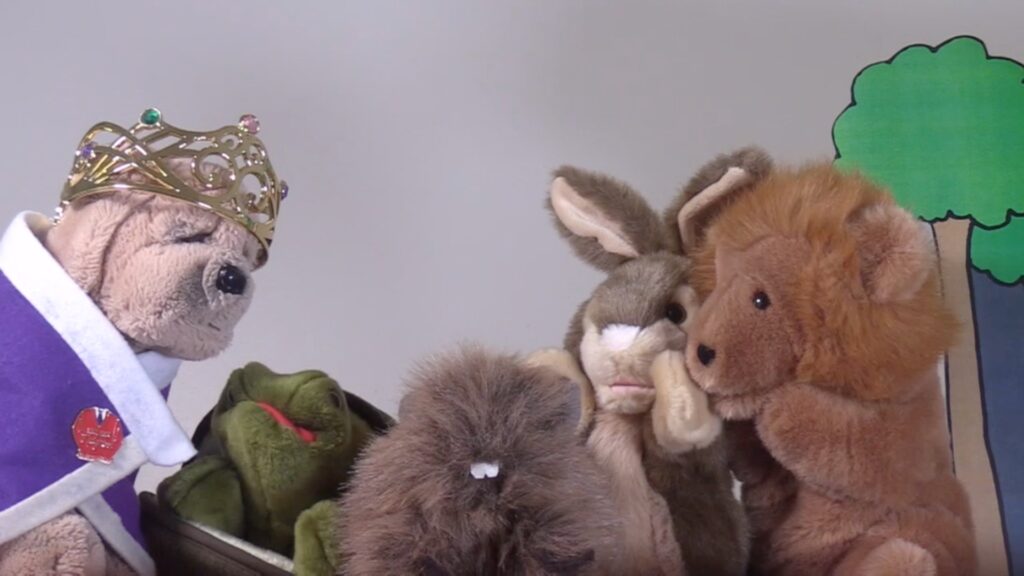
Rolf, Sharpie, Possum, and the gang decide to act out another story from the Ramayana.

Click on the image above to view the video on Vimeo.

Full script below the fold.


Rolf: I want to hear the story of the Pool of Enchantment!

Sharpie: Oh, yes, the story from the Ramayana. I’ll act out the part of King Yudhisthira.

Possum: The King, or rather the Queen, and her siblings were chasing a deer who had stolen the wood needed to start a Brahmin’s sacred fire. After chasing the deer for a long time, they sat down under a tree, so thirsty they couldn’t go on.

Sharpie: If we don’t find water soon, we’ll die. Nakula, climb this tree to look for water.

Birago: There’s water over there.

Sharpie: Go get some water and bring it back to us.

Possum: Nakula soon found a pool of clear water. A Crane stood at the far edge of the pool.

Birago: Water! I’m so thirsty!

Voice: Do not drink, O Prince, until you answer my questions.

Possum: Nakula was thirsty, so he ignored the Voice. He drank the cool water, and in a few moments lay dead beside the pool.

Sharpie: Where is Nakula? Sahadeva, you’ll have to go and bring us some water.

Castor: On my way!

Castor: Nakula, dead! I’m so thirsty, I’ll drink before I find out what killed him.

Voice: Do not drink, O Prince, until you have answered my questions.

Possum: But Sahadeva had already drunk from the water, and also lay dead beside the pool.

Sharpie: Arjuna, find our siblings, and bring us water.

Nicky: I’ll take my bow and arrows, just in case.

Nicky: My two siblings, dead! I’ll find who or what killed them. But first, I’m so thirsty.

Voice: Do not drink, O Prince, until you have answered my questions.

Nicky: Who are you? Come out and fight with me.

Voice: Bwa ha ha ha. Do not drink, O Prince.

Possum: Soon Arjuna, too, lay dead beside the pool.

Sharpie: Bhima, go find our siblings, then bring water back to me.

[Nods silently.]

Possum: Seeing his siblings, Bhima wondered what evil demon had killed them.

[Looks around in silence.]

Voice: Do not drink, O Prince, until you have answered my questions.

Possum: When the Queen realized that her siblings were not going to return, she went to the pool herself.

Sharpie: This must be the work of some evil spirit. But I am so thirsty, I will drink first.

Voice: Do not drink, O Queen, until you have answered my questions!

Rolf: They shouldn’t have drunk the water!

Nicky: Who’s that strange Voice that speaks?

Possum: We’ll have to wait until next week to find out….

The Story of the Flower Communion

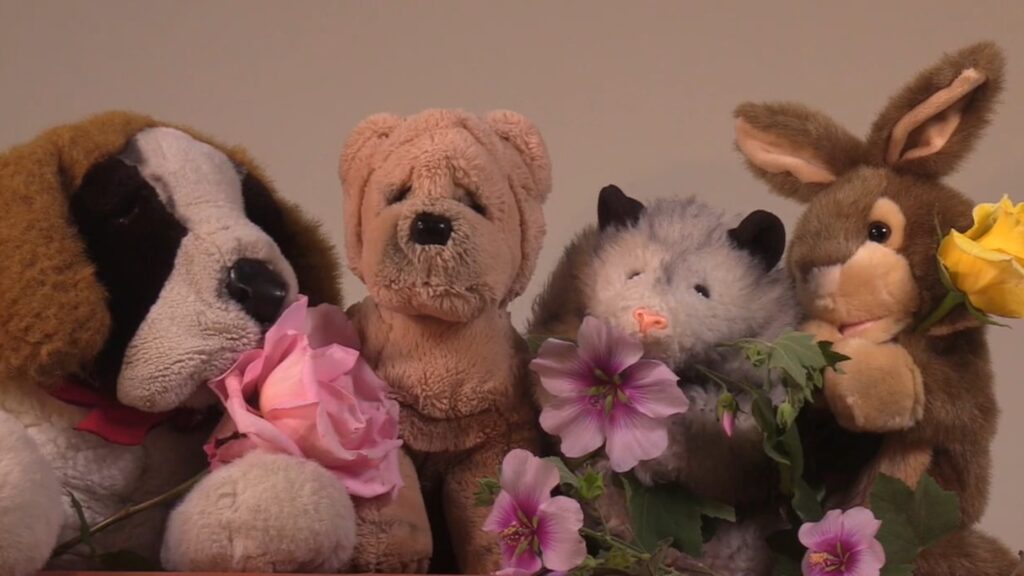
Dr. Sharpie, Rolf, Possum, and Nicky ask to be told the old story of the UU Flower Communion, or Flower Celebration.

Click on the image above to view the video on Vimeo.

Full script below the fold.


Rolf: Dan, can you tell us the story of the Flower Communion again?

Dan: Don’t you know that story already?

Possum: You tell it better. But you don’t have to tell us that Unitarian churches in the Midwest did flower services starting in 1875.

Rolf: Just start with Maja Oktavec, when she came to the United States from the Czech Republic.

Sharpie: And we already know that she was a librarian in the New York Public Library.

Nicky: And she fell in love with Norbert Capek, and they married in 1917.

Dan: OK, I’ll start there. Norbert was a Baptist minister, but he started to doubt his Baptist beliefs. Maja encouraged his doubts. After they married, he resigned from the Baptist ministry because of his doubts.

Rolf: They sound like Unitarians to me!

Dan: One day, their children wanted to go to Sunday school. Each week, the children chose a church to try. Afterwards, Maja and Norbert asked them what they had learned. It always sounded like the same old religion they had left behind, so they’d ask the children to try a different church next week.

Possum: Until the children went to a Unitarian church.

Dan: And they told their parents that they had been encouraged to wonder and to ask questions. So of course they returned to the Unitarian church. And Norbert and Mája decided that they’d attend the Unitarian services, and then they became Unitarians.

Nicky: Meanwhile, back in Europe….

Dan: The Capeks’ homeland became an independent country. The American Unitarians helped Norbert and Mája to go back to Czechoslovakia to start a Unitarian church in the city of Prague.

Sharpie: And they didn’t want to be reminded of the religions they had left behind.

Dan: In 1923, Norbert and Mája created a new Unitarian ritual that wouldn’t be like anything in any other religion. They called it the Flower Celebration.

Possum: Now we call it a Flower Communion.

Rolf: Yeah, and everybody gets to exchange flowers.

Nicky: Exchanging flowers symbolizes how all we are all connected to one another.

Dan: Soon the Unitarian church in Prague had three thousand members. It was largest Unitarian church anywhere. But next to Czechoslovakia, in Germany, the Nazis had taken over the government. In 1939, the Nazis began invading nearby countries.

Rolf: This is the scary part.

Dan: Maja came to the United States to raise money to help refugees who were escaping from the Nazis. While she was here, the Nazis invaded Czechoslovakia. Norbert was arrested because he spoke out for freedom. The Nazis put Norbert into a concentration camp, where he died in 1942. After the Nazis were finally defeated, Mája stayed in the United States. Norbert’s death made her sad, but she watned to keep working to make the world a better place.

Nicky: Now for the good part!

Dan: Maja decided to bring the joyous Flower Celebration to Unitarians here in the United States. What better way to remember Norbert, and all the Czech Unitarians who fought for freedom?

Possum: I’m glad Maja Capek brought the Flower Communion to the United States.

Sharpie: I like the way the Flower Celebration honors the connections between all beings.

Rolf: I like the flowers!

Nicky: Now I can’t wait till next year’s Flower Communion!

Dancing on May Day

It’s time for the annual Maypole dance, and the annual Morris dance — virtual, of course, in these pandemic times. But if the Morris dancers don’t dance on May Day, the sun won’t come up!

Click on the image above to view the video on Vimeo.

Full script below the fold….


Eric: Welcome everyone! It’s time for the annual UUCPA Maypole dance. This year’s dance will be a virtual dance. Everyone take a ribbon.

(Outdoor sounds)

Eric: You want a blue one? … If you’re following along at home, it’s fine to grab a virtual ribbon or an imaginary ribbon. When the music starts, half of you circle around one way, half of you circle around to the right. And make sure you weave between each other. OK, go!

(Music)

Eric: Over! Under! Weave!

(Music)

Eric: Over!

(Music)

Robert: Good morning. Morris dancing is an ancient English traditional dance form. And today’s dance is inpsired by one observed in the village of Adderbury about a hundred years ago. It’s meant to be danced in the spring to encourage the earth to wake up and produce goodness, fertility. So when it comes to whacking, you might want to whack something. All right Maestro, let’s dance.

(Music, and sounds of sticks hitting)

Eric: You know, of course, that spring will only arrive if the Morris dancers dance at May Day. Now that we’ve danced, spring can come. Welcome, spring time!