On Monday, Zoom released a major update to the Zoom client. If your church is using Zoom for religious education and services, note that the 5.0 version will be required for all users by May 30, so start reaching out to your congregation now — after May 30, they won’t be able to log in to one of your meetings without upgrading.
If you run kids’ programs on Zoom, you will want to upgrade now. Zoom has plugged some obvious holes that could be exploited by trolls — or by mischievous kids wanting to disrupt a class. Most important, the host “can disable the ability for participants to show their profile picture or change it in a meeting.” Other critically important security upgrades for those of us who do Zoom meetings with legal minors include the ability to embed an audio watermark in recordings (you really don’t want anyone recording minors without parental permission). And there are a few other enhancements to security that will also be helpful to teachers.
I spent much of this week producing and aggregating online content suitable for UU kids. I’ve been trying to keep up with my sister, Abby, who’s been recording read-aloud videos at a breakneck pace — some of her videos have their own dedicated playlists at the UUCPA CYRE Youtube channel: Alice’s Adventures in Wonderland, and The Wonderful Wizard of Oz. I’ve been posting Beth’s Aesop’s Fables on another playlist. Yet another playlist has Amy reading aloud The Secret Garden.
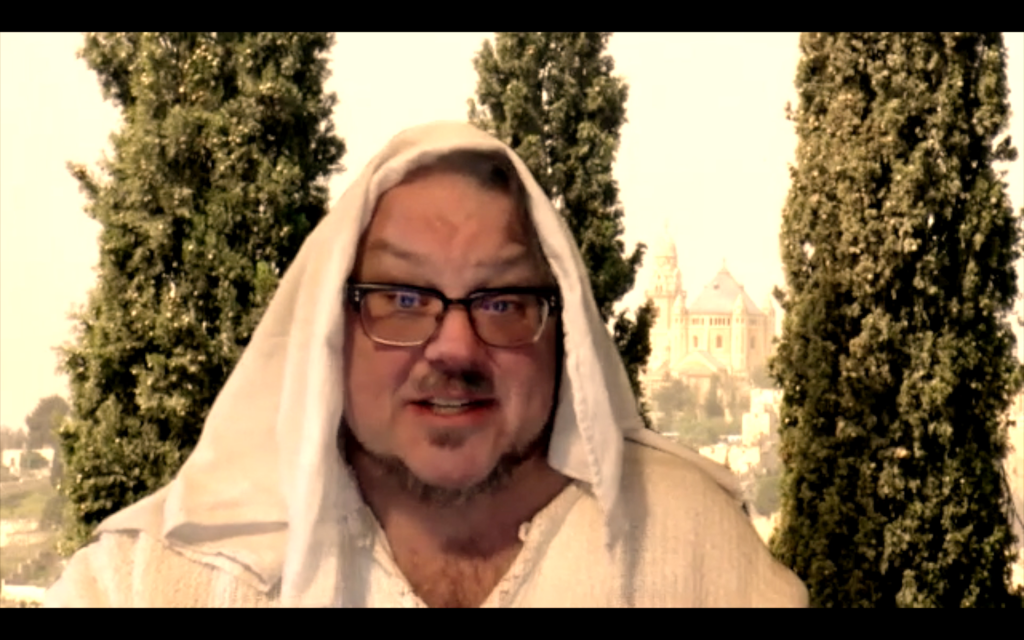
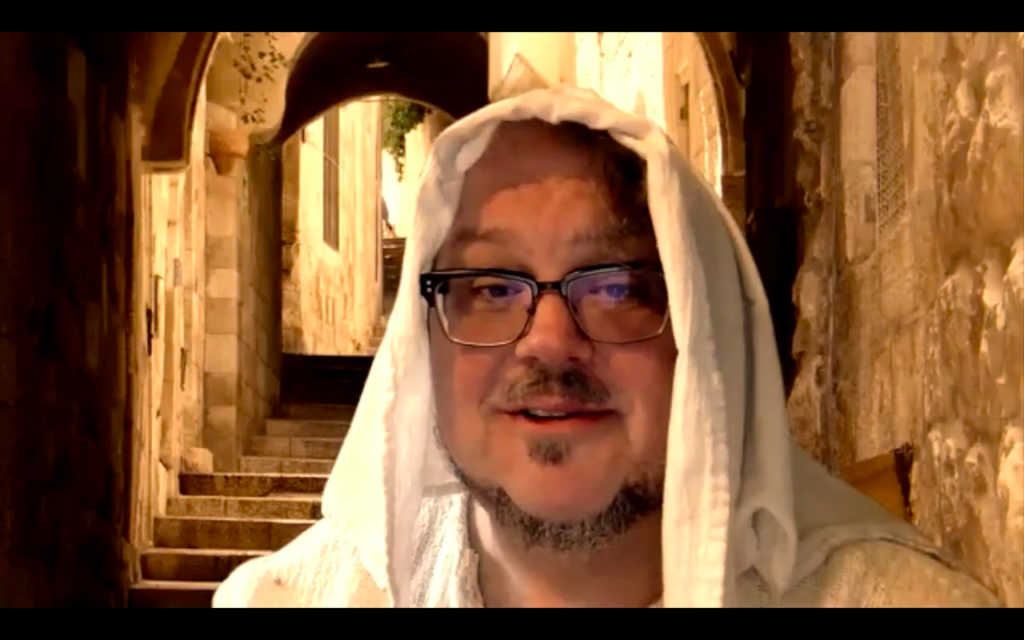
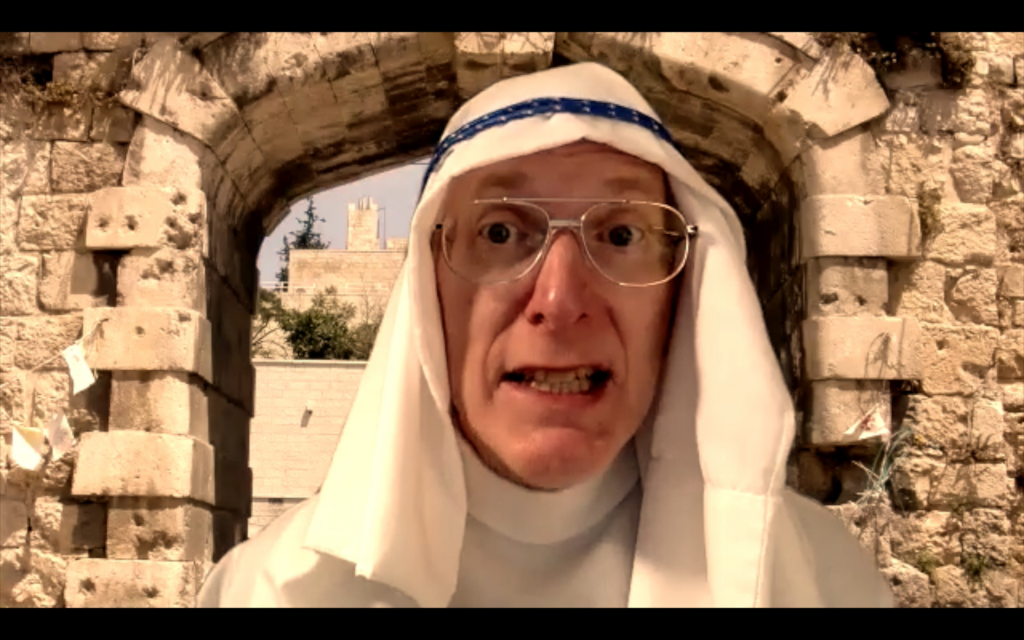
Barnabas (played by Greg Becker) in the latest installment of the “Back in Time” saga.
It’s not easy to figure out how to make good online religious education content in the era of COVID. First and foremost, parents tell me that they don’t want another lesson plan; they’re sick of helping their kids do online school lessons, they don’t need another burden. So that means the videos I post have to require minimal supervision from an adult. Second, religious education is always optional, which means it has to be fun or engaging or no one will watch it.
These two constraints mean I have to interpret “religious education” pretty broadly. How is listening to “Alice’s Adventures in Wonderland” religious education? Well, Unitarian Universalist religious education has always included the broad goal of supporting literacy; we want children to grow up thinking for themselves, and literacy promotes that in a number of ways. So while “Alice” doesn’t have any religious content per se, it’s a book that encourages literacy because it makes kids want to read.
And how is a series on “Things To Make” religious education? Well, the things I’m showing kids how to make promote independent play; they give kids a sense of agency; they cultivate creativity instead of consumption; and they have kids engage in hands-on embodied activities as a partial antidote to the disembodied lives many of us are now forced to lead online. This is rooted in good feminist theology: promoting embodied activities, promoting agency instead of passivity.
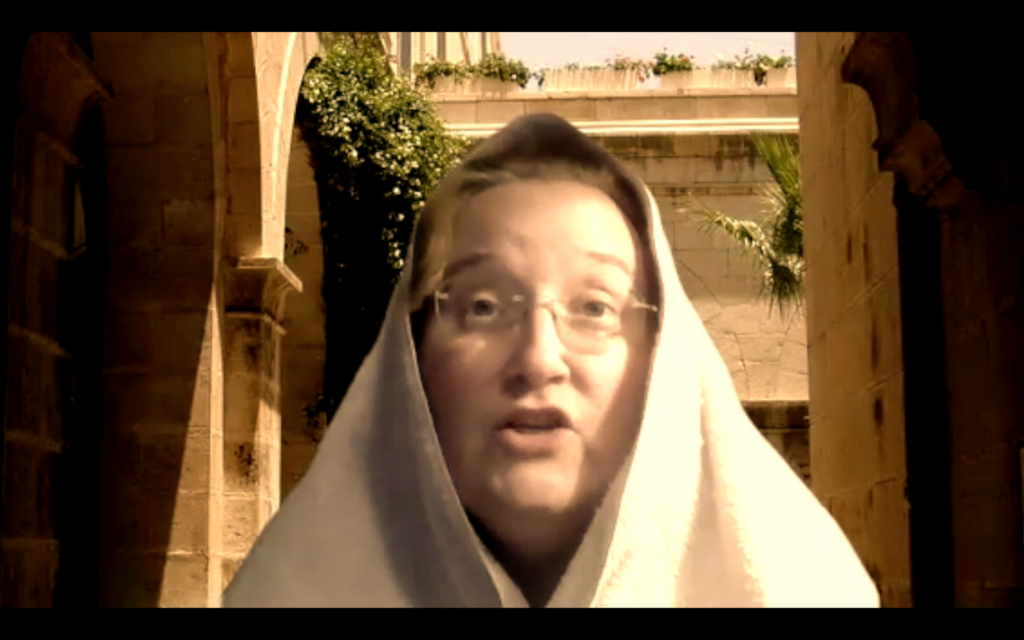
The “Back in Time” video saga could be considered religious education by almost any definition. (Yes, it would be considered rank heresy by many, but it’s still education on a blatantly religious topic.) The Aesop’s Fables series could certainly be considered moral education. But I think both showing kids how to make things, and reading aloud to kids, help us achieve some of the larger educational goals of Unitarian Universalist religious education.
Update, July 24: I’ve now added posts with links to the “Back in Time” series of videos on Youtube, as well as to subsequent video “Stories for All Ages.” The posts are backdated to the release date of the video, and include the full script for each video. You can see the entire series of posts here.
I like several things about Abby’s videos. First, they’re a great supplement to Zoom calls — some of us are getting Zoom burnout, and it’s nice to be able to watch a video when YOU want to watch it. Second, they’re Goldilocks videos — not too long, not too short, but just the right length. Third, they don’t put a big burden on parents — the crafts project can be done by kids on their own without parental supervision, kids can watch the installments of Alice on their own, and the story time for young children has them doing what they’re going to be doing anyway which is sitting in a parental lap.
So I repurposed this Youtube channel, where I already had some religious education videos. I added a video we used in last Sunday’s service. I created a couple of playlists, one for crafts (Abby’s craft video is included there), and another for story time (Abby’s Alice stories are going there, because Alice in Wonderland is a sacred text). I’ve got a children’s librarian from our congregation half convinced to do a story time, I’m planning a story time (I think I’ll read aloud from an old edition of the Jataka Tales), there will be more crafts projects.
Blog readers, if you know of some videos that you think would be appropriate to share on this Youtube channel, please send me the links. I can’t promise to put everything up, but I’d really like to see your suggestions — send them to danharper then the little “at” sign then uucpa then a dot then org.
Nadine offered to do a virtual Sunday school session today for our gr. 2-3 group (which we call “Green class”). Her plan was simple: light a chalice, have time for check-in, read a story, everyone say our unison benediction together. I haven’t yet hear from her how it went.
Nadine’s idea inspired Carol and Ed, two of the teachers of the middle school “Ecojustice Class,” who put together an online session for that group. Carol and Ed planned a half hour session including lighting the chalice, a check-in where kids could talk about what’s going on in their lives, and a virtual tour of the Ecojustice Class garden, rain barrels, and composter.
Three middle schoolers logged in, and two siblings tagged along, for a total of five kids. Here’s a screen shot of Carol lighting the chalice:
Though Carol and Ed expected the session to last only half an hour, the kids were having fun, and ultimately the session went on for about an hour. (Carol has the free version of Zoom with a 40-minute limit on videoconference calls, but at 40 minutes she got a message saying Zoom would extend the videoconference for free; thank you Zoom!) They talked about how coronavirus shows that the non-human world still has a lot of power over humans, and they also talked about how people who are poor or otherwise vulnerable get hit hardest by natural disasters like this pandemic. One of the kids drew boba bunnies (don’t ask me what they are, I’m just telling you what Carol told me), and that led to a discussion of how boba tea tastes good but uses a lot of single-use plastic, and where tapioca comes from, and so on.
From what Carol said, it sounds to me as though there was the typical Sunday school ratio of social interaction to learning — more than half social interaction, plus some learning — and since our primary educational goal is to have fun and build community, this class definitely helped us reach that goal.