Marketing for congregations

When I arrived at First Parish in Cohasset in August, I started watching for newcomers. Of course, I didn’t know most of the people, but each Sunday I would ask the long-time members if there were any newcomers.

We had no newcomers in August. One in September. None in October. Then two so far in November.

As a former salesperson, when I see so few newcomers I immediately assume that there’s no marketing going on. That’s what marketing does — it reaches people who are new to your business (and a small nonprofit organization like a congregation is a business). The primary form of marketing for most Unitarian Universalist congregations is a website. So I decided to take a look at the First Parish website. I found that since the COVID pandemic had started, there had been very little new material added to the website (no surprise there, people were busy doing other things). The administrator and I started adding content to the website at least weekly, beginning in October. Sure enough, we got a couple of newcomers stopping by in November.

I’d like to believe the tiny uptick in newcomers is a result of our markting efforts. Of course I know this is the worst kind of evidence — it’s all anecdotal, there’s no way of proving a causal relationship, etc., etc. I know that I could simply be deluded by confirmation bias here — I see something that confirms what I already believe, and continue to believe what I believe.

But I still think marketing works. If your website is your only form of marketing, then paying attention to your website should yield dividends.

Borrowing vs. appropriation

In an interview with Religion News Service, author Liz Bucar talks about the difference between religious (mis)appropriation, and religious borrowing:

“Religious borrowing has always existed. It’s certainly a big part of the way religion in America is experienced and consumed, especially if you think about the spiritual but not religious or the nones. Some forms of cross-tradition borrowing are positive. For me, borrowing is the bigger category and appropriation is the problematic form. And the reason it’s problematic, for me, is when the borrowing happens in conditions of injustice, oppression and power inequities. That’s what generates harm.”

In fact, we might say that syncretic religions (and most religions have at least some syncretic elements in them) depend on religious borrowing.

But it’s religious misappropriation that we have to be concerned with. And I believe Unitarian Universalists are particularly prone to religious misappropriation. Here’s Liz Bucar again:

“I think that progressive secularists, a community which the academy is full of and which I’d probably identify with, haven’t always been understanding of religious communities or thought of them as a source for what human flourishing can look like. They often think about religious communities as problems to be solved, or as people ruled by hierarchical institutions or arcane rules and doctrines. This position sets them up for maybe not being as respectful or deferential to religious claims as they could be.”

Honestly, this sounds like Unitarian Universalists. We look a lot like progressive secularists. Many of us treat religion as a problem to be solved, rather than a source of human flourishing. We set ourselves up to be less than respectful to other religions — even perhaps less than respectful to our own religion.

“The quarrel is with the organized part…”

Religion New Service reports on religiosity trends in the US, as found in the 2021 General Social Survey (GSS). The GSS concluded that religious participation declined rapidly during the COVID pandemic. But Michael Hout, professor of sociology at New York University, and two colleagues raise questions about that conclusion. Participation in organized religion may have declined, but in their interpretation of the data, religiosity did not decline as much.

The article raises questions of survey methodology, which are fascinating in themselves. For example, in-person surveys and online surveys have different strengths, and produce different results. And people are less likely to want to participate in surveys these days, because social media allows a better outlet for people’s opinions.

As fascinating as the discussion of methodology was, I was more interested in a couple of Hout’s conclusions.

First, that the decline in participation in organized religion has come mostly among occasional attenders — what I call “CEO Christians” or “Christmas and Easter Only Christians.”

Second, according to Hout, “Atheism is not what’s happening. If we think of organized religion as a conjoined thing, the quarrel is with the organized part, not the religion.”

Both these conclusions sound correct to me. So I’d be interested in a survey that attempted to find out why people “quarrel with the organized part, not the religion.” Are people turned off because of abuse scandals? because organized religion doesn’t feel authentic any more? because of trends outlined by Robert Putnam in Bowling Alone? because people have more choices with their leisure time? because of trends towards hyper-individualism? because religions are organizing in new ways (e.g., network Christianity) not found by surveys? because surveys have a biased understanding of “religiosity” that is not keeping up with the way people are living their religion?

2020 U.S. Religion Census nears completion

Religion News Service (RNS) reports on some preliminary conclusions from the the 2020 U.S. Religion Census. This decennial census has been carried out since the 1950s, by the Association of Statisticians of American Religious Bodies.

As expected, the number of “adherents” (persons affiliated with a local congregation) has declined since the last such census. But religious groups that have a lot fo immigrants are doing quite well.

For example, Roman Catholics have grown modestly, from 59 million adherents to 61 million adherents. But essentially all that growth comes from Hispanic immigrants. RNS reports: “‘If you took away the Hispanic population in the Catholic Church, it would look as bad as mainline denominations,’ said Scott Thumma, director of the Hartford Institute for Religion Research….”

A more striking example: American Muslims. RNS interviewed Ihsan Bagby, associate professor of Islamic Studies at the University of Kentucky, about Muslims in the U.S. RNW summarizes Bagby’s thoughts as follows: “Muslims may be in a kind of golden age in the U.S. They are younger than the American population overall, and the Boomers among them are financially well off and able to contribute to the construction of new mosques.”

Also worth noting from the RNS report: They interviewed Scott Thumma, director of the Hartford Institute for Religion Research, who said: “Denominational brands have weakened, and divisions have increased over issues such as female clergy or sexual orientation….” Unitarian Universalism may be somewhat insulated from these trends, since we generally agree with each other on female clergy and sexual orientation (we had those fights in the last century). But I suspect we are still affected by the weakening of denominational brands.

I’ll be watching the website for the 2020 census, to see when the full report is finally released.

Race, religion, and imperialism

In the past couple of years there has been a resurgence of interest in the connections between racism, religion, and imperialism. But these connections have been a topic of conversation for over half a century. Today, were more likely to talk about colonialism, but the connections are the same. Here’s theologian Benjamin E. May in 1954:

“Race and color did not count in the early existence of the Protestant church. It was when modern Western imperialism began to explore and exploit the colored peoples of Africa, Asia, and America that the beginning of segregation and discrimination based on color was intitiated. It was then that color was associated with ‘inferiority’ and white with ‘superiority.'”

— address by Benjamin E. Mays, Second Assembly of the World Council of Churches in Evanston, Ill., August 21, 1954; quoted in Gary Dorrien, The Making of American Liberal Theology: Idealism, Realism, and Modernity, 1900-1950, p. 427

Gloom

The U.N. just issued a report saying that it’s unlikely that world leaders will meet emissions targets, meaning that it’s unlikely that we will be able to keep global temperature rise at 1.5 degrees Celcius.

In other words, we’re fucked. Because with Putin on a rampage, and United States political leadership tearing at each other like mad dogs, and China going down a rabbit hole of total control and authoritarianism, we’re seeing a total lack of leadership from three countries that actually could do something about climate change.

Putin’s strategy for ending the climate crisis appears to be starting a nuclear holocaust. America’s climate strategy appears to be declaring this a Christian nation (um, I guess God is going to bail us out?). China’s strategy appears to be ignoring it and hoping it goes away.

Actually, those leaders are all incredibly rich. They’re probably all assuming that they are rich enough to be able to insulate themselves from the worst effects of climate change.

For an adequate description of our world leaders, we need the words of a great poet. Like these words from the immortal Benny Hill (which I changed just a little tiny bit):

“Now if you’re feeling miserable, if you’re feeling blue,
Here’s a little ditty that’ll help to pull you through,
Climate change will disappear, the grey skies turn to blue:
Just stick your finger in your ear and go ting-a-ling-a-loo.

“Greta Thunberg said ‘Get your fingers out,’ and that cut us to the quick,
We took our fingers out, but it didn’t do the trick.
Now we follow our world leaders with all our might and main:
Be like Putin, Trump, and good ol’ Xi — and stick ’em back again!

“Yes, stick your finger in your ear and go ting-a-ling-a-loo,
Climate change ain’t real, just go ting-a-ling-a-loo,
Remember what George W. said in 2002:
Stick your finger in your ear and go ting…a…ling…a…loo!”

Yet another holy book

Rodney Kennedy, in an opinion piece on Baptist News Global, says:

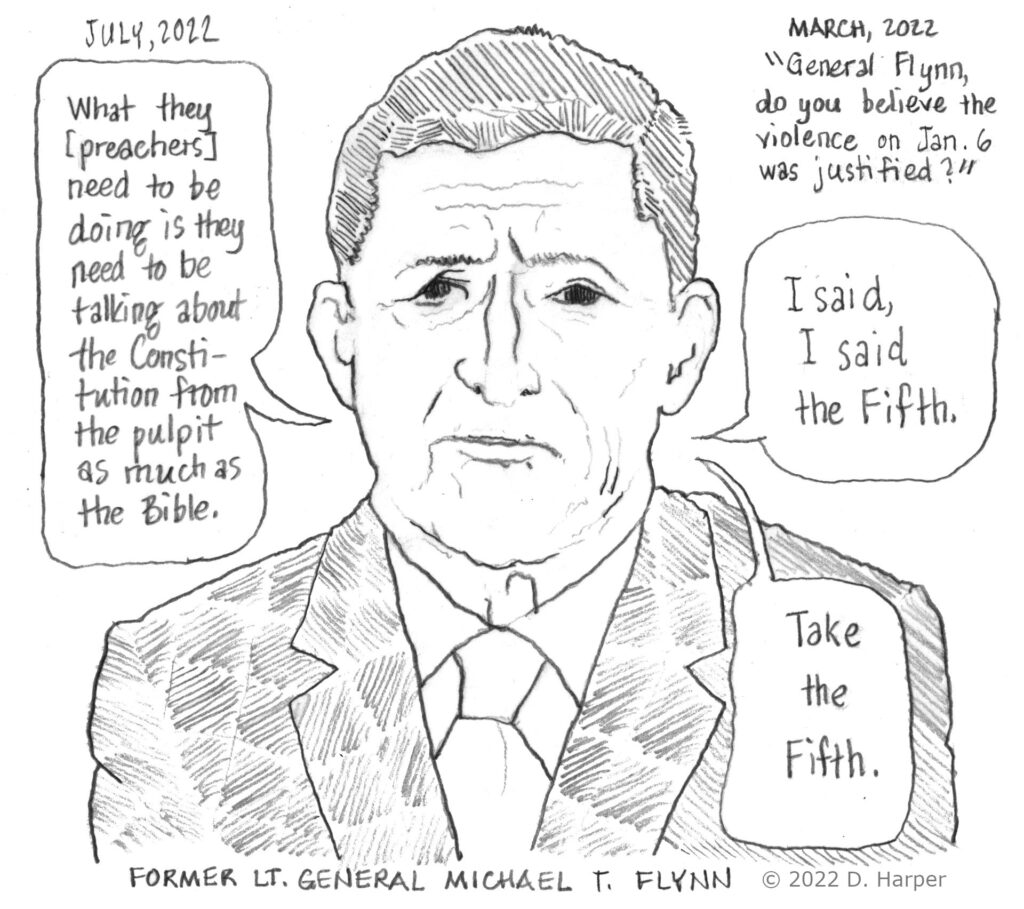
“I’m attempting to wrap my mind around the idea of a former Army general telling me I should preach from the U.S. Constitution. I mention this only because Michael Flynn has been occupying American pulpits, recommending the Constitution as a second holy book for preachers. ‘What (preachers) need to be doing is they need to be talking about the Constitution from the pulpit as much as the Bible. They have to do that,’ Flynn has said.”

Kennedy calls Flynn’s remark idolatrous. From his Christian point of view, the Bible stands alone and does not need to be propped up by any other texts.

I don’t know if Flynn actually believes what he said, or if he just said it to draw audiences. (Time reported that Flynn made $150,000 in 2016 for speaking engagements, a strong motivation to say what his audiences want to hear.) But I do know Flynn is giving voice to an opinion genuinely held by many people in the United States. These folks genuinely believe that the U.S. Constitution is divinely inspired, just like the Bible, and thus should be treated as a sacred text. These folks use short passages from the U.S. Constitution as proof texts, just as short passages from the Bible are used as proof texts, to prove the truth of a certain theological opinion or doctrine.

What a fascinating historical moment. We seem to be watching a sort of new Great Awakening, a movement which curiously adds the U.S. Constitution as a sacred text co-equal to the Bible. Like previous Great Awakenings, these folk are vibrant and adventurous and enthusiastic. My Puritan forebears would have said that enthusiasm results from excessive religious emotions that come from a deluded conceit that one is specially favored by God, and I’m still enough of a Puritan to agree. Nevertheless, what a fascinating historical moment.

Global chalice lightings

The International Council of Unitarians and Universalists (ICUU) is now defunct, another victim of COVID. According to Inga Brandes, ICUU President in 2021, “With the Covid Pandemic, the climate Emergency, and underlying funding issues, ICUU is facing major problems of sustainability and impact.” And so we now have the International U/U Collaboration.

This is sad, but not entirely surprising. As I understand it, ICUU funding has been precarious for some time. All best wishes to the new group.

However, in the transition, the old ICUU website disappeared, along with some 212 “global chalice lightings.” The global chalice lightings were words for lighting the chalice, submitted by Unitarian / Universalist communities from around the world, and often translated into multiple languages. These were a tremendously useful resource. Not only did they give insight into the internal diversity of global Unitarian and Universalist communities, not only were many of them useful in worship services, but they also were one of the only linguistically diverse Unitarian Universalist resources we had.

Yes, we have UU hymns and readings in Spanish. But here in the United States, there are Unitarian Universalists who are fluent in many other languages, and/or whose first language is other than English. For example, in my past two UU congregations, I shared global chalice lightings in Portuguese, French, and German with native speakers of those languages. I’ve known one or two African American Unitarian Universalists who felt some connection to global chalice lightings from Nigeria, and the occasional Filipino American Unitarian Universalist pleased to see global chalice lightings from the Philippines.

I hope someone has saved all those global chalice lightings, and makes them available again. The new website of the International U/U Collaboration has less than a dozen of them. I can’t find them on the UUA website. I did manage to get all the global chalice lightings from 2003 through 2014 from the Wayback Machine. But after 2014, it’s much more difficult to pull the global chalice lightings from the Wayback Machine.

The ICUU global chalice lightings are undoubtedly covered under international copyright. So I’m not going to post any of them here on my website (though I’m willing to share them with individuals if you email me directly). And if you happen to have a collection of ICUU global chalice lightings from 2015 on, and you’re willing to share, please leave a note in the comments below!

Thinking about Abigail Eliot

Abigail Eliot was a member of the Unitarian Universalist church I grew up in. I have only vague memories of her, but somehow knew she was someone important. I didn’t realize just how important she was until I read No Silent Witness: The Eliot Parsonage Women and Their Unitarian World by Cynthia Grant Tucker.

It turns out that Abigail Eliot was a pioneer of early education in the United States, and one of the founders of the National Association for the Education of Young Children (NAEYC). Eliot first trained at Margaret McMillan’s famous nursery school in England. McMillan developed the nursery school for children who lived in English slums; her school was designed to educate the whole child, mind and body, including nurturing health through outdoor education. Eliot returned to the United States and founded the Ruggles Street Nursery School in Boston.

While Eliot was not the first person to bring the nursery school concept to a city in the United States, she was one of the most influential pioneers of American nursery schools. She founded her school in 1922, and four years later turned her school into a training center for other nursery school teachers. Eliot’s training center for educators continues in the Eliot-Pearson Children’s School, a lab school that’s part of the Eliot-Pearson Department of Child Study and Human Development at Tufts University.

In addition to the material on Abigail Eliot in No Silent Witness, here are links to more information about her life and work:

I think Abigail Eliot has become a spiritual exemplar for me. She dedicated her life to child-centered education, and in so doing used her significant intellectual talents for the betterment of humankind. I wish I had better memories of her, but all I really remember is seeing her walk down the driveway to her house near the church. My friend Alison, who is my age and grew up in the same Unitarian Universalist church I did, is lucky enough to retain vivid memories of Abby Eliot. Perhaps not surprisingly, Alison went on to a lifelong career as a kindergarten teacher, and now Alison’s daughter is a schoolteacher in East Boston.

Those older Unitarian Universalists, people like Abigail Eliot, inspired many of us younger Unitarian Universalists to devote our careers to making the world a better place. Many of those older Unitarian Universalists worked in fields that are mostly ignored by the public. (Sadly, Abigail Eliot’s contributions to humankind receive far less recognition than those of her famous poet cousin, T. S. Eliot.) Yet what I learn from those older Unitarian Universalists is that public recognition is less important than doing good work in the world. That’s one of the reasons why we should continue to hold them up as spiritual exemplars.

Clerical stoles

In two earlier posts (one and two), I wrote about preaching gowns. Personally I’m not a fan of preaching gowns, but I understand why they can be of use. Now I’d like to think out loud about clerical stoles.

Stoles are those long pieces of cloth that clergy drape around their necks. The stole comes from the Christian tradition. I don’t remember Unitarian Universalist clergy using stoles until the 1980s. My recollection is that Eugene Pickett, when he was president of the Unitarian Universalist Association, insisted that clergy should wear stoles. By the 1990s, clerical stoles were pervasive in Unitarian Universalism. And by 2003, the year I participated in the Service of the Living Tradition as a newly ordained minister, I think I was the only minister who didn’t wear a stole.

Some people understand the stole to be a symbol of ordination. But choirs that wear robes often also wear stoles, and we generally expect most of our choristers to be non-ordained persons. So I’m not convinced that the stole is a symbol of ordination, and only to be worn by ordained clergy.

Also, stoles are reminiscent of other special religious clothing in other traditions. A stole is somewhat similar in appearance to the Japanese Buddhist wagesa, though the wagesa has very specific symbolic meanings (as I understand it) which obviously differ from any symbolism a stole might have. A stole is perhaps slightly reminiscent of the Jewish tallit or prayer shawl, insofar as it’s something to drape over your shoulders when engaging in religious observances.

It seems to me that there are other cultures that drape long pieces of cloth around your neck. Think of Hindu men who wear a dupatta over a sherwani for their wedding. I feel like there are other examples, though I can’t think of any right now. So even though there’s a strong connection between the stole and Christianity, it you take the cross off a stole maybe it’s not a Christian stole any more. When Unitarian Universalist minister Hank Peirce wears his Boston Bruins stole, there isn’t much connection between the stole and Christianity.

I don’t like wearing a preaching gown, but I feel reasonably comfortable wearing a stole. I think of it as a uniform. Like when I worked at the lumber yard, and I had to wear a shirt with a “Concord Lumber Corp.” patch over the shirt pocket, and my first name embroidered on the other side of my chest. (And yes, I’ve thought of having a stole made with a patch that says “First Parish Unitarian Universalist” on one side, and my name embroidered on the other side, but rejected the idea for obvious reasons.)

I wish I didn’t have to wear any special clothes to be a minister. As a Universalist, I think all humans are of equal worth, and wearing special clergy clothing sets my teeth on edge. But I realize that people want to see their clergy wearing some kind of uniform. For me, a stole represents a reasonable compromise between egalitarianism and the need for a uniform. So on Sunday, when I participate in the Town of Cohasset 9/11 observance, I’ll be in uniform, wearing a stole.

(Getting a stole for Sunday proved to be a challenge. I have a stole that my younger sister gave me when I was ordained, but it’s still in a moving container somewhere. I just found out about the Cohasset 9/11 observance, and had to get a stole on short notice. But finding a stole without any Christian symbolism on it, that could be overnighted to me, was a challenge. I finally found Threads by Nomad, a small company that’s trying to provide clothing that doesn’t do “damage to people or the planet.” They had clergy stoles on sale and they were able to overnight one to me. Sadly, it looks like they’re selling off their stole inventory, so maybe it hasn’t been a good business opportunity for them. Their website tells me that the stole I bought was “made from a fabric called mud cloth from Mali. Mud cloth is dyed using fermented mud — a traditional dying technique in many parts of the world but notably in West Africa. Our mud cloth is not mass produced and therefore every piece is different in design.” Since I’ve been influenced by African philosophy, this seemed like a serendipitous find. Plus the stole was made by an “artisan [who was] fairly compensated.”)