The long title of the article pretty much tells the whole sick story, but some of the quotes are revealing. The author interviews Tsunami Turner, who works as an educational psychologist at a company in San Jose that provides “child-centered therapy” as well as IQ testing services:
“‘Some parents come in with an IQ number in mind. They are really wanting to have their child hit a specific number,’ she said. Their kids are often very accomplished, taking dace, soccer, art, and music — and know they ‘have to get a certain number.’ They show up ‘highly anxious,’ she said. If scores come in lower than expected, Turner gets pushback and requests for retests.
“‘There’s a lot of societal pressure. The family is incredibly busy and wants their kid in a school that challenges their intellect and supports their development,’ she said. It can spiral quickly. ‘The goal is that a child will get into a good primary school, and that will lead them to getting into a good college, which will lead them to getting a good job and doing really well in the world.'”
In my 13 years working as a minister of religious education in Silicon Valley, I saw some of this — not so much among the families in the UU congregation there, because if you’re trying to fast-track your kids in this way, you don’t waste time on things like moral and spiritual education — but I did see it happening. It really is true, some well-to-do Silicon Valley parents start trying to build their child’s resume starting when the child is 2 years old. I feel this phenomenon is bad for children, and tends to result in accomplished but stunted and less-than-fully-human adults.
Sikhs are strongly monotheistic. The first words in the Guru Granth Sahib, their collection of holy writings, say “Ek Onkar,” or “God is one.” Furthermore, God is transcendent and has not been incarnated in some physical form. Guru Nanak, the founder of the Sikh religion, wrote a statement of belief that can be translated as follows (reference: Pluralism Project):
There is one God whose name is True. God is the Creator. God is without fear. God is without enmity. God is of eternal form. God is unborn, uncreated, beyond incarnation. God is self-existent and self-sufficient. God is attained by the grace of the Enlightener.
Thus within the Sikh worldview, it would be wrong to say that there is more than one deity. The Sikh religion does recognize a series of ten holy persons, the gurus, of whom Guru Nanak was the first. These human beings are not considered deities by Sikhs — even though from the perspective of other worldviews they may seem to take on some of the qualities of lesser deities — but rather they may thought of as humans who had a special connection to God and who are tehrefore worthy of veneration.
Guru Nanak lived in the Punjab region of South Asia, a place where Hindus and Muslims both claimed their religion was true. Guru Nanak said that God transcends such divisions, and famously proclaimed that there is no Hindu, there is no Muslim.
The story is told that Guru Nanak once visited Mecca, the most holy city for Muslims. Sayad Muhammad Latif, in a history of the Punjab, tells what happened there:
“He (Guru Nanak) travelled over the whole of India, visited Persia, Kabul and other parts of Asia, and it is said even Mecca. A story is related by both Hindus and Muhamadans [sic] in connection with Nanak’s visit to Mecca. It is said that while at Mecca, Nanak was found sleeping with his feet to the Kaba, before which the Muhamadans prostrate themselves when performing their devotions. The Kazi Rukan-ud-din, who observed this angrily remarked: ‘Infidel, how dare you dishonour God’s house by turning your feet towards it.’ ‘Turn them if you can,’ replied Nanak, ‘in a direction where the house of God is not.'” (quoted in Kazhan Singh, History and Philosophy of the Sikh Religion: Part I: History, Lahore: Newal Kishore Press, 1914, p. 99)
This story gives a sense of the Sikh conception of God — transcendent, omnipresent.
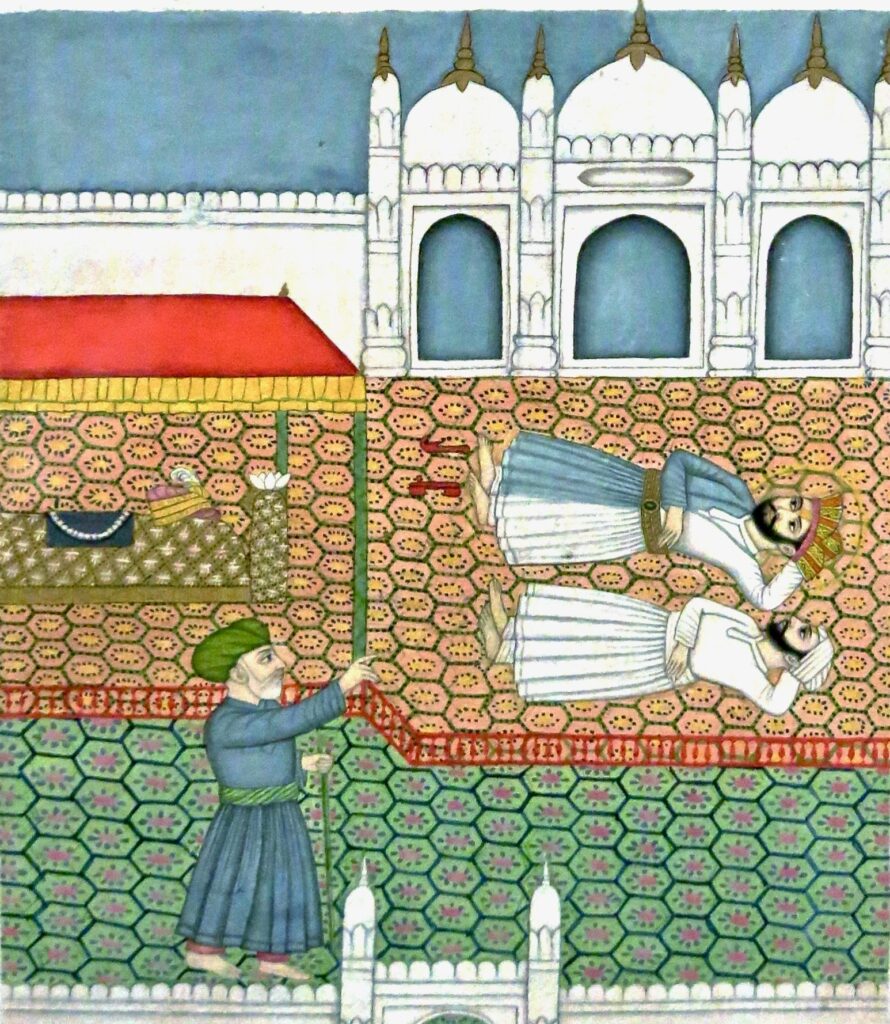
A lovely painting on paper from West Bengal, painted in the mid-eighteenth century and currently in the Asian Art Museum in San Francisco, depicts Guru Nanak sleeping with his feet towards the Kaba:
Labeled in the museum as follows: “Guru Nanak and his disciple encounter a Muslim cleric at Mecca, from a manuscript of the Janam Sakhi (Life Stories)” / Approx. 1755-1770 / India; probably Murshidabad, West Bengal state / Opaque watercolors on paper / Gift of the Kapany Collection, 1998.58.23. [N.B.: While there are many photos of this painting online, I took this photo myself on Sept. 18, 2015, and digitally edited it in 2025; photo copyright (c) 2025 Dan Harper.]
In another version of the story, a Muslim cleric kicks Guru Nanak for sleeping with his feet pointed towards the Kaba, then grabs hold of the guru’s legs and tries to turn his feet away, but “lo and behold the miracle the whole of Mecca seemed to be turning.” (Vaaran: Bhai Gurdas, Pauri 32, At Mecca)
According to tradition, the Nicene Creed turns 1,700 years old tomorrow.
I was born into a Unitarian family, and as old-school New England Unitarians, we didn’t think much about the Nicene Creed. I mean that literally, and not in a snide sense: obviously the Nicene Creed was never recited in our Unitarian church, but beyond that no one even talked about it; it just wasn’t something we ever thought about.
If we ever thought of the Nicene Creed, we thought about it in negative terms, much the same way Professor Francis Christie of Meadville Theological School wrote about it in 1910:
“The symbol of Nicaea inaugurated a mania for fixed and irreformable definitions, a consequent scholasticism, a cessation of thought, a weakening of the moral force of the church, a period of superstitious ritualism.” (Francis A. Christie, “The Significance of the Nicene Creed,” The American Journal of Theology, vol. 14 no. 2, April, 1910, p. 271.)
Today, I’d be less doctrinaire about the Nicene Creed. Even though the Nicene Creed’s trinitarian theology has never made much sense to me personally, I have friends for whom it remains a profoundly moving statement of theology (including some good Universalist friends). Part of being staunchly non-creedal is remaining open to the possibility of truth in creeds you don’t feel much emotional sympathy with. Yet Transcendentalist that I am, I continue to feel that Thoreau got it right when he wrote:
“…in dealing with truth we are immortal, and need fear no change nor accident. The oldest Egyptian or Hindoo philosopher raised a corner of the veil from the statue of the divinity; and still the trembling robe remains raised, and I gaze upon as fresh a glory as he did, since it was I in him that was then so bold, and it is he in me that now reviews the vision. No dust has settled on that robe; no time has elapsed since that divinity was revealed.…”
To use Theodore Parker’s terms, when it comes to religiou, there is that which is transient, and that which is permanent. Using these terms, Thoreau is talking about that which is permanent: “no time has elapsed since that divinity was revealed.” A creed, on the other hand, is a fallible human invention, and while it is useful for a time, it is nonetheless transient. The Nicene Creed has been useful to many Christians for 1,700 years, which is a very long time indeed; but it only points toward the divine, it is not itself divine. — At least, so sayeth my Unitarian forebears, with whom I entirely agree.
With those caveats, happy birthday to the Nicene Creed.
While researching the old Unitarian Church of Palo Alto (1905-1934), I came across someone who is famous enough to be featured on Wikipedia. He’s an entomologist, so he’s not famous famous. He’s not even that famous as scientists go. Still, he’s on Wikipedia so I think it’s worth drawing the attention of today’s Unitarian Universalists to him.
John Merton Aldrich
A renowned entomologist, he was born January 28, 1866, in Rochester, Minnesota. In 1870, he was living with his parents L. O. and Mary, and his older brother and younger sister, in Quincy, Olmsted County; his father was a farmer. In 1880, he was still in Quincy with his family, which now included another younger sister and a servant.
In 1881, John’s family moved to a farm in South Dakota. He attended the new South Dakota Agricultural College in Brookings, S.D., graduating in 1888 after just three years of study. It was in his last year of college that he first took a course in entomology.
Following his graduation, he taught school for a term, then went to study at the University of Minnesota. Although there was then no formal course in entomology at the university, John was able to study with Otto Lugger. Station Entomologist at St. Anthony’s Park. Then in the autumn of 1889, John went to Michigan State University to study entomology. It was there he first turned his attention to Diptera; as he later recalled, his professor advised him “to select a single order as a specialty, and to proceed at once to get together a library and collection; he also suggested the Diptera as a large order in which there were but two workers…at the time in the country.” John began his lifelong study of Diptera in the spring of 1890; this was also the start of his massive collection of Diptera which eventually included some 45,000 specimens.
In November of 1890, John traveled east, both to meet other entomologists and to find work. After failing to obtain a job at Harvard, he traveled to Washington, D.C., and worked for several weeks at the Smithsonian Museum on the insect collections there. However, lack of money forced John to return home, and he spent the winter of 1890-91 working on classifying his growing Diptera collection. He moved to Brookings, and worked worked at the South Dakota Experimental Station, making his first major collecting trip that summer. He received his master’s degree from South Dakota State College in 1891, and had an assistantship the following year. Due to faculty infighting, John lost his assistantship, and he went to to the University of Kansas in 1892; he received a second master’s degree there in 1893.
The University of Idaho was founded in 1893, and John was hired to found the department of zoology. He moved to Moscow, Idaho, to work at the university. There he began working on his catalogue of North American Diptera.
Before leaving South Dakota, he married Ellen J. “Nellie” Roe (b. 1870) of Brookings, S.D., in 1893. Ellen had received her B.S. degree from South Dakota Agricultural College in 1889; she and John had first met while they were both students. At the time of their marriage, Nellie was the assistant principal of the Brookings High School. John and Nellie settled in Moscow, Idaho, where they had a child, Spencer, who died the day he was born, May 17, 1895. Nellie died two years later, on December 3, 1897. To cope with his sorrow after these two deaths, John lost himself in his research. He completed his monumental A Catalogue of North American Diptera (or Two-winged Flies) (Washington, DC: Smithsonian Inst., 1905) on January 1, 1904.
I feel like such a grouch. I keep writing blog posts about ways the Unitarian Universalist Association (UUA) could be more transparent in the ways it handles clergy misconduct. But I’m not one of those people who post criticism of the UUA but who aren’t looking for actual improvement, they just want to badmouth the UUA. My purpose is different. I actually like the UUA. But like all human institutions, the UUA could be better, and I’d like to contribute in some small way to making it better. Since I have no skills for committee work or denominational governance, what I do is write about possibilities for improving the UUA.
So I’m really not a grouch. I hope.
Anyway, I’ve been thinking about ways the UUA could be more transparent in its handling of clergy misconduct. And I’d like to point out three other religious groups who inspire me with their attempts to be more transparent.
First, I’d like to point out the website of the Episcopal Church here in the U.S. Take a look at the screenshot below that shows the front page of their website:
It’s a little hard to see in my screen grab, but in the upper right hand corner there’s a prominent button that reads “Report Misconduct.” If you click on that button, you are taken to another webpage with detailed and (to my mind) confusing instructions about how to report misconduct by clergy. Indeed, there has been criticism from within the Episcopal Church about how their actual processes are not especially transparent.
But forget about their problems with their internal processes for a moment. I applaud their decision to post a prominent link on the very front page of their website that takes you right to instructions on how to initiate a complaint about clergy misconduct. Contrast that with the UUA website, which has no such prominent link. I find it very difficult to locate any information on the UUA website about how to initiate a complaint regarding clergy misconduct.
One final point — given all the publicity around clergy sexual misconduct in the past twenty years, it seems to me to be a smart marketing move by the Episcopal Church to have that prominent link on their front page. It says to people who are looking for a religious home — “We’re serious about stopping clergy misconduct.” It signals that they might be a safer religious home than, say, Unitarian Universalism.
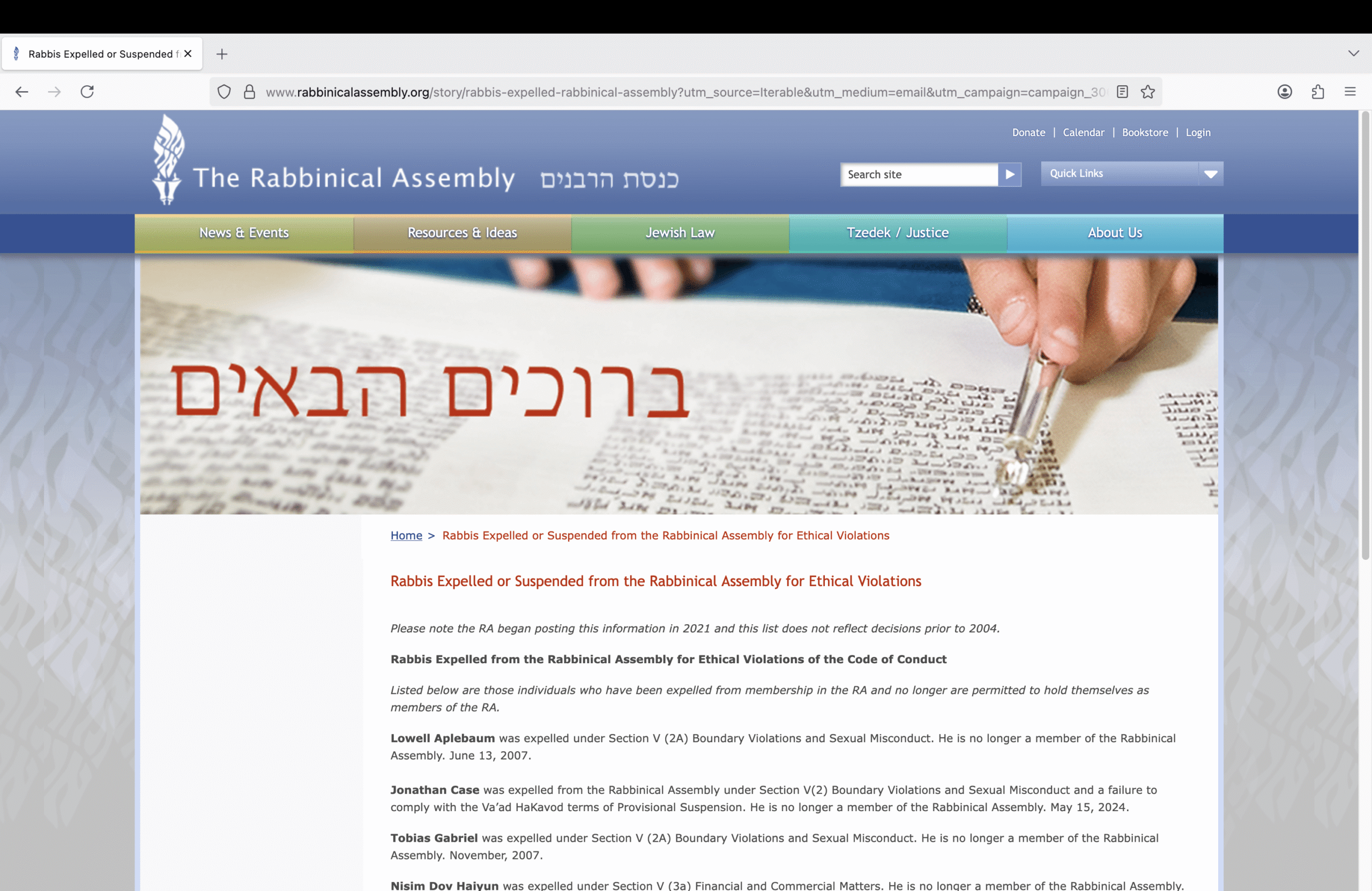
On this page, freely visible to anyone visiting their website, the Rabbinical assembly lists the names of seven rabbis who were expelled from the Rabbinical Assembly since 2004. This is exactly what should happen — if a clergy is expelled from a denomination of association of congregations, then the denomination-level website should make their names freely accessible in the interests of transparency.
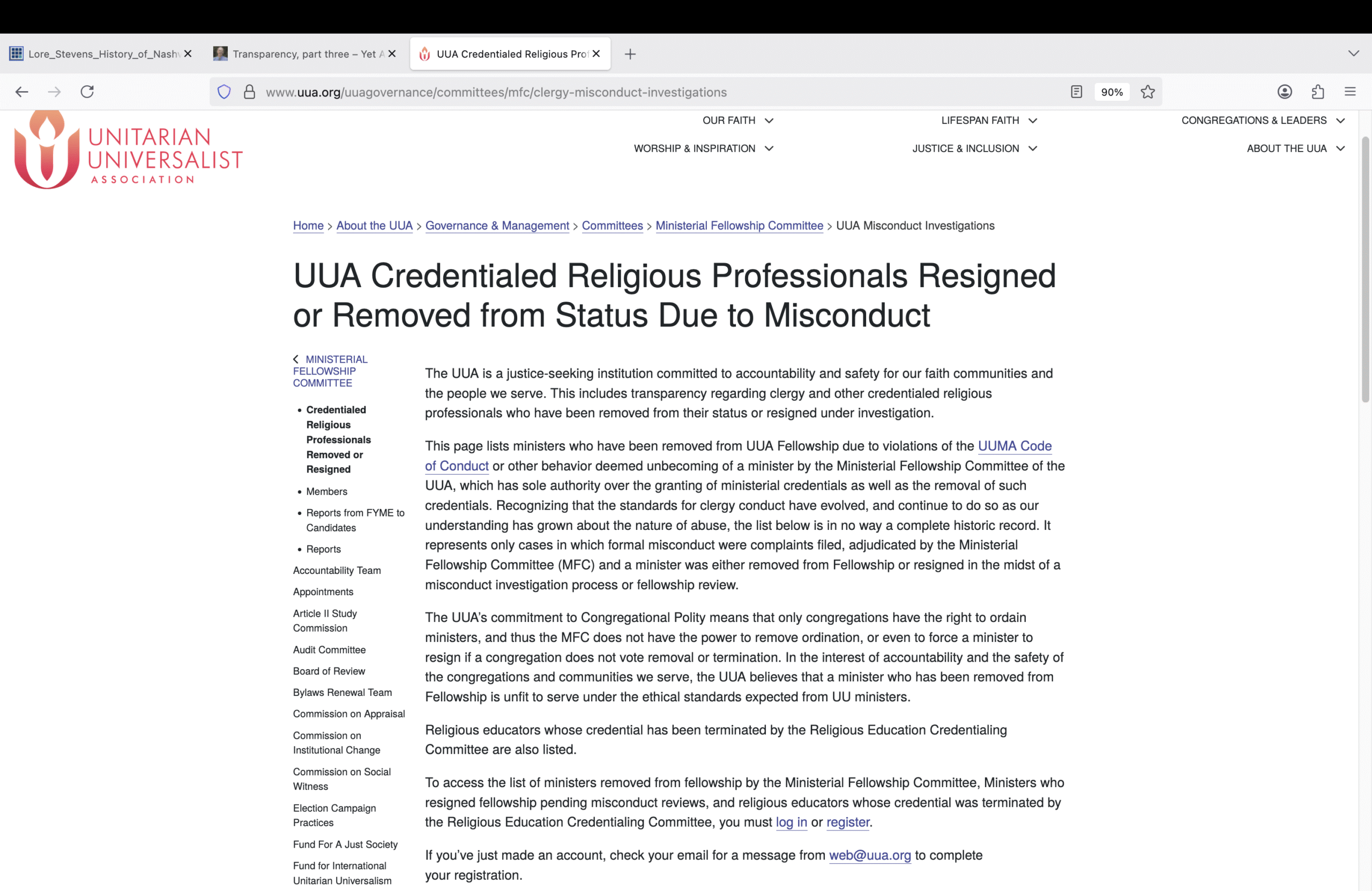
The UUA tried doing this for a while, beginning in 2021. Then, a couple of years ago, that list was hidden from public view. You can still see a webpage titled “UUA Credentialed Religious Professionals Resigned or Removed from Status Due to Misconduct” on the UUA website — but when you get to that page, you are instructed: “To access the list of ministers removed from fellowship by the Ministerial Fellowship Committee, Ministers who resigned fellowship pending misconduct reviews, and religious educators whose credential was terminated by the Religious Education Credentialing Committee, you must log in or register.” You can just about read these instructions on the screen grab below:
I can understand why this page has been restricted —I imagine that in an era of increasing violence, the UUA has the admirable goal of keeping names and personal information hidden. But there are several names that do not need to be hidden, such as ministers who have been convicted of sex offenses, so that their misconduct is a matter of public record. Examples include David Kohlmeier, Ron Robinson, and Mack Mitchell. In addition, this webpage should clearly state why access to the list is restricted — I’ve imagined a charitable reason why the UUA has hidden this page, but someone else could imagine the UUA has hidden the list for nefarious reasons.
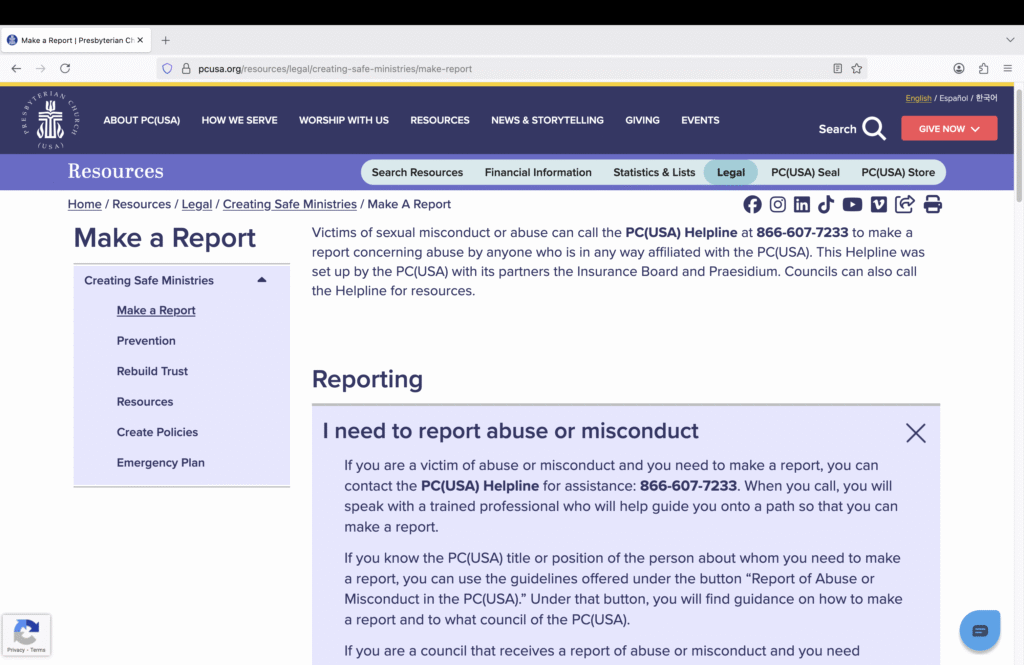
Third, the Presbyterian Church USA actually has a phone hotline that you can use to report abuse, as shown on this screen grab:
Admittedly, there are all kinds of potential problems with this helpline. Most obviously, who is the “trained professional” who answers the helpline? If it’s a denominational staffer, someone paid by the denomination, I’m going to be skeptical of their ability to remain neutral; I’d hope the “trained professional” is actually employed by their insurance carrier (which seems to be implied here), because an insurance carrier is somewhat more likely to take misconduct allegations seriously. Also, I could wish that the helpline would offer both voice calls and texting (I hate talking on the phone, but I love texting). And finally, I would like to see a guarantee of confidentiality — please tell me that if I call, and I feel uncomfortable with the “trained professional,” that you’re not going to track me down through my phone number.
Nevertheless, this makes it really easy to report misconduct, and I applaud this attempt at making the reporting process as transparent as possible. (I also applaud the fact that the “trained professional” can also provide information about abuse prevention resources — great idea.)
How might this apply to the UUA? Here are three practical suggestions — and the first two are actually very easy to implement.
First, the UUA should have a prominent link on the landing page of their website that with one click provides specific, actionable instructions on how to report misconduct.
Second, at least a partial list of ministers removed from fellowship should be publicly accessible on the UUA website without requiring registration — and there should be a clear explanation of why seeing the full list requires registration.
Third, ideally the UUA would provide an easily accessible service for reporting misconduct. And ideally, this service will be provided by an independent contractor, not by a denominational employee.
Another excerpt from my long-delayed book on people who belonged to the Unitarian Church of Palo Alto between 1895 and 1934.
Oramanda Boring
An educator and field biologist, Oramanda (Ora) A. Boring was born October 12, 1854, in Carlinville, Illinois. Little is known about her younger years except a few bare facts in the public record. In 1860, she was living in Carlinville with her father John, a carpenter, her mother Mary, her older sister Mary E., and younger siblings Mary Myrtle and William. The family was still in Carlinville in 1870, living close to Blackburn University (called Blackburn College today), a co-educational college affiliated with the Presbyterian church. By this time, Mary E. had died, leaving Ora as the oldest child. By 1880, Ora was working a school teacher, now living with her parents and younger siblings Mary Myrtle (now age 23), William A., Ella L., Lewis H., Blanche M., Frank P., and Florence A. (age 4) in Greenfield, Ill., an unincorporated town just to the west of Carlinville.
After teaching high school in Greenfield, she moved to California in 1881. She was granted a provisional teaching certificate in Los Angeles in January, 1882; the State Board of Education granted her a “life diploma” (or permanent teaching certificate) in 1884. She probably taught in the Los Angeles schools for the next few years.
Ora met David Starr Jordan, the president of newly founded Stanford University, at a conference in Coronado, and he persuaded her to enter college at age 36. She began studying biology at Stanford University as a special student in 1891, the year the university opened, and was reportedly the first woman student. She participated in the first summer session of the Hopkins Seaside Laboratory in 1892.
After a year at Stanford, she returned to teaching school. She had gained enough experience, and enough of a reputation, that she was an instructor in the summer session of the “California School of [Teaching] Methods” in 1892, teaching other teachers about the history of education. After teaching school until about 1896, she then studied at Stanford again more or less full time from 1897 to 1899. In 1899, she returned to teaching school once again, and finally received her A.B. in zoology from Stanford in 1900, at age 46.
Ora had expertise in a wide range of subjects. In the biological sciences, she pursued both ornithology and botany. She became a member of the Cooper Ornithological Club, an early association of field ornithologists. She was also a serious botanist, and Harvard University Herbaria still has her collections of California plants. Although her degree was in biology, Ora taught several other subjects in her long career as a teacher and educator. In the 1893-1894 school year, she taught English, Latin, zoology, and history in the Coronado, Calif., high school. From 1894 to 1896, she was a supervisor in “primary and grammar grade work” in Stockton, in addition to teaching biology at Stockton High School.
Through the 1890s and into 1900s, she published a number of articles in the field of education. To give an idea of her range of interests, her article titled “Nature Study” was published in School Education in 1895; and “Theological Life of a California Child,” co-written with professor Earl Barnes of Stanford, was published in Pedagogical Seminary in 1892.
In her memoir of life at Stanford University, Ellen Coit Elliott witnessed Ora’s field methods for her educational studies:
“Dear Ora Boring appeared about that time. I saw her first at my front door, notebook in hand, asking modestly, like the gentlewoman she was, if she might make a few notes on my children’s reactions to the color element: she was taking one of Professor Barnes’ education courses. Oh, certainly! Louis and Christabel (little guinea pigs) were brought in from the sandpile and stood, big-eyed, in front of the strange lady on the lounge. She showed them strips of colored paper and asked them which they liked best. Christabel preferred bright red. Louis preferred bright red. The reactions were written down. Ora thanked me for the loan of my offspring and returned to her class. Dear Ora! Her lovely life and friendship were with us through the years.”
After her father died in 1893, her mother Mary moved from San Diego to Palo Alto. In 1897, Ora was living in Palo Alto with her mother, her sisters Blanche and Florence, and her brother Frank; both Blanche and Ora were studying at Stanford at this time. Her mother was an active member of the Methodist church; there is no record of Ora’s religious affiliation at this time. Her mother was an invalid by the time she died in 1901, and Ora may have been providing care for her. By 1910, Ora lived at 101 Waverly St. in Palo Alto with her sister Blanche, brother-in-law William Snow, and their children; Ora was working as a high school teacher.
Ora taught in many different school systems across California, so many that it proved impossible to trace them all. In 1899, she was teaching zoology at Palo Alto High School. She was one of the first teachers at the Clear Lake Union High School District in 1901. In 1903, she was teaching in the high school in Riverside. In 1910, she was living in Palo Alto, though it’s not clear where she taught. From April, 1912, to June, 1914, she taught in the Yosemite Valley School, a one room schoolhouse; the school year ran from April through December, and she may have lived elsewhere when the school was not in session, although as a biologist perhaps she chose to live in the Yosemite Valley year round.
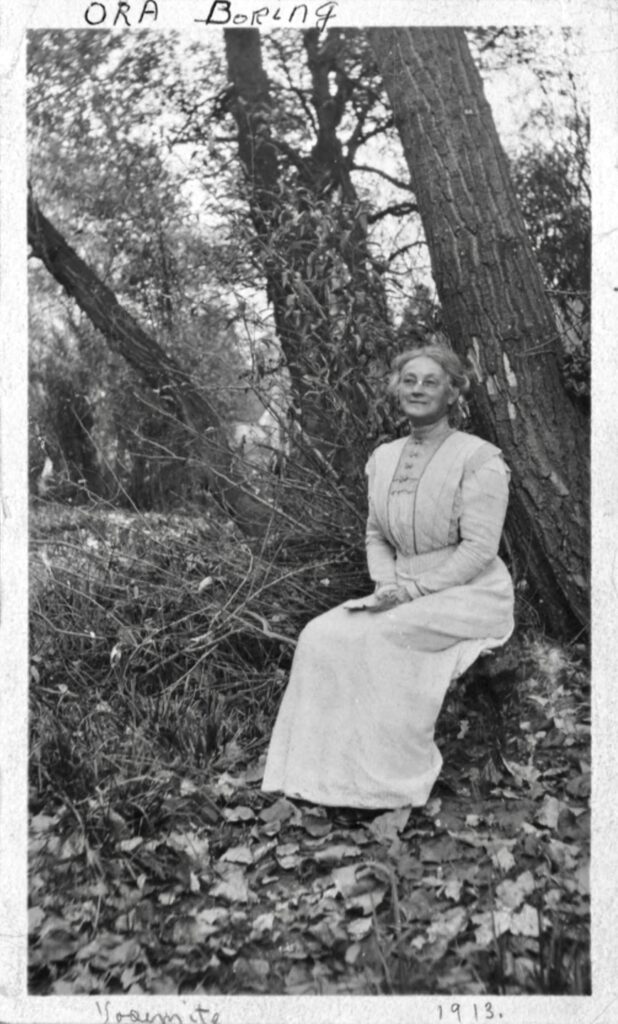
Ora Boring in Yosemite, 1913 (included in “Sunland: A Scrapbook”)
In autumn, 1914, at age 60, Ora began teaching school in Sunland, Calif., then a remote town in the mountains outside of Los Angeles. An unattributed typescript memory of Ora’s tenure in Sunland appears in “Sunland: A Scrapbook,” assembled by Enid A. Larson in 1983:
We hear a lot about the Unitarian and Universalist ministers who stayed in ministry for decades — people like Hosea Ballou and William Ellery Channing. But what about the people who served as Unitarian or Universalist ministers for just a short while, then moved on to something else?
Here is one such person.
William E. Short Jr.
William E. Short, Jr., served as a Unitarian minister for just two years, from 1915 to 1917, primarily at the Unitarian Church of Palo Alto. He left the ministry for radical politics, then became a building contractor and later a realtor.
He was born on September 6, 1888, in Jackson, Miss. Short’s father was an Episcopalian minister, who moved the family to St. Louis, Mo., in 1889. William Short, Sr., died on October 27, 1905, when William, Jr., was 17 years old. After his father’s death, William, Jr., completed high school at the University School, St. Louis, Mo., and went on to attend Trinity College, Hartford, Conn., his father’s alma mater, receiving his B.A. there in 1912.
As an Episcopalian lay reader, William had charge of a few “missions,” or what we now might call church plants or emerging congregations. He received his B.D. from the Episcopal Theological School, Cambridge, Mass., in 1915. Beginning in the fall of 1914, he became interested in Unitarianism, and made contact with the American Unitarian Association (A.U.A.). In the summer of 1915, he served the Unitarian church in Walpole, Mass. At the end of the summer, he was accepted into Unitarian fellowship. The A.U.A. recommended him to the Unitarian Church of Palo Alto, and the congregation called him in November, 1915. It appears that the Palo Alto church never regularly ordained him, due to his feelings about ordination, though he was recognized as a minister by the congregation and denomination.
Initially, he was quite happy in Palo Alto, and wrote to the A.U.A.: “I am more pleased than ever over the fact that I left the Episcopal Church and became a Unitarian.” However, he avoided contact with the denomination, going so far as to resist meeting with other Unitarian ministers. Even though the A.U.A. paid much of his salary, Short consistently neglected to submit to them the monthly reports they required of him.
Another in a series of stories for liberal religious kids.
The great philosopher Socrates, who lived two thousand five hundred years ago, once had a long conversation with another philosopher named Gorgias. And during that long conversation, he told a story about what happens to human beings after we die.
Listen, then (said Socrates), as story-tellers say, to a very pretty tale, which I dare say that you may be disposed to regard as a fable only. But I believe this is a true tale, for I mean to speak the truth.
The poet Homer tells us in his immortal poem The Iliad, how the gods Zeus and Poseidon and Pluto divided the empire which they inherited from their father. Poseidon ruled the oceans, Hades ruled the underworld, while Zeus ruled over everything, including over the other gods and goddesses.
Now in the days of Cronos there had existed a law about what happens to human beings after we die. This law has been in force since the beginning and remains so today. The law decrees that human beings who have lived their whole lives in justice and holiness shall go, after they die, to the Islands of the Blessed, where they will dwell in perfect happiness. On the other hand, human beings who have lived unjust and irreverent lives have to go to Tartaros, the house of vengeance and punishment.
In the time of Cronos, and even into the early days of Zeus’s reign, the judgement was given on the very day on which people were to die — the judges were alive, and the people were alive — and the consequence was that the judgements were not well given. So Hades and the authorities from the Islands of the Blessed came to Zeus, and said that some of the people who had died had found their way to the wrong places.
“Well, first of all,” Zeus said, “we must put a stop to human beings knowing the time of their death; for this they at present do know. However, Prometheus, the god of foresight, has already been given the word to stop this in them.
“Next,” said Zeus, “human beings must be stripped of their clothing and indeed of their very bodies, and stripped of everything else before they are judged. In other words, the human beings must be fully dead when they are judged, and not alive as they currently are. Furthermore, whoever judges them also must be dead and covered over with no clothing nor a body, nor with their wealth and families or other fine array. In this way, the judge’s naked soul will be able to perceive the truth of the other naked souls. If the judgment is carried out in this way, then it will be just.”
Zeus then decreed that three of his own human children should become judges, once they died. These three were Minos and Rhadamanthus from Asia, and Aeacus from Europe. When they died, they were assigned to stay in the “meadow at the parting of the ways.” Two roads left this meadow: one road went to the Islands of the Blessed, and the other road went to Tartaros. Rhadamanthus judged all the humans who died in Asia. Aeacus judged all the humans who died in Europe. And Minos served as the final court of appeal, if either of the others had any doubt about a human being who came before them.
Brief commentary
[A couple of points you might want to mention if you talk about this story with actual children:] This “fable” was written nearly half a millennium before the Christian era. And it’s worth remembering that Socrates spoke a different language from us, and his word for truth — aletheia — meant something more like “revealing” or “disclosing.” Aletheia was not the opposite of falsehood, but rather the opposite of forgetfulness. Aletheia was also a goddess.
Source:
Plato, Gorgias 523a – 524a, trans. Benjamin Jowett (1871), with reference to the translation by W. R. M. Lamb (1925).
Another in a long-running series of brief biographies of obscure Unitarian Universalists. This is a chapter from my long-delayed book on Unitarians in Palo Alto from 1895 to 1934.
Out of poverty
Assistant minister, then settled minister, of the Unitarian Church of Palo Alto in 1926-1927, she was born at Larned, Kansas, on October 18, 1888, the first child of Fred Newton Lasley and Leura Auretta Davis. Times were hard in Kansas, and not long after Leila was born, Fred scraped together enough money to take the train to Portland, Oregon, where his brother and half-sister lived, in hopes of finding work. He found work as a carpenter, and saved enough money to send to Leura so that she could join him in Portland. Leura was just twenty years old when she took that five day journey by rail, carrying a baby in diapers, and with no one to help her.
After a year in Portland, Fred found work managing a farm in Springdale, east of Portland. He and Leura felt financially secure enough to have more children, and Leila’s younger sisters Weltha Evadna Lasley, and Gladys Mable Lasley, were born in Springdale; a brother Clarence, born in 1890, died young. By 1896, when Leila was 8 years old, the family had saved enough money to purchase their own farm in what is now Corbett, Ore. On the side of a hill, Fred built a two room shack using rough lumber he purchased, with a root cellar underneath. Fred built a trough that ran from a nearby spring to the house, so that they would have running water in the house. Leila’s sister Clara Belle Lasley was born on the farm the next year, in 1897. Leila’s younger brother Walter was born there in 1905.
The Lasleys were “poor as church mice.” They had few toys, and their clothes were often faded and patched. But their mother kept them looking neat and tidy, and encouraged them with homey moral sayings. If the children felt discouraged and unable to do something, their mother would say, “Mr. Can’t just fell off the fence and broke his neck — now you girls get back to work.” If their mother heard something that sounded like gossip, she would say, “That doesn’t concern you, so don’t publish it.” What Leura lacked in schooling, she made up for in common sense. Leura also had pride: she wanted her daughters “to be brought up decent.”
Religion News Service reporter Kathryn Post has an interview with William J. Kole about his new book, “In Guns We Trust,” to report on White evangelical gun culture. In the interview, titled “‘In Guns We Trust’ challenges white evangelicals to rethink their alliance with firearms,” Kole says that he was a part of White evangelical churches, but has been “deconstructing” his Christian faith over his perception that gun culture (and its ally, Christian nationalism) has nothing to do with Christianity:
“…I feel like the historical Jesus is objectively nonviolent. I understand that evangelicals will cherry-pick Scripture to find a few verses to help them feel more comfortable with gun culture, but I find it completely unbiblical. The churches that are embracing gun culture now were almost entirely pacifist up until the late ’60s and early ’70s, when a shift began. Even the Assemblies of God, where I served as a lay missionary for three years in Europe, was officially pacifist in its constitution and bylaws. So, they’ve had to pivot, and it’s a perplexing pivot for me. I just don’t see how weapons have anything to do with a faith tradition that is rooted in nonviolence.”
Kole also says that he’s now “reconstructing” his Christian faith, adding:
“I just can’t, in good conscience, continue in the evangelical tradition.”