Tonight I made an apple pie for Thanksgiving. It smelled good when it came out of the oven. We went out for a walk, and when we came back it still smelled good, so we each had a slice, and then I had another slice. Why wait until Thanksgiving to eat pie? It is now three eighths gone.
Category: Places
Fall foliage
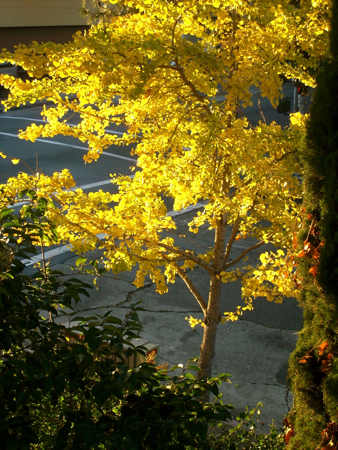
Gingko tree, from one of the windows in our apartment.
Just a sweatshirt
Early this evening, Carol and I were discussing how Penn State fired football coach Joe Paterna, because he didn’t report credible allegations of child abuse to the police.
Then we decided to go for a walk. It was a little bit chilly out. Carol went to get her sweatshirt, which just happens to say “Penn State” on it. “I wonder if I should wear it?” she said. We decided that probably no one would notice.
We had been walking for a quarter of an hour when a car drove by and someone yelled something out the window. We couldn’t figure out if they were yelling at us. There were no other pedestrians in sight. But we couldn’t think of anyone who knows us who would yell out the window at us if they drove by. “I wonder if it’s the sweatshirt,” Carol said.
After half an hour, we got to the business district at Burlingame Avenue. There were quite a few people walking on the sidewalks. Suddenly Carol stopped. “I can’t tell if they’re looking at me or not,” she said, and took off the sweatshirt, and tied it around her waist.
Toronto, I think
I’m in Toronto for the annual Religious Education Association annual meeting. This year’s topic is neuroscience and cognitive science as applied to religious education.
I say I’m in Toronto, except that the conference is in an airport hotel, which looks like every other airport hotel I’ve ever been in. The only way I know that I’m really in Toronto, and not in San Francisco, is that the airport had bilingual French and English signs.
Supporting Occupy Wall St.
Peter Boullata has written a good post on his blog on how we can support Occupy Wall Street.
Morning fog in the Coastal Range
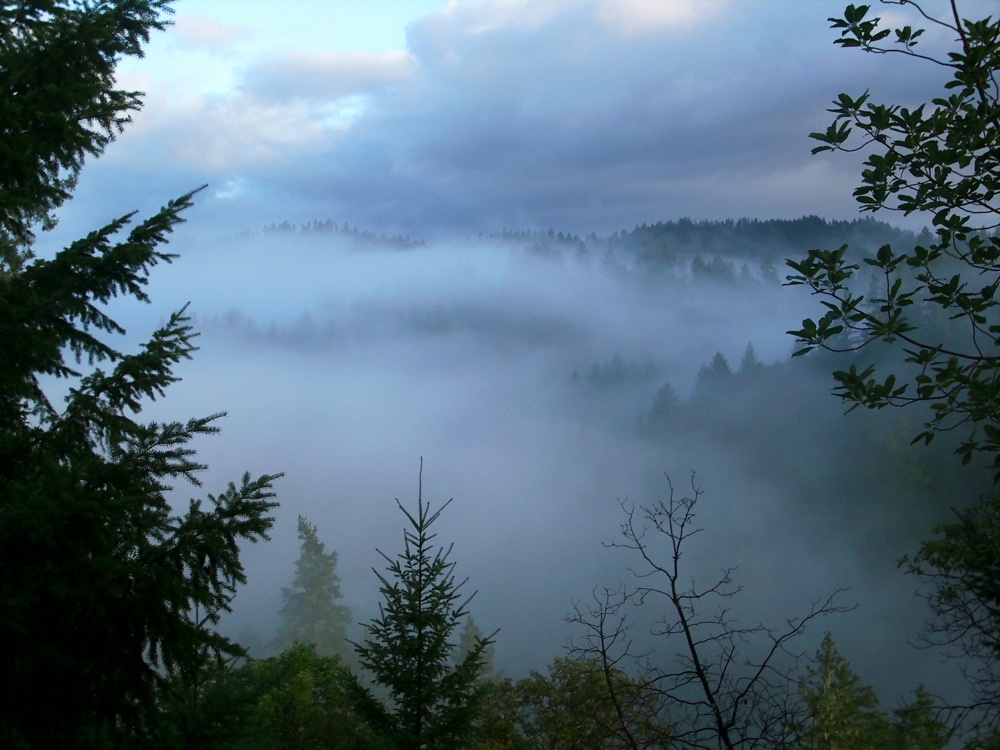
When I first started looking at classical Chinese landscape painting seriously, I never thought of it as realism: those steep fantastical hills, the mists that so conveniently provide a sense of distance and perspective, none of that looked real to me. But when you live on the Pacific Rim, you see that much of classical Chinese landscape painting is realism.
For the past couple of days, I have been staying at a retreat center on a steep hillside in a redwood grove in the Coastal Range of northern California. This morning the mist drifted in the valley below us, and this is what I saw when I looked out my window at about eight o’clock:
The first rain
Camp Meeker, California
As I drove up here to where the ministers meeting would take place, it started to rain. By the time I arrived, it was raining steadily. I got out of the car, and it smelled like rain and wet ground. It was the first rain I had seen and felt and smelled since last spring. I took a deep breath.
This evening, Carol texted me: “Where do we have tarp for rowing machine?” This summer, Carol bought a rowing machine for ten dollars, and we had set it out on our little second floor deck so we could sit outdoors while we were using it. But now it was getting wet. I texted back: “Crap. Look in basement.” I hope she managed to find the tarp and protect the rowing machine from the rain.
Silicon Valley wins again
A Silicon Valleyite has gotten another distinguished award. Yesterday, John Perry of Stanford University was awarded an Ig Nobel Prize for his Theory of Structured Procrastination, which states: “To be a high achiever, always work on something important, using it as a way to avoid doing something that’s even more important.”
Perry’s original research was published in the Chronicle of Higher Education in February, 1996. Perry did not go in person to receive his award, which is no surprise since the awards were given out at Harvard University.
Berkeley fog
I had to drive to a meeting at the Unitarian Universalist Church of Berkeley (UUCB) yesterday, and because I had to drop Carol off near the Rockridge BART station in Oakland, I wound up driving over Grizzly Peaks Boulevard. This was the route I drove to get to work for a year in 2003-2004: from north Oakland up over Grizzly Peaks to UUCB. It is the most dramatic route I have ever commuted along: a section of Grizzly Peaks Boulevard is a winding mountain road through Berkeley Hills a thousand feet above the cities of Oakland and Berkeley. On a regular basis, I would pull over during my commute to enjoy the view: the sun setting over the Golden Gate, the play of light on San Francisco Bay, the view down into the wooded canyons along the ridge.
As I drove along Grizzly Peaks Boulevard this morning, a huge bank of fog was moving in through the Golden Gate from the Pacific; it had mostly covered the city of Berkeley, and was at the foot of the Berkeley Hills. It was so beuatiful, I had to stop, even though I was a little late for the meeting. Looking out I saw the brilliant white of a thousand-foot high fog bank stretching out across the bay, and looking down I could see ridges and cnayons covered with live oaks and eucalyptus trees, and I could see one little corner of the city of Berkeley before the fog blocked my view.
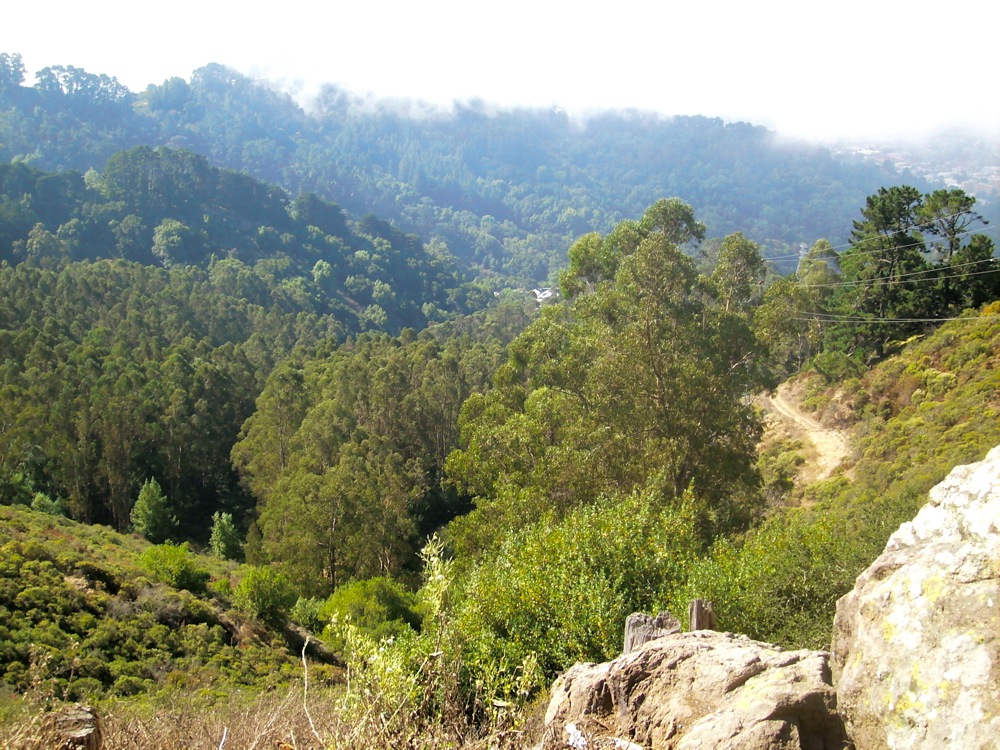
By the time I drove back up over Grizzly Peaks Boulevard three hours later, the fog was swirling up over the peaks, and there was no view of anything except white fog.
October 2 sermon topic: discuss….
My title for this Sunday’s sermon here in the Palo Alto church is “Liberal religion, Silicon Valley style.” I’m a big believer in the notion that any religious organization will be influenced by the immediately surrounding community. Therefore, Unitarian Universalism in Silicon Valley should have some distinctive features. So what are some of the most important of those distinctive features, and how do they affect the way we do religion here? Here are three possible answers:
(1) One distinctive feature of Silicon Valley life is the ethic of hard work: here in the Valley, people believe that the harder one works the better off one will be. By contrast, Thoreau’s famous book Walden, an important book for many Unitarian Universalists, extolls the virtue of spending less time working hard, and more time contemplating Nature. I’d say Silicon Valley liberal religion extolls the virtue of lots of hard work, and tends to ignore thinkers like Thoreau.
(2) Another distinctive feature of Silicon Valley life is that we live in a truly multicultural and multiracial place. Santa Clara County is a white-minority county with no dominant racial or ethnic group; this is what the rest of the United States will look like within a generation. And while our congregation is 85-90% white, that also means that we are 10-15% non-white, and we’re all so used to living in the multiracial, multicultural world of Silicon Valley that it seems to me we’re pretty relaxed about becoming an increasingly multicultural congregation.
(3) Now add another distinctive feature of Silicon Valley life: the engineering and entrepreneurial drive which lead us to believe we can fix anything if we put our minds to it. I think Silicon Valley is going to be the place where liberal religion figures out how to be truly multiracial and multicultural. Here in the Valley, multiracial doesn’t mean there are both black and white people in the congregation, it means there are whites, blacks, East Asians, and South Asians; and people who were born in several different countries (Russia, India, Taiwan, etc.).
So liberal religion in Silicon Valley is characterized by a strong work ethic; by multiculturalism; and by a can-do attitude. This raise the interesting question that I’m going to try to address in the sermon: Does this mean all we’re going to do in our congregation is work our asses off? Because if all we’re going to do is to work our asses off (or work our collective ass off, whatever), even if it’s for a good cause, I’m just not interested. There has to be a better way to do religion….