Virginia City to Salt Lake City

Paul, our host at Cobb Mansion B & B, prepared baked eggs with herbs and cheese in individual egg cups, bacon, fresh fruit, and rolls. He said he was disappointed in the rolls because he can’t get the second rise to happen in Virginia City, which is 6,200 feet above sea level. This led to a discussion about high altitude baking. Anna, one of the other guests, and a native of Germany, said that when she moved to Utah where she now lives, she had to give up baking some cakes and other traditional baked goods because they all came out flat. Paul said that, contrary to what you might think, high altitude baking requires less leavening, not more. It was all very interesting to hear, but I decided I was glad we live near sea level.

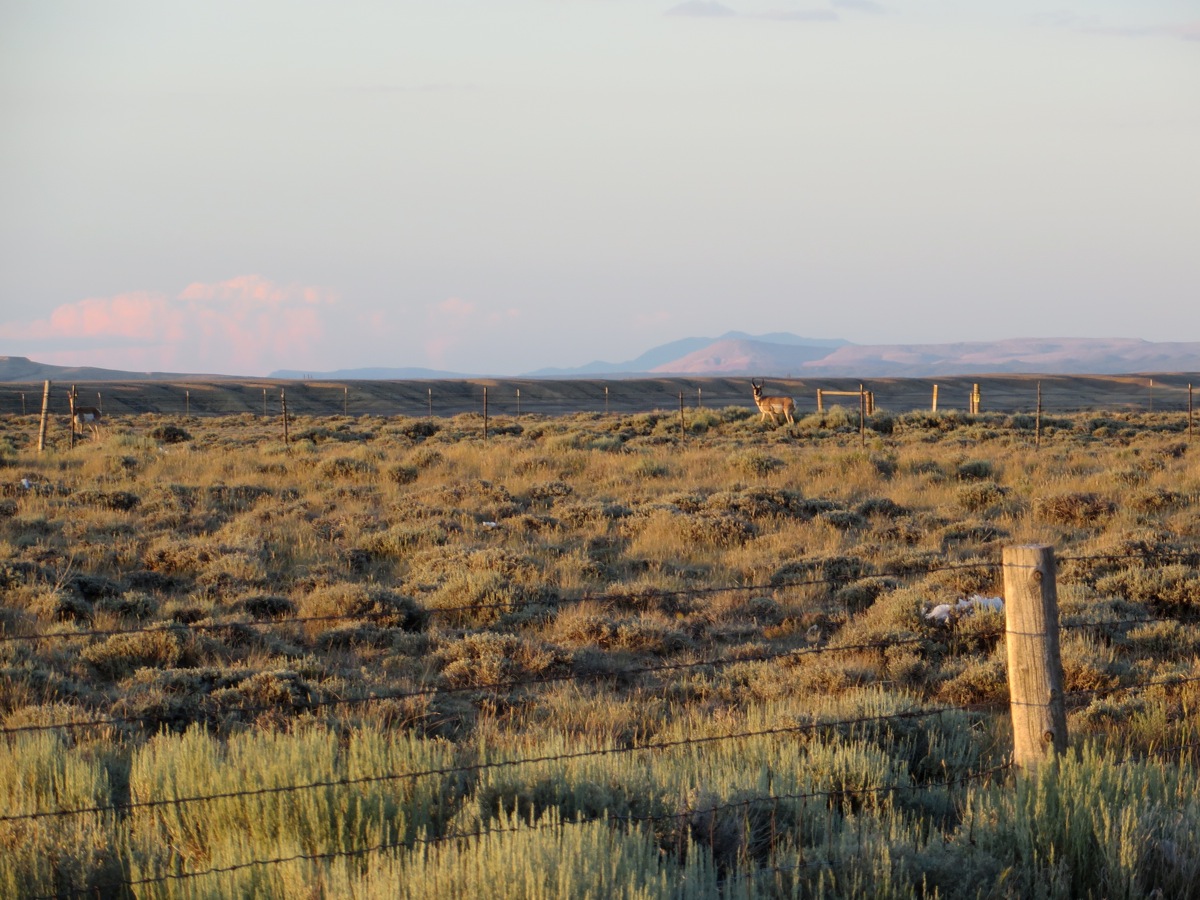
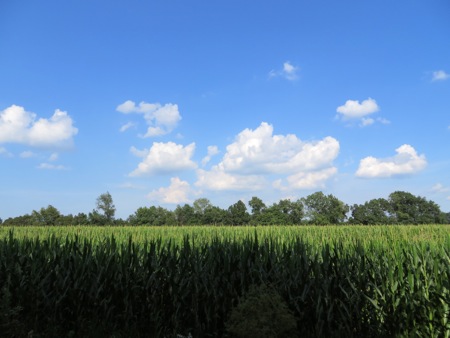
The drive across Nevada was notable because it rained off and on all day long. The sagebrush was greener and brighter-looking than I had ever seen it before. We stopped at one rest stop — nothing more than a gravel lot with two pit toilets — that was surrounded with yellow flowers. In places, the flanks of the mountains, seven or eight thousand feet high, were covered with light green. I have never seen this stretch of Nevada look so alive. And looking out across the wide open spaces between the mountain ranges we could see rain showers moving across the landscape:

BlogJun2413

We didn’t see the sun for nearly the entire day. We stopped for lunch in Winnemucca, and the cloudy sky seemd to make the garishly colored signs for motels and casinos look even brighter:

BlogJun2413b

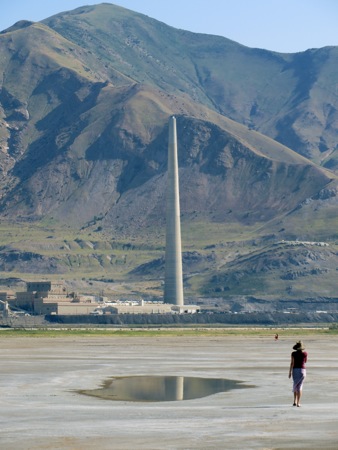
The sun came out briefly and brilliantly for us when we stopped in Wendover, where it made the town look less tawdry and depressing for the short time it shone. The long drive across the salt flats of Utah was made more tolerable by the audiobook we’re listening to, A Thief of Time by Terry Pratchet. We finally arrived at our cheap motel near the Salt Lake airport at a quarter to ten, feeling just a little bit road-weary.

San Mateo to Virginia City

We left San Mateo at ten in the morning, and drove to Berkeley where we had a dim sum brunch with my cousin Nancy and her husband and daughter. From there we started driving west on Interstate 80. I had hoped to stop to visit a member of the Palo Alto church who now lives in the Central Valley, but the timing didn’t work out. We stopped at the rest area on Donner Summit, and I walked a little half mile loop trail through the heavily glaciated alpine environment. The little loop trail intersects the Pacific Crest Trail, and sure enough I passed two hikers with full packs on. We exchanged cheerful hellos, and I couldn’t help smiling at the similarities of, and contrasts between, driving on the interstate highway and backpacking on a long-distance trail.

We got to Virginia City, Nevada, at about five o’clock. We were too late for the tour of the Cobb Mansion, the bed and breakfast where we’re staying — and the house was interesting enough that we were sorry to have missed it — but we were in time for happy hour: a glass of wine, and time to chat with our hosts, Paul and Jeff, and the other guests. Paul made us a reservation at Core, a new restaurant in town. It was a little out of our price range, but this is our splurge day for this trip. The most memorable part of the meal was the appetizer: mussels in a light sauce with a touch of fresh mint; the delicate mint was a nice contrast to the rich seaside flavor of the mussels.

We stayed in Virginia City because we had both read Mark Twain’s Roughing It; this was the city where he got his first job writing for a newspaper, the beginning of his career as an author. Unfortunately, there was a big fire in Virginia City in 1875,after Twain had left the city, so there aren’t any buildings left from his time there. Nevertheless, you can see many of the things he describes: the little city perched on the side of Mount Davidson, the sage-brush covered slope of the mountain going up to the distant peak high above the city, the houses built into the side of the slope so that the main entrance to a house might be in the second floor, and so that the first floor of one house looks down onto the roof of the house below. And in honor of Mark Twain, I bought copies of the two little local newspapers, the Virginia City News, and the Comstock Chronicle.

Tomorrow we start driving to Salt Lake City.

Conclusion of youth service trip

Here’s the rest of the story about the youth service trip….

We finished up with Habitat for Humanity on Thursday, June 20. From there, we drove to the Big Oak Canyon site of Earthroots Field School, in Silverado Canyon east of Los Angeles. We worked there on Friday, June 21, helping prune and rehabilitate an abandoned orchard, and doing some trail maintenance. We camped at Big Oak Canyon — half of us slept outside under the stars. (Since June 21 was Pee on Earth Day, several of us celebrated the day by avoiding the portapotty when possible.) Then on Saturday, June 22, we drove back up to Palo Alto.

Starting tomorrow — Sunday, June 23 — Carol and I start driving across the country to visit family.

(Posted on July 1, and backdated.)

Youth service trip, day two

We worked on a Habitat for Humanity rehab project today. Three of us worked on nailing down oriented strand board on the roof, then putting up drip edge. Four of us worked on painting and other miscellaneous tasks. I posted a couple of photos here. And here’s a photo proving that, even though I haven’t worked as a carpenter for 18 years, I still actually know how to use a hammer (thanks for taking the photo, Samuel):

BlogJun1913c

By the end of the work day, we were pretty dirty, a little sore, a little sunburned, and very satisfied. Habitat for Humanity is a great organization to work for: they are well organized, they have clear goals, and they know how to manage volunteers.

We have another day of work at Habitat, and then we head off to volunteer at an ecology school doing trail maintenance. We’ll be camping at the ecology school, with no Internet access, so don’t expect another post until Saturday or Sunday.

(And, honestly, this service trip is more enjoyable for me than attending General Assembly. I’m doing something to make the world better! )

Favorite crossing guard

“Favorite crossing guard” read the sheet of poster paper someone had taped to the green-painted steel utility box that stands next to the traffic lights at Nelson and Charleston Roads. Another sign taped to the utility box read “Charles, you’re the best.” Whoever had taped up the signs left pens and markers so that passers-by could leave their own message to Charles, who is retiring, and whose last day at the crossing was Thursday.

Earlier this week, I had been talking with Charles about his upcoming move to Georgia, where retirement money goes a lot farther than here in the Bay area. But we didn’t stay long on that topic. Years ago, Charles had been a case manager in Cleveland working with emotionally disturbed children, before he moved to the Bay Area and became a custodian. (I never asked him about the career change, but moving from a burnout job with low pay, to a stable union job, sounds pretty attractive to me.) As is inevitable when two people get together who work with kids, we started talking about kids we had known and worked with. I’ve seen some troubling things in my career as a children and youth minister, but of course Charles had seen much worse.

This was one of the few uninterrupted conversations we have ever had, in the two years Charles has worked at this crossing. I probably saw him once or twice a week on my way to get lunch at the supermarket across the street, but mostly he spent his time talking to the kids from the nearby elementary school and middle school who went past. He seemed to know them all by name, and if a child came up while he was talking to me, he’d immediately greet that child, and turn his attention to them. It’s an unusual adult who can do that without being creepy; I like adults who treat adults and children with equal respect, and I like the more unusual adult who will end a conversation with another adult in order to have a conversation with a child. But on this day, I happened to come along when no kids were coming by, so we talked about kids: happy kids, troubled kids, kids who needed to talk with an adult who has excellent listening skills. Both of us have been trained to keep confidentiality, so there were no names or identifying characteristics; you can still have a good conversation of this sort without breaking confidentiality.

So on Thursday, I walked up to those two posters someone had left, and I read some of the things the kids wrote to Charles: they mentioned little in-jokes he had had with them, they wrote how much they’d miss him. I thought about signing one of the posters, but it seemed more appropriate to let the kids have their say, on their own. I wished Charles luck in my head, and walked on by.

News story about Charles here. As it happens, it was a member of our church who created the retirement posters.

Out the window

Carol and I recently completed a mind-body wellness class offered (for free!) by our health care provider. One of the things that our instructor said was that a good way to reduce stress is to spend time “in nature.” Further reading in the text book for the class revealed that our brains becomes fatigued by doing all the things most of us have to do in our jobs: staring at computer screens, meeting deadlines, sitting in meetings, etc. The natural world engages different parts of our brains, allowing the fatigued parts to rest. — I may not have this exactly right, but I think I have the gist of it.

When I learned this, I thought to myself: and where are we supposed to find the natural world in downtown San Mateo? This is not Tokyo where, according to my Aunt Martha, who lived there for two years, the residents cultivate little pockets of natural beauty throughout the city. Here in San Mateo, we could walk over to Central Park where the Japanese American community maintains a Japanese garden; but that garden is only unlocked for a few hours a day. Like many densely populated areas in the United States, downtown San Mateo has little to offer in the way of natural beauty; it combines urban density with dreary suburban sprawl; and even where there is some natural beauty, someone will have dropped trash there: fast food bags at the base of a tree, malt liquor cans thrown in among flowers, women’s underwear draped in the branches of a tree overhanging San Mateo Creek (I’m not making that up).

At some point during our wellness class, though, I realized that we have created a little oasis of natural beauty on our little balcony. We have nothing to compare with Japanese bonsai, but over the years we have accumulated quite a few plants. At the moment several of them are in bloom: the purple flowers of the potted lavender; the orange and gold of the nasturtiums; the vivid pink flowers of the succulent Carol can’t remember the name of. I was staring out the window at these flowers this morning. Carol walked into the kitchen and asked, “What are you looking at?”

“Nothing,” I said. “Nothing at all.”

Memorial Day

Carol and I went to Wisnom’s hardware store across the street. I had to get some supplies for this Sunday’s Judean Village project in the Sunday school, and she went just because it’s an interesting place.

One of the guys who works there who knows us asked if I was finding what I was looking for. I said I was, and then asked why there were so few people in the store.

“Maybe because Easter was Sunday,” he said. “Maybe because school vacation’s this week. Maybe because Chinese Memorial Day’s tomorrow.”

“Chinese Memorial Day?” I said.

“April 5,” he said, “solar holiday, so it’s the same day every year. On Chinese Memorial Day, everyone goes to family graves. I went yesterday.” He bowed to an imaginary grave. “There will be lots of people up at Skylawn cemetery tomorrow. Flowers everywhere.”

We started talking about visiting graves, from a New England and a Chinese perspective. I wanted to hear more about Chinese Memorial Day, but Carol had to get back to work, so we cut our conversation short.

Ching Ming Festival

Click the Chinese characters above for photos of this year’s Ching Ming Festival in Skylawn cemetery.

Dusk

I like the contrast between colors that occurs at dusk when the sky turns a deep blue at about the same time that yellow-orange sodium vapor and incandescent lights turn on. I was enjoying this phenomenon a couple of evenings ago when I noticed that a nearby traffic light periodically turned some of the shadows red:

BlogMar0213

In the Holbrooke

In room 2 of the Holbrooke Hotel, supposedly California’s oldest hotel in continuous operation, there is a bookcase. In the bookcase there are a number of old books. In one of the old books (I won’t say which one) there is a dollar bill. On the lower edge of the front face of the dollar bill is written: “THE Beginning (1) Russ and Sue 8-5-12 (2)”. Don’t ask me what it means; I’m just telling you what I’ve seen.

Golden haze

Carol and walked down to the waterfront in San Mateo. It was a beautiful evening. It’s the rainy season, so the hills across the bay are now a soft green. The setting sun glinted off windows of houses far up in the Oakland hills. And a beautiful golden haze hung over the waters of the bay.

“It’s the golden haze again,” I said to Carol. We’ve been seeing this for the past week or so: cold, still air has settled down over the area, trapping pollutants in the wide bowl formed by the mountains surrounding the bay. The people who monitor air pollution have been detecting high levels of fine particles, and because of that all wood fires have been banned most days this week. The air quality index has been moderate to unhealthy. That’s what has caused the golden haze.

“It’s beautiful,” I said. We kept walking, watching the shorebirds, and the play of light on the water.

Written on Monday, posted on Saturday; I’ve been slowed down this week by a cold this week.