Rensselaer, N.Y., to Saco, Maine

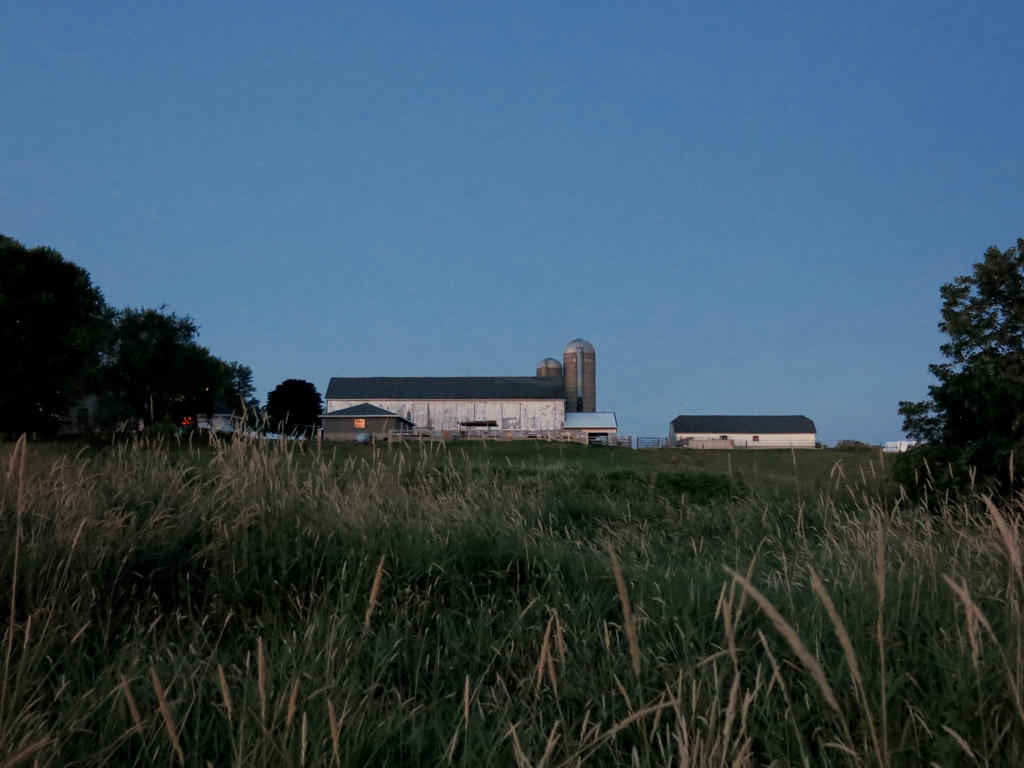
A short drive today, so by three o’clock I had set up my tent, and started walking up the beach. Very light rain fell off and on, but that didn’t reduce the number of people on the beach by very much. In the short stretch of beach between Ferry Beach Camp and Conference Center, and the entrance to Ferry Beach State Park, I passed a dozen families set up with towels, three different guys casting bait in hopes of a striper coming by, a dozen people walking up or down the beach, and half a dozen people tossing a frisbee around.

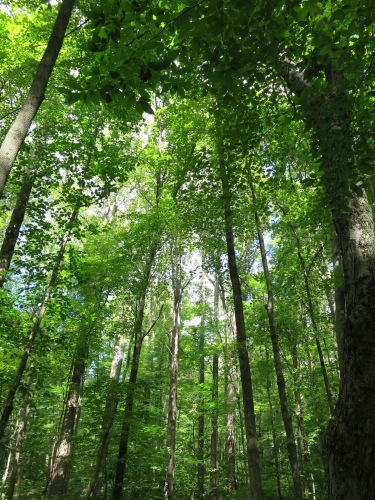
As soon as I got away from the beach, and onto the trails in the woods of Ferry Beach State Park, I didn’t see another human being. Probably the mosquitoes kept them away. There is plenty of open water in the woods behind the dunes this year, plenty of places for mosquitoes to breed. And then I heard a Veery singing, that strange downward spiraling song that is one of the most haunting and beautiful bird songs I have ever heard: a bird song worth driving three thousand miles to hear.

Geneva, Ohio, to Rensselaer, N.Y.

Of course I awakened late. First of all, I hadn’t gotten into the motel room until 11:30 the previous night. Second of all, the time I awakened might seem late in the Eastern time zone but in the Pacific time zone I got up at six o’clock. When I finally got to Erie Bluffs State Park, it was half an hour before noon.

Erie Bluffs State Park, the largest undeveloped stretch of Lake Erie lake front in Pennsylvania, is mostly fields and woodlands. There is a boat launch, and there’s a tiny beach at the mouth of Elk Creek.

BlogJul0315a

But, as I say, it’s mostly fields and woodlands. I walked down through the woods to the shore. The trees were mostly maples and oaks, with some nut trees and sassafras — typical woodlands of the middle Appalachian region, and very similar to the woodlands I got used to growing up in eastern Massachusetts on the eastern edge of the hills of central New England. The woods felt familiar, more familiar than the town I grew up in which has been so altered by development and gentrification, and so many of the woodlands built up with very expensive houses, that it no longer feels like the town I once knew. But there were still surprises in the woodlands of Erie Bluffs. I came across a downed tree covered with some kind of insect I had never seen before, coming out of its larval stage to its adult stage.

BlogJul0315b

There wasn’t much to see at the shores of Lake Erie except people on personal watercraft bouncing over the chop raised by the northeast wind. I got tired of their buzzing, and the faint stench of two-cycle engine, and head back up the bluffs to the fields. The eastern fields at Erie Bluffs cultivated, with what I think was an annual rye grass, some kind of seed-bearing grass that probably provides good foraging for migrating birds. The western field is not cultivated, and it was filled with birds: Field Sparrows, Blackburnian Warblers, Indigo Buntings, Baltimore Orioles, and many more birds took advantage of the ecotone, the edge zone between the woodlands biome and the field biome.

BlogJul0315c

Then, all too soon, it was time to go. I started driving east, and kept driving east.

After dark, I stopped at a rest area somewhere in upper New York state. By that time, there was little traffic on the highway, and few people in the rest area. Just one other person was waiting for coffee at Starbucks, and she and I got into a conversation with the two workers at Starbucks. I asked the workers if they got time and a half for the holiday, and they said they did. But, they said, no benefits. I told them I thought Starbucks had good benefits, but they said they were actually employed by the company that runs the rest area, a company which pays minimum wage, provides not benefits, and does not allow them to take tips. The other customer and I commiserated with them. She — the other customer — said she drove that stretch of highway regularly, because one of her children was involved with Circus Smirkus. We both said we love to drive, and we both agreed that the best time to drive was after dinner, after the crazy drivers got off the road. When I left, I told one of the workers that I wasn’t leaving a tip, because that wasn’t allowed, but it looks like I left some money on the counter by mistake so they better keep it.

Joliet, Ill., to Geneva, Ohio

It was not a pleasant day of driving. I left my rain coat at the motel, and lost over an hour driving back to get it. Traffic on the interstate south of Chicago was bad, as usual, made worse by the beginnings of holiday weekend traffic. It’s tough to get off the toll road through Indiana and Ohio, and I hadn’t had time to stop at a supermarket, so I was stuck eating bad fast food in dreary highway rest areas — not just ordinarily bad fast food, but really bad fast food: french fries cooked in slightly rancid grease, quasi-Chinese orange chicken where there is a tiny little speck of chicken meat surrounded by thick deep-fried batter and slimy sauce, iced tea from Star-yuck that had a faintly foul aftertaste. And after eating bad food, it was back on the gray interstate highway.

BlogJul0215a

Day gradually turned into night. The moon came up, rising right in front of me, but it was orange like the mercury vapor lamps and it got lost in the street lights.

BlogJul0215b

I tried to think back to the morning, when I had managed to spend an hour walking at Midewin National Tallgrass Prairie in Illinois, and another half an hour talking with a woman who worked for the U.S. Forest Service (the Forest Service manages Midewin) about how we were each trying to develop programs that got kids outdoors to experience other living organisms and learn stewardship for the land. But the swarming traffic somehow managed to drive out the memory of the vivid blue Indigo Bunting which sat on the highest point of a bush in the middle of the prairie and sang. Nor could I quite remember the sound of the high water rushing down Prairie Creek to the flooded Kankakee River.

BlogJul0215c

I need to get some sleep.

Avoca, Iowa, to Joliet, Ill.

I was sleepy today, and had to stop twice in rest areas to take long naps. I tend to drive myself pretty hard at work, even when I’m on sabbatical, and I suspect my body is constantly putting out a little adrenalin to keep me moving fast. Now I’ve been away from work long enough that the adrenalin has stopped, and it makes me sleepy. Because of the naps, I got in late tonight, so this will be a short post.

In the middle of the day I stopped for a walk at the Kuehn Conservation Area in Dallas County, Iowa, three and a half miles along well-graded gravel roads from the interstate. A cold front had gone through last night, with thunder and lightning, and the day was cool and gray; the grass was wet, and the sky still threatened showers. There was not another car in the parking lot. I walked around the upland meadows, looking and listening to the birds, all from the eastern half of the continent — no more Chestnut-backed Chickadees, now there were Black-capped Chickadees; no more Scrub Jays, now there were Blue Jays; no more Western Bluebirds, but rather Eastern Bluebirds.

I walked down a wooded bluff into the Bear Creek valley. The rolling grasslands near the creek were damp and unbelievably green to an eye which has become accustomed to dry, drought-ridden California. You could see the humidity in the air, turning everything a faint blue.

BlogJul0115c

But what really captured my attention were the variety and number of butterflies. I must have seen ten different species (not that I could say what species they were, but they were so obviously different), and a great many individuals: flittering through the grass, basking on the mud or gravel, dodging in and out of the brush in the woods, sitting half hidden in the leaves.

BlogJul0115b

BlogJul0115a

The rest of the drive was uneventful. I drove, it rained off and on, I stopped in Grinnell, Iowa, to find Chinese food and a bookstore, I drove some more, took another nap, it rained, and slowly it got dark. I knew when I was getting close to Chicagoland because there were more buildings, more cars, more people. I have now left behind the lightly settled western two-thirds of the United States, and entered the busy, crowded, bustling eastern third of the country.

Big Springs, Neb., to Avoca, Iowa

As you drive along Interstate 80, the people you meet in desert places, like in Winnemuca, tend to be friendly, tolerant of eccentricity, with a live-and-let-live attitude towards the world. The people you meet in mountainous places, like Laramie, tend to be outdoorsy and a little bit macho or macha, mountain-men and mountain-women who like to prove themselves. And the people you meet in the Midwest are courteous, pleasant, and just plain nice.

As anecdotal evidence to prove this theory, I offer the desk clerk at the Motel 6 in Winnemuca: friendly and tolerant even when he had to chase people out of the motel pool after the posted closing time, and on the edge of being eccentric himself. And I offer the clerk in the food coop in Laramie, who works in the ski industry, who obviously lives for his time outdoors, who was polite but uninterested in anything but outdoor sports. And I offer the waitresses as Ember’s Restaurant in Avoca, Iowa, who were unfailingly polite to me though I was the last customer of the night, the only customer in the place; they even chatted pleasantly with me and made me feel welcome while they were cleaning tables and mopping floors around me.

Of these three regions, where would I prefer to live? The idea of proving myself to the junior Paul Bunyans of the mountainous regions is not very appealing to me. I like the niceness of the Midwest, but I’m too much of a New Englander to trust constant niceness. But I’d like to live with the desert rats: I like friendly and tolerant people, and I’d fit in pretty well with the eccentrics.

East of Kearney, Neb., I saw a sign that said “Rowe Audubon Sanctuary Next Exit,” so I took the next exit. I crossed over several channels of the Platte River, turned right onto a gravel county road where a sign told me to, and soon pulled into the parking lot of the sanctuary headquarters, a stone’s throw from where the Platte River rushed by under cottonwood trees.

BlogJun3015a

A staffer in the the headquarters building told me that they were experiencing a “high water event”: heavy snow in the Front Range in April, followed by heavy rains in May, caused high water in the Platte River in June. I found that the water was indeed high, right up to the main trail in places, and covering a number of small side trails completely.

It was hot — better than ninety five degrees, with humidity that made it feel hotter — and the mosquitoes were biting. But I hardly noticed. Northern Bobwhites were calling everywhere, and I saw several, running along the edge of a field, bursting into flight when I got too close, flying from a low perch in a cottonwood into the brush. I haven’t seen that many bobwhites since I was a child, and their calls brought me back to childhood, listening to them call in the fields behind our house: “Bob — white! Bob, bob, white!” over and over in the mysterious dark humid summer evenings.

It wasn’t just the Northern Bobwhites that drew my attention away from heat and mosquitoes. Dicksissels sang throughout the fields, a female Baltimore Oriole screamed at me when I got too close to her nest, a three-point buck stared at me from the edge of a corn field then sprang away, Tree Swallows zipped past just a few feet above my head. Overhead, high cirrus clouds refracted the sun into red, yellow, green, and blue; and since cirrus clouds are made of ice, this created a partial ice bow.

BlogJun3015b

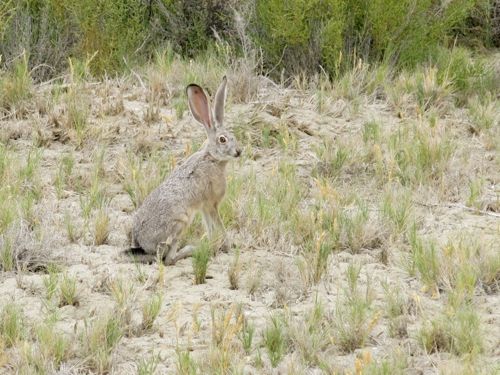
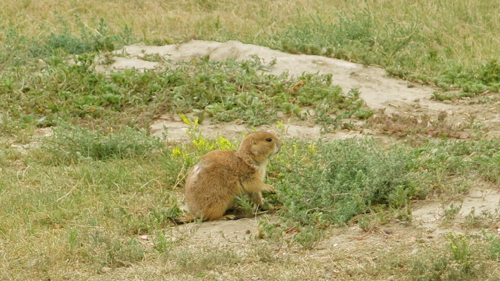
A big old rabbit stretched out in the shade with its legs splayed out fore and aft, so that its belly was on the cool, damp ground. It looked at me imperiously, daring me to come any closer, ready to spring into action if I did.

BlogJun3015c

But I went back by the other path, because I suddenly realized how hot I was, and how good the air-conditioned car would feel. Besides, I had been walking around for two hours, and if I were to get to Avoca, Iowa, at a reasonable hour, I had better start driving.

Evanston, Wyo., to Big Springs, Neb.

About an hour from Evanston, I got off the interstate and headed north on state route 372. I drove over a rolling sagebrush-covered landscape; here and there along the road I could see the usual sights of the West: a railroad siding with a string of covered hoppers; a fence and gate with a sign saying something-or-other mine and huge piles of tailings in the distance; some kind of industrial complex blowing white smoke; and so on. Martin Heidegger talked about “enframing,” the way our technological society divides up the world with maps and grids, marking where there are resources we want, where we can run roads and railroads and pipelines, where we can enjoy recreation opportunities, where we can set aside some land for wildlife. I was heading to a national wildlife refuge that was created when the Green River was dammed, and a place had to be found for some of the displaced wildlife.

About a half hour from the interstate, I was pulling in to the headquarters compound of the Seedskadee National Wildlife Refuge. I walked down a low bluff about thirty or forty feet high, into the broad basin of the Green River, and suddenly there was life all around me: horse flies buzzed my head, Violet-green Swallows flew overhead, Marsh Wrens and Red-winged Blackbrids calling in the cattails, birds and insects everywhere. In dry Wyoming, water means life, and water flowed throughout the basin, in human-made channels through the highly-managed wetlands.

BlogJun2915a

I walked down one trail, but it got swallowed up in lush, thigh-high grass — besides which, I was obviously disturbing some Killdeer, who must have had a nest nearby, since they circled around me calling repeatedly, trying to distract me from wherever it was their nestlings were. The Green River was rushing by, little pockets of turbulence marking its surface. A Cinnamon Teal burst out of the rushes and flew away. An Osprey sat in a nesting box on top of a tall telephone pole, and I walked towards it for a closer look. But it grew increasingly agitated, and began to fly in circles around the nest, so I retreated again.

BlogJun2915b

The remnants of an old log cabin and some agricultural implements were almost lost in the grass. I stopped to look at them for a moment, the new buildings of the refuge headquarters in the distance, and thought about how humans of European descent had made use of this land for a century and a half.

BlogJun2915c

What I really wanted to do was talk over what I had seen with my father, but he really can’t talk on the phone any more. He likes wetlands as much as I do — Great Meadows National Wildlife Refuge is one of his favorite places, and the last place he took a real walk outdoors — and he would be interested in the birds I saw. When I see him in a few days, I’ll tell him about Seedskadee, and show him the photos I took.

Seedskadee N.W.R. was the highlight of my day; everything else was an anticlimax, even though I drove through some fantastic scenery. I already want to go back, and spend a week there, and fish in the Green River, and maybe see some Sage Grouse on their leks.

Winnemuca, Nev., to Evanston, Wyo.

This morning, I had a hard time getting on the road; a week’s worth of twelve-hour days running Ecojustice Camp finally caught up with me. I was a little bleary when I started driving. Yesterday in a truck stop I had found an audiobook, on CDs no less, of Isaac Asimov’s I, Robot, and I put the first disc into the car’s CD player. When I was in high school, I had loved I, Robot; I found I still liked it, even though there were huge holes in the plot, even though Asimov doesn’t appear to like women very much, even though he mixes slide rules and space ships; I liked it even though the characters were caricatures, but they were engaging caricatures.

At some point after I passed through Battle Mountain, I began to notice how green the mountains looked — green by northeastern Nevada standards, that is. It had obviously rained in the recent past. Then I began to notice the banks of yellow flowers along the edges of the interstate; I could not only see them, but in a few places I could feel the pollen in the air. They ere so stunning in that desert landscape that I finally pulled over at the exit ramp to Welcome, Nevada, and photographed them. They looked bright and dramatic against the freshly green sage brush.

BlogJun2815a

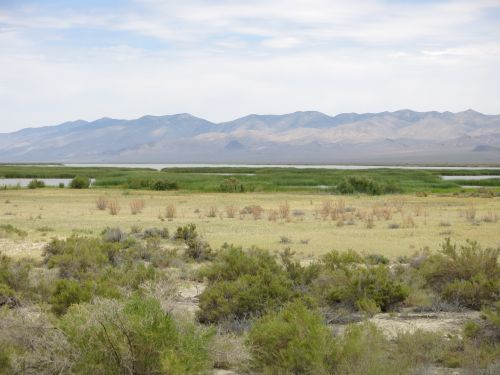
I rolled through dreary little West Wendover, Nevada, its faintly shabby casinos looking even more shabby in that huge landscape, with towering mountains, and the white expanse of the salt flats stretching eastward into the haze. I rolled across the salt flats — stopping briefly to eat a sandwich in the shade of the rest area in the middle of the salt flats — across the plains and hills on the other side, and got off at the Dugway exit. The directions said to head north, take an immediate left, go a third of a mile, then take the right fork. But the road didn’t fork, it terminated in the exit gate of a huge Cargill salt facility, with a railroad siding and towering piles of salt. Finally I figured out that what I was supposed to do was to turn right at the gates to the Cargill plant, and sure enough there I was at the entrance to Timpe Spring Wildlife Management Area.

One moment I was between the railroad siding and the salt plant, and the next moment I was driving along a narrow dirt road looking out at American Avocets and Black-necked Stilts squawking at me, and California Gulls soaring purposefully overhead towards Antelope Island, which loomed out of the invisible Great Salt Lake in the distance, and a Northern Shoveler dabbling at the edge of the marsh with that absurdly long bill it has.

BlogJun2815b

I started walking out across one of the dikes, but Forster’s Terns and Black-necked Stilts began circling closer and closer to me, and Song Sparrows came up out of the brush at the edge of the dike, all of them giving calls of alarm. Obviously, I was getting too close to their nests. So I walked out along the other dike, but soon an American Avocet and a Wilson’s Phalarope came out of the marsh grasses giving their calls of alarm, so I retreated once more. By that time, I had been walking around for most of an hour, and the temperature was one hundred degrees even, and I was longing for a drink of water. I walked back to the car.

The birds were not so bothered by me while I was in the car. I drove out very slowly, stopping several times to see if I could see the nests of the American Avocets and the Black-necked Stilts, but I could not; the nests must have been well down in the marsh grass. I swatted one last biting fly, slow and stupid from the heat, that had landed on my face, rolled up the window, and drove on to Evanston, Wyoming.

BlogJun2815c

San Mateo, Calif., to Winnemuca, Nev.

As usual on one of these cross-country trips, I got a late start on the first day. Carol was going off to Lake Tahoe with her friend Elaine, and I sat and talked with Elaine while Carol finished getting ready. Elaine has lived all her life in the Bay Area. She grew up in the city — that is, in San Francisco. Even though San Jose is more populous and has more land area, San Francisco is “the city” in the Bay Area, while San Jose is not even a place. Joan Didion, a fifth generation Californian, once wrote that the problem with California is that every place is starting to look like San Jose; not a real place, just featureless sprawl; but San Francisco is still a real place, and so it remains “the city.”

Even though I’m a relative newcomer to the area, Elaine and I both agreed that the Bay Area is a lovely place to live — except for the traffic and the cost of housing. Then Carol was ready to go, and they left, and I finished packing the car and started driving sometime after eleven.

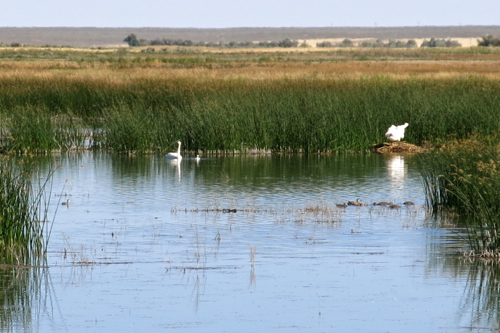
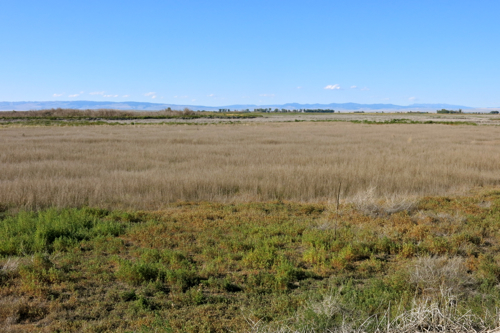
I got to Yolo Bypass Wildlife Area at a quarter past two, my head still buzzing from the Bay Area traffic. At Parking Lot B, I got out of the car. Marsh Wrens were calling all around me. Through the cattails and rushes I could see that there was still water in some of diked areas. There were flowers everywhere: most prominent were banks of plants in the carrot family — call it Queen Anne’s Lace — with nodding umbrelliform flowers three to seven feet off the ground. I stopped to watch honeybees buzzing around these flowers.

BlogJun2715a

There were plenty of birds, too: Black-necked Stilts, White-faced Ibis, Snowy Egrets, Greater Yellowlegs, and many more feeding in the shallow water. As usual at Yolo Bypass, the birds were very aware that there was a human nearby, and as I got closer they moved farther away.

BlogJun2715b

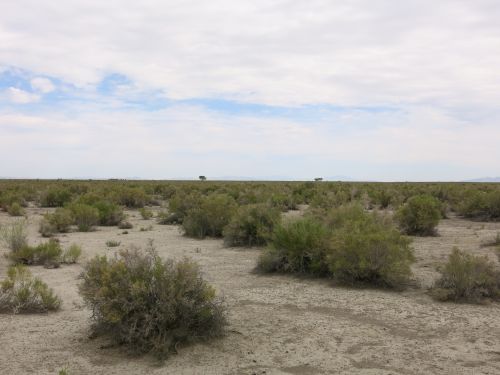
Then it was time to get back on the road. Up over the Sierras where I could see dark clouds and lightning to the east, then down into Reno where the roads were still wet from a thunderstorm. Thence up through the Humboldt River valley, with dark clouds all around. Everywhere I looked, the hills were washed with a faint green, the desert coming to life after rain. At dusk, I pulled over to get gas near Mill City, and pulled over near the exit ramp to stretch my legs. As I walked through the low grass, grasshoppers sprang to life to get out of my way, and small burrs wormed their way into my socks, and swallows swopped close to my head catching evening insects.

BlogJun2715c