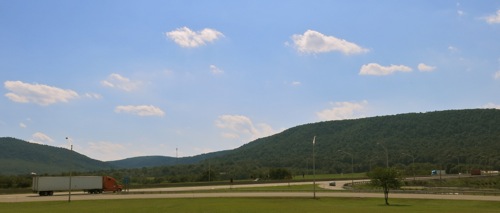
Black Wolf, Wis., to Alexandria, Minn.

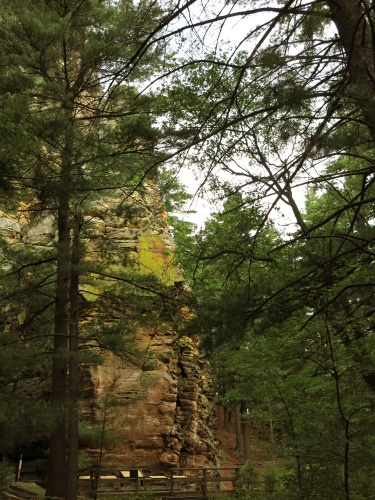
I said my good-byes in Black Wolf, took one last look at the antenna I helped Ed put up over the past two days, and started driving west. After about an hour and a half of driving, I was ready for a break, so I drove a couple of miles south of U.S. 21 to Roche-A-Cri State Park. The main feature of the park is a 300 foot high sandstone formation, a mound known as Roche-A-Cri,” or crevice in the rock. This formation is mostly overgrown with trees, but in one place there is a dramatic sandstone cliff, weirdly weathered with petroglyphs at its base.

BlogJul2715a

If this cliff were in Arizona or New Mexico, it would barely merit a glance, but it is in Wisconsin and thus it is strange and wonderful. I looked at the petroglyphs, left by ancestors of the Ho-Chunk people; I had passed the Ho-Chunk Nation casino earlier in the day. I climbed the 303 steps to the top of the mound, pausing half a dozen times on the way up to let my heart rate slow to normal. From the top, you can see for a long way across the flat plain of the Central Sands of Wisconsin, where there was once, thousands of years ago, a huge glacial lake. But it doesn’t look like much more than a flat tree-covered plain, so I headed back down.

By the time I climbed down the 303 steps and walked back to the parking lot at the entrance, it was time for lunch. While I was eating, three girls ran to play on the little playground there, and Tom, their grandfather, came over to chat with me. He told me about Necedah National Wildlife Refuge, half an hour down the highway, where Sandhill Cranes nest. So I decided to stop there.

BlogJul2715b

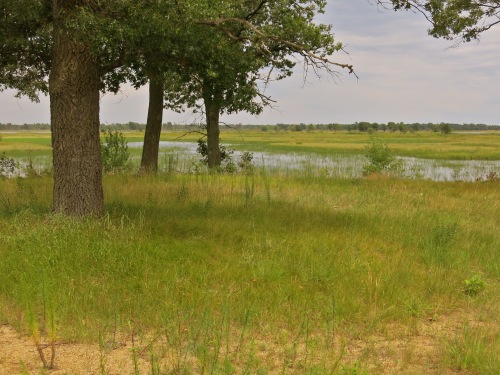
The first thing I noticed about the refuge is that the soil is that same sandy soil I saw in Roche-A-Cri State Park; the soil of the Central Sands region. The next thing I noticed was the variety of plant communities within the refuge: I walked through woodlands and oak savanna and prairie and walked on boardwalks over marshland, all in the space of less than a mile.

It was the middle of the day, and most of the birds kept themselves far away. But I did see some Sandhill Cranes fly by, giving their loud rattling honking call; I saw a couple dozen White Pelicans glide over the marsh in the distance, their heads tucked back against their bodies, black wingtips barely moving as they soared in close formation. I saw a pair of Trumpeter Swans in the distance, distorted by the shimmer of heat rising from the marsh, with three or four cygnets swimming between them. Way off in the distance, I saw some sort of tall white long-legged wader; could it be some of the Whooping Cranes that have been re-introduced into Wisconsin? They were too far away for me to be sure.

Then, in the middle distance, flying low over the marsh, I saw some white birds with black wingtips flying along, but they weren’t pelicans for no pelican would fly with its neck outstretched, and no pelican would flap its wings like that; against all my expectations, I had just seen one of North America’s rarest and most dramatic birds, the Whooping Crane. True, I had only seen the birds at a distance, and only for a few short moments, but I had seen them; and the birds I had seen were part of a small population with a dramatic story: they have been re-introduced into the eastern half of the continent where they hadn’t lived in over a century, and they have had to be taught to migrate by following ultralight aircraft.

After seeing Whooping Cranes, the rest of the day was anti-climactic.

Black Wolf, Wisconsin

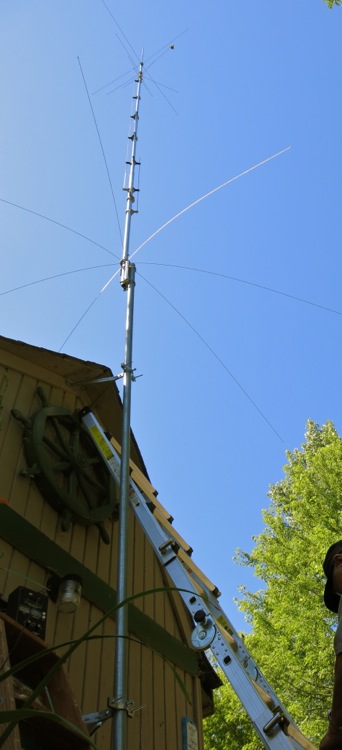
For the past two days, I’ve been staying in Black Wolf, Wisconsin — which is on the shores of Lake Winnebago — helping Ed put up a 28 foot vertical 6-band amateur radio antenna. Assembling the antenna took several hours, as there were hundreds of pieces to put together. Then we had to mount the antenna about twelve feet off the ground, so that the radials are well out of reach of anyone (if someone touched one of the radials during transmission they could get a nasty RF burn). By the time we were done assembling and erecting it, the top of the antenna was about forty feet above ground. Here’s a photo I took just before we attached the coaxial cable and tested the antenna; I was lying on the ground (those are two blades of grass you see in the foreground) looking up forty feet above me:

28 foot vertical antenna

The new antenna was much quieter than Ed’s other antenna; he quickly made a contact on the 20-meter band, an the other operator reported that Ed’s signal sounded good. And since that wasn’t enough time spent working on antennas, we went out to my car and tuned my roof-mounted 10-meter antenna for the FM-simplex calling frequency (29.600 MHz), something I had not been able to do before I left on this trip.

Yesterday Nancy asked, Didn’t I want to go out in Ed’s sailboat? No, I said, I’d help Ed with the antenna. Didn’t I want to go to the glass museum? Or go fishing? No, I couldn’t think of anything more fun than spending two days assembling and putting up an antenna. Nancy didn’t say it, so I will say it for her: Yes, I am a geek.

Hudson, Ohio, to Black Wolf, Wisconsin

Another unpleasant drive. I tried to schedule the drive so I could miss the morning rush hour around Cleveland, and still get through Chicagoland before the evening rush hour. But I grew sleepy in the middle of the day and pulled over to take a nap, and by the time I got to Gary, Indiana, it was four o’clock. I called Ed and Nancy from a noisy, busy, dirty service area to say I wasn’t going to get in to Black Wolf until after nine.

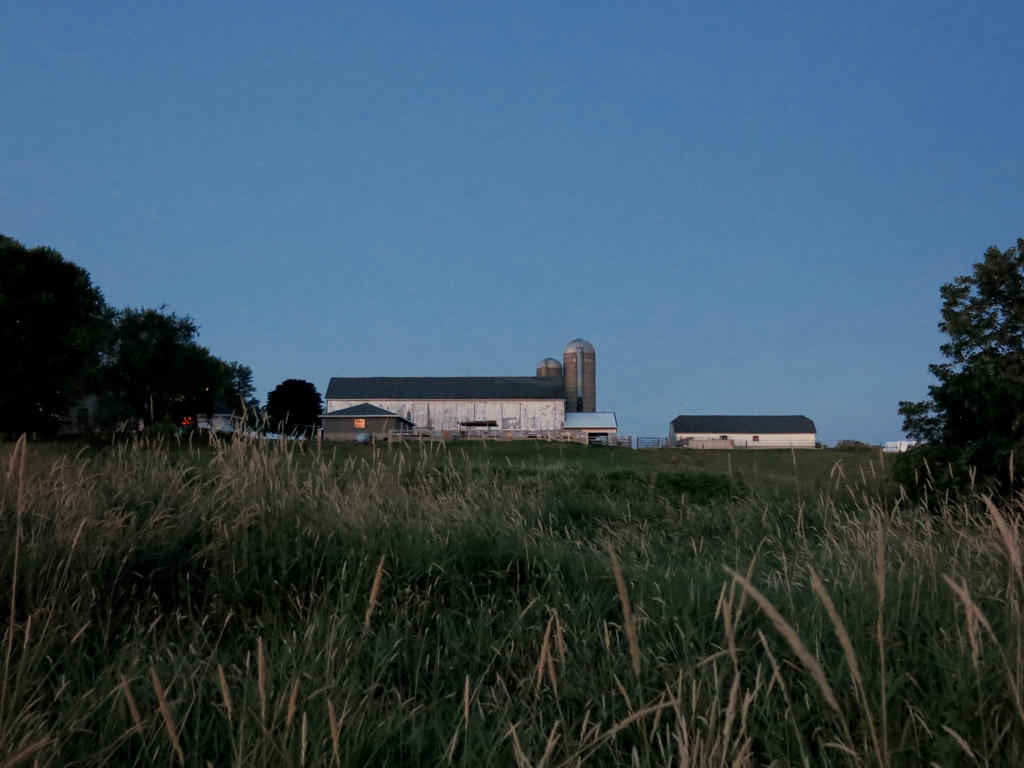
It took me two and a half hours to get past Chicago. Finally I got into Wisconsin. At dusk, I pulled over at a rest area. It was green and peaceful, with fireflies rising up out of the grass. I looked up the hill from the rest area, and there, in the fading light, was a classic midwestern farm. And in Wisconsin, it might actually be a real farm, not just empty buildings left after agribusiness took over the actual farming.

Wisconsin farm, July 23

This July 23 post was actually uploaded on July 24.

Cuyahoga National Park

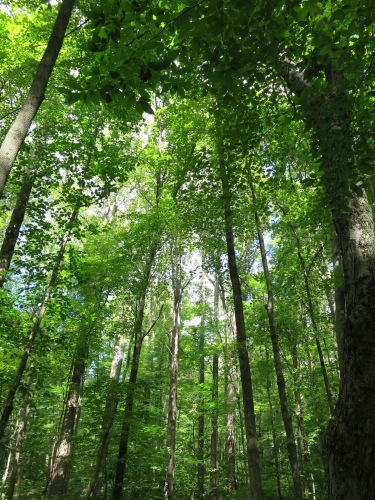
My uncle wanted to meet for lunch, so I went over to Cuyahoga National Park. Did I go look at the historic railroad that runs through the park? I did not. Did I go to look at the beautiful waterfalls? I did not. No, I walked along the Plateau Trail off Oak Hill Road, to look for vireos. Vireos are small, drab, unremarkable birds that sit in the very tops of trees in woods. They are almost impossible to see, looking up thirty or fifty feet above your head, trying to see a small drab bird through the leaves. This is what it looks like, hunting for vireos in the Cuyahoga National Park:

Cuyhoga National Park

Mostly, you don’t really look for vireos, you listen for vireos. I only heard one or two vireos, and I certainly didn’t see any vireos. But looking up into the treetops was pleasant, and I did not consider it an ill-spent morning.

This July 22 post was actually uploaded on July 24, due to poor Internet access.

Paoli, Penna., to Hudson, Ohio

The drive from Paoli, Pennsylvania, to Hudson, Ohio, is mostly along the Pennsylvania Turnpike and it is not particularly enjoyable. For most of the distance, the Pennsylvania Turnpike is only two lanes wide, and it carries a lot of truck traffic and a lot of automobile traffic. If you’re driving alone, you don’t have much time to look at the scenery because you’re concentrating on the winding roads and the traffic.

This is too bad, because the scenery is worth looking at. The Turnpike winds up and down and back and forth to get across the Allegheny Mountains, and there are four tunnels, the last of which is almost a mile long — it’s a major engineering feat. This is one of several routes through the Alleghenies that date back to the nineteenth century when various interests were competing to connect eastern Pennsylvania with the west. After the American Revolution ended, Americans started pushing west through Pennsylvania, but “in these early years, terrible roads were the norm; they were rudimentary, often badly built, poorly graded, and seldom maintained.” (Robert Kapsch, Over the Alleghenies: Early Canals and Railroads of Pennsylvania [Morgantown, W.V.: West Virginia Univ. Press, 2013], p. 13).

By 1824, the Commonwealth of Pennsylvania was making plans for building a canal from Philadelphia to Pittsburg, in order to make travel across the mountains easier. One early plan called for a canal “40 feet wide at the top, 24 feet wide at the bottom, and four feet deep” to get through and across the mountains; “to accomplish the most difficult portion, a canal over the Alleghenies, … the commissioners proposed a tunnel [over] 4 miles long” (Kapsch, pp. 52-52). As amazing as it sounds, canals were built through this rugged terrain; these canals mostly followed rivers, but there were sections of canals to be dug, locks to be built on the rivers, aqueducts and tunnels that had to be constructed — and most of the work had to be done by hand, in those early days.

Hearing about the early canals and railroads makes the construction of the Pennsylvania Turnpike seem less impressive. Imagine getting a canal boat through the mountains — after thinking about that, the winding grades that require semi-trailers to grind upwards in low gear with flashers on are not at all impressive.

Penna. Turnpike through the Alleghenies

Aside from the scenery — which I did not have time to look at — aside from the scenery, the Pennsylvania Turnpike is not a pleasant highway to drive: enough traffic to be annoying, too many poor drivers, service areas that range from cheerless to grim. But it was worth the drive because I got to visit with cousins and an uncle in Pennsylvania, and tomorrow I will visit with cousins and an uncle in Ohio. Sometimes the point of the journey is not the journey, but the destination.

Posted several days late, due to lack of good Internet access.

West Concord, Mass., to Paoli, Penna.

From my dad’s condo, I drove along Route 117 to get to the interstate highway. In Stow, I remembered I needed to get gas before I got on the highway, so I stopped at the little gas station at corner of Hudson Road. Ed and Nancy used to live just up the street from there, and it was a little disconcerting to remember that they now live in Wisconsin, and that I would be seeing them at the end of the week. I bought a copy of the local newspaper, the Stow Independent, to bring to them; a quarter of a mile down Route 117, I stopped at Applefield Farm to buy blueberries and carrots, but those will get eaten long before I get to Wisconsin.

The drive down to Pennsylvania is not all that interesting. Traffic is always heavy enough that you can’t really look at the scenery, when there is scenery worth looking at. You also have to figure out which route you’re going to take: from Hartford, will you take Interstate 84 or the Merritt Parkway through Connecticut? from the Tappan Zee Bridge, will you take the Palisades Parkway or the Garden State Parkway to get to the New Jersey Turnpike? when the Jersey Turnpike divides, will you go on the cars-only side, or the cars-buses-and-trucks side?

I passed by one of New Jersey’s refineries, and the smell brought back memories of all the trips my family took to Staten Island to visit my grandmother. In the 1960s, the highway system was not as well-developed, and the drive would take nine hours. Dad would take a day off from work, we’d pile in the car, Jean and I would annoy each other in the back seat (“I’m putting up an invisible shield, and you can’t get me!” “There! I put my hand through your invisible shield!” etc.). We’d pull in Friday night, Grandma would give Jean and me each a big hug, and we’d sit down to dinner. On Saturday, Dad would work the whole day around the house for Grandma, and Jean and I would play in the basement, or read books in the little room off the stairs. Grandma’s next door neighbors Dave and Alice would usually stop in for a visit. Dave was a big man, over six feet tall I think, a New York City cop, and when I started to get tall he told me that I had to learn to stand up straight instead of slouching over. Then on Sunday we’d drive home. We’d make this trip two or three times a year, and we all got to know that drive pretty well. Mom and Dad would debate whether to take the Merritt Parkway, or the new route, Interstate 84. When the Verrazano Narrows Bridge from Brooklyn to Staten Island opened, we drove across it — but just once, and never again, because going through Brooklyn took forever. Sometimes we’d get to stop at a Howard Johnson’s for lunch, though mostly I remember Mom packing lunch for us. And when we drove past the refineries, in New Jersey, Jean and I would loudly exclaim that it stank, and we’d roll up the windows until we were past.

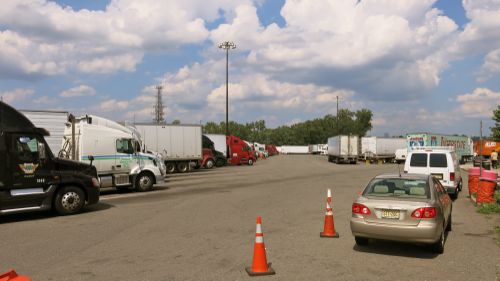
Driving in the northeast corridor is not like driving out in the Far West, where traffic is almost always light and people do not routinely drive like maniacs. I remember the radio raconteur Jean Shepherd talking about driving down the New Jersey Turnpike, and looking in his mirror only to find that the driver behind him was so close that he was using Jean Shepherd’s rearview mirror to shave. When I finally got to the New Jersey Turnpike, I was feeling a bit frazzled. I pulled over at the Vince Lombardi Service Area to relax for a few minutes. The Vince Lombardi Service Area was huge, and not particularly relaxing. Hundreds of semi-trailers filled the truck parking lot.

BlogJul2015

The parking lot for cars was also active, with cars and people coming and going constantly. The last time I had stopped at the service area was in the 1990s, and back then they had had Vince Lombardi memorabilia on display. But now the entire service area was devoted to retail sales, fast food joints and a coffee shop and a travel store. more and more, this is the fate of our public spaces: they are dominated by sales of consumer products, or advertisements featuring consumer products. I missed the replica of the football stadium Vince Lombardi’s team played in, a model built entirely of matchsticks. It was kind of stupid, but definitely worth looking at.

The rest of the drive was more of the same. I was glad to pull into Steve and Cheryl’s house in Paoli, and sit down to a peaceful dinner with uncle and cousins.

“Nature, red in tooth and claw”

The old time Universalists were fond of saying that “God is love.” That statement may be true, but not in any sentimental sappy sense. Many years ago, Tennyson pointed out that he who might place trust in the belief that “God was love indeed / And love Creation’s final law” needed to remember that “Nature, red in tooth and claw … shriek’d against his creed.”

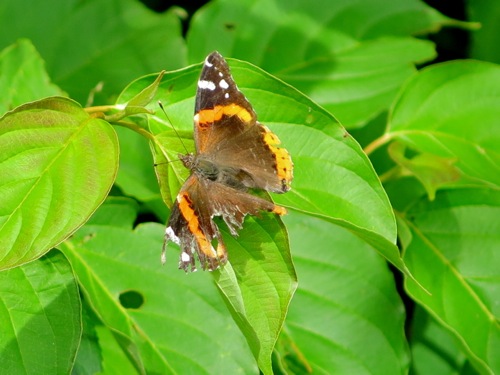
On our walk today, Abs and I saw a butterfly that had lost much of its left hindwing, and a part of its left forewing. We speculated that perhaps a bird or other predator had attacked the butterfly, and somehow it had gotten away, and was still flying:

BlogJul1715b

Living things need to eat, and as often as not they eat other living things in order to stay alive. And this is true of you, too, O human being who think yourself an apex predator: there are plenty of microorganisms and parasites and biting insects who feed on you.

“Humble bee”

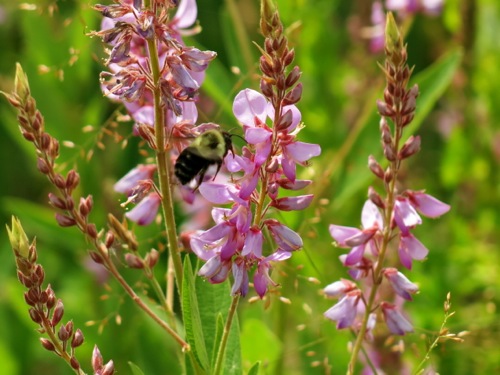
Abs and I went for a walk in Great Meadows in Concord, Mass. We spent some time looking at native pollinators, of which my favorite was a bumble bee (Bombus sp.) working the blossoms on Purple Loosestrife and goldenrod:

BlogJul1715

It reminded me of Ralph Waldo Emerson’s poem about bumble bees, called “The Humble Bee.” When I got home I looked up the poem; it wasn’t as good as I had remembered, but I did like the fourth stanza, which captures something of the flavor of a warm July day in New England:

Hot midsummer’s petted crone,
Sweet to me thy drowsy tune,
Telling of countless sunny hours,
Long days, and solid banks of flowers,
Of gulfs of sweetness without bound
In Indian wildernesses found,
Of Syrian peace, immortal leisure,
Firmest cheer and bird-like pleasure….

Rensselaer, N.Y., to Saco, Maine

A short drive today, so by three o’clock I had set up my tent, and started walking up the beach. Very light rain fell off and on, but that didn’t reduce the number of people on the beach by very much. In the short stretch of beach between Ferry Beach Camp and Conference Center, and the entrance to Ferry Beach State Park, I passed a dozen families set up with towels, three different guys casting bait in hopes of a striper coming by, a dozen people walking up or down the beach, and half a dozen people tossing a frisbee around.

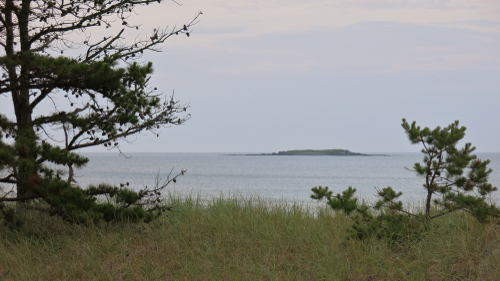
As soon as I got away from the beach, and onto the trails in the woods of Ferry Beach State Park, I didn’t see another human being. Probably the mosquitoes kept them away. There is plenty of open water in the woods behind the dunes this year, plenty of places for mosquitoes to breed. And then I heard a Veery singing, that strange downward spiraling song that is one of the most haunting and beautiful bird songs I have ever heard: a bird song worth driving three thousand miles to hear.