Seattle to Redding

We dropped off Saba at the Montessori school where she works, and started driving south. It was a gray and dreary day, and before long it started snowing. Pretty soon it was snowing hard enough that the ground was white on either side of the highway, and in a few places slush accumulated between the lanes. We saw some accidents: a couple cars spun out and off the highway, something on the northbound side of the freeway with several tow trucks and emergency vehicles and traffic backed up for a mile or more. South of Eugene, the snow stopped, but the forecast for the Siskiyou Mountains was for snow tonight and snow tomorrow morning. We decided to drive as far south as we could before we got tired. Wes topped briefly in Ashland so Carol could collect mineral water from the public fountain in Ashland Plaza. Then we started driving again, winding up over the mountains and back down again until we reached Redding, where we stopped to spend the night.

As for the lithium water, it smells sulphurous, like slightly rotten eggs. The water also has quite a bit of barium in it, so you’re not supposed to drink more than a few sips at a time. If we decide to drink it, we should do with it what they do with “Crazy Water” from Texas: dilute it; “Crazy Water” tastes pretty yucky, too, but once diluted it’s at least drinkable.

San Mateo to Eugene, Ore.

We got up later than planned (and isn’t that how all our trips begin, getting up later than we had planned?), and immediately gave up on the idea of driving to Seattle in one day. Carol researched places for us to stay while I drove through the unpleasantness that is Bay Area traffic. We were glad to get off Interstate 80 and head north, away from the sprawling tentacles of the growing San Jose – San Francisco – Sacramento megalopolis.

I’ve been reading Roadside Geology of Northern and Central California, and when Carol started driving after lunch, I read to her from the section on driving Interstate 5 up through the Central Valley: it’s all Quarternary alluvial deposits, for miles and miles, with the one exception of the Sutter Buttes, a group of craggy hills that thrust up seemingly out of nowhere, a volcanic intrusion that seems incongruous.

The geology along the road got really interesting a couple of hours further north, but by that time we had moved on to other things. We sang some Sacred Harp songs, to get us ready for the Sacred Harp convention we’re going to this weekend, and then we sang some other songs — old standards like Moon River, Close to You, Ring of Fire — until I got the hiccups and had to stop.

We drove up, up, up over the Siskiyous, where there was some snow on the side of the road once we got above 4,000 feet, and then down, down, down into Ashland where we stopped for dinner. We saw a lot of street people in Ashland. Two of them accosted us as we walked towards a restaurant. “Hi, how are you?” the young white man said. “Good, how are you?” I said. “Poor and hungry. Can you give us a dollar?” he said. “We’ll stop on the way back,” Carol promised, and we did, but they were gone: it had gotten pretty chilly by then.

As we approached Eugene, we talked about Steve who had lived in Eugene. Steve was someone we had hung out with at the Alaska Sacred Harp Convention in October, and he had died suddenly and unexpectedly in California last month at the age of 60. He was not someone you would expect to die suddenly, and we keep talking about it, trying to make sense out of his death.

And then we were at the motel, where they were showing Olympic ski jumping competitions on a big TV. I talked to one of the young men staffing the desk while Carol checked in. “What they have on right now is figure skating or ski jumping,” he said apologetically. “I don’t need to see figure skating,” I said. He grinned. We talked about all the sports they never seem to show. “Like curling,” I said, “ho come they never show curling?” “It’s pretty boring,” he said, “it’s like people who weren’t good enough to play hockey had to invent a sport they could play.” It turned out that he enjoyed shooting, and shot both pistols and rifles; we both agreed that we would like to see the Olymplic biatholon competition, where you have to ski a certain distance, then shoot. We both looked up at the big screen as another ski jumper twisted through the air in slow motion, then landed wrong and tumbled down the hillside.

Lichens, Camp Meeker, Calif.

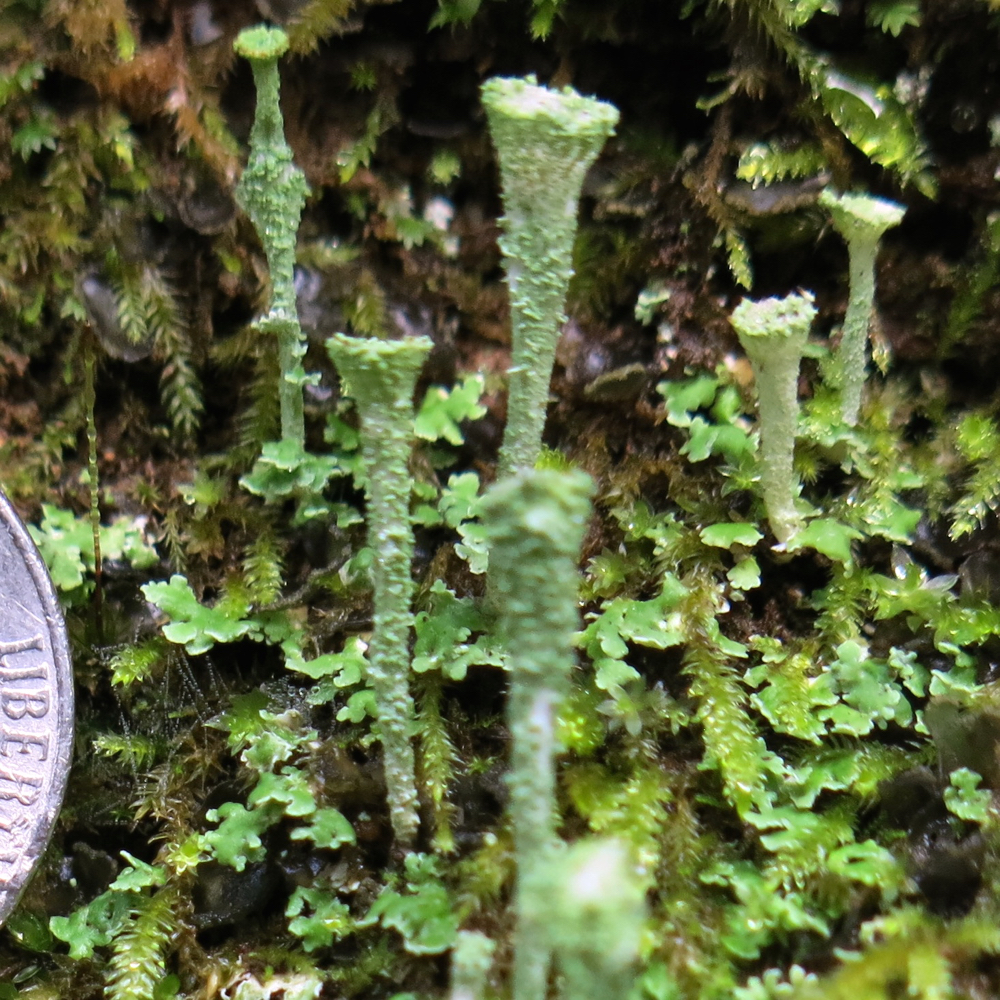
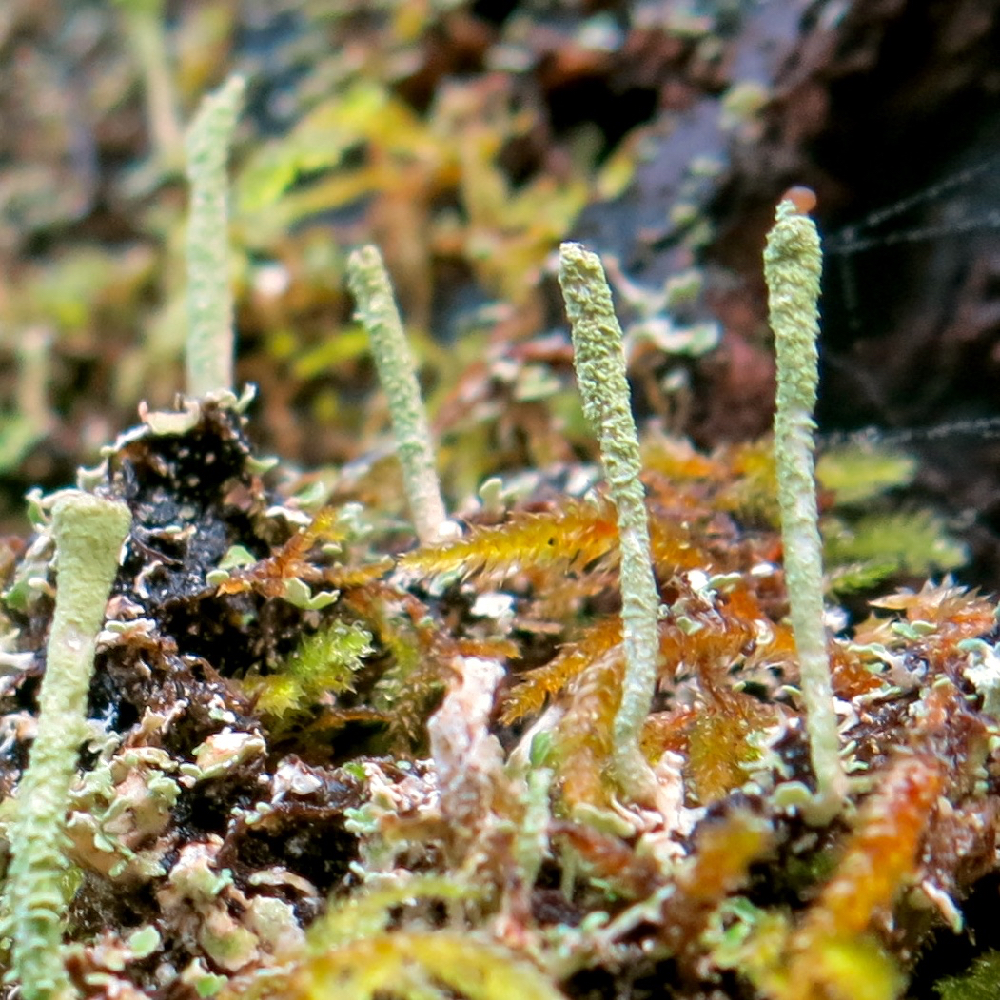
These lichens were growing on reddish soil exposed by a road cut, in the redwood forest above Camp Meeker, California. The lichens in both photos are approximately the same size; in the first photo, the edge of a nickel appears at lower left to provide a sense of scale.

As to identification, these lichens are in the genus Cladonia: the primary thallus consists of whitish-green squamules (the little leaf-like things at the bottom of the organism); and arising from the squamules is the podetium, an upright structure characteristic of the genus Cladonia. But to determine which species of Cladonia, I would have had to collect some samples and carefully examined them. In Lichens of California, Mason E. Hale Jr. and Mariette Cole state that “Cladonia is one of the first lichens collected by amateurs; since I am a rank amateur when it comes to lichens, it is thus no surprise that I paid so much attention to these showy and fascinating lichens.

Portable radio

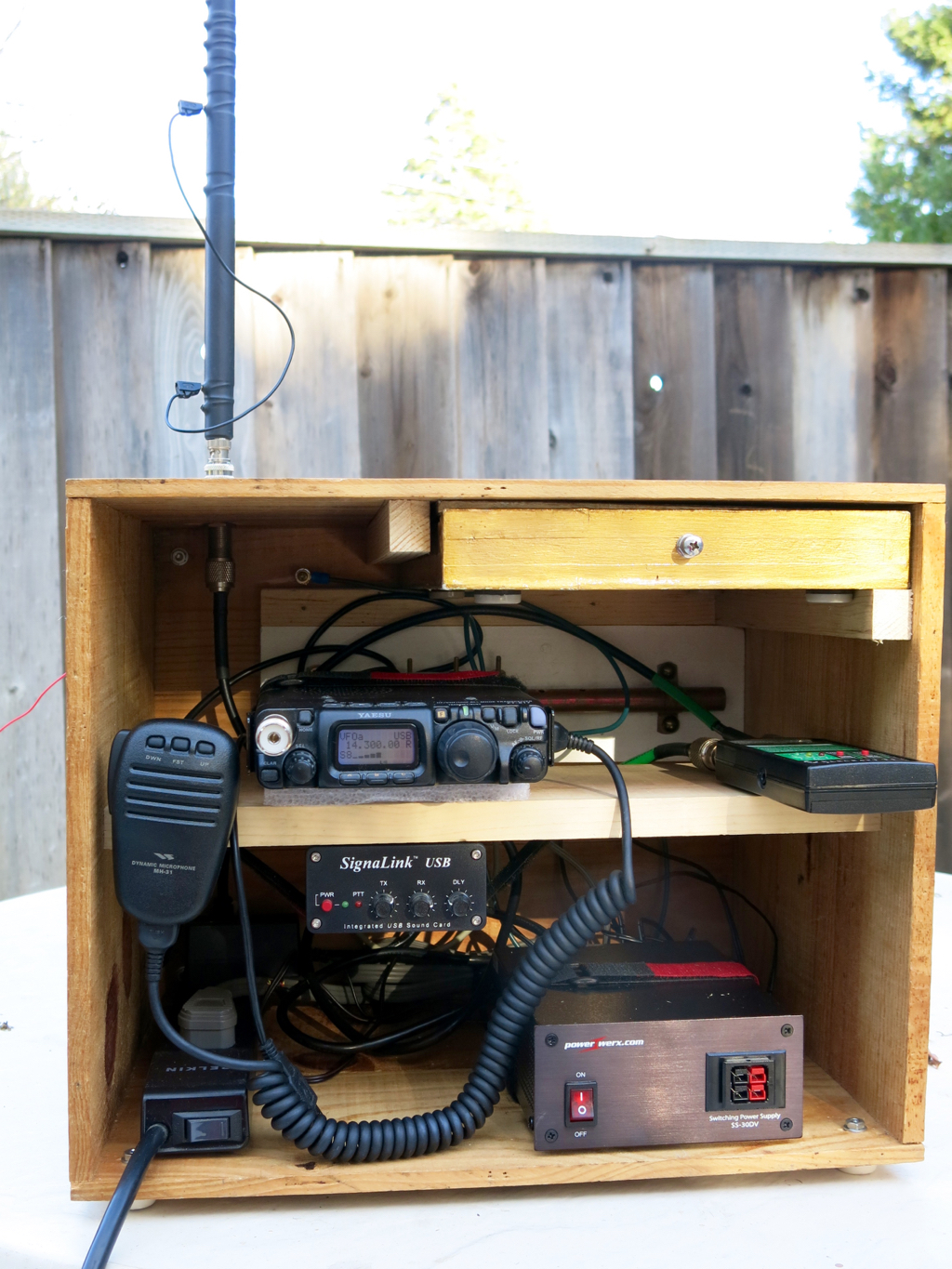
Michelle and Don stopped by this morning to pick up some amateur radio gear I got from Dad that I’m no longer using. We stood around talking for a while, and Don showed me the prototype of a large variable air capacitor he’s fabricating for use in magnetic loop antennas. So of course I had to show off my latest project: a portable box containing a low-power transceiver, digital interface, power supply, antenna tuner, and antenna.

OK, in terms of raw geek street cred, my portable radio box isn’t as cool as fabricating a large variable air capacitor. But it’s worth something as a small piece of systems engineering that addresses a specific problem that I face: our new house is clad with stucco on wire mesh, which means I live inside what is essentially a Faraday cage; and the landlord does not allow permanent outdoor antenna installations (let’s face it, most visitors to a cemetery don’t want to see a big antenna array). Now I can grab this box, walk out to our fenced-in patio, sit down and get on the air. Mind you, as with any good DIY maker-type project, there is room for improvement and expansion: it definitely needs a door on the front to protect everything; I’d like to add a straight key for Morse code and a space to store an Android tablet for digital modes; I’m thinking of a separate battery and solar cell unit to go with this; maybe someday I’ll add a small linear amp. But in the mean time, this works as is, and it was fun to sit outside in the sun yesterday and monitor the mobile maritime net.

Moving

Carol and I have decided that it’s easier to move a thousand or more miles away, as we have done four times now, than it is to move two miles away, as we are doing right now. When you are contemplating a long distance move, you know you have to plan everything well in advance. When you’re moving two miles up the street, you think it’s going to be easier, so you relax.

But a move of two miles is not much easier than a move of two thousand miles. Friday, while we were in the middle of schlepping boxes, Carol looked at me and said, “This is traumatic.” OK, maybe “traumatic” is too strong a word; it certainly is extremely unpleasant.

Housing solution

I wrote recently about how insanely difficult it is to find housing in the Bay Area. Since then, the East Bay Times reported that high housing costs have contributed to recent job losses in the Bay Area:

“The Bay Area’s job losses stem from two distinct phenomena: Some employers are slashing positions, and others are unable to hire. Some economists attribute this second problem to structural barriers posed by skyrocketing housing costs. The lack of affordable places for workers to live appears to have hobbled the region’s ability to fill jobs as briskly as in prior years.

“‘Housing is the chain on the dog that is chasing a squirrel,’ said Christopher Thornberg, principal economist and founding partner with Beacon Economics. ‘Once that chain runs out, it yanks the dog back.'”

High-cost municipalities like Palo Alto have been experiencing a net decline in population for over a year now — while housing costs continue to rise. It will be interesting to see how this trend plays out. I suspect that changes in policy will have much effect on rising housing prices; this suspicion is based on what Jay Forrester wrote in his 2009 paper “Some Basic Concepts in Systems Dynamics”:

“People seldom realize the pervasive existence of feedback loops in controlling everything that changes through time. Most people think in linear, nonfeedback terms. … people see a problem, decide on an action, expect a result, and believe that is the end of the issue. [This is] the framework within which most discussions are debated in the press, business, and government.” Yet the world does not really work in a simple, linear fashion. Instead, says Forrester, “we live in a complex of nested feedback loops.”

Another way of saying this is that we human beings like to think of the world in terms of simple, linear, cause-and-effect relationships. Linear thinking provides a reasonably good model for most of our day-to-day actions, and we like to think it will work in all situations. A better model is to think of the world in non-linear terms, as a complex of interconnected feedback loops.

However, in practice it has proved very difficult to get most people to adopt a non-linear model of the world. I see this all the time in my work life. For example, when I’m doing pastoral counseling with people, I see that people often shy away at understanding their personal, spiritual world in terms of nonlinear feedback loops; they prefer to think that a personal, spiritual problem is easily addressed using linear cause-and-effect solutions; and those linear solutions may work in the short term, but after short terms gains there are typically feedback loops in the family and in other social relationships which tend to draw the person back to their original equilibrium.

In another example from my work life, congregations try to solve their problems using linear cause-and-effect thinking. If a congregation wants to increase membership, for example, they will typically find a linear cause-and-effect solution like improving their Web site or doing other advertising to draw new people in the door. One common result of this kind of linear “solution” is that there is a brief influx of newcomers, and a brief increase in attendance, but then within a year various feedback loops bring the congregation back down to the size it was before the advertising campaign.

So the reason I see little hope for policy solutions to the housing crisis in the Bay Area is that most policy efforts are driven by linear cause-and-effect thinking. Build more housing and housing prices will drop; implement rent stabilization measures and housing prices will at least be stable; — both these measures will fail because they don’t take into account the complex of feedback loops that are driving high housing costs, including availability of a range of jobs, transportation infrastructure, national and world forces bearing on the region, etc.

We have managed to solve our own immediate housing crisis. After the landlord sold the building we live in, we spent a month looking for housing and yesterday we signed a lease. We will be living in a cemetery — I kid you not — in a nice two-bedroom house that had been built for a caretaker. We solved our immediate problem with a linear cause-and-effect solution; but we have not solved the longer term problem of how two people who are not earning those six-figure high-tech salaries can afford to live in Silicon Valley.

Mount Edgecumbe

Carol and I are here in Alaska to participate in the Alaska Sacred Harp Convention, and we have been singing every day, and we attended a “singing school,” pretty much as you’d expect. But our gracious host Kari also arranged for those attending the convention to go on a whale watch trip. Over the course of an hour and three quarters on the water, we saw more than twenty humpback whales — and the scenery was spectacular as well. I particularly enjoyed looking at Mt. Edgecumbe, a long-extinct volcano. At this season Mt. Edgecumbe is snow-clad from it summit about halfway down to the sea, making it look like something out of a classic Japanese woodblock print, only more dramatic.