The state of California just changed the COVID rules again. As reported by Bay Area News Group:
“Under mounting pressure, California’s workplace-safety board on Wednesday voted to drop controversial new rules that would have required many workers to keep their masks on for months — just hours after state officials announced that vaccinated Californians can go mask free in most settings starting next week.”
(The “mounting pressure” was from business groups, who out-pressured employee groups and unions who emphasized the safety of workers. Next time some politician says, “We follow the science,” remember that there are still many things scientists don’t know about COVID, which means that politicians are responding to political pressure as much as they’re “following the science.”)
The most difficult aspect of complying with COVID rules is that they’re constantly changing. Those of us who work with children are going to be dealing with changing COVID rules for at least six more months, assuming the vaccine trials for children aged 5 to 11 are completed by late this year. And those of us who also work with children under age 5 may be dealing with changing COVID rules for another year.
It’s exhausting. You learn one set of rules, and they change. This is inevitable. Our knowledge of COVID keeps changing. Though Americans love to blame people — the Democrats blame the Republicans, the Republicans blame the Democrats — in this case, there are no people to blame. We can only blame the virus. It’s silly to blame an unthinking virus. So there’s no blame.
But it’s still exhausting. COVID rules are changing on a weekly basis. It’s impossible to keep up.
So we’re still stuck in lockdown, and maybe you’re getting bored with your daily walks. The British Pilgrimage Trust has a suggestion: turn your walks into mini-pilgrimages. Their Web site has a list of “holy places” in the U.K. that you can walk to. Next you set a spiritual “intention,” then treat your walk as a kind of “focused meditation.” In an interview with Religion News Service, Guy Hayward, director of the Pilgrimage Trust, says more about those “intentions”:
“Pilgrimage is about traveling, about being a stranger in a strange land, according to [Hayward]. The pandemic flips that on its head. ” ‘Staying still is actually even more of a strange experience,’ he said. ‘It’s like, how do you make yourself be a stranger in a place you know really, really well? How do you make yourself see it fresh and see it in a new way?’ “
This, by the way, sounds a lot like Henry Thoreau’s essay on “Walking.”
For us Unitarian Universalists, what might constitute a “holy place” to which we might make a micro-pilgrimage? Back when we lived in downtown San Mateo, I would walk to different houses of worship. As is true of many small American cities these days, San Mateo has quite a diversity of faith communities, so from our old apartment I could walk to a Hindu temple, an Islamic masjid, a couple of historically Black churches, a Pure Land Buddhist Temple, a UCC church, a Catholic church, a Pentecostal storefront church, and several other places of worship. I’d think about — maybe I should say, do “focused meditation” on — the religious diversity of the world, and my place in that diversity. It proved to be both uplifting (“A masjid? how cool is that!”) and humbling (“Gee, Unitarian Universalism is not as important in the world as I’d like to believe”).
Now I live next to a cemetery. Walking in cemeteries was something of a tradition in New England, in part because they plow the roads in cemeteries in winter so it’s one of the few places you can walk safely without skis or snowshoes. But it was also a meditative practice: you’d read the inscriptions and wonder about the person who had died. This is another exercise in humility, and a lesson in perspective. How well am I living my life now, knowing that I’m as mortal as that person lying under the gravestone? But perhaps you have to be from New England, with that grim New England worldview, to appreciate this kind of micro-pilgrimage.
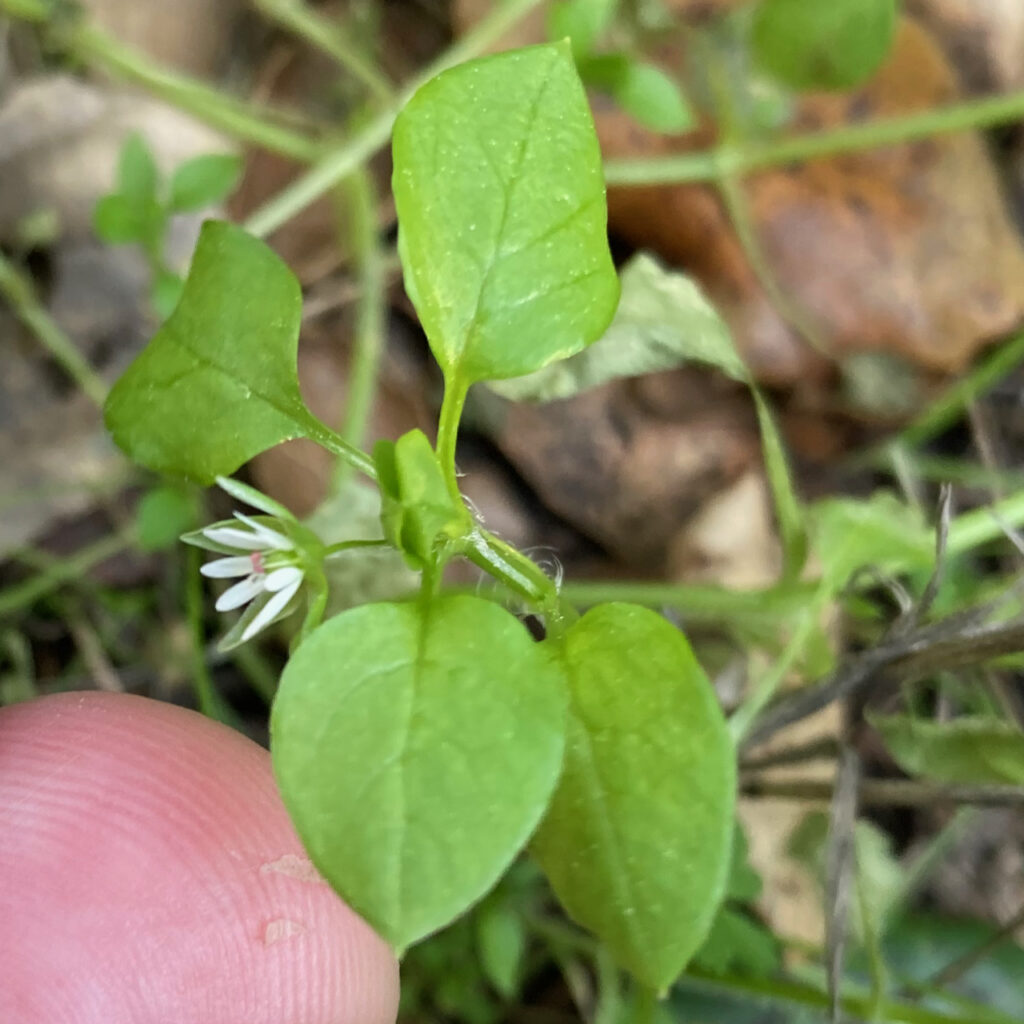
You can also follow Thoreau’s lead, and look at the world of nature around you. Even when you live in the city, or in the inner suburbs, places where humans utterly dominate the landscape, there are still plenty of non-human organisms worthy of human attention. Recently, I find myself looking for flowering weeds, like this chickweed:
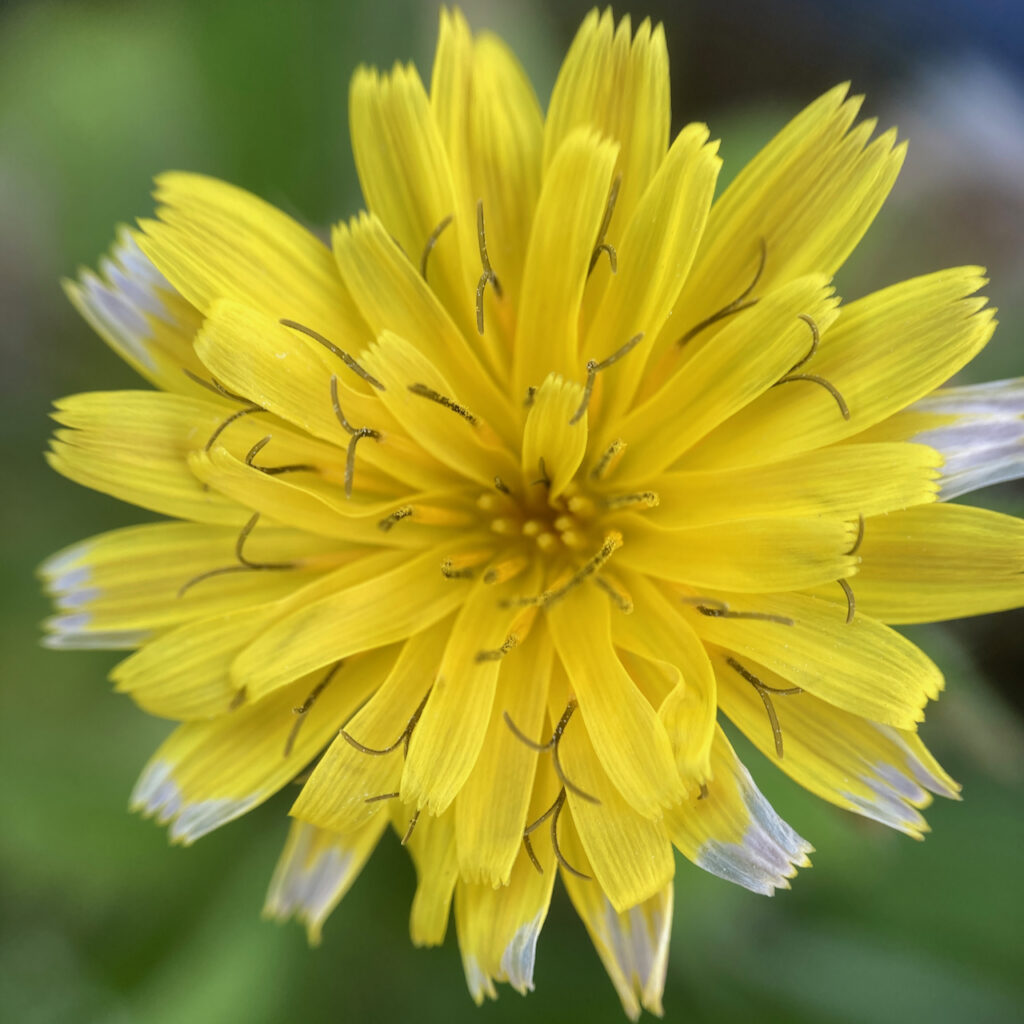
Or this flower, which is not a dandelion, but a related flower from the Cichorieae tribe (probably a Sow Thistle):
Why do I look for weeds? Maybe because of the same sentiment that Malvina Reynolds expressed in her song, “God Bless the Grass”:
God bless the grass that grows through the crack, They roll the concrete over it to try and keep it back…. God bless the truth that fights toward the sun, They roll the lies over it, and think that it is done….
The real point in all this is that any walk, even a walk around your neighborhood, can become more than just a walk. It can become a spiritual journey, where even though you stay in your neighborhood, you travel very far in spirit.
Photos from our trip to Point Reyes National Seashore:
American White Pelicans (Pelecanus erythrorhynchos) feeding in Estero de Limantour, watched by a Great Egret (Ardea alba)
Moonglow Anemone (Anthopleura artemisia) in a tidal pool formed from a ship’s engine block on Limantour Spit
One of about 145 Giant Bell Jellies that we saw stranded on Limantour Beach. Not a true jellyfish, this organism is actually a colony of smaller hydrozoans. The purple spots are ocelli, or primitive eyes.
“The Newt Patrol is a group of citizen scientists in the South Bay. We have been surveying newt roadkills near Lexington Reservoir since 2017. We have documented over 10,000 dead newts so far, representing one of the highest rates of amphibian roadkill mortality known worldwide. This project aims to raise awareness of this problem and provide a rigorous database that could be used by the authorities to implement mitigation measures.”
I’ve been trying to think of good things that have come out of this pandemic. Most of the pandemic is bad: personally there’s the loss of social contact, cabin fever, the fact that every task at work seems to take much longer so I either have to work long hours or things don’t get done, we can’t go to visit our relatives (who live far away)…. Then in wider society, there’s economic disaster, increasing mental distress and illness, rise in domestic violence, children not learning, widening gap between the rich and everyone else….
So is there anything good to come out of this pandemic?
Well, I haven’t had a cold or any other illness since the pandemic started. Wearing masks in public places (as everyone does here in San Mateo County) and frequent hand washing really do reduce the spread of illnesses.
I only have to commute to the office twice a week, and traffic is light when I do drive. Pre-pandemic, when there was a lot of traffic, I had a grinding, soul-sucking commute, so this is a benefit.
Since I’m stuck at home, I’ve been practicing the guitar more. I haven’t become a good guitarist by any means, but at least I’m no longer bad.
That’s really all I can come up with right now. Maybe you can add to this list?
Here’s another environmental threat to keep you up at night:
“Nitrogen deposition and pollution is [a] more acute threat than climate change. … [But] few people are paying attention.” — Dr. Stuart Weiss, Chief Scientist of Creekside Science.
I’m listening to Weiss talk to the California Naturalist class I’m taking right now. Weiss makes some interesting points: Smog does an amazing amount of damage, not only to human lungs but also to non-human organisms. Non-native grasses are big contributors to the increase in pollen in recent times. Free-range cattle on California grasslands can keep non-native invasive grass species under control, providing habitat for endangered species as well as reducing allergens.
It was a strange Christmas Eve. We did the usual Christmas Eve candlelight service in the Main Hall of the Unitarian Universalist Church of Palo Alto (UUCPA) — but the only people there were Amy, the senior minister; Paul, the camera operator; and me. The music all had to be pre-recorded, and I set up my laptop next to my lectern (Amy and I each had our own lectern, about twenty feet apart from each other) so that I could join the Zoom call and be able to hear the music. The strangest part was not being able to see anyone: the whole point of Christmas Eve for me is seeing being able to see people, including the young adults who come back to Silicon Valley for the holidays.
Yes, it was a strange Christmas Eve.
But something that happened in the afternoon made the rest of the day bearable. I was taking a break from checking email, and walked out to the edge of UUCPA’s campus to look down into Adobe Creek, which is routed into a large concrete channel for the last mile or two before it reaches the Bay. By fall, there’s always sediment that has accumulated during the summer, when not much water flows through the channel. This year, there was a luxuriant growth of what was probably water cress, and the last rain had been enough to cut some winding channels through the greenery, without washing everything down stream. The usual Mallards were paddling around, and then I noticed a Snowy Egret crouched behind a thicket of greenery; it lashed out with its bill, and appeared to spear something from the water.
I know Snowy Egrets are good at finding food anywhere, but I was a little bit surprised to see one in that particular urban channelized stream. There must have been enough prey to make it worth the bird’s time and effort; it’s a fairly sterile environment, so perhaps it was finding organisms washed down from upstream. Whatever drew it there, it certainly gave me a lift to see it.
Because I’m currently taking the California Certified Naturalist class, I’m spending more time than usual looking at and photographing various organisms. I’m astonished at the diversity of organisms that I saw this week within a 45 minute drive of our house. I managed to see organisms from four kingdoms — plants, animals, fungi, and Chromista (which includes brown algae). Going down one taxonomic level, I saw organisms from over a dozen different phyla (for animals) or divisions (for the other three kingdoms).
This represents an astonishing evolutionary diversity: green algae, red algae, vascular plants; sac fungi and allies, mushrooms and allies; brown algae; sea anemones and allies, molluscs, sea stars and allies, arthropods, ringed worms, flatworms, chordates. And I saw eight of these taxonomic groupings within a five minute walk from my desk.
I have a tendency to focus on flowering plants and vertebrates, while ignoring other organisms. Sometimes it’s good to remind myself how much biological diversity is in my own back yard.
Ochre Sea Star (sea stars and allies), Sea Lettuce (green algae), Surf Grass (vascular plant), and unidentified red algae at Pescadero State Beach on Friday — that’s four phyla/divisions in one photograph.
I’m currently taking the California Certified Naturalist class, with a curriculum developed by the University of California, and offered through a local environmental nonprofit, Grassroots Ecology. One of the ongoing assignments is to keep a field journal of observations of the natural world.
Keeping a field journal feels like a kind of spiritual practice to me. It’s a way to keep connected with the non-human organisms around us, and helps me pay attention to the abiotic components on which life depends. It forces me to get away from the computer and get outdoors, which is something I need to do more of. And it’s very calming, probably because I stop thinking about myself, and think about something larger than myself.
Tonight was the first class in the California Naturalist course I’m taking, a course offered by a local nonprofit, Grassroots Ecology, and University of California Agriculture and Renewable Resources.
Tonight I learned that we’ll be participating in “Nature’s Notebook,” a citizen science project of the USA National Phenology Network, in cooperation with the US Geological survey. The Web site says, “Nature’s Notebook gathers information on plant and animal phenology across the U.S. to be used for decision-making on local, national and global scales to ensure the continued vitality of our environment.”
Put into plain English — With global climate change, spring arrives earlier and winter starts later. Ordinary people like you and me can help gather data on these changes by observing key species of animals and plants. They make it easy; you submit your observations using either a smartphone app or a Web site.
And I learned a new word, phenology, which the OED defines as “the study of times of recurring natural phenomena.”