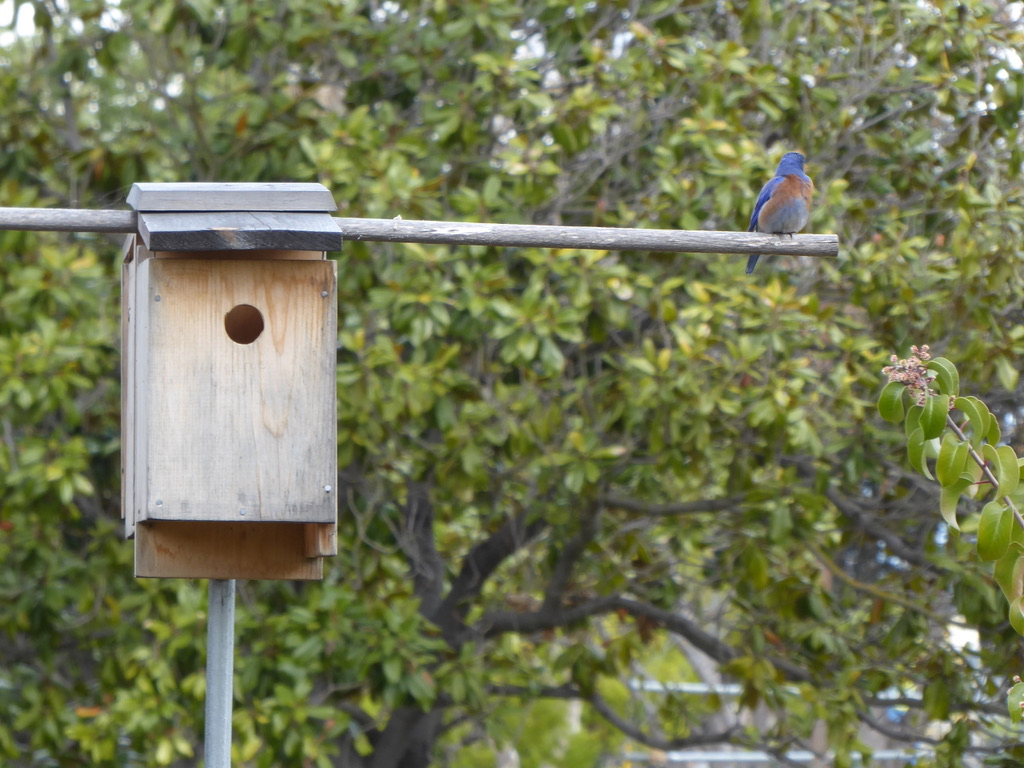
While livestreaming the Sunday service, I happened to catch sight of a couple of Western Bluebirds. After the service was over, I went out to the front garden for a little stress reduction break, and sure enough, there was a bluebird resting on the perch attached to the nesting boxes.
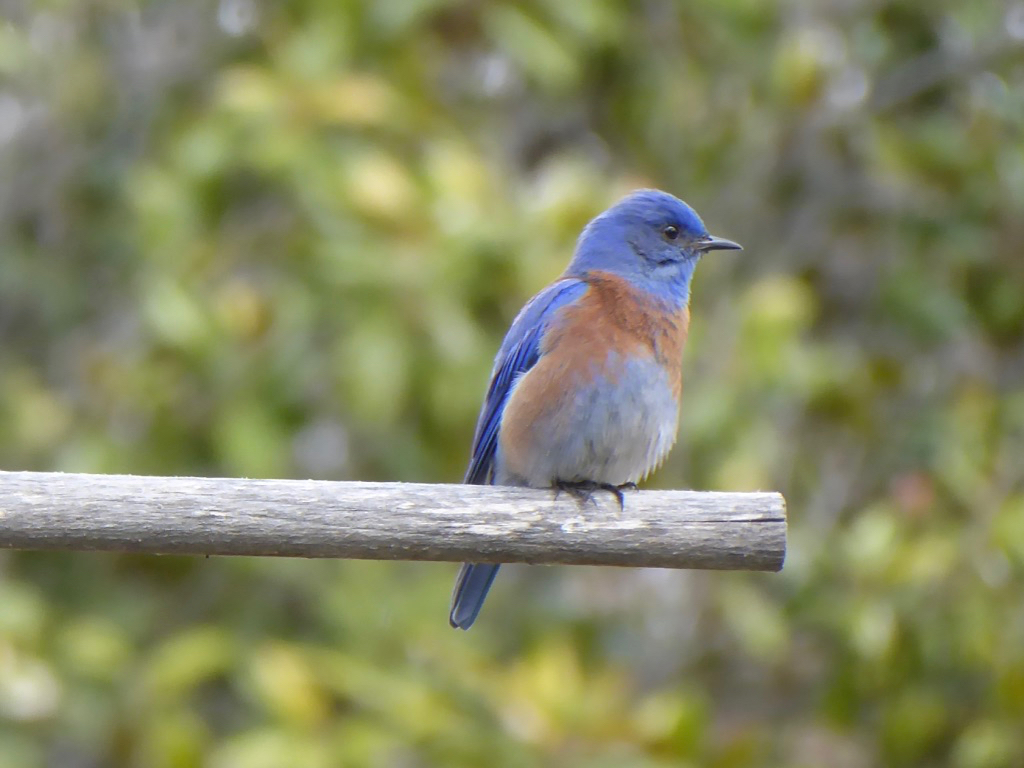
Thanks to my super-zoom pocket camera, I managed to get a pretty good photo of this bird:
We had bluebirds nesting in these boxes from 2016 to 2018. The nesting boxes began to split in the sun, so we had to replace them in early 2019; nothing nested in the boxes last year. I’m hoping that this bird has decided this will be its nesting site in 2020.
Update, 3/30: We saw a BIG uptick today, to a total of 848 cases. What we saw a couple of days ago was merely an anomaly. We are still in deep doo-doo.
Update 3/31: Kaiser Permanente, my healthcare provider sent out a mildly optimistic message this morning: “Thank you for accepting the challenge of sheltering-in-place and practicing social distancing … we think it is making a difference. Calls about cold and flu-like symptoms have declined over the past 10 days. That is a good sign. It doesn’t mean we won’t see more illness….” …but at least that’s some good news.
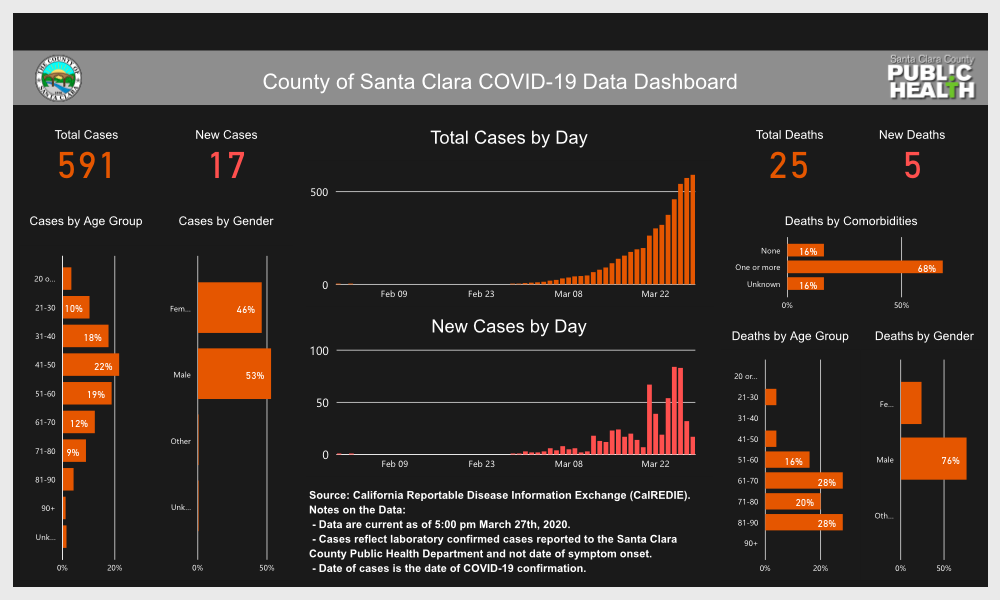
Original post: It’s really too soon to tell, and it might just be an anomaly, but the total number of COVID-19 cases shown on a bar graph on the Santa Clara County Board of Health Web site has not been rising at the same breakneck pace in the past three days:
The bar graph showing the number of new cases also declined in the last two days. However, that graph has a lot more noise in it, and two days’ worth of low numbers doesn’t indicate a trend.
In other good news, the Chinese city of Wuhan, where the coronavirus pandemic began, has “partially re-opened” according to the BBC. Now it appears that the biggest threat is coronavirus imported into the province of Hubei from elsewhere: “On Saturday the province reported 54 new cases emerging the previous day — which it said were all imported.”
We started sheltering in place a week ago. Let’s hope that by mid-May, the number of cases in California will have gone down enough that some of our restrictions can be loosened.
We had a long dry spell which lasted through most of January and February. The soil got dry, and not much was growing. March has brought us some rain, and finally the soil is getting damp again. Although the total rainfall for this season is still only half what it should be, there’s enough moisture that weeds are starting to grow in our garden beds, and a few mushrooms have started to appear, sometimes in odd places.
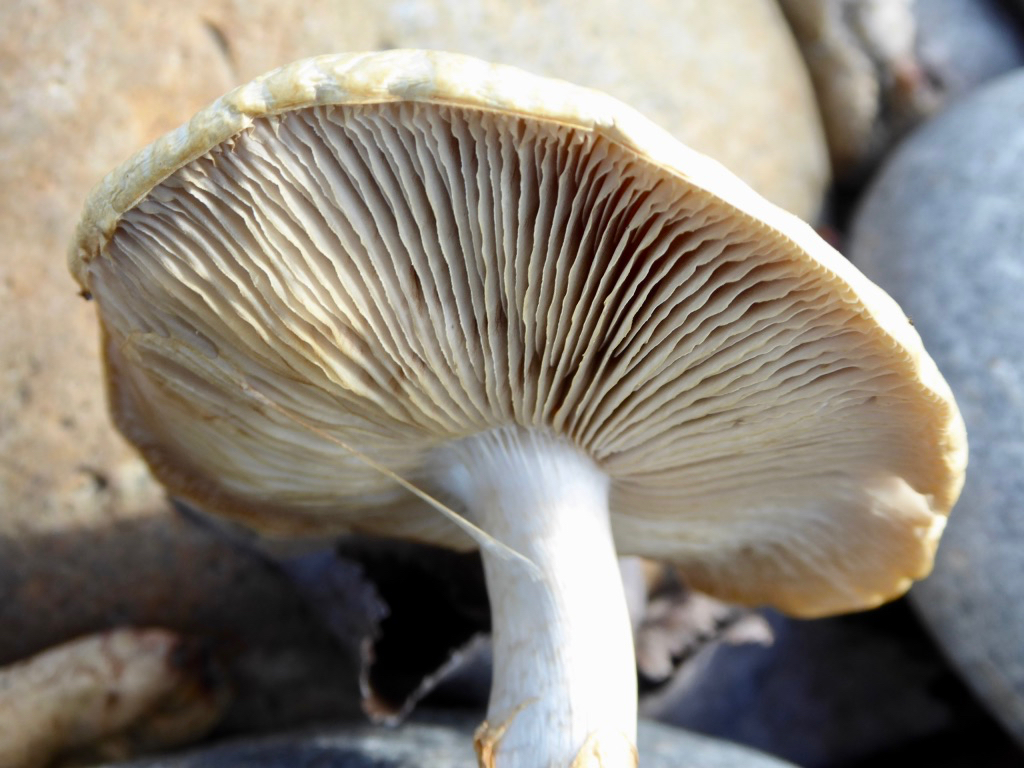
Like this mushroom, probably in genus Psathyrella, which just appeared today, growing up through some rounded rocks spread around one of the memorials in the cemetery:
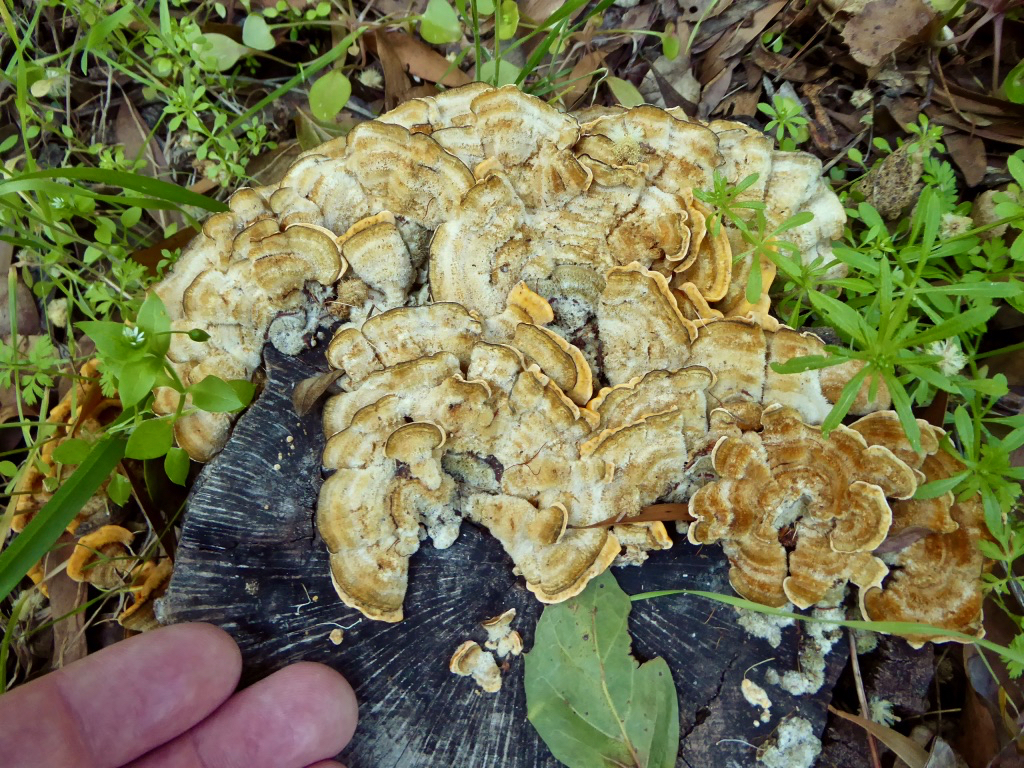
And this Turkey-Tail, Trametes versicolor, growing on a stump left after the cemetery crew cleared some brush last fall:
The shelter-in-place order in our county forbids us from driving to parks or nature preserves, but fortunately you don’t need to drive somewhere else to find nature. These mushrooms, and several others, were all within a five minute walk of our house. And by having to stay at home, I find I actually have more time to spend looking for mushrooms, flowers, insects, and tracks — I’ve uploaded more observations to my iNaturalist page in the past week than I had uploaded in the previous four months.
We got the shelter-in-place order from the San Mateo County Board of Health:
“Effective midnight tonight, the Health Officer of San Mateo County is requiring people to stay home except for essential needs. The intent of this order is to ensure the maximum number of people self-isolate in their places of residence to the maximum extent feasible. … This order is in effect until April 7. It may be extended depending on recommendations from public health officials.”
We’re allowed to go to the grocery store or the pharmacy, and we can go for walks outdoors if we stay away from other people, but that’s about it.
So Carol and I went up to the local grocery store at 5 p.m. We usually go shopping every day, but now we’d rather minimize our trips to the store, so we thought we’d pick up a few things. The store showed all the signs of panic buying — I call it panic buying because while there were no bags of rice on the shelves, there was plenty of bulk rice available. I also noticed that the only canned beans left on the shelf were good old B&M Baked Beans; Californians don’t really like New England style baked beans, not even when they’re panic-buying. In any case, we found plenty of food for our needs.
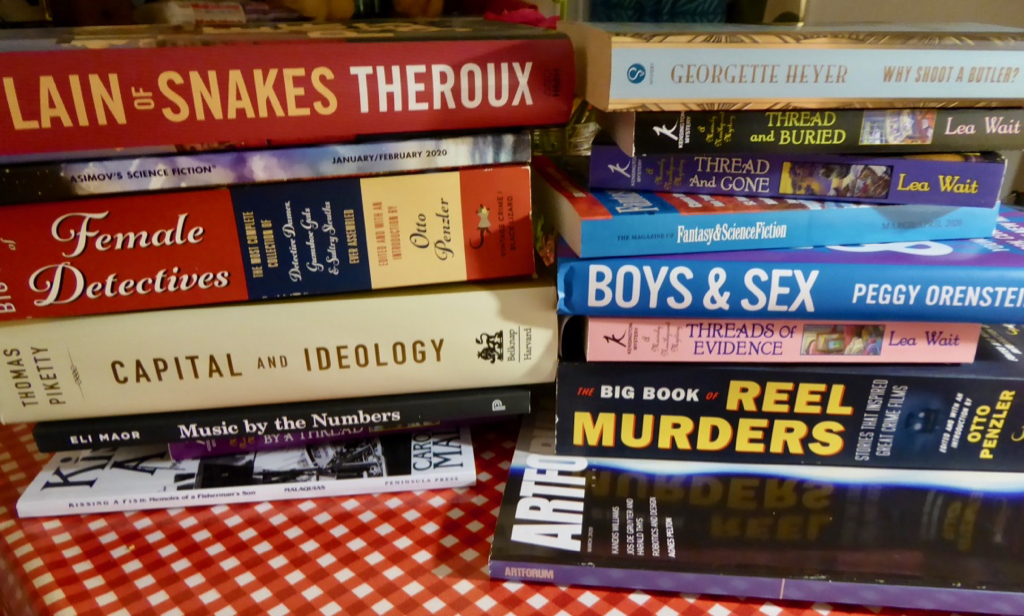
Then we went off so I could do my own panic buying. You see, the libraries closed a couple of days ago, and I’ve already finished the books I had taken out. I hate ebooks because they make my eyes tired. I hate Amazon. And if I don’t feed my reading addiction, things get ugly. So we went to our local Barnes and Noble, and I bought some books:
Yes, most of the books I got are junk — pulp fiction and cozy mysteries and science fiction magazines — but I got some serious books too. The book by Thomas Piketty should be dense enough to last me a while.
But … I don’t know … this may not be enough books … maybe I better rush down and buy more books before the bookstore closes….
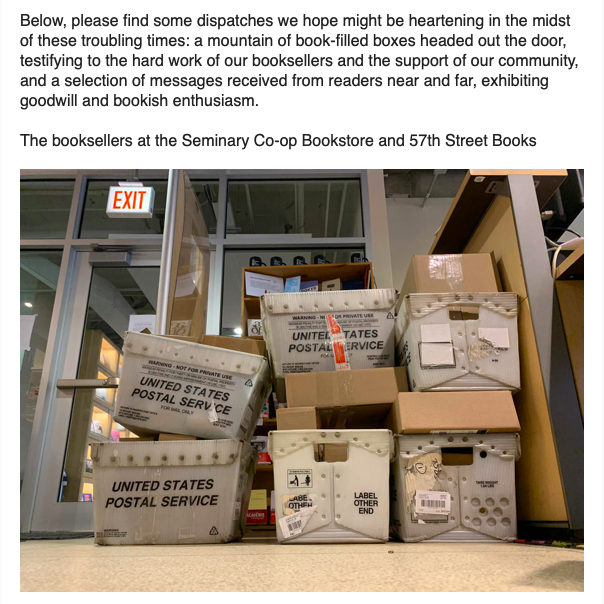
Update, Friday, March 20: The Seminary Coop Bookstore in Chicago is offering free shipping to its book-deprived customers. Amazon doesn’t need your business right now! Feed your book addiction, and help keep one of the last independent coop bookstores in the U.S. alive. I just place an order with them, why don’t you? Below is an excerpt from the email they sent out:
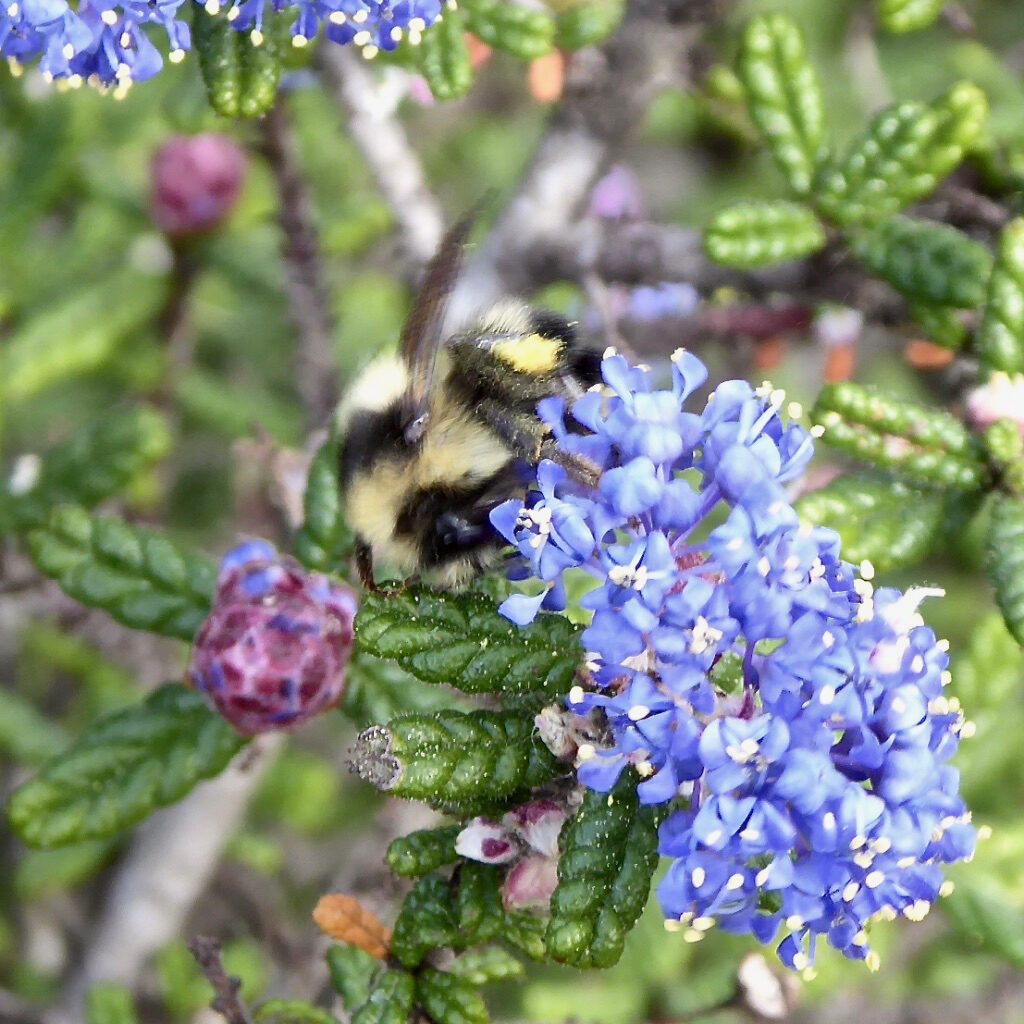
Another pollinator, this time a bumble bee (Bombus sp.). For my money, bumble bees are perhaps the most attractive of all insects. Unfortunately, this individual was very active, and as a result most of my photos of it were blurry.
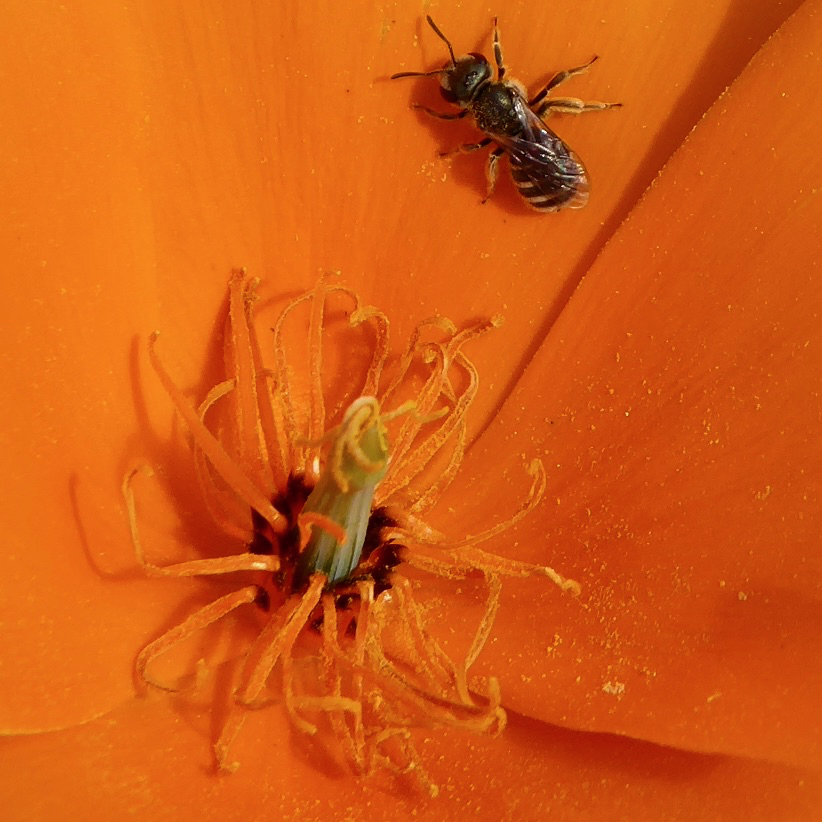
A bee, probably a species in the genus Halictus, in a blossom of a California Poppy. There are over 200 species in the genus Halictus; since I didn’t collect a specimen and don’t have a dissecting microscope, I won’t attempt to determine which species. It’s enough for me to have seen the bee, and admired it.
…on Nov. 15, 1969, Son House was recorded live, performing “Death Letter Blues,” “John the Revelator,” “Preachin’ the Blues,” and “I Wanna Live so God Can Use Me.” House accompanies himself on guitar on the first and third songs; the other two are a capella. Since he was Son House, he did a little preaching too. All four songs are worth listening to, but the first song, “Death Letter Blues,” is my favorite. Listen on Youtube.
Yesterday I went for a walk along Charleston Slough in Palo Alto at high tide. It was a gray day, and the light seemed to make the colors of the ducks appear more dramatic than usual. Looking at the ducks helped me forget the crazy stuff that’s in the news these days.
Notes: Common and Latin names from Dunn and Alderfer, Field Guide to the Birds of North America, 7th ed. (2017); however, the AOU now assigns American Wigeon to its own genus, Mareca. Photos: inexpensive superzoom camera (cheaper than your smart phone) and free image manipulation software.
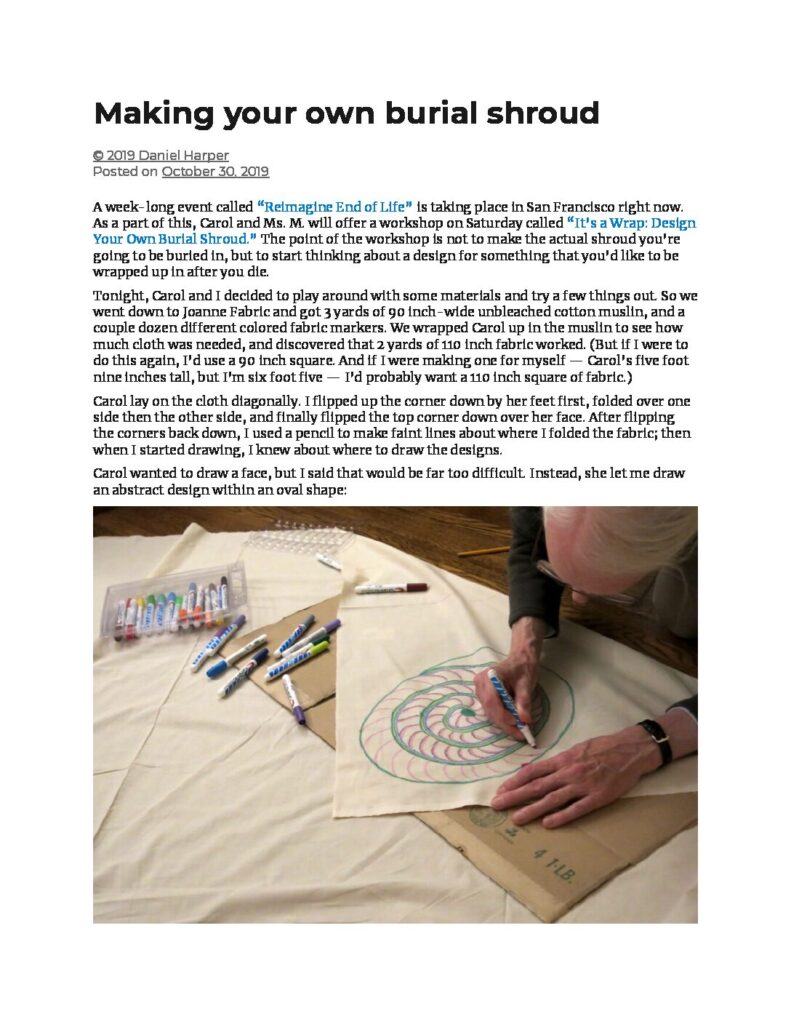
A week-long event called “Reimagine End of Life” is taking place in San Francisco right now. As a part of this, Carol and Ms. M. will offer a workshop on Saturday called “It’s a Wrap: Design Your Own Burial Shroud.” The point of the workshop is not to make the actual shroud you’re going to be buried in, but to start thinking about a design for something that you’d like to be wrapped up in after you die.
Tonight, Carol and I decided to play around with some materials and try a few things out. So we went down to Joanne Fabric and got 3 yards of 90 inch-wide unbleached cotton muslin, and a couple dozen different colored fabric markers. We wrapped Carol up in the muslin to see how much cloth was needed, and discovered that 2 yards of 110 inch fabric worked. (But if I were to do this again, I’d use a 90 inch square. And if I were making one for myself — Carol’s five foot nine inches tall, but I’m six foot five — I’d probably want a 110 inch square of fabric.)
Carol lay on the cloth diagonally. I flipped up the corner down by her feet first, folded over one side then the other side, and finally flipped the top corner down over her face. After flipping the corners back down, I used a pencil to make faint lines about where I folded the fabric; then when I started drawing, I knew about where to draw the designs.
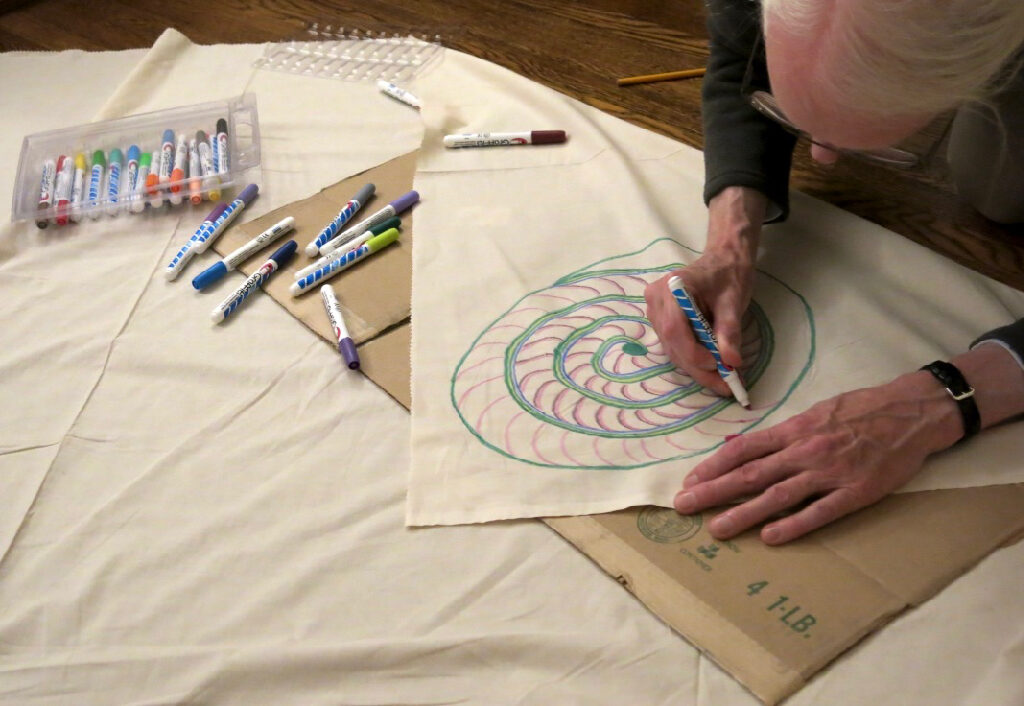
Carol wanted to draw a face, but I said that would be far too difficult. Instead, she let me draw an abstract design within an oval shape:
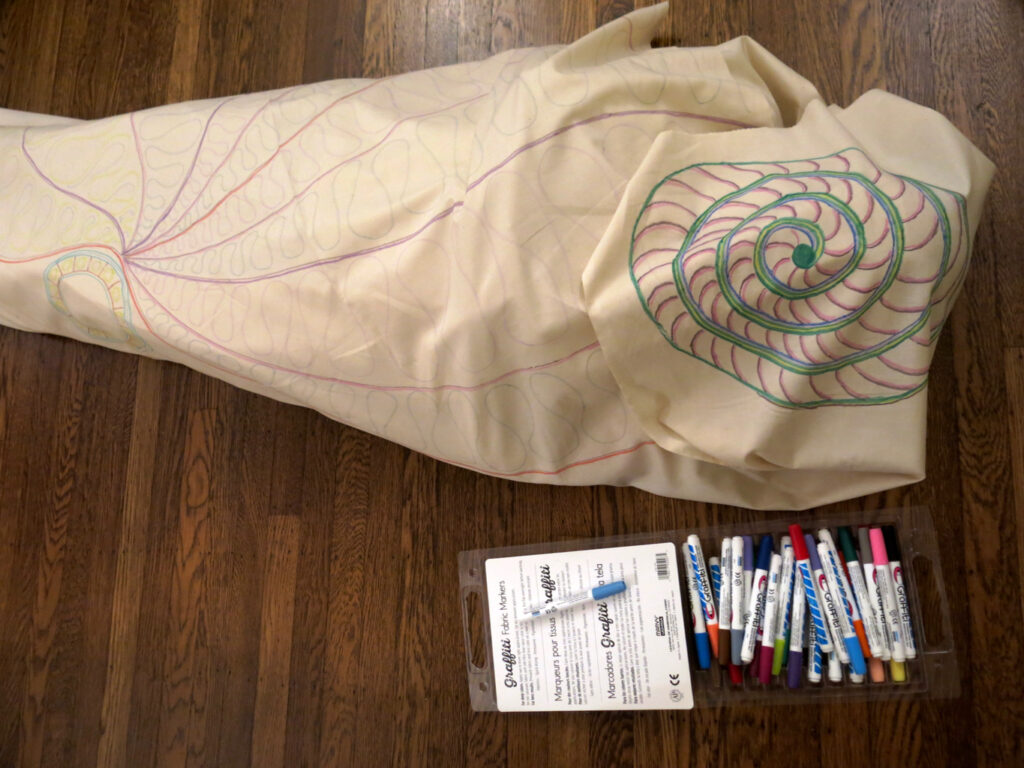
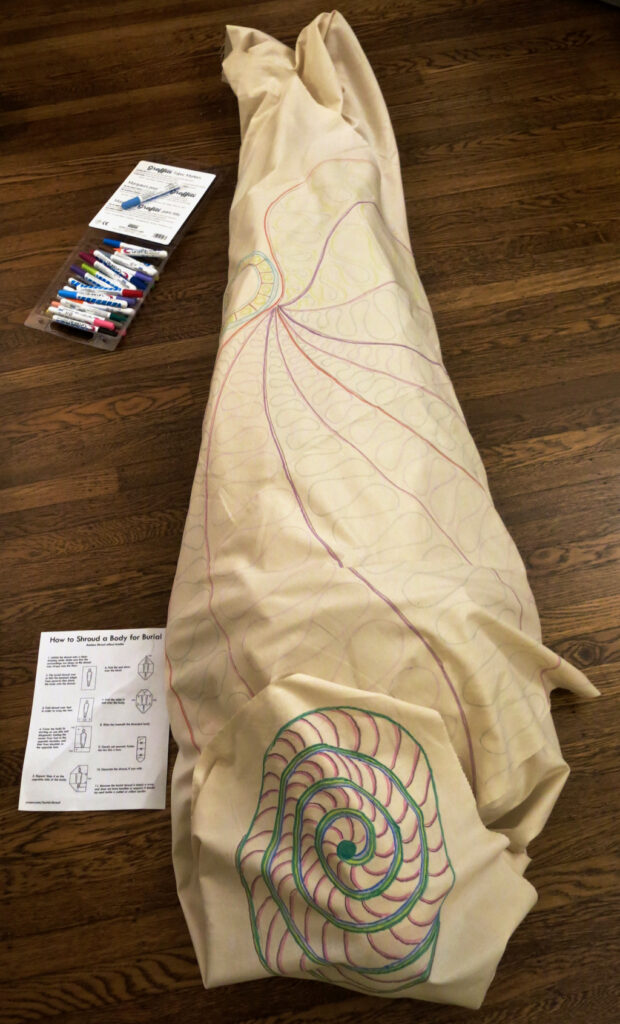
Next I drew a design on the final flap of fabric that would be folded over her body. Ultimately, I suppose you could draw designs over the entire piece of fabric. But most of what would be exposed would be those two flaps of fabric, as you can see in the photograph below:
(That took me about an hour. But I have excellent hand skills, and years of training and experience in making art; someone with less experience could easily take two hours to get that far.)
To complete the shroud shown in the photo, I’d use fabric paint to fill in the design — perhaps a light wash inside the drawing at the head, with a dark bold color outside it; and then a light wash inside and around the swirls in the part over the body. If I wanted a more carefully crafted shroud, I’d get another piece of fabric and hem all the edges, and repaint the design on the hemmed fabric.
Really, though, for me this isn’t about coming up with a carefully-crafted final product. It was very pleasant working with these materials, and it was a chance to reflect on — not on death so much as to reflect on the entire life cycle.
Cost: 90 inch cotton muslin is about US$8 a yard. A nice set of fabric markers is going to set you back $20-35. If you want to use paints, that will cost you about $3 per color (for good-but-not-expensive paints). If you want to try stamping or printing with dyes, expect to pay about $45 for a starter kit.
Registration is closed on the workshop, but if you contact Carol directly ASAP, she might be able to get you in.
Update: 1/13/22 — There are now two requests for this post in come other format (see comments). So I made a PDF version which should be easy to download. Just click on the link above, or the preview below.
PG&E, the utility that everyone in northern California loves to hate, is going to shut down our power tonight, due to a forecast of high winds that could cause a downed wire that could in turn spark wildfires.
Why does PG&E have to shut down the power? Because they are owned by hedge funds, which demand maximum short-term profit instead of efficient running of a utility company, and they have skimped on power line maintenance for decades. Or, to put it more pointedly, as the governor of California recently said about PG&E: “Years of mismanagement, years of greed.”
Power could go out very soon, so I’m setting up the propane stove so I can cook dinner.