Labor Day picnic

Carol and I went to a Labor Day picnic in Alameda today. But this wasn’t your typical backyard barbeque. I’ve started singing with the Bay Area Labor Heritage Rockin’ Solidarity Chorus again, and the Chorus got invited to sing at a Labor Day celebration sponsored by the Alameda County Coalition of Unions.

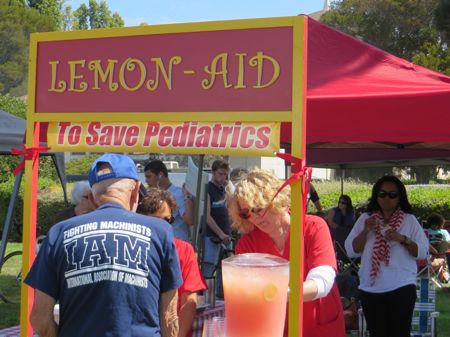
Carol and I got to Alameda Point Park a little early, so we had time to wander around. Several of the unions had booths set up, and Carol got to talking with a nurse who was at the booth that said: “Lemon-Aid To Save Pediatrics.” The nurses union is trying to convince Kaiser Permanente not to shut down a pediatrics inpatient unit. The nurse told us that Kaiser is building a new hospital — a good thing, since the old Hayward hospital does not meet current state requirements for earthquakes — but the new facility will not include a pediatrics inpatient unit. We talked about the craziness of the health care industry these days, and we all agreed that Kaiser is one of the best health care providers out there — yet the health care market can cause event hem to make bad decisions.

BlogSep0213

The nurse had to go serve lemonade to someone else, so we walked around some more. I saw all kinds of people from all kinds of unions: teachers, nurses, cops, firefighters, electrical workers — I saw a sign for IFPTE Local 20 Engineers and Scientists of California, lots of t-shirts that said AFL-CIO, someone was wearing a button that said International Association of Machinists and Aerospace Workers. This being the Bay Area, no one racial or ethnic group predominated. I saw parents with babies and little children; Carol pointed out one big man with a little boy on his lap; the man had a colorful Rosie the Riveter tattoo on his right bicep. Bigger kids without any parents nearby were running around playing together. Some firefighters from Alameda drove a big ladder truck around the periphery of the picnic area, and waved out the windows at the kids.

At some point, it hit me that we were all representatives of the eroding middle class. The people around me were people who managed to make it through the Great Recession still holding on to their decent middle class jobs with benefits. I’m one of those people. Even though Unitarian Universalist ministers aren’t unionized — all we have is a professional organization that is pretty toothless — ministers fit right in with cops and nurses and teachers and electricians. All of us in the middle class are facing the same problems: we feel lucky to have jobs, we’ve lost ground in terms of real wages over the past couple of decades, there are fewer full-time job openings than there were ten years ago. But we’re holding on. The middle class keeps shrinking, but we’re still in it. For the moment.

The director of the Labor Chorus showed up, and she found us a place at the opposite end of the picnic area from the rock band that was playing. We warmed up for a few minutes, then the rock band quit and it was time for us to get up on stage. Carol said that when we went on stage, it took awhile for people to realize that we weren’t going to be singing rock ‘n’ roll. It took a few minutes, she said, but then you could see people realizing that we were singing labor songs. Up on stage, I noticed that when we sang phrases like “We’re talking about dignity,” or “All we need is unions,” or “Don’t you cross that picket line,” I could hear some cheering. When we got to the final three songs, “Roll the Union On,” “We Shall Not Be Moved,” and “Solidarity Forever,” Carol said people started singing along — as you can see in this thirty second video clip of the final chorus of “Solidarity Forever”:

After our half hour set was over, we in the chorus all hung around for a while at the picnic, and ate hot dogs and veggies burgers cooked by guys wearing AFL-CIO t-shirts. It was a good way to celebrate Labor Day.

From Elko, Nevada, back home

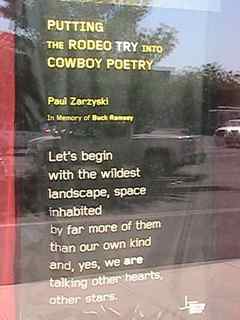
The air in Elko this morning was clean and dry and cool, and it made me feel like a million dollars. We walked a couple of blocks to McAddoo’s in downtown Elko for breakfast, and then headed over to the Western Folklife Center, the home of the Cowboy Poetry Gathering in late January, and currently housing an exhibit on Basque sheepherders that we thought sounded like it was worth seeing. But the Center is closed on Sundays, so we read the cowboy poem that was displayed on six banners hung in six large windows near the entrance. The section of the poem on the first banner read:

BlogJul2113a
PUTTING THE RODEO TRY INTO COWBOY POETRY
Paul Zarzyski

Let’s begin
with the wildest
landscape, space
inhabited
by far more of them
than of our own kind
and, yes, we are
talking other hearts,
other stars…


It was a pretty good poem, and I took photos of each window so I could remember it.

We drove across north Nevada, a land of forbidding desert and mountains interspersed with small green valleys that look so inviting that you want to settle down and live there. We could have lived in Elko, if there were jobs for us; my cousin Susan and her husband ran a computer business in Winnemucca for many years, and I can understand why they wanted to live in a small city in northern Nevada: open and friendly people, bracing desert air, incredible natural beauty that overwhelms even the tawdriest casino. We stopped in Battle Mountain for lunch. It is not as attractive a city as Elko, but it was still a pleasant place to spend an hour or two.

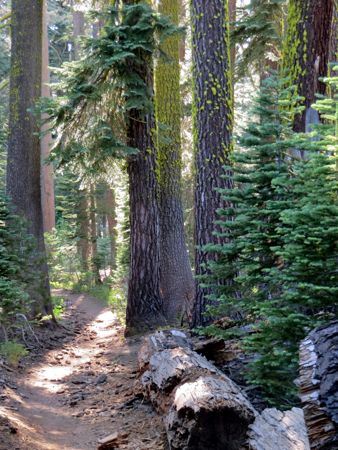
As we made our way down into Reno, the traffic got heavier, and the fact that I would have to return to ordinary life tomorrow at last began to emerge in my consciousness. Then we climbed up out into the Sierra Nevadas, and stopped at the Donner Summit rest area. We needed to stretch our legs, so we walked along some of the trails that connect to the rest area.

BlogJul2113g

One of the trails that connects to the rest area is the Pacific Crest Trail. We met three or four people through-hiking the trail from Mexico to Canada; Carol offered to take photos of Sheepdog, and later of Trivia — these are their trail names, for through-hikers on long distance trails in the United States tend to use trail names rather than their regular names — and then email the photos to them. We chatted a bit with both these hikers, and Sheepdog said that there had been very little water for the last fifteen miles of the trail, and that it had been a very hot day, and that she would have loved a cold can of soda. Unfortunately, we had none to offer her.

We ate dinner at the rest area, enjoying the delightful air that you get in an alpine environment at an altitude of about six thousand feet above sea level. At last it was time to begin the drive back down out of the mountains, down to sea level and the Bay Area. Down, down, down we drove, and when we got to Loomis (population 6,430, elevation 399), I realized that this was probably the lowest altitude we had been at since we left Massachusetts. Down we drove, dodging the crazed drivers going at maniacal speeds — I imagined they were stressed-out people trying to get home after a relaxing weekend in the mountains — and I thought about when we drove under the Appalachian Trail where it crossed Interstate 90 in the Berkshires just a few days ago, and I thought about my friends who hiked the Appalachian Trail, and I wondered where Sheepdog and Trivia would spend the night tonight; and now I sit here at home wondering why we take long trips, pilgrimages, that have no real destination, trips that are taken only for the sake of leaving home and then returning once again.

Fredonia, New York, to Joliet, Illinois

After breakfast served on the front porch of the White Inn in the village of Freedonia, we got back on Interstate 90 and started driving west. We drove through the hills of western New York state and northwestern Pennsylvania and the Western Reserve of Ohio, the waters of Lake Erie (elevation 570 feet above sea level) invisible somewhere off to our right.

After we got through the sprawl of Cleveland, the land flattened out, and we felt that we were in the true Midwest: a less dramatic landscape than the northeast, one that is best appreciated when seen from close at hand. For when the Midwest is seen close at hand, you can see the details that make it charming: creeks and small rivers at the bottom of gullies and ravines, hedgerows and small patches of woodlands nestling in among fields of corn and soybeans, hundred year old farmhouses turned into residences while the surrounding fields have been bought up by agribusiness, old barns falling into quaint and attractive disrepair. Even the industrial buildings that punctuate the landscape, and the high tension lines that tie industry together, and the mile-long freight trains loaded with containers being shipped across the continent look almost attractive, if not quaint, under the gentle clouds and high-arching blue sky.

Carol had some business that she had to take care of during business hours today, so we stopped at two or three different rest areas in Ohio and Indiana so she could use the free wifi connections. I started eating some blueberries at one rest area in Ohio, and thought about how I had picked those blueberries in Massachusetts two days ago with my friend Will, on the farm where four or five generations of his family have lived. We walked along the neatly mowed paths between the blueberry bushes, which grew six to nine feet high, the branches thick with berries, mostly green berries, but plenty of ripe ones for us to pick, and either put in the plastic containers that hung around our necks or pop in our mouths. We picked two gallons of berries while we caught up with each other’s lives: health problems with our siblings, what his children are doing, how our parents are doing, etc.

Before we started picking, I told Will and his wife about the invasive Asian fly that moved into southern New England last year and decimated the blueberry crops for many growers in New Hampshire. I told them how the flies lay their eggs in the berries, and when the farmers get the berries to market, sometimes they find maggots crawling out of the berries; not an appetizing sight for potential buyers. Their eyes got big — it’s not often that you actually see someone’s eyes get big, but theirs did — as they heard about such a devastating pest. Blueberries have been an easy crop to grow in New England, since they evolved here; as opposed to apple trees, which evolved elsewhere, are troubled by native New England pests, and require lots of care.

I had heard about these invasive flies just a couple of days earlier, on Firday, when Carol and I went up to Apple Annie’s orchard in Brentwood, New Hampshire, so that Carol could look at a composting toilet that was malfunctioning. Carol was fascinated because it was a composting toilet that she had never seen before. I was fascinated to hear Laurie tell about the invasive flies, which she had learned about in a course she took to re-certify for her pesticide certification. She said they prefer red fruits, so rasberries are even more vulnerable — raspberries, which used to be yet another relatively pest-free crop in New England.

So I ate my New England blueberries in a rest area in Ohio, thinking that this might be the last easy crop of blueberries grown in my home town. Who knows why that Asian fly finally chose last year to arrive in New England. There are too many human beings everywhere, prying into niches in ecosystems where they don’t belong, moving species from one ecosystem to another at an alarming rate, and warming up the planet so that certain invasive species suddenly have to potential to disrupt native species. I would not be upset if nine-tenths of all humans died off suddenly, and I’m willing to be one of them — but I’m only willing to be one of them if we really get rid of nine-tenths of human beings; although I guess I could settle for a seven-eighths mortality rate.

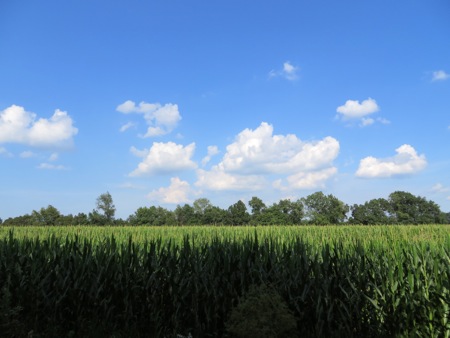
We stopped again at a rest area in Indiana, where Carol and I took a long walk out through the employees’ parking lot and down a country road. On our right hand side was a corn field. It was not a field of sweet corn, grown to be sold at roadside stands and eaten as corn-on-the-cob. Carol recalled how we had once had a housemate who talked about “cow corn,” tough corn sold for cattle fodder. I said that there was a good chance this wasn’t even cow corn, but rather industrial corn bred to serve as the raw materials for chemical processes that produce ethanol, high-fructose corn syrup, corn oil, corn steep liquor, polylactic acid used to make corn-based plastics, and other industrial products.
BlogJul1613

On our left hand side was a patch of woodlands, covering at least twenty acres, that made the air feel twenty degrees cooler. We noticed black splotches on the road, and realized that mulberry trees hung over us. We picked as many ripe mulberries as we could reach reach, and ate them, the sweet elder-y taste a perfect complement to a hot humid afternoon.
Favorite crossing guard

“Favorite crossing guard” read the sheet of poster paper someone had taped to the green-painted steel utility box that stands next to the traffic lights at Nelson and Charleston Roads. Another sign taped to the utility box read “Charles, you’re the best.” Whoever had taped up the signs left pens and markers so that passers-by could leave their own message to Charles, who is retiring, and whose last day at the crossing was Thursday.

Earlier this week, I had been talking with Charles about his upcoming move to Georgia, where retirement money goes a lot farther than here in the Bay area. But we didn’t stay long on that topic. Years ago, Charles had been a case manager in Cleveland working with emotionally disturbed children, before he moved to the Bay Area and became a custodian. (I never asked him about the career change, but moving from a burnout job with low pay, to a stable union job, sounds pretty attractive to me.) As is inevitable when two people get together who work with kids, we started talking about kids we had known and worked with. I’ve seen some troubling things in my career as a children and youth minister, but of course Charles had seen much worse.

This was one of the few uninterrupted conversations we have ever had, in the two years Charles has worked at this crossing. I probably saw him once or twice a week on my way to get lunch at the supermarket across the street, but mostly he spent his time talking to the kids from the nearby elementary school and middle school who went past. He seemed to know them all by name, and if a child came up while he was talking to me, he’d immediately greet that child, and turn his attention to them. It’s an unusual adult who can do that without being creepy; I like adults who treat adults and children with equal respect, and I like the more unusual adult who will end a conversation with another adult in order to have a conversation with a child. But on this day, I happened to come along when no kids were coming by, so we talked about kids: happy kids, troubled kids, kids who needed to talk with an adult who has excellent listening skills. Both of us have been trained to keep confidentiality, so there were no names or identifying characteristics; you can still have a good conversation of this sort without breaking confidentiality.

So on Thursday, I walked up to those two posters someone had left, and I read some of the things the kids wrote to Charles: they mentioned little in-jokes he had had with them, they wrote how much they’d miss him. I thought about signing one of the posters, but it seemed more appropriate to let the kids have their say, on their own. I wished Charles luck in my head, and walked on by.

News story about Charles here. As it happens, it was a member of our church who created the retirement posters.

Out the window

Carol and I recently completed a mind-body wellness class offered (for free!) by our health care provider. One of the things that our instructor said was that a good way to reduce stress is to spend time “in nature.” Further reading in the text book for the class revealed that our brains becomes fatigued by doing all the things most of us have to do in our jobs: staring at computer screens, meeting deadlines, sitting in meetings, etc. The natural world engages different parts of our brains, allowing the fatigued parts to rest. — I may not have this exactly right, but I think I have the gist of it.

When I learned this, I thought to myself: and where are we supposed to find the natural world in downtown San Mateo? This is not Tokyo where, according to my Aunt Martha, who lived there for two years, the residents cultivate little pockets of natural beauty throughout the city. Here in San Mateo, we could walk over to Central Park where the Japanese American community maintains a Japanese garden; but that garden is only unlocked for a few hours a day. Like many densely populated areas in the United States, downtown San Mateo has little to offer in the way of natural beauty; it combines urban density with dreary suburban sprawl; and even where there is some natural beauty, someone will have dropped trash there: fast food bags at the base of a tree, malt liquor cans thrown in among flowers, women’s underwear draped in the branches of a tree overhanging San Mateo Creek (I’m not making that up).

At some point during our wellness class, though, I realized that we have created a little oasis of natural beauty on our little balcony. We have nothing to compare with Japanese bonsai, but over the years we have accumulated quite a few plants. At the moment several of them are in bloom: the purple flowers of the potted lavender; the orange and gold of the nasturtiums; the vivid pink flowers of the succulent Carol can’t remember the name of. I was staring out the window at these flowers this morning. Carol walked into the kitchen and asked, “What are you looking at?”

“Nothing,” I said. “Nothing at all.”

Memorial Day

Carol and I went to Wisnom’s hardware store across the street. I had to get some supplies for this Sunday’s Judean Village project in the Sunday school, and she went just because it’s an interesting place.

One of the guys who works there who knows us asked if I was finding what I was looking for. I said I was, and then asked why there were so few people in the store.

“Maybe because Easter was Sunday,” he said. “Maybe because school vacation’s this week. Maybe because Chinese Memorial Day’s tomorrow.”

“Chinese Memorial Day?” I said.

“April 5,” he said, “solar holiday, so it’s the same day every year. On Chinese Memorial Day, everyone goes to family graves. I went yesterday.” He bowed to an imaginary grave. “There will be lots of people up at Skylawn cemetery tomorrow. Flowers everywhere.”

We started talking about visiting graves, from a New England and a Chinese perspective. I wanted to hear more about Chinese Memorial Day, but Carol had to get back to work, so we cut our conversation short.

Ching Ming Festival

Click the Chinese characters above for photos of this year’s Ching Ming Festival in Skylawn cemetery.

Dusk

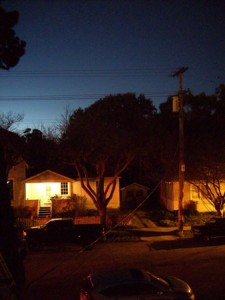
I like the contrast between colors that occurs at dusk when the sky turns a deep blue at about the same time that yellow-orange sodium vapor and incandescent lights turn on. I was enjoying this phenomenon a couple of evenings ago when I noticed that a nearby traffic light periodically turned some of the shadows red:

BlogMar0213

Golden haze

Carol and walked down to the waterfront in San Mateo. It was a beautiful evening. It’s the rainy season, so the hills across the bay are now a soft green. The setting sun glinted off windows of houses far up in the Oakland hills. And a beautiful golden haze hung over the waters of the bay.

“It’s the golden haze again,” I said to Carol. We’ve been seeing this for the past week or so: cold, still air has settled down over the area, trapping pollutants in the wide bowl formed by the mountains surrounding the bay. The people who monitor air pollution have been detecting high levels of fine particles, and because of that all wood fires have been banned most days this week. The air quality index has been moderate to unhealthy. That’s what has caused the golden haze.

“It’s beautiful,” I said. We kept walking, watching the shorebirds, and the play of light on the water.

Written on Monday, posted on Saturday; I’ve been slowed down this week by a cold this week.

Treasure

Two nearly identical houses across the street from us went on the market today. An artist couple had been living there, but finally they decided to sell.

I was out in our driveway putting racks on our car. I saw a couple pushing a stroller come up to the first house, and I heard a well-dressed woman, presumably the real estate agent, tell them, “We’re not quite ready to open yet. Come back in half an hour.”

When I came back from picking up some plywood, the houses were obviously open. Two or more cars a minute drove slowly down our dead end street, slowing down when they reached the two houses. The sign out in front of the first house said, “Treasure behind door #1.” I didn’t bother to see what the sign in front of the second house said.

Carol went over to look. She said that paintings done by the artists who used to live there are hanging on the walls. She overheard someone say, “…but they won’t appreciate that much because they’re on the wrong side of….” We are on the wrong side of the tracks: gardeners and artists and cab drivers and ministers live down this street; many of us are renters, and the majority of us aren’t white.

But these houses are going for less than half a million, an incredible bargain in the Bay area housing market. So the people keep coming, amazed to find houses for so little money.

Jan 19 2013