Bald Knob

Carol and I decided to hike up to the top of Bald Knob from the parking lot at Higgins Canyon Road. We climbed steadily through the Coastal Redwoods up into the Douglas Fir forest, and in less than two hours were at the summit of Bald Knob. It was a little disappointing, because Bald Knob wasn’t at all bald, and instead of the views we had hoped for, we just had a Douglas Fir forest. But it was a beautiful Douglas Fir forest, smelling of fir trees and woods, and it was quiet, so we sat down to eat lunch.

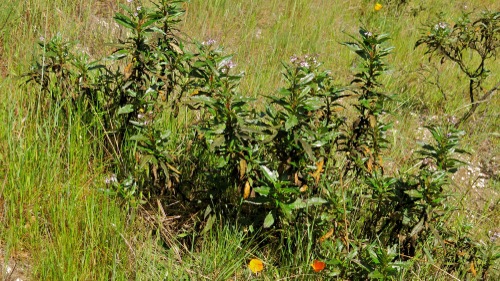
After lunch, we walked down Irish Ridge Trail, and just a short distance down the trail, there were green grassy slopes sprinkled with wildflowers. Dad and I used to talk about the way wildflowers sprang up all over the hills of coastal California during the spring; it was one of the things that had most impressed him, I think, in one of his early trips to California. Unfortunately, Dad’s dementia means that that well-worn, familiar conversation is no longer possible, so I took a photograph of some flowers instead — Dad has always taken photographs documenting what he saw in the world; and still does, sometimes.

Irish Ridge Trail, San Mateo county, California

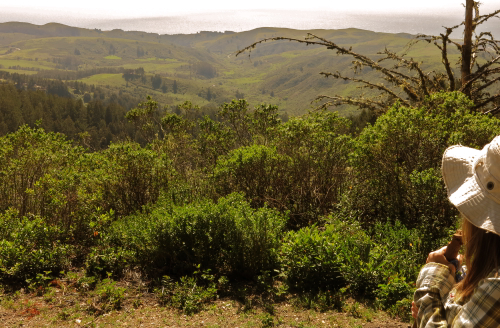
And a little way further down the trail were the views that we had hoped for. We looked out over an open slope, which was covered with Poison Oak in full bloom, down into the Lobitos Creek valley, out at the Pacific Ocean. Some kind of flower was sending its delightful perfume into the sun-warmed air around us; I’m pretty sure this perfume came from the Poison Oak; maybe Poison Oak is good for something after all.

Looking down from Irish Ridge towards the Pacific

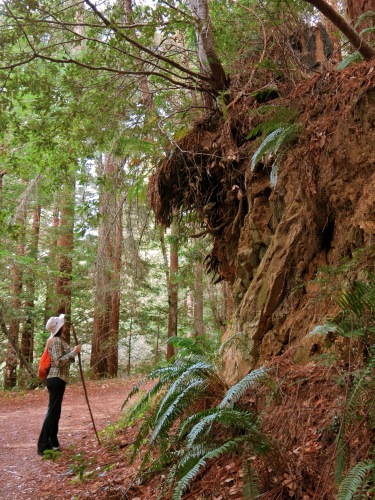
On the way back down the trail, Carol said that these tree roots, balanced precariously on a gradually eroding bank, looked like a huge Muppet monster:

BlogApr0415c

By the time we got back to the car, it was cloudy and cool, down to 52 degrees. We had walked about 11.4 miles, with a total elevation gain of about 2,500 feet. We felt kind of tired.

Obscure Unitarians: the Alderton family

Dorothy Marion Alderton — She was born in Oct., 1889, in New York to Henry A. Alderton and Marion Starr Alderton, the eldest of three children. She was a student at Stanford University from 1908-1912. On Sept. 17, 1912, when a senior at Stanford, she married Herbert Anthony Kellar of Peoria, Illinois, at her parents’ Palo Alto home, with Rev. Clarence Reed, the minister of the Unitarian Church of Palo Alto, officiating. The couple moved to Wisconsin, and then to Chicago, where Herbert worked at the McCormick Agricultural Library. They had one son, James, who died c. 1922. Dorothy was diagnosed with “dementia praecox” — what might be diagnosed as schizophrenia today — around 1924. She was institutionalized, and by 1930 Herbert was living with the woman he would eventually marry as his second wife. Herbert obtained a divorce in Reno, Nevada, on Nov. 8, 1934, but he continued correspondence with Dorothy’s mother Marion up to 1942, the year Dorothy died of cancer.

Marion Starr (Decker) Alderton — She was born in Aug., 1865, in Brooklyn, New York. In 1885, she married Henry Arnold Alderton, a physician; they lived in Berlin in 1890-91 while Henry studied at the University of Berlin. They made their home in Brooklyn, but when Dorothy entered Stanford in 1908, Marion, with her two other children, move to Mayfield with her. Henry, Sr., moved to California in 1912, and took up painting.

Marion withdrew from the Unitarian Church of Palo Alto in June, 1920, in protest against “the attitude taken” by the church in the First World War; the church had a pacifist minister, William E. Short, Jr., in 1916-1917, who resigned to work for a pacifist organization in San Francisco; but by 1918, the church had hired a pro-war minister, F=Bradley Gilman, and had voted to display a U.S. flag on the pulpit. The church’s turn towards a pro-war stand may have been simply pragmatic, since the church received significant financial assistance from the American Unitarian Association, and since the A.U.A. made it a condition of receiving such aid that churches must declare their support of the First World War; however, the church always included both anti-war (e.g., Prof. Guido Marx) and pro-war (e.g., Prof. Melville B. Anderson) members.

By 1924, her daughter Dorothy was diagnosed with schizophrenia; see Dorothy M. Alderton above. Henry, Sr., died c. 1931; Marion died after 1940.

Update: See revised biographies in the second comment below.

Black Mountain trail camp

More and more, I’m coming to believe that if organized religion is going to help fix global climate weirdness, we have to get out of our buildings more. Not that we should get rid of our buildings — we need our indoor spaces to accommodate a wide range of human person, including elders. But we also need to do more outdoor ministries.

Last night, group of youth spent the night at the Black Mountain trail camp, in Santa Cruz Mountains behind Silicon Valley. The hike in is two miles, with a total elevation gain of about 500 feet. We got to the camp, set some tents and made dinner.

After dark, some of us took a quick walk up to the summit of Black Mountain (elev. 2,800 ft.) and looked down at the bright lights of San Jose and Silicon Valley on one side, and the mysterious fog creeping up the valley on the other side of the Santa Cruz Mountains. Come to think of it, that image could serve as a metaphor for the role of organized religion in understanding humans’ place in the universe: if we wanted it to, organized religion could be the metaphorical high point where we could see both human-centered life on one side, and non-human-centered life on the other side.

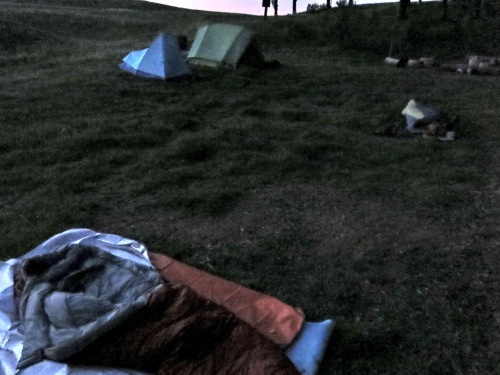
Back in camp, some of us slept in tents, and some of us just slept out under the stars. The moon was really bright, so I slept restlessly. I awakened before dawn, and snapped this photo of our campsite:

BlogMar2815

Dawn from the top of Black Mountain was beautiful: orange sky at the horizon and pink clouds above. After a breakfast of bacon hot chocolate, and more bacon, we hiked out, and were back in Silicon Valley by about ten. It was a short trip, but short trips fit in well with the busy schedules of our teens.

Fast food for gulls

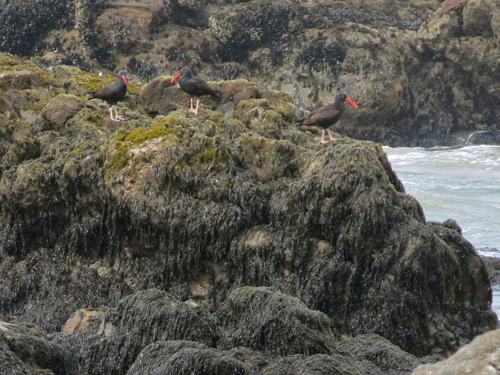
I spent the afternoon and early evening hiking around Pescadero Marsh. At the beach near the end of Pescadero Creek, I saw many of the same animals I saw during my last trip here: Harbor Seals (Phoca vitulina): shells of the California Mussel (Mytilus californianus): the remains of Red Crabs (Cancer productus), Pacific Sand Crabs (Emerita analoga), and Eccentric Sand Dollar (Dendraster exentricus); Black Oystercatchers (Haematopus bachmani), etc.

Haematopus bachmani

Above: Black Oystercatchers on the rocks at Pescadero Beach

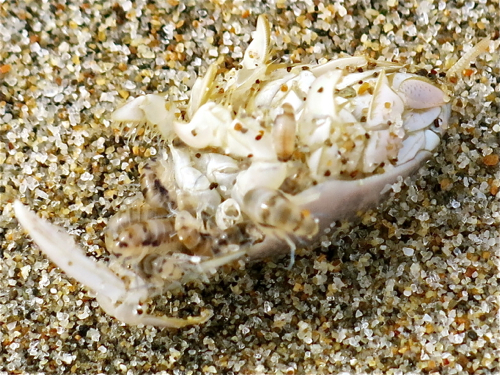
dead Emerita analoga being eaten by unidentified organisms

Above: The remains of a Pacific Sand Crab being eaten by unidentified smaller organisms

Walking around the marsh, I saw an even greater diversity of animals: warblers hiding in willow thickets, butterflies cruising in amongst the coastal scrub, raptors hunting over the marsh, huge nests made by wood rats. This is an area of ecotones, where several different plant communities meet one another: ocean comes up against beach; sandy beach comes up against coastal scrub; coastal scrub comes up against saltwater marsh; freshwater riparian corridor and marsh flows into saltwater marsh. I’m amazed by how many biomes, and organisms adapted to live specifically in those biomes, can be found within a short walk: I saw Arroyo Willow (Salix hinsiana) growing next to an ephemeral freshwater stream; fifteen minutes of slow walking brought me to Snowy Plovers (Charadrius alexandrius) who live and breed on sandy beaches above the high tide line.

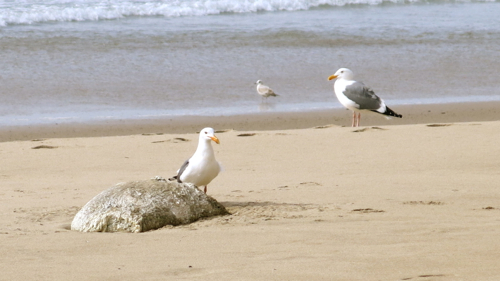
And then there are the organisms who happily move from one biological community to another, exploiting the resources of all of them. Like gulls (Larus spp.) who fly everywhere, and eat everything. Everywhere I went, I saw gulls. As I walked north on the beach, I cam across two Western Gulls (Larus occidentalis), in beautiful fresh plumage, snacking on what remained of a Harbor Seal:

Larus occidentalis eating a dead Phoca vitulina; Larus delawarensis in the distance

I walked up to the dead Harbor Seal to have a look; the gulls, looking grumpy, gave way to my intrusion, watching me from a safe distance. The corpse didn’t stink, but there was no longer a head, and it looked like it had been lying there for a while. I guess gulls will eat just about anything.

Shoulder pole carrier for water

Every other year in our Sunday school, we do a recreation of a Judean Village in the year 29 C.E. Children become “apprentices” to artisans, and do activities that evoke village life in 29 C.E.

Carrying water by hand from the village well to wherever it was needed was an integral part of village life. This year, Edie Keating came up with an activity in which children learn how to use a traditional shoulder pole carrier to bring water to irrigate plants. Given the extreme drought that is blanketing most of California, this is also a very relevant activity. Ancient Judea had a very similar climate to ours — what if we had to carry all our water from a well by hand? — how would that change our water consumption habits?

I got to design a shoulder pole carrier using readily available materials. It was fun to design and build, and once it was built it was surprisingly comfortable and easy to use. This is a cool piece of ancient technology that really works well!

———

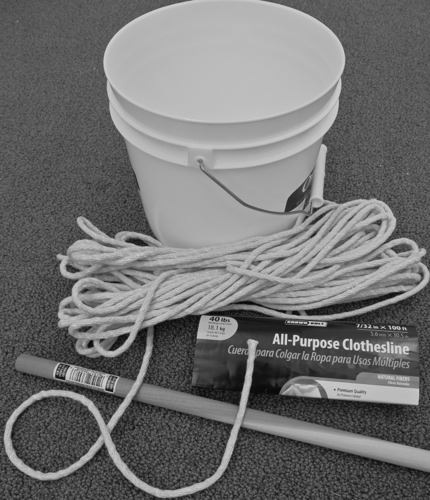
Assembled materials

Materials for 6 pole carriers:
— 100′ of 7/32″ cotton “sash cord” or “all purpose clothesline” (easy to tie, and soft on kids’ hands if they grab it)
— 12 ea. 1-gallon plastic buckets, often sold as painter’s buckets; the ones we like best look like miniature 5-gallon buckets with sturdy reinforcement at the top (see photo above)
— 6 pcs. 5/8″ dia. 4-foot long hardwood dowels
— 9/16″ drill bit and drill (hand drills work well for this project)

———

Measuring for the holes in the buckets

Step one:
Mark out locations for three holes spaced equally around the bucket. Our buckets were 7-3/4″ in diameter, and spacing the holes 6-3/4″ apart (as measured on a straight line, as in the photo above) provided fairly equal spacing.

———

Drilling the holes in the buckets

Step two:
Drill three holes as shown in the photo above.

———

How the cords are tied to the buckets

Step three:
Cut two lengths of sash cord, one 6′ long, and one 4’6″ long. Thread cord through holes and tie with two half hitches as shown — the longer piece of cord is tied at its two ends through two holes, and the shorter piece of cord is tied at one end through one hole. Note that two half hitches function as a slip knot, so snug the knot down to the bucket. (If you don’t know how to tie two half hitches, look at a Scout handbook, or search the Web for instructions.)

Make two of these assemblies, one for each end of the dowel.

———

Tying the cords to the pole

Step four:
Loop the longer rope (tied off at both ends) over the dowel. Then tie a clove hitch, using the free end of the shorter cord, so that the clove hitch goes over the longer cord, and secures it to the dowel (see photo above).

Once you get the clove hitch tied, lift up the assembly, and see how the bucket is hanging. It will probably hang unevenly, so adjust all the cords until it hangs more or less evenly — this is much easier if you get someone to hold the dowel for you. When everything looks even, snug up the clove hitch so it’s tight. (You can also tie off the free end of the rope onto one of the other ropes, using two half hitches — this makes for a slightly more secure assembly, although it isn’t really necessary.)

———

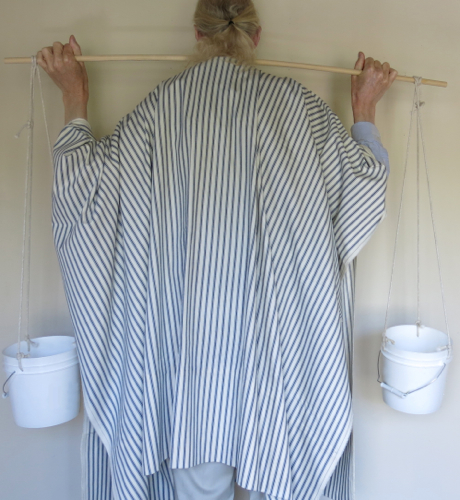
Person in ancient Judean costume with loaded shoulder pole carrier

Above is what the whole thing looks like when it’s completed, with each bucket filled about 1/3 full. Don’t fill the buckets more than half full — if you do, the water will slop all over your feet when you carry it, and there’s a good chance you’ll snap the dowel from the weight.

In fact, for most school-aged children, filling the buckets about a third full will provide the most pleasant experience. With that much water in the buckets, it’s heavy enough so that the water carrier stays in place on the child’s shoulders, but it’s not so heavy that it hurts. Notice that the dowel in this design is relatively thin so that it acts as a spring, providing some cushioning to the shoulders — carrying water with this water carrier is relatively comfortable.

Of course, you can also use this type of carrier with a heavier load in the middle, and with two people carrying, one on each end of the pole. Obviously, a longer, stronger pole would be needed.

If you want to carry bigger loads with a shoulder pole carrier, use a heavier pole. Asian cultures often use bamboo for the pole — it’s a material that’s light, flexible, and strong. Traditional European shoulder pole carriers were typically less flexible, and carved (like ox yokes) to fit around the neck and put more of the load on the shoulders.

Web of relationships

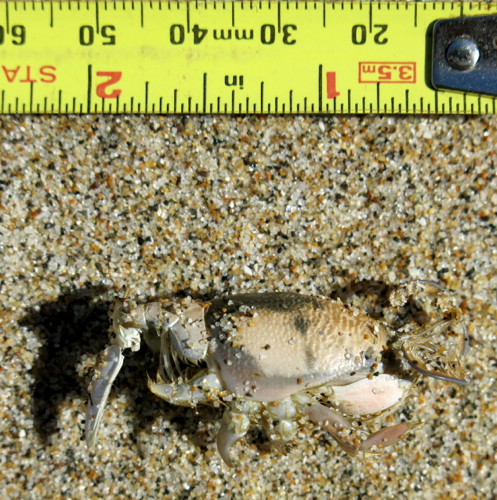
Today I was at Pescadero Marsh to look at live birds, but the dead things proved more interesting. It was just after low tide, and I saw two empty crab shells (prob. Red Crabs, Cancer productus), looking as though they had been eaten by gulls; interesting, but a pretty common sight, and it’s more interesting to actually see a gull eating a crab. Then I found the empty shells of two small crustaceans, organisms I’d never seen before. Here’s one of them:

BlogMar1215a

I have no idea what species this is, though I suspect it’s a fairly common organism.

Later, I walked along the dike near Butano Creek, and came across a dead mole (the notebook next to the mole is marked in inches):

BlogMar1215b

Given the size of those front feet and the short tail, I’d say it was a Broad-footed Mole (Scapanus latimanus). This is the third dead mole I’ve found in six months.

What interests me when i see dead things in the field is trying to figure out how they died, and how they are tied in to the ecosystem. The Red Crabs were easy to figure out — probably eaten by gulls. But why did that little crustacean die? it didn’t look as though another organism had tried to eat it, so was it simply left high and dry at low tide? As for the Broad-footed Mole, there was a definite hole in the other side of the animal, which could have been made by a bird’s bill; I saw Red-tailed Hawks and Northern Harriers hunting in the marsh; perhaps a raptor killed the mole, then got scared away before it could eat.

These are just possible scenarios; I’ll never know what really happened; but what I do know is that somehow these dead creatures reveal something about the web of relationships between organisms.

Pescadero Marsh

Pescadero Marsh

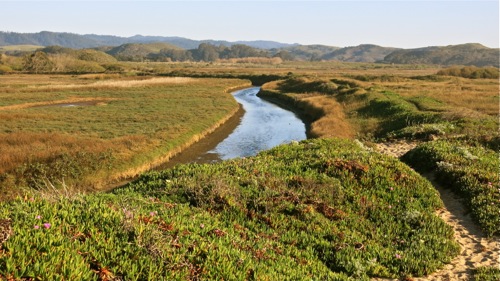
I went for a walk in Pescadero Marsh for the first time today. It’s a pretty remarkable place. It encompasses a variety of habitats, including pickleweed salt marsh, freshwater marsh, riparian corridor, sandy beach, old sand dunes, etc. Birdlife ranged from birds typical of beaches, like Sanderlings and Black Turnstones; to birds typical of freshwater marshes, like Marsh Wrens and Common Yellowthroats.

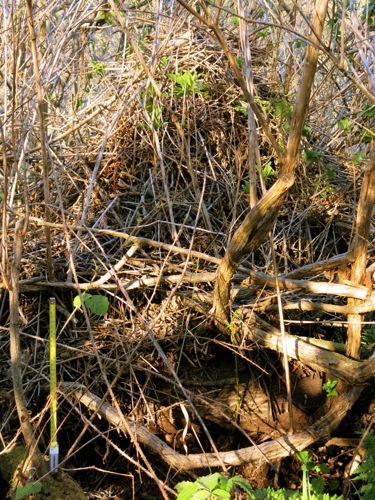
There were signs of other resident animals as well. Along the edge of Pescadero Creek, you pass by what look like big piles of sticks, but they’re actually houses built by Dusky-footed Wood Rats (Neotoma fuscipes). In the photo below, the tape measure at lower left is extended to 12 inches (300 cm); so this particular wood rat house is about four feet high (1.3 m).

house of Neotoma fuscipes

From a little further down the same trail, you can see a Great Blue Heron rookery. Their nests look like big piles of sticks, piles that may be three or more feet from bottom to top, that somehow got stuck high up in the branches of dead trees. I counted at least eight herons sitting on nests — four foot high birds roosting on three foot high piles of sticks thirty or forty feet above the ground.

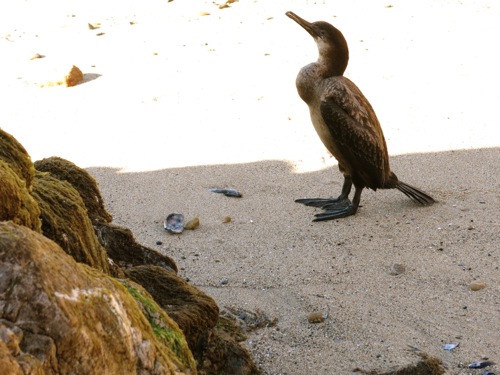
immature Phalacrocorax auritus

On a secluded part of the beach on the other side of Highway 1, an immature Double-crested Cormorant (Phalacrocorax auritus) was too stupid, or too dazed, to move away when I walked past it. It stood quite still while I took its photo (above). The other birds and animals I saw were far less trusting than this cormorant: as soon as humans came into view, they flew or scuttled away out of danger. Except for the fifty or so Elephant Seals I saw lying on the rocks out beyond the beach: they did not seem to pay any attention to the humans walking on the beach; but then, they were well out of reach of any meddling humans, protected by a couple hundred feet of surf and slippery rocks.

Malcolm

Malcolm X was shot to death on February 21, 1965 — fifty years ago.

Of the two most prominent figures of the Civil Rights Era, I feel more religiously aligned with Malcolm X than with Dr. Martin Luther King, Jr. I find Dr. King to be a forbidding figure. Dr. King’s writing, his preaching, and his speaking were all extraordinary. Dr. King not only stayed true to his principle of non-violence in the face of actions that would make just about anyone else retaliate in anger, but he also managed to lead his many thousands of followers to maintain their commitment to nonviolence as well. Dr. King intimidates the hell out of me, and makes me realize my own utter inadequacy as both a minister and a human being.

Of course, Malcolm X is a forbidding figure as well. His father was murdered by whites, and his mother then went into an insane asylum, leaving Malcolm X effectively an orphan. Malcolm was imprisoned, yet in prison he had a religious awakening, got himself straightened out, and educated himself. He wound up becoming one of America’s most compelling religious leaders. Malcolm X intimidates the hell out of me, too: I have no doubt I would crumple under that kind adversity, and he too makes me realize my own utter inadequacy as both a minister and a human being.

I’m a pacifist, but I still feel more aligned with Malcolm X than with Dr. King. I think it’s because I better understand Malcolm X’s way of writing. He was a master of the plain style. In his book The Ballot or the Bullet, he wrote: “Three hundred and ten years we worked in this country without a dime in return — I mean without a dime in return. You let the white man walk around here talking about how rich this country is, but you never stop to think how it got rich so quick. It got rich because you made it rich.” This is stating a simple fact as clearly as possible. Perhaps it lacks some of the literary finesse of, say, “Letter form Birmingham Jail”; what it lacks in finesse it gains in clarity.

Reading Malcolm X is a bracing experience for me. Recently, I’ve been questioning this notion of “white privilege” that we white liberals have been playing around with for twenty-five years or so. In The Ballot or the Bullet, Malcom X writes: “Whenever you’re going after something that belongs to you, anyone who’s depriving you of the right to have it is a criminal. Understand that. Whenever you are going after something that is yours, you are within your legal rights to lay claim to it. And anyone who puts forth any effort to deprive you of that which is yours, is breaking the law, is a criminal.” This simple, clear statement puts the lie to the concept of “white privilege”; what we’re actually talking about is theft, a criminal act, a crime; it’s not white privilege, it’s white theft.

One of Malcolm X’s clearest statements comes from his Autobiography. Yes, the Autobiography of Malcolm X was written in collaboration with Alex Haley. But Haley based the book on extensive interviews and conversations, and I have enough trust in Haley’s skill as a writer to trust him to accurately record Malcolm X’s words in key passages. And when I read the following passage, I can hear the clarity of language and thought that belong Malcolm X, not Alex Haley:

“Since I learned the truth in Mecca, my dearest friends have come to include all kinds — some Christians, Jews, Buddhists, Hindus, agnostics, and even atheists! I have friends who are called capitalists, Socialists, and Communists! Some of my friends are moderates, conservatives, extremists — some are even Uncle Toms! My friends today are black, brown, red, yellow, and white!”

An essential religious insight into theological anthropology; a plainly spoken insight that needs to be heard clearly by people throughout America.

Malcolm X was murdered at age 39: a sorry waste of a brilliant mind.

Amphibian

This afternoon I was walking in Purissima Creek Redwoods Open Space Preserve, through Douglas Fir woodlands, along a ridge that was about 1,400 feet aboe sea level. I happened to look down at my feet, and there was a — well, no, it wasn’t a lizard, it was some kind of salamander.

Sometimes it pays to walk slowly and deliberately. I got down on my knees to look more closely.

BlogFeb1815

I haven’t seen seen a salamander since I moved to California more than five years ago, so I stopped to watch it for a while. I placed a quarter on the ground, to give a sense of scale in the photos I was taking. The salamander obligingly stepped right on the quarter:

BlogFeb1815b

It was fun to watch it walk — it had that rolling, deliberate salamander gait, so very different from the quicker-than-the-eye sprinting done by lizards. Eventually, it walked off the trail and disappeared into the leaf litter.

When I got home, I looked on the California Herps online identification guide. I’m pretty sure it was a Rough-skinned Newt (Taricha granulosa). Another possibility would be the Red-bellied Newt (Taricha rivularis) — but the eye of my newt showed some whitish yellow, while T. Rivularis has uniformly dark eyes.