Adventures in grilling

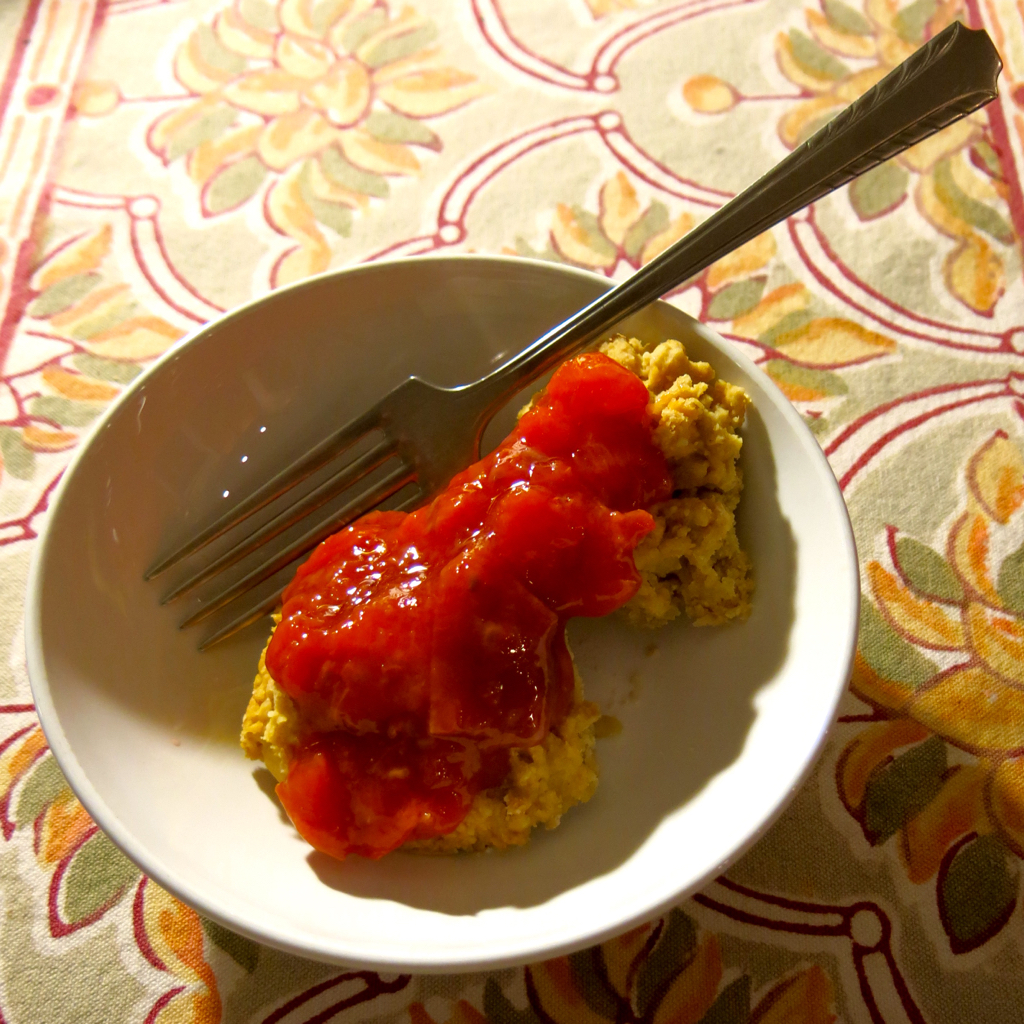
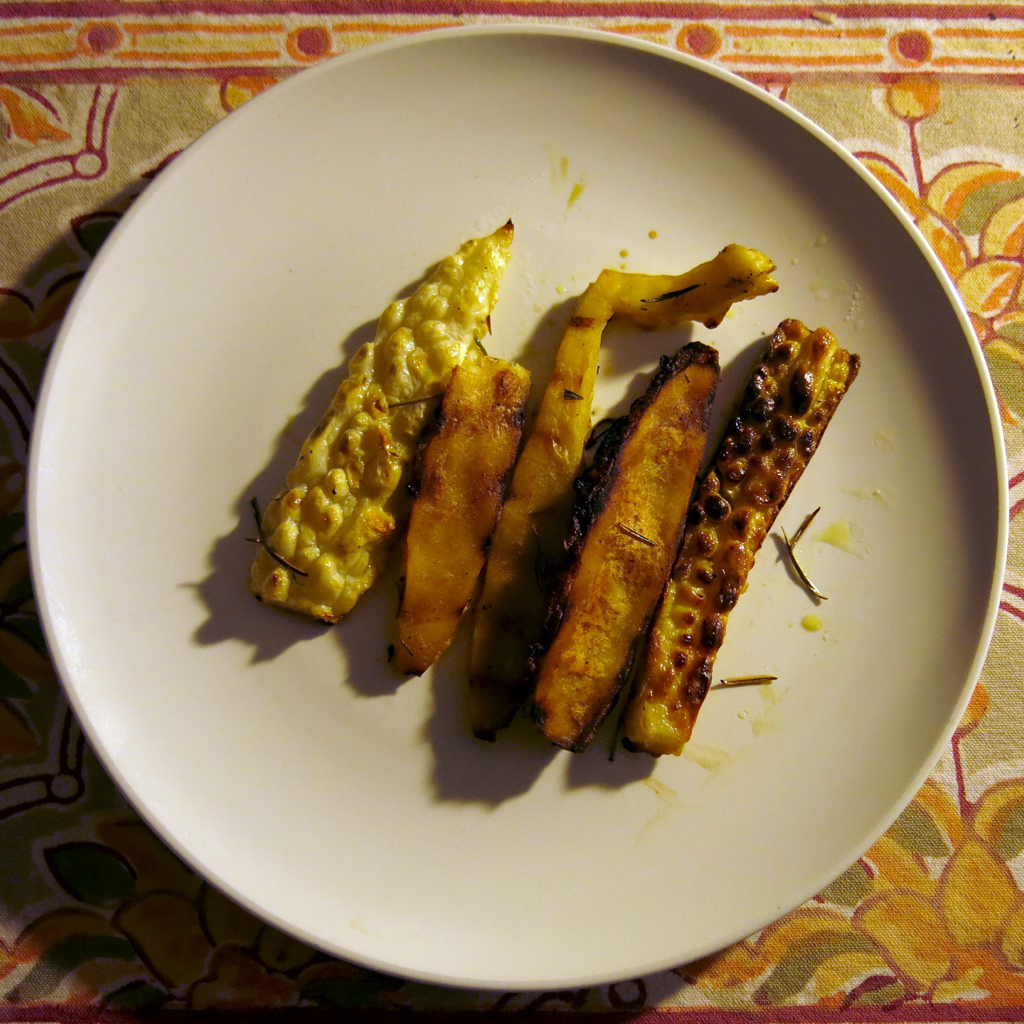
It was hot today, so we decided to grill our dinner. I hardly ever eat beef any more (can’t afford it, it’s bad for me), but Carol had gotten some local grass-fed beef from a nearby farm, so we grilled hamburgers and potatoes. That wasn’t quite enough for a dinner. Carol saw that we had a small mild white bitter melon in the refrigerator — what about grilling that? She basted it in olive oil and rosemary before she grilled it. It turned out well — slightly crispy, nicely bitter, very yummy.

Bioregional quiz

In the Winter, 1981, issue, the editors of the magazine Coevolution Quarterly published “Where You At? A Bioregional Quiz,” developed by Leonard Charles, Jim Dodge, Lynn Milliman, and Vitoria Stockley (you can find this quiz online here). The quiz was later republished in the book Home: A Bioregional Reader (New Society, 1990). Since then, others have modified the quiz; most notably, in 2006 Kevin Kelly posted a revised version of this quiz titled “The Big Here” on his blog.

As much as I like the original version of the quiz, some of the questions are specific only to certain bioregions, such as “What spring wildflower is consistently among the first to bloom where you live?” — if you live in a region where flowers bloom year-round, there is no good answer to that question. And some of the questions are maybe too difficult, such as “Name five grasses in your area” — I’ve been trying to learn how to identify grasses down to the species level, and it’s very challenging. A couple more things bother me about the quiz. First, the quiz focuses too much on book knowledge; you are merely asked to “Name five resident and five migratory birds,” you are not asked to identify them in the field. Second, the quiz ignores whole clades of organisms that would have been familiar to indigenous peoples, such as invertebrates and non-vascular plants.

So I’ve been thinking about how to revise the quiz. I wanted to create a quiz that would prompt me to learn more about my watershed, and to encourage me to get outdoors and explore that watershed. The first draft of my quiz appears below. How many answers did you get? What did I leave off that I should have included?

Continue reading “Bioregional quiz”

Lichens

Living in a cemetery gives me the opportunity to observe a nice diversity of lichens. I went out this evening to see some of this diversity; my camera served in stead of a hand lens.
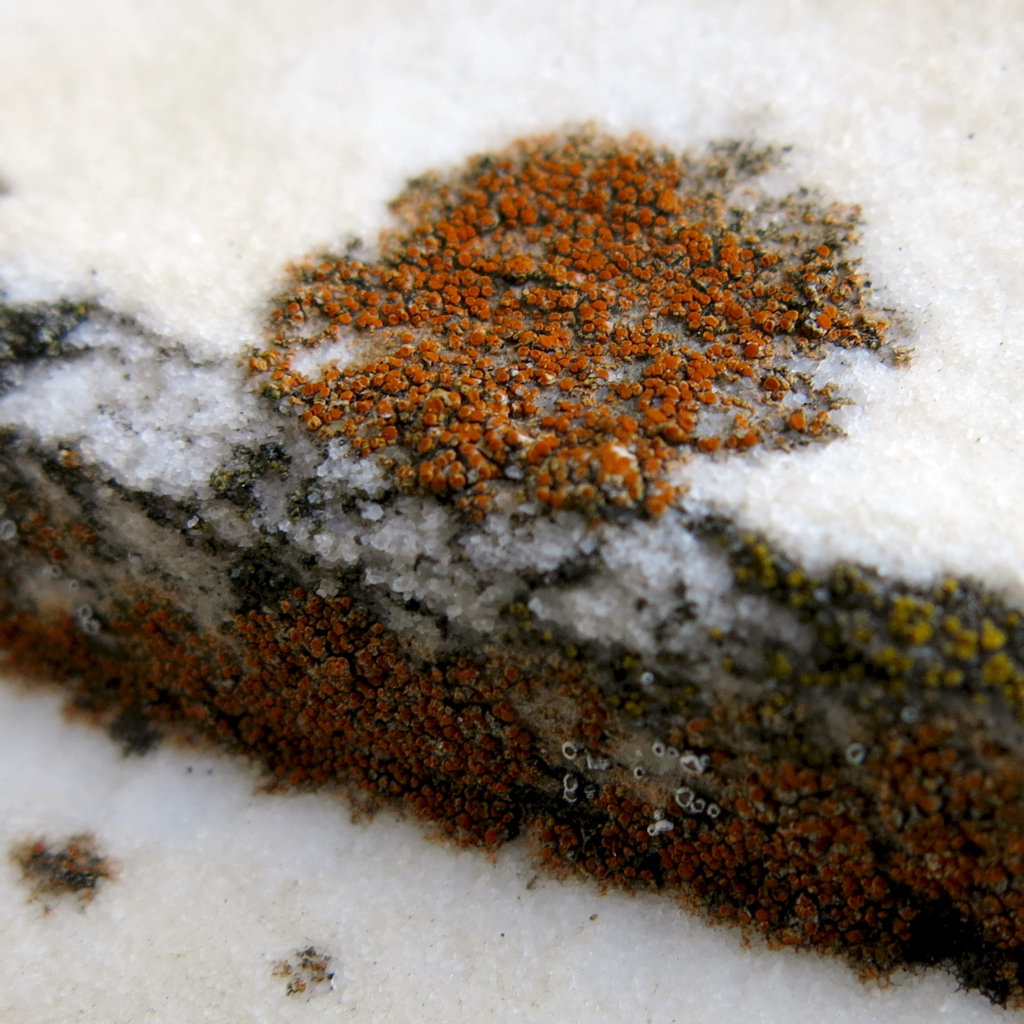
This crustose lichen, covering an area about the size of a quarter, was growing on a marble gravestone. The magnification of the photo shows how the lichen has etched an indentation into the stone. To make an accurate identification of crustose lichens, I’d need both a microscope and far more knowledge than I currently have. But this may be in the genus Caloplaca: “The 25 to 30 species [of Caloplaca] reported from California … occur very widely on trees and mostly calcareous rocks. Caloplaca saxicola is common and one of the first crustose lichens collected by beginners” (Mason E. Hale Jr. and Mariette Cole, Lichens of California [Berkeley: Univ. of Calif. Press, 1988], p. 190).
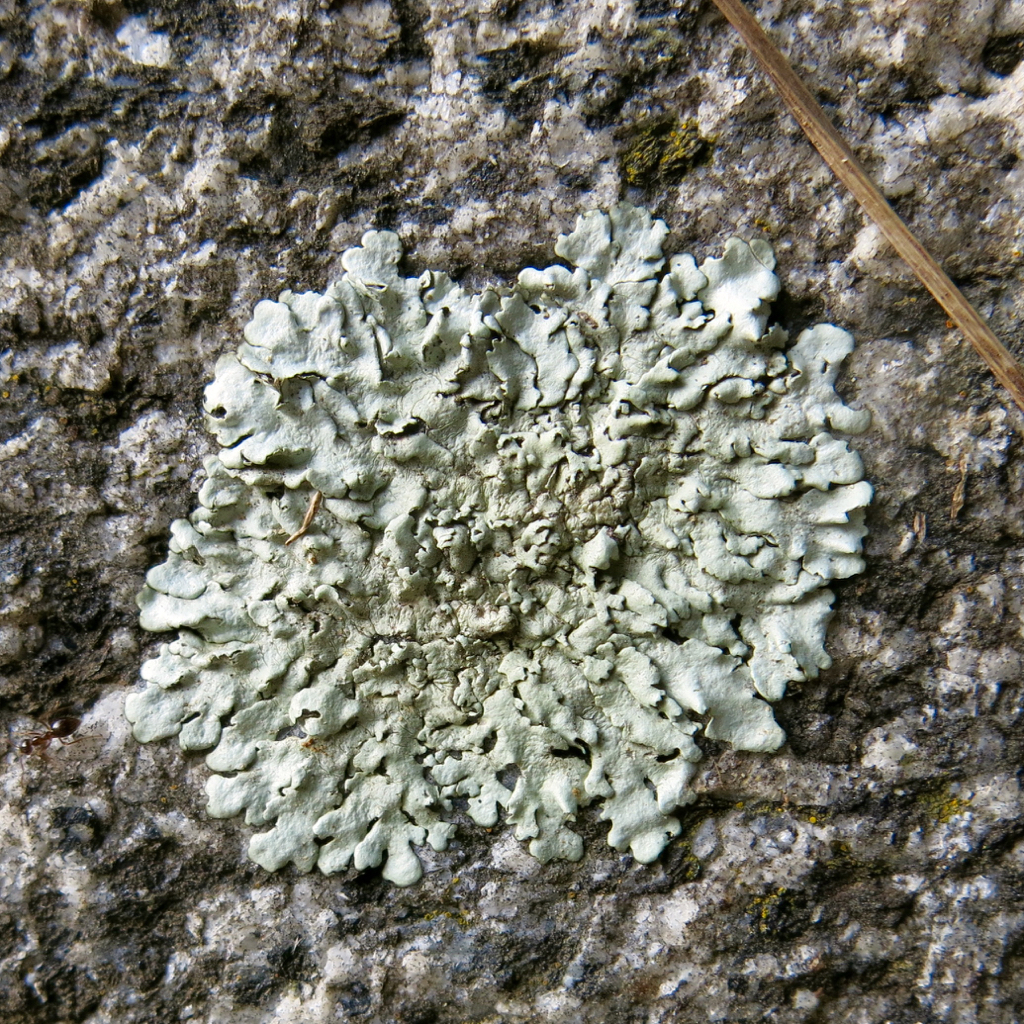
The foliose lichen above, about an inch across, and found on a piece of granite, may be in the genus Xanthoparmelia. According to Hale and Cole, “Xanthoparmelia is by far the dominant foliose lichen on granites, schists, shale, and other non-calcareous rocks throughout California…. Two species, X. cumberlandia and X. mexicana, are common and collected almost everywhere in the state.”

If I were to get serious about identifying lichens, I’d need to go out and get the K, C, and P reagents, an inexpensive USB microscope, and a few other things. Then I’d have to get serious about studying them: dissecting them, looking at them under the microscope, etc. Is it enough to just look at lichens without identifying them? or do I want to engage in more serious study of them? Heraclitus advised that “those who are lovers of wisdom must be inquirers into many things indeed” (DK35); but how deeply should one inquire into each of those many things? One only has so much time in this world; a serious in-depth study of one topic means less time to inquire into the many other things.

New potatoes

We planted a four foot row of potatoes right after we moved in to our new place, back in November. Something ate most of the leaves from the plants, and they slowly withered and died. This evening, Carol said we should look to see if there were any potatoes. I turned the heavy black soil over with a spading fork, and she sifted through looking for potatoes. We wound up with about a pound and a half of new potatoes. I took them in to the kitchen and carefully scrubbed them, trying to keep as much of the tender skin as I could.

When they were washed, I cut up the larger ones. I put them in a pot of simmering water for a few minutes. We served them with nothing more than some olive oil, a little kosher salt, and a sprinkling of black pepper.

Less than an hour after we pulled them out out of the soil, we were eating them. They tasted wonderful: faintly earthy, with a delicate texture.

It’s that time of year

Five minutes ago, Carol was sitting in the living room staring at her laptop, and I was in the kitchen reading a murder mystery. Suddenly my ears caught the sound of something outside the window. I stopped to listen, and it came again.

“Hear the owl?” I said to Carol.

“No,” she said. “Where?”

I opened one of the kitchen windows a crack, and we stood there and listened.

“Hu-hu, hu, hu,” said the owl in a nearby tree.

Carol and I grinned at each other. This is one of those times when we really like living in a cemetery. “Great Horned Owl,” I said.

“Hu-hu, hu-hu.” It’s mating season.

Portable radio

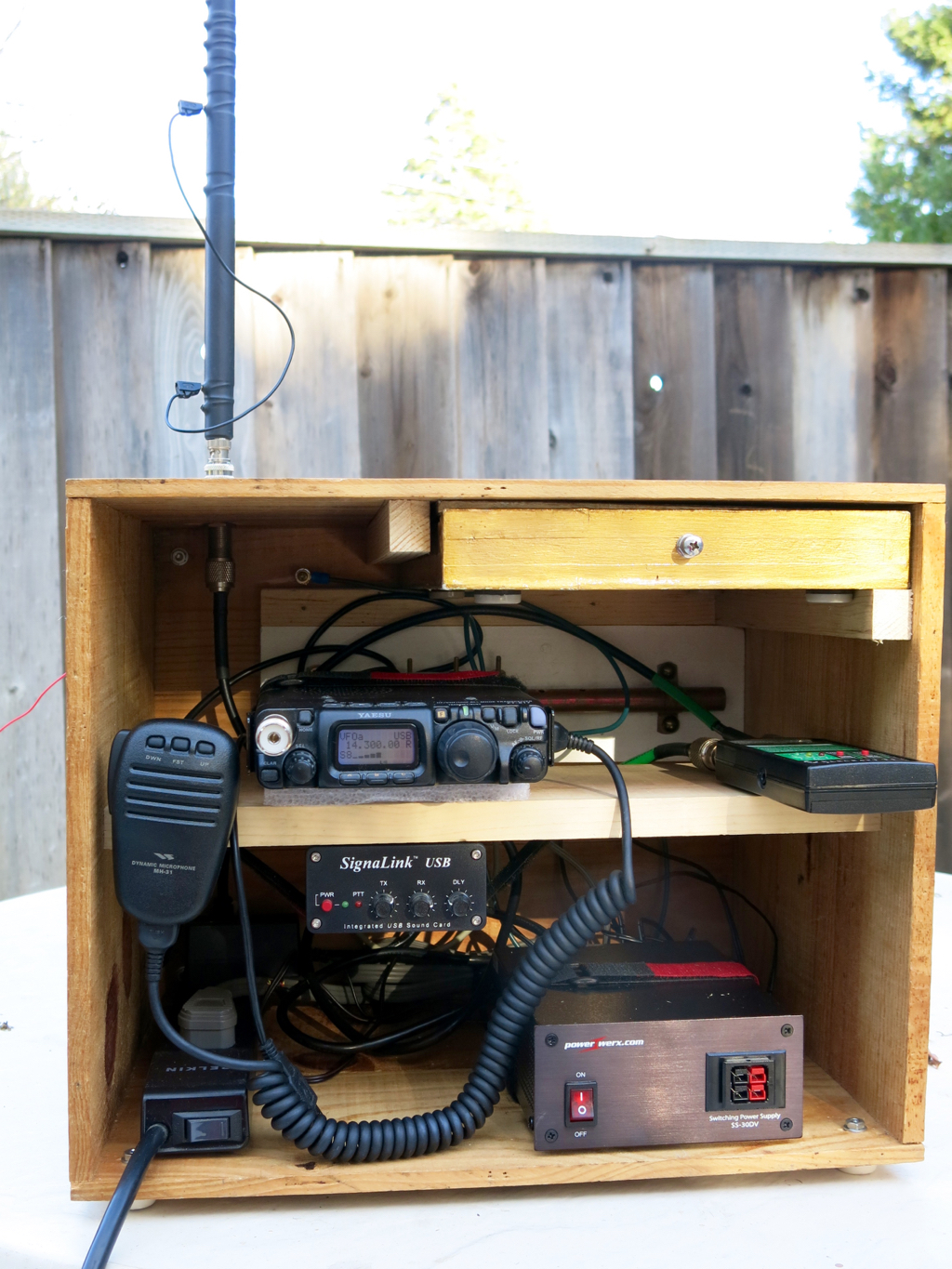
Michelle and Don stopped by this morning to pick up some amateur radio gear I got from Dad that I’m no longer using. We stood around talking for a while, and Don showed me the prototype of a large variable air capacitor he’s fabricating for use in magnetic loop antennas. So of course I had to show off my latest project: a portable box containing a low-power transceiver, digital interface, power supply, antenna tuner, and antenna.

OK, in terms of raw geek street cred, my portable radio box isn’t as cool as fabricating a large variable air capacitor. But it’s worth something as a small piece of systems engineering that addresses a specific problem that I face: our new house is clad with stucco on wire mesh, which means I live inside what is essentially a Faraday cage; and the landlord does not allow permanent outdoor antenna installations (let’s face it, most visitors to a cemetery don’t want to see a big antenna array). Now I can grab this box, walk out to our fenced-in patio, sit down and get on the air. Mind you, as with any good DIY maker-type project, there is room for improvement and expansion: it definitely needs a door on the front to protect everything; I’d like to add a straight key for Morse code and a space to store an Android tablet for digital modes; I’m thinking of a separate battery and solar cell unit to go with this; maybe someday I’ll add a small linear amp. But in the mean time, this works as is, and it was fun to sit outside in the sun yesterday and monitor the mobile maritime net.

Moving

Carol and I have decided that it’s easier to move a thousand or more miles away, as we have done four times now, than it is to move two miles away, as we are doing right now. When you are contemplating a long distance move, you know you have to plan everything well in advance. When you’re moving two miles up the street, you think it’s going to be easier, so you relax.

But a move of two miles is not much easier than a move of two thousand miles. Friday, while we were in the middle of schlepping boxes, Carol looked at me and said, “This is traumatic.” OK, maybe “traumatic” is too strong a word; it certainly is extremely unpleasant.

Housing solution

I wrote recently about how insanely difficult it is to find housing in the Bay Area. Since then, the East Bay Times reported that high housing costs have contributed to recent job losses in the Bay Area:

“The Bay Area’s job losses stem from two distinct phenomena: Some employers are slashing positions, and others are unable to hire. Some economists attribute this second problem to structural barriers posed by skyrocketing housing costs. The lack of affordable places for workers to live appears to have hobbled the region’s ability to fill jobs as briskly as in prior years.

“‘Housing is the chain on the dog that is chasing a squirrel,’ said Christopher Thornberg, principal economist and founding partner with Beacon Economics. ‘Once that chain runs out, it yanks the dog back.'”

High-cost municipalities like Palo Alto have been experiencing a net decline in population for over a year now — while housing costs continue to rise. It will be interesting to see how this trend plays out. I suspect that changes in policy will have much effect on rising housing prices; this suspicion is based on what Jay Forrester wrote in his 2009 paper “Some Basic Concepts in Systems Dynamics”:

“People seldom realize the pervasive existence of feedback loops in controlling everything that changes through time. Most people think in linear, nonfeedback terms. … people see a problem, decide on an action, expect a result, and believe that is the end of the issue. [This is] the framework within which most discussions are debated in the press, business, and government.” Yet the world does not really work in a simple, linear fashion. Instead, says Forrester, “we live in a complex of nested feedback loops.”

Another way of saying this is that we human beings like to think of the world in terms of simple, linear, cause-and-effect relationships. Linear thinking provides a reasonably good model for most of our day-to-day actions, and we like to think it will work in all situations. A better model is to think of the world in non-linear terms, as a complex of interconnected feedback loops.

However, in practice it has proved very difficult to get most people to adopt a non-linear model of the world. I see this all the time in my work life. For example, when I’m doing pastoral counseling with people, I see that people often shy away at understanding their personal, spiritual world in terms of nonlinear feedback loops; they prefer to think that a personal, spiritual problem is easily addressed using linear cause-and-effect solutions; and those linear solutions may work in the short term, but after short terms gains there are typically feedback loops in the family and in other social relationships which tend to draw the person back to their original equilibrium.

In another example from my work life, congregations try to solve their problems using linear cause-and-effect thinking. If a congregation wants to increase membership, for example, they will typically find a linear cause-and-effect solution like improving their Web site or doing other advertising to draw new people in the door. One common result of this kind of linear “solution” is that there is a brief influx of newcomers, and a brief increase in attendance, but then within a year various feedback loops bring the congregation back down to the size it was before the advertising campaign.

So the reason I see little hope for policy solutions to the housing crisis in the Bay Area is that most policy efforts are driven by linear cause-and-effect thinking. Build more housing and housing prices will drop; implement rent stabilization measures and housing prices will at least be stable; — both these measures will fail because they don’t take into account the complex of feedback loops that are driving high housing costs, including availability of a range of jobs, transportation infrastructure, national and world forces bearing on the region, etc.

We have managed to solve our own immediate housing crisis. After the landlord sold the building we live in, we spent a month looking for housing and yesterday we signed a lease. We will be living in a cemetery — I kid you not — in a nice two-bedroom house that had been built for a caretaker. We solved our immediate problem with a linear cause-and-effect solution; but we have not solved the longer term problem of how two people who are not earning those six-figure high-tech salaries can afford to live in Silicon Valley.