Transgracial

“Transgracial” — that’s not a typographical error. Rebecca Tuvel, professor of philosophy at Rhodes College in Memphis, explores the implications of a “transgracial,” or combined transgender and transracial identity, in a post to the American Philosophy Association (APA) “Black Issues in Philosophy” blog. In this post, Tuvel argues that transracial identity is analogous to transgender identity, where “analogous to” doesn’t mean “identical to.” When she first published these ideas in 2017, apparently some people were outraged. But I think Tuvel’s proposed analogy is less interesting than an essay she refers to written by Ronnie Gladden, who presents as a black man but who identifies as a white woman.

This essay, published in 2015 in Queer Cats Journal of LGBTQ Studies is titled “TRANSgressive Talk: An Introduction to the Meaning of Transgracial Identity.” The author, at that time a doctoral student in education at Northern Kentucky University, identifies their names as both Ronnie Gladden and Rachael Greenberg, so I’ll refer to them as Gladden/Greenberg. (For reference, it appears in 2021 that they identify simply as Ronnie Gladden.) In 2015, Gladden/Greenberg began their essay by saying:

“My confrontation with my internalized racial unrest, along with a growing awareness of my authentic gender identity, has been prompted, in part, by two socio-political shifts: 1) the escalating tensions belying the ‘Black Lives Matter’ movement, and 2) the increased visibility of transgender individuals in a myriad of public spaces. Increasingly, I feel an urgency to be forthcoming about my true identity in an era where transparency is not just encouraged; it is demanded. In spite of presenting as outwardly black and male — by and large I view myself as white and female….”

Gladden/Greenberg writes about an intersectional identity that I hadn’t thought about before. They describe tensions in their life that I wouldn’t have thought about. At the same time, claiming a transracial identity in the U.S. today may not seem possible, given the way we understand race in our society. But a 2014 article in Georgetown Law Journal by Camille Gear Rich, Gould School of Law at USC, titled “Elective Race: Recognizing Race Discrimination in the Era of Racial Self-Identification”, referred to in Tuvel’s blog post, may help to think further about the question of transracial identities. In this article, Rich writes:

“[W]e are in a key moment of discursive and ideological transition, an era in which the model of elective race is ascending, poised to become one of the dominant frameworks for understanding race in the United States. Because we are in a period of transition, many Americans still are wedded to fairly traditional attitudes about race. For these Americans, race is still an objective, easily ascertainable fact determined by the process of involuntary racial ascription — how one’s physical traits are racially categorized by third parties. The elective-race framework will challenge these Americans to recognize other ways in which people experience race, including acts of voluntary affiliation as well as selective and conditional affiliations.”

Rich acknowledges that this new elective model of race poses distinct challenges: “The elective-race framework rejects claims about the obdurate, all-encompassing nature of white privilege and the need for racial passing” (p. 1506). Rich isn’t denying that white privilege is real, but at the same time different individuals may navigate white privilege in different ways. Rich also points out that “neither lay understandings nor institutional understandings of elective race are fully developed”; I’m finding Rich’s article to be an excellent resource as I develop my own understanding of elective race.

Given that a significant number of people — let’s say, a growing number of people — accept the evolving concept of elective race, it should be no surprise to find people who identify as living at the intersection of transracial and transgender identities. I imagine that will be a difficult intersection at which to live. I wonder how Unitarian Universalism (and other religions, for that matter) will respond to the persons living at that intersection.

Jokes from class today

The question of the day in today’s middle school class was “What’s your favorite joke?” This unleashed a spate of jokes. We all laughed (and groaned) a lot, and I realized that during the pandemic I don’t hear jokes much any more. Below are some of the jokes I can remember from today’s class; add more (clean ones preferred) in the comments.

Why is pi the loneliest number?
No one talks to him because he goes on forever.

A goat, a drum, and a snake fall off a cliff.
Baa, dump, tss.

What do you call a cow with no legs?
Ground beef.

Why did the whale cross the road?
The chicken was on a break.

What’s the stickiest Greek monster?
The Mino-tar. (thanks, Benjamin!)

How to make Halloween costumes for your stuffies

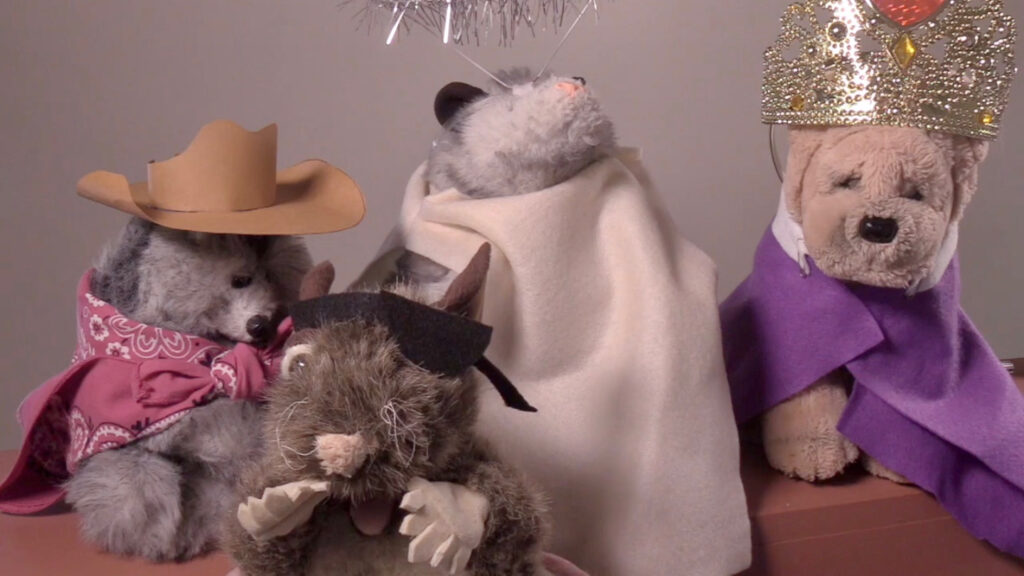
If you can’t go out trick-or-treating this year, or go to a Halloween party, how about making costumes for your stuffed animals? You could even hold a costume party for stuffies. Here’s a video with some idea on how to make easy, effective costumes for your stuffed animals:

Click on the image above to take you to the video on Youtube.

In the video, you’ll see Dr. Sharpie Ann get costumed as a queen (Queen of the Universe, of course), Packie the Dusky-footed Woodrat as a pirate, Possum as an angel, and Hedgehog as a cowboy.

Once you dress up your stuffies, take their photos and post them on social media.

Adventures in mask making

As of April 2, the San Mateo County Board of Health recommends that everyone wear a mask when they’re in public places.

I’ve been doubtful about the efficacy of masks, since my understanding is that wearing a mask won’t do much to protect you from being infected by others. But I’ve come to understand that masks might protect others from being infected by you, if you happen to have COVID-19 but are still asymptomatic.

So today I decided to be a good citizen and sew a couple of masks, one for Carol and one for me. I am very slow at sewing, partly because I don’t know how to use a sewing machine, and partly because I don’t know what I’m doing. But I found a good online video showing how to make one of the 2-layer pleated masks that are supposed to be the most effective handmade masks. I didn’t have the elastic bands called for in the video, but I had some 1/4 inch polyester cord to use for the ties. Carol has a big bolt of unbleached cotton muslin, and I sacrificed an old t-shirt. Sewing the pleats by hand was kind of a pain at first, but I quickly figured it out.

After two or three hours, I had a mask for Carol and a mask for me. We went to the grocery store, and three quarters of the people there were also wearing masks. Mask wearing peer pressure has begun.

Me wearing my mask

As soon as we got home, I washed both masks in hot water, as you’re supposed to do.

Next step: make another mask for Carol using a high fashion fabric for the outer layer….

The obligatory COVID-19 blog post

Any blogger worth their salt now has to write a post about the novel COVID-19 virus, popularly known as coronavirus. I want to talk about the recommendations for handwashing issued by the Center for Disease Control (CDC).

Now, the CDC is recommending that we wash our hands frequently to avoid spreading infection from COVID-19 and other infectious diseases like the flu. I’m fine with that. According to the CDC, proper handwashing technique involves five steps.* I’m fine with that, too. But in Step 3, the CDC instructs us to sing the “Happy Birthday” song twice so we make sure we wash for a full 20 seconds. [* Update: 14 March 2025: Charlie pointed out that’s now a dead link; the CDC info has moved here.]

Ugh. I hate the “Happy Birthday” song. I don’t want to sing it once, let alone twice, let alone every time I wash my hands.

Fortunately, I have an alternative. Ginger, a UU religious educator in the Bay Area, found this, which was posted in a bathroom of a UU congregation:

Sign saying Wash, wash whoever you are...

“Wash, wash, whoever you are,
Wanderer, worshipper, lover of cleaning,
Rinsing the germs off is easy to do
Wash, yet again, wash.”
(with presumed apologies to Rumi and Coleman Barks)

If you sing “Wash, wash, whoever you are…” to Lynn Ungar’s tune in the UU hymnal Singing the Living Tradition (no. 188), at a reasonably quick tempo (about 144 bpm), it takes about 16-17 seconds to sing. Then you can repeat “Wash, yet again, wash” to make a full 20 seconds. Much better than the “Happy Birthday” song.

And there are still more songs you (and/or your children) can use to time your handwashing.

More than a decade ago, Dr. Robert Piper, retired professor of political science at UMass Dartmouth, demonstrated how you can sing the ABC song to time your handwashing. Since I trust retired professors of political science, that’s what I’ve been doing ever since.

Or, if you want to be religious, there’s a passage from sacred scripture that neatly fits the tune of the ABC Song (which is, by the way, a lovely folk tune immortalized by Mozart in K. 265) — I’m referring of course to the Mad Hatter’s poem in the holy writ of Alice’s Adventures in Wonderland:

“Twinkle, twinkle, little bat!
How I wonder where you’re at!
Up above the world you fly,
Like a tea tray in the sky.
Twinkle, twinkle, little bat!
How I wonder where you’re at!

So you see, if you too hate the “Happy Birthday” song, you (and/or your children) now have 3 other options to time handwashing: “Wash, wash, whoever you are”; the ABC song; and “Twinkle, twinkle, little bat.”

Update: (1:12 p.m.) Ginger found yet another UU handwashing song online, which also lasts about 20 seconds:

“Come wash your hands with me
Come wash your hands with me
Come wash your hands with me,
So we can know peace of mind.
And I’ll bring you soap,
When soap is hard to find,
And I’ll wash my hands with you
So we can help humankind.”

What does it mean to be cisgender?

In article on Feminist Current, a Canadian Web site, Robert Jensen, a professor of journalism at the Univ. of Texas Austin, questions his assignment into the category of cisgender:

“…Sex is a question of biologically determined male and female, gender of socially determined masculinity and femininity. The dominant conception of masculinity in U.S. culture asserts that men are naturally competitive and aggressive, and that being a ‘real man’ means struggling for control, conquest, and domination. A man looks at the world, sees what he wants, and takes it. This is sometimes labeled ‘toxic masculinity,’ which implies it is an aberration from some ‘normal’ masculinity. But this understanding of masculinity-as-seeking-dominance is the default setting for most males growing up in patriarchy, especially through the glorification of aggression in the military, sports, and business.

“All that definitional work [Jensen continues] is necessary to explain why I am not cisgender. As a male human, this patriarchal conception of masculinity is not my ‘chosen’ identity, nor do I believe it is my fate. As a short, skinny, effeminate child … I never felt very masculine. As an adult with feminist politics, I reject and struggle to overcome the masculinity norms in patriarchy. If we were someday to transcend patriarchy, would I feel more ‘like a man’? That would depend on how the term was defined, but in the world in which I live, I refuse to embrace the patriarchal gender identity handed to me….

“So [Jensen concludes], I’m not cisgender and I’m not transgender. I am not gender fluid, non-binary, or multi-gender. I self-identify as an adult biological XY male who rejects patriarchal gender norms and works from a radical feminist perspective to eliminate patriarchy….”

While it has some problematic moments, I think Jensen’s essay offers a small but useful addition to the ongoing debate about the term “cisgender.” If you haven’t been following that debate, some have argued that “cisgender” is analogous to the introduction of “heterosexual” as the opposite of “homosexual”; similarly, “cisgender” can help non-trans people realize the extent to which they have the privilege of not having to articulate their gender; therefore it is a necessary term. Arguments against the term include the possibility that setting up such a strong distinction between transgender and cisgender may actually work against a widespread acceptance of transgender as normal; others claim that transgender and cisgender are Western cultural concepts that don’t apply cross-culturally (e.g., Native Americans who reject the identification of the Two-Spirit tradition with transgender).

What Jensen offers to this debate is his personal experience of gender. He does not see himself as typically masculine; therefore, he does not see that his biological sex matches society’s expectations about the gender role he should take on. Yet he does not consider himself transgender, either. There’s an argument to be made that Jensen has cisgender privilege because he’s non-trans, and thus the term is useful; however, I’m not convinced that biological men and boys who are not masculine, but also non-trans, get the same level of privilege as a stereotypically masculine biological male since (depending on how effeminate you are) a straight non-trans non-masculine man will tend to experience some level of bullying and teasing.

The word “cisgender” is not going to go away, and I feel it remains useful in many settings. What Jensen makes me realize is that we should be careful in how we use the term: we shouldn’t use the term “cisgender” in such a way that it reinforces gender stereotypes. For example, we wouldn’t want to reinforce gender stereotypes of masculinity by grouping Robert Jensen together with Donald Trump under the rubric “cisgender men”; Trump is constantly enacting stereotypes of a hyper-masculine gender role (marrying a woman much younger than he, asserting his virility in various ways, putting success above everything else, etc.); Jensen is taking on a significantly different gender role.

So I’ll continue to use “cisgender” as a term for larger groups of people. But I’m going to be disinclined to apply it to a individuals, aware of its cultural assumptions, and careful not to turn it into yet another binary division.