
I’ve added a page to my Web site, a checklist of Perry Mason novels and stories, and you can find it here.
Category: Pop Culture
A clear causal chain
I did not follow the World Series.
I wore my Hebrew Red Sox cap during the Series.
Ergo:
The Red Sox won the World Series.
You can talk all you want about there being a big difference between correlation and causality. I know better.
The Red Sox won because I did not follow the Series, and because I wore my Hebrew Red Sox cap during the Series. I know that there is a direct causal link, because the world revolves around me.
Red Sox clergy
What’s the well-dressed clergyperson from Red Sox Nation wearing today? Well, obviously it depends on which faith tradition you’re part of. Since I’m from a faith tradition that requires Biblical knowledge in its clergy, an obvious choice for me is some kind of Red Sox garb in a Biblical language. No, not Koine Greek — that message of loving your enemies is not a good fit with the World Series. The teleology of Revelation is not exactly the kind of thing I’m looking for either. Definitely not Koine Greek.
Hebrew, on the other hand — the language of Moses and the story of the journey to the Promised Land — and, in case the Sox lose, the language of Jeremiah — Hebrew strikes me as a good Biblical language for Red Sox clergy. So today I’m wearing the hat that my friend the rabbi gave to me:
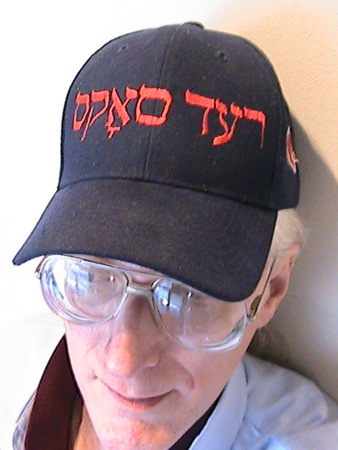
Yeah. Go, Sox!
Shareable economy
“Shareable economy” and “the new mutualism” are new and trendy terms for new-fashioned things like bikesharing programs, coworking, hacker spaces, etc. — and also names for old-fashioned things like public libraries, public parks, credit unions, co-ops, etc.
Two blogs on the shareable economy that seem worth reading:
Both blogs encourage social entrepreneurship. Both blogs look beyond North America to Europe, South America, Australia, and beyond. Not sure I’d read either blog on a regular basis, but both are worth looking at for ideas at least once.
The real America
In his 1994 introduction to his 1981 novel Hello, America, J. G. Ballard writes: “The United States has given birth to most of our century’s dreams, and to a good many of its nightmares. No other country has created such a potent vision of itself, and exported that vision so successfully to the rest of the world…. Whenever I visit the United States I often feel that the real ‘America’ lies not in the streets of Manhattan or Chicago, or the farm towns of the mid-west, but in the imaginary America created by Hollywood and the media landscape.”
The real America is the imaginary America which is presented in pop culture; this makes sense to me. And this raises a question for me: should religion accommodate to this imaginary America, as for example Rick Warren and his version of the prosperity gospel do? — or should religion take pains to point out that the “real America” is really an imaginary America? — or should religion ignore altogether the problems caused by the imaginary America being the real America? Or put more starkly: should religion resist pop culture, or embrace it?
I think they did it again…
“Oops, I Did It Again,” a song written by Max Martin and Rami Yacoub, has gotten a bad reputation. In an introduction to his own version of the song, Richard Thompson says that unfortunately, the best-known performance of the song was done by “a rather crass pop artist”; yet, Thompson says, the song itself is lovely, with a chord structure “reminiscent of other centuries,” and “if we just take it out of the original hands, and give it a slightly different interpretation, … we can reveal its splendor.” 1”
Since this is such a splendid song, it seems a prime candidate for adaptation: instead of a song addressed to a confused lover, why not make it into a song addressed to some of the people who are behind the growing economic inequality in the U.S.?
Oops, They Did It Again
I think they did it again,
They made us believe
That they were our friends.
Oh, baby,
They might think act like they care
But it doesn’t mean
That they’re serious;
‘Cause to make empty promises
That is just what CEOs do.
Oh, baby, baby —
Oops, they did it again,
They played with our hearts,
To them it’s a game.
Oh, baby, baby,
Oops, they cut back our pay,
Took benefits away;
They’re not so innocent! Continue reading “I think they did it again…”
Homework
If you haven’t yet seen it, I recommend an article in the October, 2013, issue of Atlantic magazine.
The article is titled “My Daughter’s Homework Is Killing Me.” For one week, the author does homework alongside his 13 year old daughter — and it’s more work than he bargained for. The author finds he has doubts about whether the homework is worth spending so much time on, and he also cites studies that claim there is little correlation between the amount of homework and academic performance. Also of interest — the author says that the amount of homework increases and decreases in a 30 year cycle, and we are currently at the peak of heavy homework. You can read this article online here.
I was interested in this article because I often hear from kids in middle school and high school how overwhelmed they are by the amount of homework they have. Of course, from my point of view as a religious educator, I care less about academic performance than about whether kids are growing up to be ethical, sensitive, and caring human beings — and as far as I know, homework has not helped kids become more ethical, sensitive, and caring. But I have definitely noticed that kids are getting more homework now than, say, a decade ago.
I wonder what you think about homework — especially those of you who are parents of middle school and high school students. Are kids getting too much homework these days? Do you think kids need lots of homework in order to remain competitive in today’s academic environment? How is homework affecting their lives — and your life as a parent? I’d love to hear from you!
Originally posted here.
Down by the docks
This afternoon, I went down to the marina, and stood on one of the docks. Plodding along the dock came a tall, strong, heavy man with a tarry pigtail falling over the shoulder of his soiled blue coat, muttering under his breath and occasionally breaking out into song:
Fifteen men on the dead man’s chest,
Yo, ho, ho, and a bottle of rum…
He sang in a high, old tottering voice that sounded like it had been tuned and broken at the capstan bars. As he came closer, I could see a scar across one cheek, an old sabre cut that now showed a dirty, livid white on his nut-brown face. Continue reading “Down by the docks”
Independence Day, Acton, Mass.
Independence Day in Acton, Massachusetts: It was blazing hot and the sky was a perfect New England blue with a few clouds. We went to Nara Park. The chair of the Board of Selectmen read a proclamation. Someone read the Gettysburg Address, then a color guard in Civil War uniforms fired their rifles. I ate a pulled pork sandwich I got from the Lions, Abby had fried chicken from a food truck, Jim ate a hotdog, Carol ate some of my potato chips. A Beatles cover band played. We left before the fireworks so we could sit in Abby and Jim’s living room and watch “Little Britain.” We went to bed late.
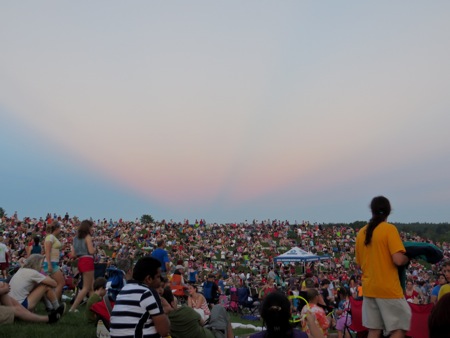
Above: Independence Day sunset, Acton, Mass.
What squirrels want
As we walked past the little plum tree this morning, heading towards the car to drive to the church, Carol pointed to the ripe plums that lay on the ground. “The squirrels have been getting to them,” she said.
“You know what I’m going to say,” I said.
“What?” she said, somewhat warily.
“Squirrels just want to have plums,” I said.*
Despite herself, Carol laughed.
We got into the car, and she began singing, “And squirrels they want to have plu–ums / Oh, squirrels just want to have plums….”
———
*If you were lucky enough to miss the popular music of the 1980s, that’s a reference to a 1983 hit song, with vaguely feminist lyrics, performed by Cyndi Lauper.