ARC-5 radios

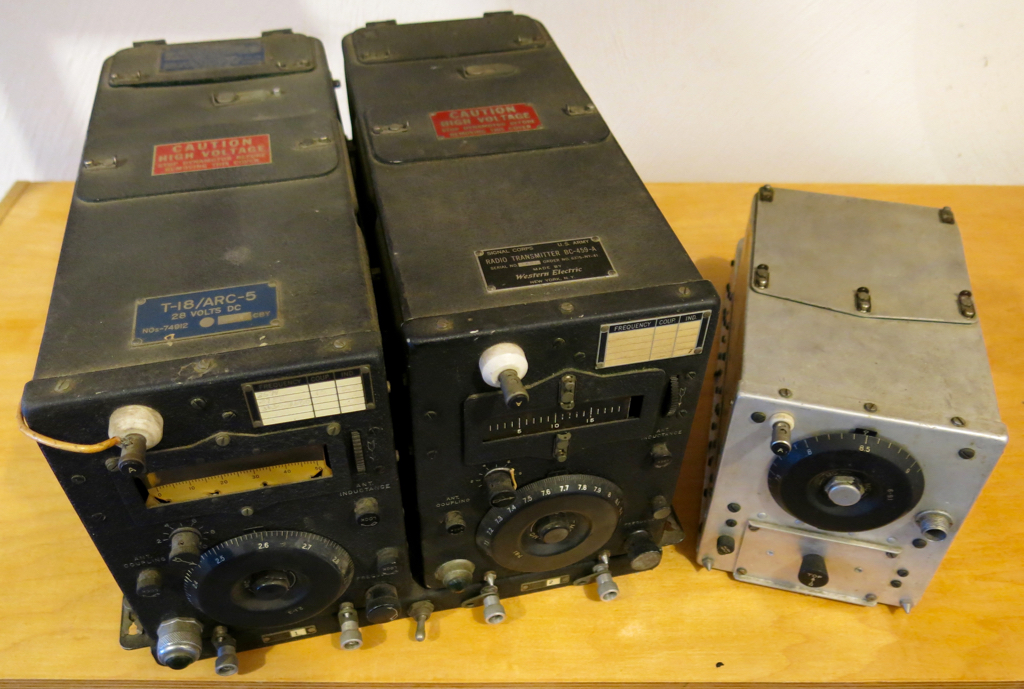
We’ve been cleaning up Dad’s condo, and I got the job of going through nearly 70 years’ worth of amateur radio gear. I found some lovely old radios, including these military surplus ARC-5 series “command sets.” I don’t know when Dad got these. He was licensed as W2YLY not long after he got out of the service; he might have gotten these while he was still finishing college, but I’m guessing he purchased these around 1950 after he got his first job (he doesn’t remember any more).

ARC-5 radio BC-459A

Plenty of ARC-5s are still on the air, and W1IS is helping us to find them a good home. I like to think that some day I might wind up contacting one fo Dad’s old radios.

Personal computer, c. 1983

My sister and I are doing some organizing in our father’s condo. Dad’s a retired electrical engineer who saved almost everything, and he has several decades worth of electrical gear. Including this:

Sharp PC-1500 Pocket Computer

It’s a Sharp PC-1500 Pocket Computer, which apparently ran the same operating system as the famous Radio Shack TRS-80 computer. What you’re seeing above is the computer nested in its docking station, which has a little printer built into it. For memory, you hitched up a cassette player, and at top left there’s a special computer memory cassette. There are several boxes of software — not sure how that worked — plus a keyboard overlay (on the ground in front of the computer) which goes with one of the software packages.

Abby remembers this computer well, because Dad had a biorhythms program that fascinated her.

Easy face painting

Some of our high school youth youth advisors went to Kids Carnival today, the fun event organized by the University AME Zion Church as a way for people of different races and ethnicities to get to know each other a little better while having a good time. Our youth group offered to do a face painting booth. We lucked out in that Elaine, a high school senior from the Palo Alto Vineyard Church, joined us — she is a fine artist who has her own business doing face painting for kids’ birthday parties. We let her do all the hard designs (Ice Bear, a Death Eaters logo, etc.), and we used our own easy designs.

Our designs turned out to be easy enough that children can do them (we let some of the children who came to our booth use our paints to paint designs on each other) — yet they’re satisfying and look pretty good when you’re done. I’m posting them here in case you want to use them next time you do face painting in your congregation. Except where noted, our designs are meant to go on cheeks or backs of hands. We had copies of the designs where children could look at them and choose the one they wanted. One last suggestion: it is worth spending extra money for good face paints; we bought the cheap ones, but when Elaine let us try hers, we saw that they were far better.

Face Painting 1

Face Painting 2

Face Painting 3

How to fail sex ed

One of the wonderful people who teaches comprehensive sexuality education in our church sent along a link to a post on Imgur headed: “Two years ago today, my then 14 year old sister got suspended for submitting these answers for her sex-ed class. I’m so proud of her.” Then there’s a photo of a worksheet titled “Objections to Condoms.” Kids were supposed to come up with possible responses to various excuses for not using condoms.

So, for example, one of the excuses for not using a condom was: “Condoms are gross; they’re messy; I hate them.” To which this creative girl replied: “So are babies.”

Condoms are messy -- So are babies

Mind you, a couple of the replies are just plain unconvincing, e.g. — Excuse: “I’d be embarrassed to use one”; reply: “Look at all the fucks I give.” Yeah, whatever.

But some of the replies, while very snarky, just might actually work in the real world, e.g. — excuse: “I don’t have a condom with me”; reply: “I don’t have my vagina with me.” This is not a good response to put on a worksheet that a public school teacher has to read; but a snarky early adolescent girl who needs to use a little humor to get through to a boy might find that reply useful.

This brings up an interesting point of educational philosophy. A core element of my educational philosophy is to start where the learner is. Some early adolescents learning about sex and sexuality may be most comfortable using snark and f-bombs to talk about sex. Of course we want to move them to a more reasoned form of discourse, a way of speaking that will allow them to talk about sex with potential partners openly, humanely, and with emotional intelligence. But we may have to listen to their f-bombs for a while before we get them there.

REA: “Cross-cultural Analysis” and “Sabbath as Post-Christian Ed”

On Friday afternoon at the Religious Education Association 2014 conference, I attended a colloquium with two presenters: Courtney Goto ofBoston University presented “Troubling Cross-Cultural Analysis in Healing the Effects of Racism,” and Jonathan LeMaster-Smith, doctoral student at Garrett-Evangelical Theological Seminary, presented on “Sabbath as Post-Christian Education: The (De)valuing of Rural Working-Class Persons as Liberation from Socio-Economic Disposability.”

Goto told us that she was presenting work in progress, and what she was going to present differed from the outline on the conference meeting Web site. She is working on two case studies, comparing the way two different cultural communities use aesthetic practices to form people theologically, aesthetically, and culturally.

Her first case study is of Lithuanian rituals on All Saints Day, during which families place candles and decorations at the grave sites of deceased family members. Her second case study is of an All Saints Day ritual at the Sacramento Japanese United Methodist Church.

Since Lithuanians and Japanese Americans are people on the margins, Goto’s research will use the concept of “social death” to explore these two case studies. Social death happens when a group of people is treated as nonpersons by the dominant culture. Examples of victims of social death include Jews during the Holocaust, native Americans in the U.S., etc. Both Japanese Americans and Lithuanians were victims of social death before and during the Second World War. Both communities use All Saints Day to hold rituals which serve as a response to trauma.

Of particular interest to me were the slides that Goto showed of an All Saints Day art installation in the Sacramento Japanese United Methodist Church. 26 yukata (a type of traditional Japanese clothing) were hung from from the ceiling of the sanctuary; another yukata clothed the usually plaint cross at the front of the church. The symbolism — how this art installation represents the way Japanese Americans were treated during the years of internment — was explained during services, in orders of services, etc. I felt this was a powerful example of all-ages religious education in a congregation.

Jonathan LeMaster-Smith spoke about another marginalized group, rural white working class persons. He is in the process of investigating ways to do religious education around the Sabbath in a post-Christian rural working class context. “One possible pedagogical practice is the observance of Sabbath,” LeMaster-Smith said — but not Sabbath in the traditional sense of a day of rest on Sunday (or Saturday).

Rather, LeMaster-Smith wants to ways the concept of Sabbath could be incorporated into popular culture rituals such as, for example, a Hallowe’en bonfire. (One of the participants later pointed out the obvious parallels between the Lithuanian popular culture ritual on All Saints Day described by Goto.) LeMaster-Smith said he saw potential in finding Sabbath-type observances in existing holiday celebrations.

A draft of Lemaster-Smith’s paper is online here. I saw a great deal of potential in this idea of translating the old observance of Sabbath into current post-Christian celebrations. Indeed, I believe some churches and faith communities are already on this path, e.g., many non-Hispanic congregations are incorporating Dias de los Muertos into Sunday services. LeMaster-Smith is simply asking faith communities to take this kind of thing outside the walls of the church building, out into the community. It seems to me that powerful things could happen at the intersection of pop culture and post-Christian religion.

Join the elite

Those of us who are religious progressives continue to try to understand conservative Christianity in the United States, and more specifically to understand how a religious option that asserts the leadership of Jesus of Nazareth also seems to advocate for consumerism, individualism, and intolerance.

I’ve spent some time learning about the theology of the prosperity gospel, so I feel that I have some sense of how conservative Christians can support consumerism and individualism — and honestly, conservative Christians aren’t very different from many religious moderates and progressives in the U.S. If you live in the U.S., it’s hard not to see consumer capitalism and individualism as normative.

But I have had a harder time understanding premillennial dispensationalism. That’s the theological position that there will be a Rapture, at which time a select few persons will be raptured away by Jesus Christ to be the Bride of Christ. The best known pop culture representations of remillennial dispensationalism is probably the “Left Behind” series of books and movies; a reboot of the movie series just came out, starring Nicholas Cage. And most of us religious progressives stop with the pop culture representations of premillennial dispeansationalism. But a closer look at premillennial dispensationalism is worth our time.

On recent post at the Sojourners Web site, Dr. LeAnn Snow Flesher points out that premillennial dispensationalism is “an elitist theology”: a few people get raptured, the rest of us don’t because the rest of us are disposable. This helps explain why premillennial dispensationalism is compatible with the prosperity gospel, that is, with theologies of economics that privilege the few at the expense of the many.

Flesher goes on to point out how premillennial dispensationalism is compatible with intolerance:

“The entire doctrinal belief system necessitates a separatist perspective and lifestyle, an emphasis on individual salvation, and adherence to a homogeneous set of doctrinal beliefs. It does not in any way foster tolerance for an interracial, intercultural, and interfaith context, and certainly has no tolerance for many of the social issues we struggle with in our nation and world today.”

It’s worth reading Flesher’s complete post here.

Link to Flesher’s post from @anglobaptist.

Adventures in solar cooking

Yesterday in Sunday school, two groups of kids started making solar ovens. While they were working, we had solar s’mores cooking in the solar oven I made on Saturday. However, it took a long time for the solar s’mores to cook. First problem: the morning clouds didn’t begin to clear until halfway through Sunday school. Second problem: thin clouds persisted most of the morning, and even the thinnest of clouds caused the temperature to drop at least ten degrees inside the oven. We started cooking the s’mores at about 10:00, and they weren’t really done until just before noon — after most of the kids had already gone home.

The clouds finally cleared away completely, and I left the solar oven outside my office for several hours in the early afternoon. The inside temperature rose to over 200 degrees Fahrenheit (200 degrees is as high as the meat thermometer goes), with outside air temperature in the high 70s. I heated up a mug of water, to over 170 degrees, and made a nice cup of tea. While I was making tea, Fred Z., from the Green Sanctuary Committee, stopped by and suggested trying cast iron cookware in the oven — it’s dark and absorbs heat well, plus it provides a good thermal mass to even out cooking temperature.

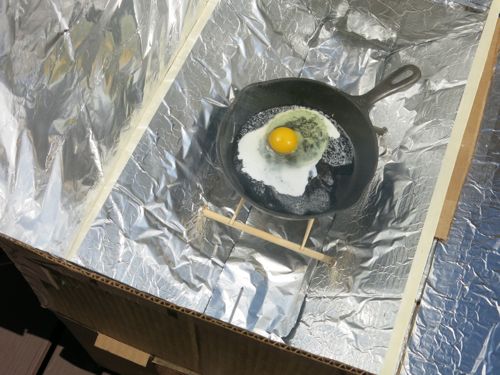
So this morning I dug out a small cast iron frying pan, and decided to try cooking a fried egg in the solar oven. The air temperature was about 65 degrees, but in spite of clear skies I couldn’t get the inside temperature over 190 degrees — which suggests I need better insulation in the oven. I cooked a fried egg, over easy:

BlogSep0814

It took about twenty minutes, and was really more of an egg baked in butter than it was a fried egg (it tasted good, though); obviously there is a lot more to be done to improve the efficiency of the oven.