
During the religious education committee meeting tonight, one of the committee members was telling us about a bunch of five year olds hanging out in their underpants. It was a pretty funny story. When the story was done, I couldn’t resist bringing up the Anthony Weiner silliness — I said that while the American news media are saying that Weiner sent “sexually explicit” pictures of himself (which makes it sound important and serious), the BBC tells it like it is: Weiner sent underpants photo. He sent pictures of himself in underpants; not even five year olds would be that silly! We had a good laugh at Underpants Weiner, and moved on with the rest of the business we had to cover.
Category: Arts & culture
The joy of cars
It is fashionable among religious and political liberals to bemoan the existence of automobiles, particularly because their environmental impact. I do it all the time. Of course, if you’re like me, you’re familiar with various counter arguments that tell us why cars are not so bad as all that:– we know that suburban sprawl began long before the automobile age, and so doesn’t require automobiles — and that having automobiles was better than using horses for transportation purposes, since the exhaust put out by horses in cities is arguably more noisome and a greater public health issue than automobile exhaust, and the maltreatment of horses when they were used primarily as transportation is arguably an ethical problem as serious as that of sprawl.
However, I don’t see many of us paying attention to what might be called the cultural argument in favor of cars. This argument is presented quite well by Agatha Christie in her autobiography:
“Oh, the joy that car [the first car she owned] was to me! I don’t suppose anyone nowadays could believe the difference it made to one’s life [to own a car for the first time]. To be able to go anywhere you chose; to places beyond the reach of your legs — it widened your whole horizon. One of the greatest pleasures I had out of the car was going down to Ashfield and taking mother out for drives. She enjoyed it passionately, just as I did. We went to all sorts of places — Dartmoor, the house of friends she had never been able to see because of the difficulties of transport — and the sheer joy of driving was enough for both of us. I don’t think anything has given me more pleasure, more joy of achievement, than my dear bottle-nosed Morris Cowley.”
Yes, I hate suburban sprawl, and I dislike having to commute to work by car,– but I too, like Agatha Christie, love to drive. And I have found that it is no use to me personally to address the first two points without acknowledging that last point. What about you?
Never enough computers
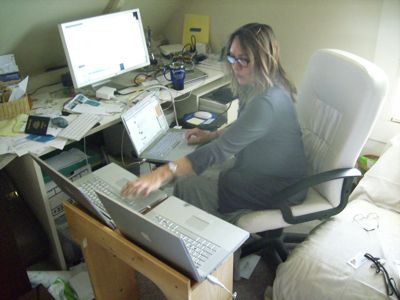
Carol at work in her office, writing the next great book.
Midnight in New York
The movie theatre was in the middle of the block, and the line to get in already stretched to the corner. It was forty minutes before the movie began. We had our tickets already — the early show was already sold out by the time we showed up, so we had bought tickets for the seven o’clock — but we figured that if we wanted to get seats together, we had better line up with all the others. Pretty soon, the line was twice as long.
Someone walking by to get to the end of the line said, “All these people must’ve started seeing Woody Allen films when they were in college and here they all are.” But several people had brought children and teenagers, so that wasn’t entirely true. Someone else said that there are three hundred seats in this theatre, but usually only a couple dozen are filled. Not tonight, though. A man standing behind us talked knowledgeably and at length about other Woody Allen films: “Remember the scene where they’re standing in line to see the movie in ‘Annie Hall’? … Then Marshall McLuhan walks up, and says … And Woody Allen looks out at the camera and says …” A woman said, “I can’t remember the last time I stood in line on the first night of a movie.” The knowledgeable man said, “It already opened in New York and L.A. This is just opening night for the Bay area. But at least it still hasn’t opened in Pittsburgh.”
At last the line started moving. We found two seats together, at the very back, with an aisle seat for my very long legs. A couple, maybe in their late twenties or early thirties, asked if the seats beside us were open, and we said yes. He went off to get something or other, and she said to us, “Do you think we’ll be able to see back here?” “It’s a small theater,” said Carol. “Those must be the last two seats left together,” I said. “Well, it’s much better to sit together,” said the woman. They came and went a couple of times, and on the last time in, he murmured an apology, and she said, “It’s our first movie together.”
I won’t tell you anything about the movie; anything I could tell you would spoil it. Except I can tell you that although the movie claims to be about Paris, it’s really about New York, like all of Woody Allen’s movies; everyone speaks with a New York rhythm, except the Parisians of course, but they might just be tourists. Come to think of it, many of the people in the movie theatre sounded like they came from New York — not the Bronx or Staten Island, mind you, but Manhattan.
Bike party
We came out of the theatre at about eleven o’clock and looked to see if it was safe to cross the street. A whole passel of bicycles was coming at us. “Bike party!” said one of the bicyclists as they came near. We watched for about five minutes as clumps of bicycles passed by. There was a break in the bikes, and I scurried across; Carol wiated for another couple of minutes for another break in the bikes before she got across. There were enough bikes that we weren’t going to be able to get the car out easily, so we stood on the sidewalk and watched. Hardly anyone seemed to be talking to one another, except that everyone once in a while someone say, “Bike party!” A few of the bikes were playing recorded music ranging from rap to norteno to classic rock. Two daredevils rode too fast and weaved in and out of the other bikes, but most people just rode along fairly sedately. It looked a little boring to me, but then I never was one for making long bike rides in a group. Finally, along came two motorcycle cops, a few stragglers on bikes, and that was it. We got in our car and drove home.
Sex in the news
Three of the biggest stories in the news today involve sex or sexual morality: Dominique Strauss-Kahn, head of the International Monetary Fund, is in the news for allegedly committing sexual assault on a housekeeper at a New York hotel; Arnold Schwarzenegger has admitted that he fathered a child with a woman who was a domestic worker at his mansion; and the Roman Catholics say that the incidence of priests sexually abusing minors increased greatly during the 1960s due to the sexual revolution.
Each of these news stories centers around someone in power engaging in sexual acts with someone who was relatively powerless — a domestic worker, a low-wage hotel worker, legal minors. Or to put it another way, these stories aren’t about sex so much as they are about the misuse of personal power.
Hard-boiled
My guilty pleasure: I love hard-boiled pulp fiction. Every once in a while, I come across a passage that is just so — so hard-boiled, that I have to read it twice to make sure it really says what I thought it said. Like this one, from Gold Comes in Bricks (1940) by Erle Stanley Gardner. :
“I kissed her.
“‘To hell with that stuff,’ she said. ‘Really kiss me.’
“Fifteen minutes later, the kid came up with the half case of Scotch.
“I showed up at Ashbury’s place about two o’clock in the morning. I still couldn’t get the girl’s hair out of my mind. I thought of that strand of the hangman’s rope every time I thought of the way the light glinted along those blonde tresses.”
I will never look at blonde hair again in quite the same way. I’m not sure that is a good thing.
He’s dead?…
Osama bin Laden is dead. It feels strange to write that. I could wish he had been brought to trial — or brought to justice really — rather than killed in a firefight. But they’re reporting that he used another person as a human shield, which reveals a lack of courage and a moral depravity. So he’s dead. I can’t help but think that the world is a better place without him.
By sheer coincidence, today I’ve been thinking about the Cain and Abel story from the book of Genesis. You’ve heard the story: Adam and Eve are the first two humans. They have two sons, Cain and Abel. God favors Abel over Cain, and in a fit of pique Cain murders Abel. When God asks Cain where Abel has got to, Cain replies, How should I know, am I my brother’s keeper? But God, being God, knows that Cain has killed Abel, and tells him so. Cain is ashamed. God punishes Cain, saying: I’m cursing you, your life will be tough, you’re going to be a vagabond and a fugitive forever. Cain says, I’m gonna be a vagabond and a fugitive, and everyone who finds me out will try to kill me. But God says, Not so, anyone who kills you, vengeance will be taken upon him sevenfold. Then God set a mark upon Cain to let people know about that. There’s some kind of weird complex poetic truth to the Cain and Abel story that I can never quite wrap my head around. It is obviously not a literally true story, but like the best fiction it gets at deeper truths — what the deeper truths are is open for debate.
And although it’s an inexact and incomplete analogy, I can’t help thinking of Osama bin Laden as a Cain-like figure: someone who commits a heinous murder, and who, after his crime was committed, had to become a fugitive and vagabond. It’s an inexact analogy, and Osama bin Laden was not Cain, but I have to admit I do worry about the aftermath of his death. Osama bin Laden is dead, the world is a better place without him, but I would not call this a neat and tidy ending to his story.
I do feel an enormous sense of relief that he’s dead. He was both depraved and powerful. And now the question is: what next?
This week’s protest sign
According to today’s San Mateo County Times, a group of students at Hillsdale High School held a rally to protest statewide cuts to public education funding. The Times shows a photo of a group of students marching behind a banner that reads:
“You Don’t Pay For Our Education
We Won’t Pay For Your Social Security!”
Perhaps this is the beginning of a new generation gap, the start of a widening rift between the Millennials and the Baby Boomers?
Poly Styrene: an appreciation
Various media sources are reporting that singer Marianne Elliot-Said has died of complications of breast cancer at age 53. Elliot-Said was better known under the stage name Poly Styrene, a name she used while singing with X-Ray Spex.
X-Ray Spex had a short career. In 1976, Elliot-Said was taking voice lessons, learning how to sing opera, and recording derivative reggae songs on the side, when she saw the Sex Pistols perform. This exposure to punk rock galvanized her, and she decided to form her own punk band, X-Ray Spex. The band performed together for about three years, recorded a handful of singles and one album, then disbanded in 1979.
Following the demise of X-Ray Spex, Elliot-Said joined the Hare Krishnas, or more properly, the International Society for Krishna Consciousness, a branch of Hinduism that worships Vishnu, and is devoted to bhakti yoga, or expressions of devotion to God. I had not known that Elliot-Said had joined the Hare Kishnas, but I guess I wasn’t entirely surprised. When she was singing with X-Ray Spex, her voice had a transcendent, joyful quality to it — even when she was singing about the horrors of genetic engineering, or screaming (in late 1970s punk vocal style) “Oh bondage! up yours!” Although the punk rock idiom of the late 1970s was fairly limited, as practiced by someone like Poly Styrene the vocal style could approach a raucous and ecstatic transcendence. There was often a hint of rapture in her voice, even a hint of a connection to something larger than herself.
Elliot-Said has been interpreted as an early exponent of what came to be called third-wave feminism; she had a clear influence on later feminist bands like The Slits, and it’s hard to imagine the riot-grrrl movement without her example. She allied herself with the anti-racist forces within punk rock and was bi-racial — a Somali father and a White English mother — and perhaps she will be claimed as an early adopter of multiracial identity. She also had a preference for day-glo colors and wore braces on her teeth, though it’s harder to know what to make of those attributes.
But I prefer to remember her simply for her full-throated, no-holds-barred singing, a kind of punk bhakti devotion that invited us all to transform and transcend. The hell with the anemic pablum of praise bands. If you’re gonna make me have amplified music in a worship service, I won’t settle for anything less the raw full-throated raucous singing of someone like Poly Styrene.